

LCP_hide_placeholder
fomox
MarketsPerpsSpotSwap
Meme
Referral
More
Become a Smart Money on Tracker
Search Token/Wallet
/

Ethereum vs Bitcoin: A Comprehensive Comparison

2025-12-20 09:17:35
Bitcoin
Blockchain
Crypto Insights
DeFi
Ethereum
Article Rating : 3.5
half-star
43 ratings
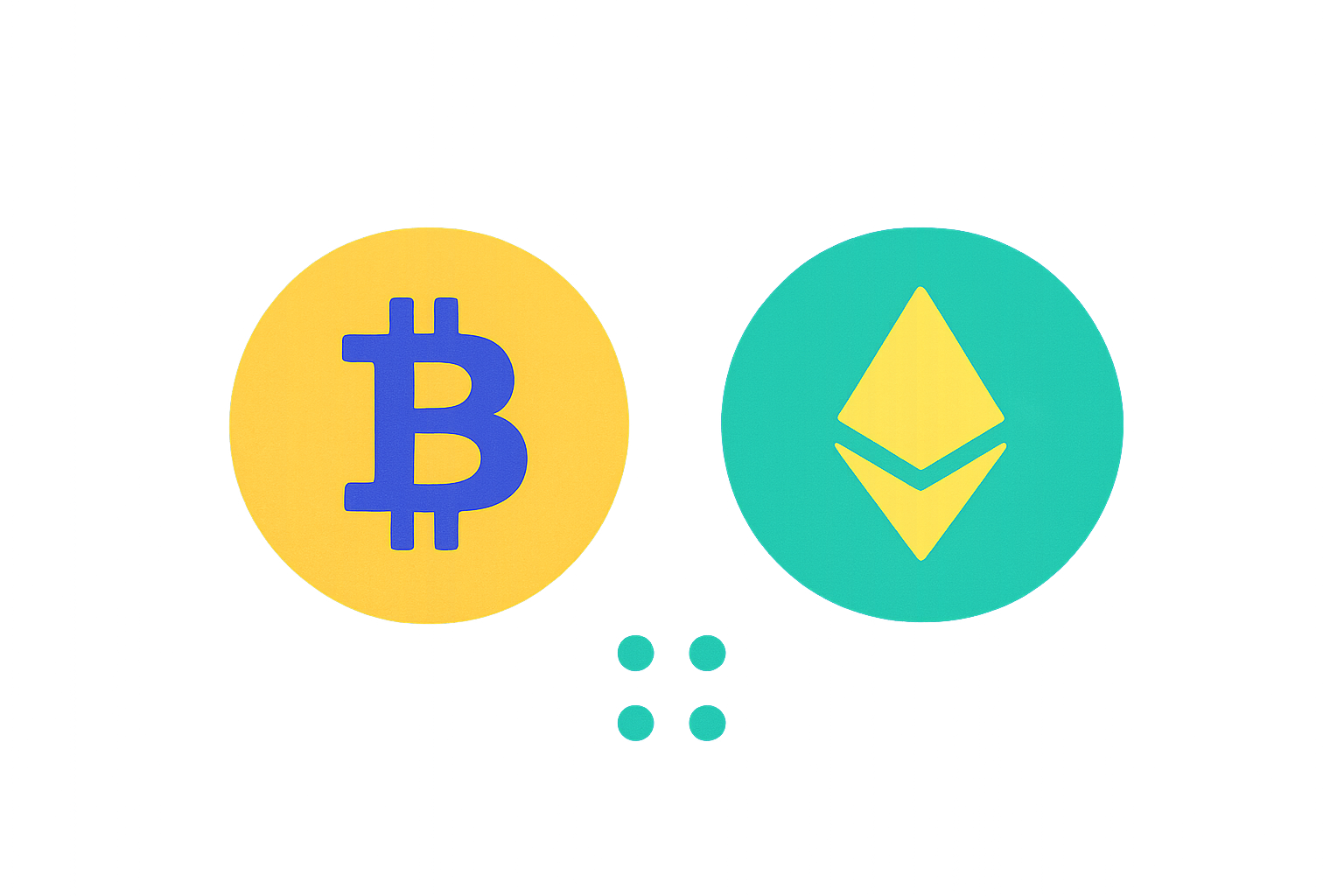
Explore the dynamic relationship between Bitcoin and Ethereum in this comprehensive comparison. This article examines their origins, purposes, market positions, and technical differences, highlighting how they cater to distinct niches. From understanding the complementary roles both play in the cryptocurrency ecosystem to assessing investment strategies, readers will discover insights into their coexistence and potential. Ideal for investors, developers, and cryptocurrency enthusiasts seeking to grasp these two giants' roles and influence, it offers clarity on their fundamental differences rather than viewing them as direct competitors.
Ethereum vs Bitcoin: A Comprehensive Comparison

Is Ethereum a Competitor of Bitcoin? Understanding the Relationship Between Two Crypto Giants

The cryptocurrency landscape has evolved significantly since Bitcoin's introduction, and Ethereum's emergence has sparked ongoing debates about whether these two blockchain platforms are truly competitors or serve fundamentally different purposes. Understanding the relationship between Bitcoin and Ethereum requires examining their design philosophies, use cases, and market positions.

Different Origins, Different Purposes

Bitcoin was created as a peer-to-peer electronic cash system, designed primarily as a store of value and medium of exchange. Ethereum, on the other hand, was developed as a programmable blockchain platform that enables smart contracts and decentralized applications (dApps). While both utilize blockchain technology, their core missions differ substantially.

Bitcoin functions as "digital gold," focusing on security, decentralization, and maintaining a fixed supply of 21 million coins. Ethereum operates as a "world computer," prioritizing flexibility, programmability, and supporting a vast ecosystem of decentralized finance (DeFi) protocols, non-fungible tokens (NFTs), and other blockchain-based applications.

Market Position and Use Cases

When considering is Ethereum a competitor of Bitcoin, it's essential to recognize that they occupy different niches within the cryptocurrency ecosystem. Bitcoin dominates as the premier store of value and has established itself as the most recognized cryptocurrency globally. Its market capitalization and adoption as an institutional investment vehicle demonstrate its strength in this specific role.

Ethereum has carved out its own territory as the leading smart contract platform. The vast majority of DeFi applications, NFT marketplaces, and blockchain-based projects are built on Ethereum or compatible networks. This positions Ethereum as a utility platform rather than purely a currency or store of value.

Technical Differences That Define Their Relationship

The technical architecture of these networks highlights why the question is Ethereum a competitor of Bitcoin isn't straightforward:

Consensus Mechanisms: Bitcoin continues to use Proof-of-Work (PoW) mining, emphasizing security through computational power. Ethereum has transitioned to Proof-of-Stake (PoS), prioritizing energy efficiency and scalability.

Transaction Speed and Costs: Ethereum typically processes transactions faster than Bitcoin, though both networks experience congestion during high-demand periods. Layer-2 solutions on both platforms continue to address scalability challenges.

Programmability: Bitcoin's scripting language is intentionally limited to maintain security and simplicity. Ethereum's Turing-complete programming language enables complex smart contracts and diverse applications.

Complementary Rather Than Competitive?

Many cryptocurrency analysts argue that Bitcoin and Ethereum are complementary rather than directly competitive. Bitcoin serves as the foundational cryptocurrency and a macro-economic hedge, while Ethereum provides the infrastructure for decentralized applications and financial innovation.

Investors and institutions often view them differently: Bitcoin as a long-term store of value comparable to precious metals, and Ethereum as a technology investment with growth potential tied to blockchain adoption across industries.

The Investment Perspective

From an investment standpoint, the debate about is Ethereum a competitor of Bitcoin becomes more nuanced. Portfolio diversification strategies often include both assets, recognizing their different risk profiles and growth drivers. Bitcoin's performance typically correlates with broader cryptocurrency market sentiment and macroeconomic factors, while Ethereum's value is additionally influenced by network usage, DeFi activity, and technological upgrades.

Evolving Ecosystem Dynamics

The cryptocurrency ecosystem continues to mature, with both Bitcoin and Ethereum evolving to address their respective challenges. Bitcoin developers work on improving privacy and scaling through technologies like the Lightning Network. Ethereum's roadmap focuses on sharding, rollups, and further efficiency improvements.

Both networks face competition from newer blockchain platforms, but their established network effects, developer communities, and institutional adoption provide significant advantages. Rather than competing directly with each other, they often compete with traditional financial systems and other blockchain platforms.

Conclusion: Competition or Coexistence?

So, is Ethereum a competitor of Bitcoin? The answer depends on perspective. While they compete for investor capital and market attention, their fundamental purposes and use cases differ significantly enough that they can coexist and thrive simultaneously.

Bitcoin's position as digital gold and a store of value remains largely unchallenged by Ethereum, whose strength lies in powering decentralized applications and smart contracts. The cryptocurrency market has demonstrated sufficient size and diversity to support both networks, each excelling in their respective domains.

Understanding that Bitcoin and Ethereum serve different purposes helps investors, developers, and users make informed decisions about which platform suits their needs. Rather than viewing them as direct competitors, recognizing their complementary roles within the broader blockchain ecosystem provides a more accurate picture of their relationship and future potential.

FAQ

Is Ethereum a competitor to Bitcoin?

Yes, Ethereum competes with Bitcoin in the cryptocurrency market. While Bitcoin focuses on payments, Ethereum enables smart contracts and DApps. Both vie for market dominance and investor attention.

Who is the biggest competitor to Bitcoin?

Ethereum is Bitcoin's biggest competitor. It introduced smart contracts and decentralized applications, offering functionality beyond Bitcoin's store-of-value focus. With massive transaction volume and developer ecosystem, Ethereum remains the leading alternative cryptocurrency.

Who is Ethereum's biggest competitor?

Bitcoin remains Ethereum's primary competitor as the largest cryptocurrency by market capitalization. However, among smart contract platforms, Solana and Cardano are major rivals competing for developer adoption and transaction volume.

Is it better to buy Ethereum or Bitcoin?

Bitcoin is generally the better long-term choice due to its established market position and broader adoption. However, Ethereum offers stronger short-term growth potential. Your choice depends on investment horizon and risk tolerance.

* The information is not intended to be and does not constitute financial advice or any other recommendation of any sort offered or endorsed by Gate.

Share

Content

Different Origins, Different Purposes

Market Position and Use Cases

Technical Differences That Define Their Relationship

Complementary Rather Than Competitive?

The Investment Perspective

Evolving Ecosystem Dynamics

Conclusion: Competition or Coexistence?

FAQ

Related Articles
Decentralized Finance and Centralized Finance: A Comparative Analysis

Decentralized Finance and Centralized Finance: A Comparative Analysis

This article provides a comprehensive comparison of Decentralized Finance (DeFi) and Centralized Finance (CeFi), highlighting their core functionalities and distinctions. It addresses the nuances of user trust, control, and risk in cryptocurrency management, essential for anyone navigating the digital asset landscape. The article explores how both systems offer trading, lending, and storing services, yet operate differently—CeFi relies on intermediaries like Gate with inherent counterparty risks, whereas DeFi emphasizes peer-to-peer transactions with blockchain transparency. By understanding these differences, traders can make informed decisions tailored to their technical proficiency and risk tolerance.
2025-12-01 10:08:46
What Are the Biggest Cryptocurrency Security Risks and How Can Investors Protect Themselves?

What Are the Biggest Cryptocurrency Security Risks and How Can Investors Protect Themselves?

This article delves into the significant security risks in the cryptocurrency industry, focusing on smart contract vulnerabilities, exchange hacks, and centralization issues. It highlights key incidents, such as the DAO Hack and recent breaches like the one affecting Gate, emphasizing how these events shaped investor behavior. The discussion provides valuable insights into preventative measures investors can take, such as employing self-custody solutions and understanding the importance of security protocols on platforms like Gate. Targeted at cryptocurrency investors, this piece aims to enhance their understanding of cryptographic risks and secure asset management.
2025-11-13 05:27:47
How does SUI price volatility compare to Bitcoin and Ethereum in 2026?

How does SUI price volatility compare to Bitcoin and Ethereum in 2026?

# Article Overview: SUI Price Volatility vs Bitcoin and Ethereum in 2026 This comprehensive analysis examines SUI's price volatility profile compared to Bitcoin and Ethereum throughout 2026, revealing SUI's emerging stability as institutional adoption accelerates. The article addresses investor concerns about comparative risk levels, price prediction accuracy, and optimal trading strategies across Layer 1 blockchains. Structured in four key sections, it progresses from current price action and technical levels, through correlation analysis, to 2026 price trajectory forecasts. Readers will discover why SUI's contained volatility (demonstrated by its -0.83% movement despite a $78.9M token unlock) positions it as a resilient alternative to Bitcoin and Ethereum's extreme swings, supported by institutional catalysts like Bitwise's ETF filing on Gate and growing DeFi ecosystem expansion targeting the $10 price milestone.
2026-01-01 03:48:39
What Are the Biggest Security Risks in Crypto History?

What Are the Biggest Security Risks in Crypto History?

This article explores the most significant security risks in crypto history, emphasizing vulnerabilities in smart contracts, centralized exchange collapses, and network attacks. It addresses issues such as coding errors, exchange mismanagement, and coordinated assaults on blockchain systems. The text appeals to crypto investors and developers by highlighting the importance of robust security measures and the industry's evolving responses. Structured in three main sections, the article presents a comprehensive analysis of past incidents to inform future security strategies. Keywords include smart contract vulnerabilities, centralized exchange risks, and network security attacks.
2025-11-23 05:19:20
Maximize Your Earnings with Secure Digital Asset Savings

Maximize Your Earnings with Secure Digital Asset Savings

Explore the power of crypto savings accounts to elevate your earnings and secure your digital assets. With the potential for higher interest rates and flexibility compared to traditional savings methods, these accounts enable growth in cryptocurrency holdings. The article provides insights into the operation, benefits, and security features of crypto savings accounts, helping users make informed decisions in selecting providers like Gate. Popular cryptocurrencies and stablecoins are highlighted for diversification. Addressing risks and offering security tips, this guide caters to individuals seeking innovative financial strategies in the evolving digital finance landscape.
2025-11-14 06:55:20
How to Use On-Chain Data Analysis to Track Active Addresses, Transaction Volume, and Whale Movements in Crypto

How to Use On-Chain Data Analysis to Track Active Addresses, Transaction Volume, and Whale Movements in Crypto

# How to Use On-Chain Data Analysis to Track Active Addresses, Transaction Volume, and Whale Movements in Crypto Master on-chain data analysis to unlock real blockchain insights beyond price charts. This comprehensive guide reveals how to monitor active addresses for network growth, analyze transaction volume and value flows for market patterns, and track whale movements through Gate to predict price shifts. Learn to evaluate fee trends, understand network congestion mechanics, and distinguish genuine adoption from temporary spikes. Whether you're a trader identifying support levels, an investor assessing ecosystem health, or an analyst detecting institutional activity, this article equips you with essential on-chain metrics and practical strategies to make informed cryptocurrency decisions. Gain competitive edge by combining active addresses, transaction analysis, and whale holder distribution to anticipate market movements.
2025-12-27 04:07:10
Recommended for You
How does Pancakeswap compare to Uniswap in market share and user adoption in 2026

How does Pancakeswap compare to Uniswap in market share and user adoption in 2026

This article provides a comprehensive comparison of PancakeSwap and Uniswap's market positions in 2026, analyzing market share dominance, user adoption trajectories, and competitive differentiation strategies. Uniswap leads overall DEX trading volume at 35.9% with $60 billion in volume, while PancakeSwap captures 29.5% as the second-largest platform. Network-specific analysis reveals distinct patterns: Uniswap dominates Ethereum with 60% market share, whereas PancakeSwap commands 70% on BNB Chain with $20 billion daily volume. The article explores how PancakeSwap attracts 6.2 million active users through lower 0.25% trading fees, cross-chain bridge infrastructure, and innovative features like CAKE.PAD, while Uniswap maintains advantage through superior liquidity depth and advanced tools for institutional traders, highlighting how DEX dominance remains ecosystem-dependent rather than universally absolute.
2026-01-14 02:52:17
How much will UNI price fluctuate in 2026: analysis of support, resistance, and volatility trends

How much will UNI price fluctuate in 2026: analysis of support, resistance, and volatility trends

This article provides a comprehensive UNI price analysis for 2026, examining current trading dynamics at $5.50-$5.82 with 2.86% daily volatility. The analysis identifies critical support at $5.20 and resistance zones between $5.80-$6.30, offering traders clear technical boundaries. Key findings project UNI's 2026 trading range at $3.67-$9.01, with potential upside to $10.43 under favorable conditions. The outlook is shaped by Uniswap's tokenomics overhaul, fee switch activation, and planned $100 million UNI burn creating deflationary pressure. Regulatory developments and Unichain adoption serve as primary volatility drivers. This guide equips DeFi traders and Uniswap investors with technical framework and volatility insights for navigating UNI price fluctuations throughout 2026.
2026-01-14 02:49:40
What is KGEN whitepaper core logic: proof of gamer engine and verified distribution protocol explained

What is KGEN whitepaper core logic: proof of gamer engine and verified distribution protocol explained

This article explores KGEN's revolutionary whitepaper framework featuring two transformative technologies: the Proof of Gamer Engine and Verified Distribution Protocol. The Proof of Gamer Engine leverages blockchain to build verifiable player reputations on-chain, enabling authentic user acquisition across multiple games with impressive 700% account growth since January 2024. The Verified Distribution Protocol expands beyond gaming, integrating AI, DeFi, and consumer applications through a unified identity verification system processing 876 million data points across 60+ countries. Backed by $43.5 million in funding from Jump Crypto and Accel, KGEN demonstrates remarkable market adoption with 38 million users and $48.3 million in annualized revenue. This article examines how KGEN's innovative architecture reduces customer acquisition costs, combats fraud, and creates sustainable ecosystem value through transparent, decentralized verification mechanisms on Gate and other platforms.
2026-01-14 02:43:35
What is the current market cap and trading volume of Ondo (ONDO) in 2026?

What is the current market cap and trading volume of Ondo (ONDO) in 2026?

Ondo (ONDO) has established a strong market presence with a $1.27 billion market cap, ranking #49 in the cryptocurrency ecosystem as of 2026. The token maintains moderate daily trading volume of $89.7 million, indicating sustained market interest and healthy liquidity for price discovery. With 3.16 billion circulating tokens out of 10 billion total supply, ONDO operates under supply constraints that create scarcity dynamics, though a significant January 2026 unlock of approximately 1.9 billion tokens will reshape market conditions. ONDO trades across 56+ exchanges globally, including major platforms like Gate, Coinbase, and WEEX, ensuring broad accessibility and distributed liquidity. This multi-exchange presence directly supports trading volumes and price stability. As a real-world asset tokenization platform, ONDO represents a bridge between traditional finance and blockchain technology, with its market metrics reflecting growing institutional adoption and confidence in tokenized asset infrastructure.
2026-01-14 02:41:10
How does macroeconomic policy impact ONDO token price and crypto market volatility in 2026?

How does macroeconomic policy impact ONDO token price and crypto market volatility in 2026?

This article examines how macroeconomic policy shapes ONDO token price and crypto market volatility in 2026. It analyzes Federal Reserve interest rate decisions and monetary tightening effects on liquidity conditions, exploring how inflation data correlates with cryptocurrency valuations and risk-asset sentiment. The piece reveals ONDO's divergence from traditional equities—showing only 23% correlation with S&P 500—while highlighting sensitivity to risk-on/risk-off market dynamics. Institutional capital flows accelerated following EU regulatory approval under MiCA framework, enabling institutional participation through tokenized asset platforms like Gate. The article synthesizes how central bank policy transmission, inflation expectations, geopolitical tensions, and regulatory certainty collectively drive ONDO volatility, providing investors strategic insights for evaluating macroeconomic risks and opportunities in tokenized finance ecosystems.
2026-01-14 02:39:29
How to analyze TIA on-chain data: active addresses, transaction volume, whale distribution, and gas fees

How to analyze TIA on-chain data: active addresses, transaction volume, whale distribution, and gas fees

This comprehensive guide explores TIA on-chain data analysis across four critical dimensions. Learn how to interpret Active Address Metrics (DAA/MAA) to gauge network health and genuine user engagement on Celestia's modular blockchain. Analyze Transaction Volume and Gas Fees to understand daily activity patterns and cost efficiency, with insights into the network's $60 pricing phase revealing robust 10,000 daily transactions and minimal fee structures. Master Whale Distribution tracking and token unlock events affecting the 92.3 million TIA supply dynamics. Discover Ecosystem Growth Signals demonstrating 56+ rollup projects processing 160GB+ daily data, validating Celestia's adoption through 99.97% blob transaction success rates. Use blockchain explorers and on-chain analytics platforms like Gate exchange, Glassnode, and Nansen to monitor these metrics in real-time and make informed investment decisions.
2026-01-14 02:36:59