LCP_hide_placeholder
fomox
MarketsPerpsSpotSwapMeme Referral
More
Smart Money Recruitment
Search Token/Wallet
/

Understanding Peer-to-Peer Bitcoin Transactions
2025-12-20 16:33:51
Bitcoin
Blockchain
DeFi
P2P Trading
Web 3.0
Рейтинг статьи : 4
115 рейтинги
This article delves into the principles and functionalities of peer-to-peer (P2P) technology, emphasizing its role in Bitcoin transactions. It examines the decentralized structure of P2P networks, their historical significance, and applications beyond file sharing. Readers will learn about Bitcoin's P2P model in blockchain and the advantages and challenges of P2P systems. The piece clarifies potential legalities and security concerns, providing insight into the technological evolution towards more democratic and secure digital ecosystems. Key topics include P2P, Bitcoin, blockchain, decentralization, security, and scalability.
Understanding Peer-to-Peer Bitcoin Transactions

What is Peer-to-Peer?

Peer-to-peer (P2P) technology represents a fundamental shift in how computer networks operate and share information. The concept emerged from the early days of the internet, when decentralization was a core principle of network design. Unlike traditional centralized systems where a single authority controls data flow, P2P networks distribute power and responsibility equally among all participants, creating a more democratic and resilient digital infrastructure.

What is a Peer-to-Peer Network?

A peer-to-peer network is a distributed computing architecture where each participant, called a node, acts simultaneously as both a client and a server. In this model, there is no centralized authority or privileged server controlling data storage and transmission. When a user downloads P2P software onto their computer, they become an integral part of the network's infrastructure, with equal access to information and equal responsibility for maintaining the system.

This architecture fundamentally differs from the traditional client-server model used by major technology companies. In centralized systems like Amazon's AWS cloud, users must connect to a central server to access and transfer data, creating a single point of control and potential failure. P2P networks eliminate this dependency by distributing data across all participating nodes.

The technology gained mainstream attention in the late 1990s with the launch of Napster, a revolutionary music-sharing platform created by Sean Parker and Shawn Fanning. Napster demonstrated the practical applications of P2P technology by allowing users to share music files directly without intermediaries. Although Napster was shut down in 2001 following legal action from the Recording Industry Association of America (RIAA), it paved the way for subsequent P2P file-sharing platforms such as BitTorrent, Gnutella, and Kazaa.

What Are the Uses of Peer-to-Peer Networks?

Peer-to-peer networks offer diverse applications across various sectors and industries. The versatility of P2P technology extends far beyond file sharing, enabling innovative solutions for data management, financial transactions, and organizational workflows.

In corporate environments, companies can implement P2P networks for internal data recording and sharing, streamlining workflows without depending on third-party servers. This approach reduces costs, improves efficiency, and enhances data security by eliminating external dependencies. Charitable organizations have also adopted P2P models through peer-to-peer fundraising platforms, enabling direct digital money transfers between donors and recipients without intermediary payment processors.

The most transformative application of P2P technology is in decentralized cryptocurrencies, particularly Bitcoin. Bitcoin peer-to-peer protocols form the foundational architecture that enables these digital currencies to operate without central banks or financial institutions. The scalability and flexibility of P2P networks mean that as more computers join the network, developers can create an unlimited variety of applications and services using this decentralized model.

What Is Bitcoin Peer-to-Peer Model in Blockchain?

Blockchain technology represents the evolution of P2P networks into a sophisticated system for securing digital transactions and information. Introduced by the pseudonymous cryptographer Satoshi Nakamoto in 2008, the Bitcoin peer-to-peer system leverages P2P architecture to create a decentralized, trustless system for recording and verifying transactions.

In Bitcoin's implementation, the blockchain uses a proof-of-work (PoW) consensus mechanism where network participants, called miners, solve complex mathematical problems approximately every 10 minutes to add new blocks of transactions to the distributed ledger. Miners who successfully solve these problems receive Bitcoin rewards, creating economic incentives for network participation. For enhanced security, the Bitcoin protocol requires six confirmations from different nodes before a transaction is considered final, making it extremely difficult to manipulate the transaction history.

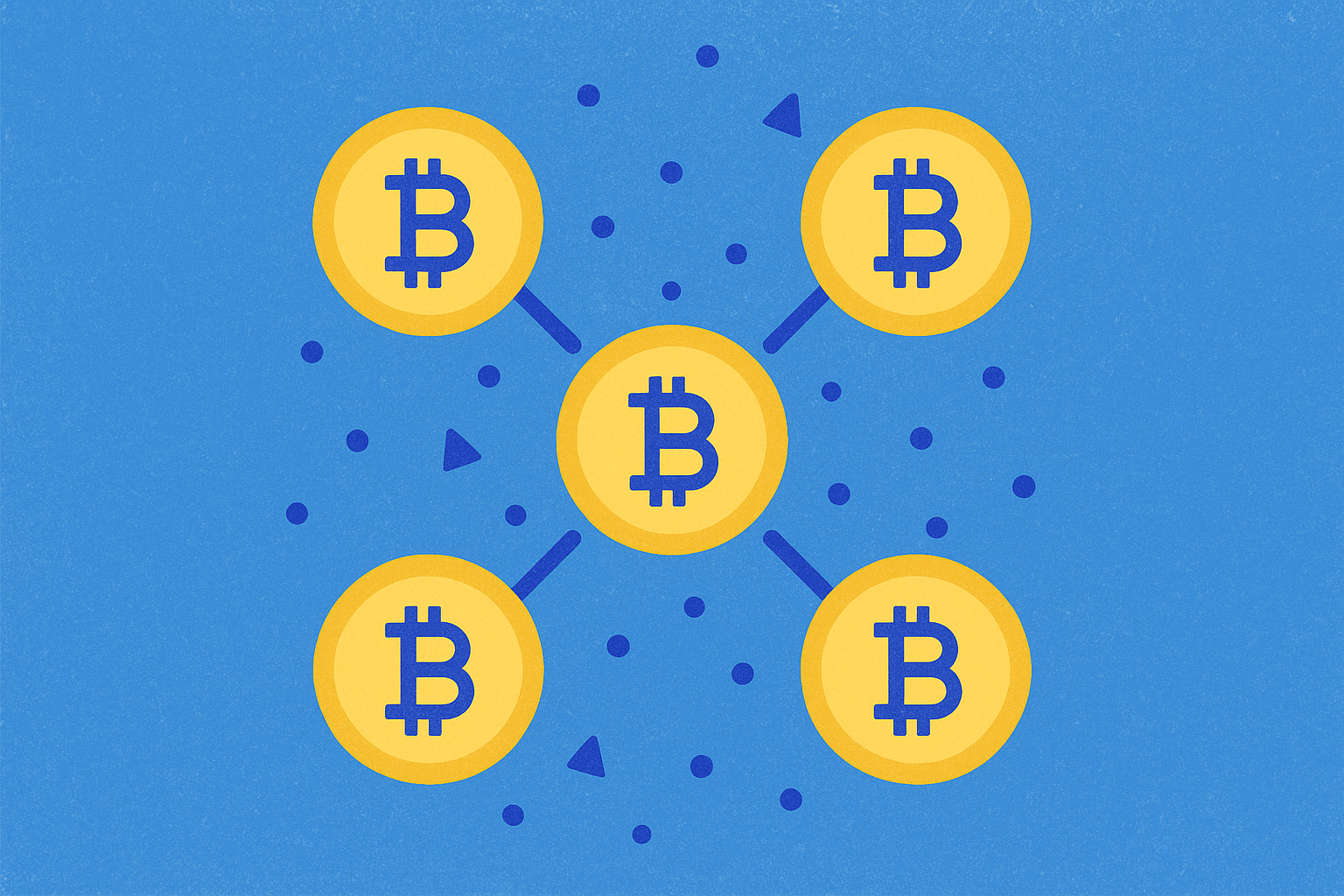
The Bitcoin peer-to-peer network operates without any central authority, allowing users to send and receive digital currency directly between one another. This peer-to-peer electronic cash system eliminates the need for trusted third parties to process payments, fundamentally changing how value can be transferred over the internet.

Beyond cryptocurrencies, blockchain's P2P model has expanded into numerous applications. Ethereum, for instance, utilizes blockchain technology to decentralize web applications through smart contracts—automated programs that execute predefined actions when specific conditions are met. This innovation has spawned the decentralized finance (DeFi) ecosystem, where users can trade, lend, and borrow cryptocurrencies without traditional financial intermediaries.

Decentralized applications (dApps) built on blockchain networks exemplify the power of P2P technology. In DeFi, platforms enable peer-to-peer lending by using smart contracts to automatically manage cryptocurrency deposits, withdrawals, and loan terms. Decentralized trading platforms allow users to trade cryptocurrencies directly from their self-custodial wallets, eliminating the need for centralized intermediaries.

The applications of blockchain-based P2P systems continue to expand into gaming, social media, and e-commerce, enabling users to create, sell, and transfer digital assets and collectibles without third-party intervention.

What Are the Benefits and Drawbacks of Peer-to-Peer Networks?

While P2P networks offer significant advantages in terms of privacy, autonomy, and censorship resistance, they also present certain challenges and vulnerabilities that users and developers must consider.

The primary benefits of Bitcoin peer-to-peer networks and other P2P systems include the elimination of single points of failure, as every node functions as an independent server. This distributed architecture makes it significantly more difficult for malicious actors to compromise the entire network, as they would need to control a majority of nodes rather than simply attacking one centralized server. Additionally, P2P systems are inherently censorship-resistant because no central authority can restrict users' ability to share or access data. The scalability of P2P networks is another major advantage, as they don't require massive server infrastructure—anyone can join the network by running the appropriate software, allowing for rapid and cost-effective growth.

Bitcoin's peer-to-peer architecture specifically provides users with full control over their transactions without requiring permission from banks or payment processors. This financial sovereignty represents a fundamental shift in how individuals can store and transfer value globally.

However, P2P networks also face notable risks and limitations. Sybil attacks represent a significant security concern, where hackers compromise a single node and create the illusion of controlling multiple nodes, potentially gaining disproportionate influence over the network. Data backup and recovery present another challenge, as the absence of a centralized server means there is no single, organized repository for network data. During system-wide attacks or malware infections, recovering essential data becomes considerably more complex than in centralized systems with comprehensive backup protocols.

Conclusion

Peer-to-peer networks represent a paradigm shift in how we conceptualize and implement digital communication and data sharing. From their origins in the early internet through their evolution into blockchain-based cryptocurrencies and decentralized applications, P2P systems have consistently challenged the centralized models that dominate Web 2.0. The Bitcoin peer-to-peer system stands as the most prominent example of how P2P technology can create alternative financial infrastructure that operates independently of traditional institutions.

While these networks offer compelling advantages in terms of resilience, censorship resistance, and scalability, they also introduce unique security challenges and data management complexities. As Web 3.0 continues to develop, Bitcoin peer-to-peer technology and other P2P innovations will likely play an increasingly central role in creating more democratic, transparent, and user-controlled digital ecosystems. Understanding both the capabilities and limitations of peer-to-peer networks, particularly what Bitcoin peer-to-peer technology offers, is essential for anyone seeking to participate in or develop the next generation of internet technologies.

FAQ

What is peer-to-peer in Bitcoin?

Peer-to-peer in Bitcoin refers to a decentralized network where users directly exchange Bitcoins without intermediaries. Each participant can transact and validate transactions independently through a network of nodes maintaining the blockchain.

Is a P2P transaction illegal?

No, P2P transactions are not illegal. They are legitimate peer-to-peer transfers of cryptocurrency. However, using P2P transactions for illegal activities such as fraud or money laundering is illegal and subject to criminal penalties.

* Информация не предназначена и не является финансовым советом или любой другой рекомендацией любого рода, предложенной или одобренной Gate.

Пригласить больше голосов

Содержание

What is a Peer-to-Peer Network?

What Are the Uses of Peer-to-Peer Networks?

What Is Bitcoin Peer-to-Peer Model in Blockchain?

What Are the Benefits and Drawbacks of Peer-to-Peer Networks?

Conclusion

FAQ

Похожие статьи
Understanding Cross-Chain Solutions: A Guide to Blockchain Interoperability

Understanding Cross-Chain Solutions: A Guide to Blockchain Interoperability

This article delves into the transformative role of cross-chain bridges in blockchain interoperability, essential for the seamless transfer of digital assets. It explains what cross-chain bridges are, outlines their benefits for DeFi operations, and evaluates security challenges. Readers will learn about the top cross-chain bridges and how they innovate crypto transactions. Key points include addressing interoperability issues, enhancing transaction efficiency, and promoting integration across blockchains. With a focus on security audits, liquidity, and community support, the article serves as a comprehensive guide for users exploring cross-chain solutions.
2025-12-24 06:24:23
Understanding Bitcoin's Supply Limit: How Many Bitcoins Exist?

Understanding Bitcoin's Supply Limit: How Many Bitcoins Exist?

The article delves into Bitcoin's finite supply of 21 million coins, shedding light on its implications for the cryptocurrency ecosystem. It explores how Bitcoin's halving mechanism controls supply, impacting mining rewards and inflation. The piece also discusses what happens after all coins are mined, the role of transaction fees, and introduces the Lightning Network's innovation for scalability. Addressing the loss and theft of bitcoins, it highlights security challenges and advancements. Ideal for crypto enthusiasts and investors, the article explains Bitcoin's value proposition rooted in scarcity and decentralization.
2025-12-04 15:56:34
Ultimate Guide to Top Crypto Exchange Aggregators for Efficient Trading

Ultimate Guide to Top Crypto Exchange Aggregators for Efficient Trading

This article serves as an ultimate guide to understanding top crypto exchange aggregators, essential for optimizing trading efficiency in the decentralized finance landscape. It discusses their function in pooling liquidity, executing optimal trades, and reducing slippage. Readers will gain insights into selecting the right aggregator to meet individual trading needs, considering factors like cost, security, and interface usability. With detailed comparisons, the article addresses challenges and benefits for beginners and advanced traders alike. Emphasizing crucial concepts like decentralization and self-custody, it offers strategic advice for engaging with these platforms effectively.
2025-12-14 04:14:32
What Is the Current Market Overview for Cryptocurrencies in December 2025?

What Is the Current Market Overview for Cryptocurrencies in December 2025?

In December 2025, cryptocurrencies exhibit notable trends, with Bitcoin maintaining its dominance at a market cap of $1.2 trillion. Total crypto market capitalization has surged to $3.18 trillion, driven by significant trading activity and Bitcoin's recovery. The top five cryptocurrencies account for 75% of market liquidity, showcasing concentrated activity among major assets like Ethereum, Solana, USDC, and XRP. Major exchanges, including Gate, now list over 500 assets, reflecting growth in asset diversity and institutional adoption. This article targets investors and financial institutions, providing insights into market dynamics, liquidity concentration, and asset diversification.
2025-12-04 02:18:11
How Does Solana (SOL) Compare to Ethereum and Bitcoin in 2025?

How Does Solana (SOL) Compare to Ethereum and Bitcoin in 2025?

The article offers a comprehensive comparison of Solana's performance against Ethereum and Bitcoin in 2025, highlighting its scalability, institutional adoption, and technological advantages. It addresses how Solana's high transaction speed, lower fees, and unique Proof of History consensus mechanism position it favorably in sectors like DeFi, NFTs, and prediction markets. Key issues discussed include regulatory challenges, asset tokenization, and institutional access. This analysis targets developers, investors, and industry analysts seeking insights into Solana's competitive positioning and growth trajectory. The article structure logically progresses from performance metrics to market growth, technology differentiation, and regulatory landscape.
2025-12-01 01:10:08
Top DeFi Trading Platforms: Comprehensive Guide to Decentralized Exchanges

Top DeFi Trading Platforms: Comprehensive Guide to Decentralized Exchanges

Discover the dynamic world of DeFi exchanges with our guide exploring the top 19 platforms. Designed for traders seeking decentralized solutions, these exchanges offer non-custodial models, smart contracts, and automated market makers for enhanced security and efficiency. Highlights include industry leaders like Gate, known for pioneering liquidity solutions, and innovative aggregators optimizing cross-chain trading. Gain insights into trading efficiency, reduced fees, and self-governance, while addressing potential challenges such as high gas fees and impermanent loss. Equip yourself with the knowledge to confidently navigate the DeFi trading landscape.
2025-12-13 13:38:40
Рекомендовано для вас
What is BULLA coin: analyzing whitepaper logic, use cases, and team fundamentals in 2026

What is BULLA coin: analyzing whitepaper logic, use cases, and team fundamentals in 2026

BULLA coin introduces decentralized accounting and on-chain data management innovation built on BNB Smart Chain, eliminating intermediaries while ensuring real-time transaction verification. The platform addresses critical gaps in cryptocurrency infrastructure by embedding accounting logic directly into smart contracts, enabling transparent audit trails and regulatory compliance. Real-world applications include seamless transaction imports across multiple exchanges, comprehensive crypto portfolio tracking, and secure record-keeping for investors. Trade import tools enhance user experience by automating data categorization and consolidation. Founded in 2021 by blockchain architect Benjamin with support from experienced fintech designers and engineers, BULLA Networks demonstrates active development momentum with continuous smart contract iterations through early 2026. The 2026-2027 strategic roadmap prioritizes network infrastructure expansion and enhanced security protocols, positioning BULLA as a robust decen
2026-02-08 08:20:10
How does MYX token's deflationary tokenomics model work with 100% burn mechanism and 61.57% community allocation?

How does MYX token's deflationary tokenomics model work with 100% burn mechanism and 61.57% community allocation?

This article examines MYX token's innovative deflationary tokenomics, featuring a distinctive 61.57% community allocation and 100% burn mechanism. The community-focused distribution empowers token holders through MYX DAO governance while ensuring value flows back to ecosystem participants. The 100% burn mechanism systematically removes node-generated revenue from circulation, reducing the total supply from one billion tokens and creating genuine scarcity. This supply-driven deflation counters inflation pressures and strengthens long-term holder value without requiring external demand. The combination of broad community distribution and aggressive token elimination creates sustainable deflationary economics. Ideal for investors seeking to understand how MYX Finance aligns community interests with protocol success through structural value preservation and decentralized governance mechanisms on Gate exchange.
2026-02-08 08:12:23
What Are Derivatives Market Signals and How Do Futures Open Interest, Funding Rates, and Liquidation Data Impact Crypto Trading in 2026?

What Are Derivatives Market Signals and How Do Futures Open Interest, Funding Rates, and Liquidation Data Impact Crypto Trading in 2026?

This comprehensive guide decodes cryptocurrency derivatives market signals essential for 2026 trading success. Learn how futures open interest, funding rates, and liquidation data—such as ENA's $17 billion contract volume and $94 million daily position closures—reveal market sentiment and institutional positioning. The article explains how long-short ratios and liquidation heatmaps identify reversal opportunities, while options imbalance signals indicate smart money accumulation strategies. Discover why exchange outflows and funding rate extremes precede major price movements. From analyzing $46.45M ENA outflows to understanding leverage risks, this resource equips traders with actionable intelligence for predicting market turning points. Perfect for beginners and experienced traders leveraging Gate's analytics tools to navigate increasingly complex derivatives markets with informed entry and exit strategies.
2026-02-08 08:08:39
How do futures open interest, funding rates, and liquidation data predict crypto derivatives market signals in 2026?

How do futures open interest, funding rates, and liquidation data predict crypto derivatives market signals in 2026?

This article explores how three critical derivatives metrics—open interest exceeding $20 billion, funding rates shifting positive, and liquidation volume declining 30%—predict crypto derivatives market signals in 2026. The guide reveals institutional participation driving market maturation while positive funding rates signal strengthened bullish momentum. Long-short ratio stabilization at 1.2 with put-call ratio below 0.8 demonstrates sophisticated hedging strategies on Gate and other platforms. Reduced liquidation volumes indicate improved risk management and market resilience. By analyzing how these indicators combine—measuring position sizing, sentiment extremes, and forced selling pressure—traders gain precise tools for identifying trend reversals, leverage exhaustion, and market turning points with 55-65% AI-driven accuracy for 2026.
2026-02-08 08:05:14
What is a token economics model and how does GALA use inflation mechanics and burn mechanisms

What is a token economics model and how does GALA use inflation mechanics and burn mechanisms

This article explores GALA's innovative token economics model, examining how inflation mechanics and burn mechanisms create sustainable ecosystem growth. The guide covers GALA token distribution through 50,000 Founder's Nodes requiring 1 million GALA for 100% daily rewards, establishing long-term community participation. A dual-mechanism approach pairs controlled inflation with strategic annual supply reduction to establish deflationary pressure. The burn mechanism, powered by 100% transaction fee burning on GalaChain combined with NFT royalty enforcement averaging 6.1%, creates continuous supply reduction while incentivizing creator participation. Governance utility empowers node holders to vote on game launches through consensus mechanisms, transforming GALA holders into active stakeholders. Perfect for investors and ecosystem participants seeking to understand how GALA balances token scarcity with ecosystem vitality through integrated economic incentives and community governance on Gate.
2026-02-08 08:03:30
What is on-chain data analysis and how does it reveal whale movements and active addresses in crypto?

What is on-chain data analysis and how does it reveal whale movements and active addresses in crypto?

On-chain data analysis reveals cryptocurrency market dynamics by examining active addresses and transaction metrics that expose whale movements and investor behavior. This comprehensive guide explores how blockchain data serves as a critical market indicator, demonstrating the correlation between large holder activities and price movements—such as FLOKI's 950% surge in whale transactions. The article covers whale movement tracking, holder distribution patterns showing 73.47% concentration among major stakeholders, and on-chain fee trends as cycle indicators. Essential metrics include active addresses reflecting genuine network participation, transaction volumes revealing strategic positioning, and network congestion patterns during market cycles. By tracking these interconnected indicators through platforms like Glassnode and Gate, investors and traders can identify market sentiment shifts, anticipate price movements, and distinguish institutional activity from retail participation, making on-chain analysis i
2026-02-08 08:01:25