What Are Altcoins? Essential Cryptocurrency Investment Basics for Beginners
Altcoins: An Overview and Their Role in the Crypto Market
Bitcoin remains the pioneer and the world’s largest cryptocurrency, yet since its 2009 debut, thousands of alternative digital currencies have entered the scene. These alternatives are referred to collectively as “altcoins.”
The term “altcoin” blends “alternative” and “coin” and refers to any cryptocurrency except Bitcoin. Just as there are various vehicle types for different uses, altcoins are developed to address issues that Bitcoin cannot solve or to provide features that Bitcoin lacks.
Today, there are over 16,500 cryptocurrencies, each with unique characteristics and purposes. Bitcoin accounts for about half the total crypto market value, while altcoins make up the rest—highlighting their rising importance in the digital economy. This diversity reflects both the breadth of blockchain technology applications and the way each cryptocurrency targets specific needs and challenges.
What Is an Altcoin?
Understanding altcoins requires clarity on some basic crypto terminology. “Altcoin” refers to all cryptocurrencies other than Bitcoin.
However, some investors and analysts define altcoins as all cryptocurrencies except Bitcoin and Ethereum, since these two are the largest and most established. This difference in definition stems from their market positions and capitalization, and it’s a key consideration for investment strategy.
Altcoins generally fall into two main categories:
-
Bitcoin-Based: These coins share much of Bitcoin’s code but are modified to add new features. They retain Bitcoin’s core structure while introducing improvements like faster transactions or enhanced privacy.
-
Independently Developed: These coins are built from the ground up with different code and mechanisms. They employ their own blockchain technologies and consensus models, offering fundamentally distinct approaches from Bitcoin to problem-solving.
Most altcoins are designed to overcome Bitcoin’s limitations, tackling challenges such as transaction speed, energy usage, privacy options, or application diversity. Each has its own value proposition, aiming to differentiate itself from Bitcoin and other crypto assets.
Categories of Altcoins
The world of altcoins is remarkably diverse, featuring categories that serve a variety of purposes within the crypto ecosystem. Each category is tailored to specific needs or use cases, allowing investors to select options that align with their goals.
Stablecoins
Stablecoins are designed to minimize price volatility by pegging their value to stable assets like the US dollar or gold. Examples include USDC, USDT (Tether), and DAI. Unlike most cryptocurrencies, stablecoins maintain consistent value and function as a “safe haven” for daily transactions or during market swings.
Stablecoins are a vital tool for investors seeking to shield assets from crypto’s notorious volatility. They also make international payments and remittances faster and more cost-efficient than traditional financial systems.
Utility Tokens
Utility tokens provide access to services within specific blockchain networks. They act as digital keys to unlock platform features or services. For example, XRP is used for international money transfers, and MATIC covers transaction fees on the Polygon network—both are leading utility tokens.
These tokens are essential for accessing actual services and applications—not just investment vehicles. As the underlying platform grows, demand for these tokens typically rises.
Payment Tokens
Payment tokens are built to serve as a medium of exchange. Their hallmarks are fast processing and low transaction fees, with a focus on efficient value transfer.
Relative to traditional banking, payment tokens enable cross-border transfers within minutes and at much lower costs. They’re especially important in high-fee remittance markets and for the unbanked, helping drive financial inclusion.
Governance Tokens
Governance tokens grant holders voting rights in blockchain project decision-making. Owners can vote on protocol changes, similar to corporate shareholders. Maker (MKR) is a prime example, letting holders vote on the MakerDAO platform’s operation.
Governance tokens are central to decentralized autonomous organizations (DAOs), enabling community-led decision-making and providing a democratic structure for project direction.
Security Tokens
Security tokens represent ownership in external assets, akin to traditional securities. They may stand for equity, real estate, or other investments, and usually fall under securities regulation.
They combine traditional financial assets with blockchain, enabling innovations like fractional ownership and 24/7 trading. Issuers must comply with strict regulations in each jurisdiction.
Meme Coins
Meme coins started as jokes or social commentary but gained scale through community support. Dogecoin (DOGE) and Shiba Inu (SHIB) are iconic examples—coins that began as internet memes but gained massive followings. These coins often have large or unlimited supplies, keeping prices low.
Meme coins are highly speculative and risky, with extreme volatility. Still, strong communities have allowed some meme coins to endure and even thrive over time.
Play-to-Earn Tokens
Play-to-earn tokens power blockchain-based games that reward players with cryptocurrency for gameplay. Axie Infinity is a leading example: players breed, battle, and trade fantasy creatures to earn tokens, which are exchangeable for other currencies.
This new model has enabled people—particularly in developing countries—to earn income through gaming. However, building sustainable economies remains a challenge, and many projects are still experimenting with long-term models.
Top Altcoins
Among thousands of altcoins, the following are standouts in terms of utility, market capitalization, and technological innovation. Their performance and real-world adoption distinguish them from the rest of the market.
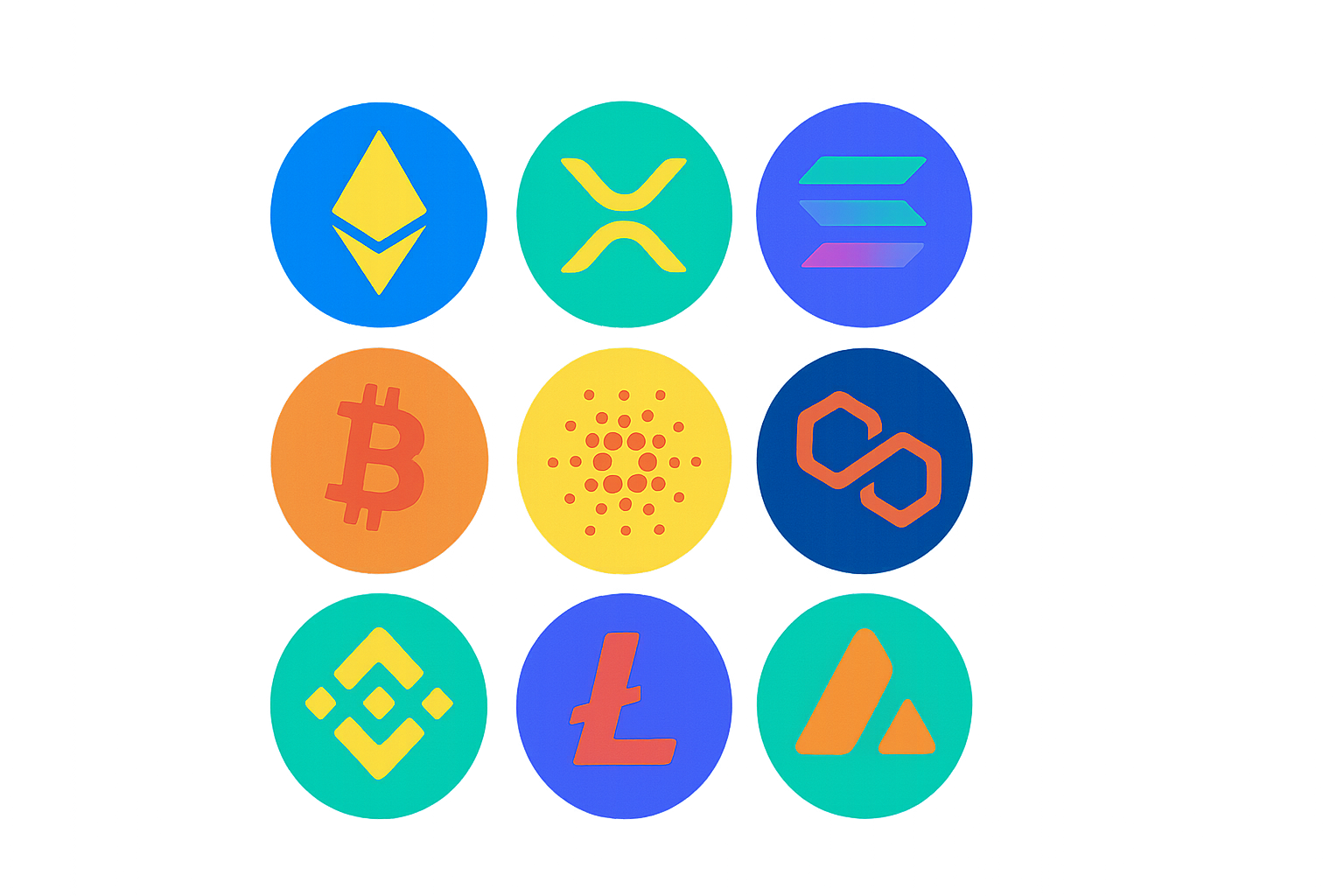
1. Ethereum (ETH)
Ethereum is the largest altcoin. Unlike Bitcoin, which functions mainly as digital cash, Ethereum introduced “smart contracts”—self-executing programs that run when specific conditions are met. This innovation has enabled thousands of applications, from financial services to gaming and art, to launch on its platform.
Ethereum is the foundation for decentralized finance (DeFi) and non-fungible tokens (NFTs), making it one of blockchain’s most successful platforms. Its migration to Proof of Stake (PoS) has also significantly reduced energy consumption.
2. XRP
Developed by Ripple Labs, XRP targets fast, low-cost international money transfers. It provides an alternative to traditional systems like SWIFT, particularly for financial institutions looking to improve cross-border payments.
XRP settles transfers in seconds with minimal fees, giving it strong potential in the remittance space. Its many partnerships with financial institutions are advancing its adoption.
3. Solana (SOL)
Solana is famous for extremely fast transaction speeds and low costs. Its blockchain can process thousands of transactions per second, making it ideal for high-volume applications like trading and gaming platforms.
Solana’s technology has fueled rapid adoption for DeFi projects and NFT marketplaces. However, network outages in the past highlight ongoing stability challenges.
4. Cardano (ADA)
Cardano takes an academic, research-driven approach to blockchain development, with a strong focus on security and sustainability. It uses a Proof of Stake (PoS) consensus that requires far less energy than Bitcoin’s mining model.
Cardano’s development process is based on peer-reviewed research, achieving high reliability and security. The project is especially focused on financial inclusion in emerging markets and blockchain applications in education.
5. Litecoin (LTC)
Often called the “silver to Bitcoin’s gold,” Litecoin is one of the earliest altcoins, launched in 2011. It offers faster transaction confirmations and a different hashing algorithm from Bitcoin. With a decade-plus of proven performance, low fees, and broad acceptance, Litecoin is widely used for everyday payments.
Its longevity and stability have led to integration with numerous payment services and wallets, cementing its role as a practical payment method.
6. Dogecoin (DOGE)
Dogecoin began as a joke based on an internet meme but has become one of the most recognizable cryptocurrencies globally. Despite its humorous start, Dogecoin has built a passionate community and attracted mainstream attention, including from high-profile supporters. Its low price and unlimited supply make it popular for tipping and microtransactions online.
Strong community cohesion and viral social media presence have made Dogecoin the flagship meme coin.
7. Tether (USDT)
Tether is the largest stablecoin by market capitalization, maintaining a peg to the US dollar. Each USDT token is backed by reserves to equal $1, enabling traders to move between volatile cryptocurrencies and stable assets without converting to fiat. It’s among the most-traded cryptocurrencies by daily volume.
Tether plays a crucial role as a base currency on crypto exchanges and is vital for maintaining market liquidity.
8. USD Coin (USDC)
USDC is a rapidly growing, regulated stablecoin pegged to the US dollar. Created by the Centre Consortium (Circle and Coinbase), its transparency is ensured through regular attestations of dollar reserves. USDC is a core infrastructure for DeFi and cross-border payments.
Strict regulatory compliance and high transparency have made USDC a preferred alternative to Tether for institutions.
9. Shiba Inu (SHIB)
Launched in 2020 as a Dogecoin alternative, Shiba Inu quickly gained a large following. While it started as a meme coin, the project has expanded to a decentralized exchange (ShibaSwap), NFT platform, and other utilities. Its extremely low price per token allows retail investors to own millions or billions of tokens, fueling its appeal.
Driven by a strong community, Shiba Inu continues to evolve from a meme coin into a project with practical utility.
10. Uniswap (UNI)
Uniswap transformed crypto trading with its automated market maker (AMM) model. As one of the largest decentralized exchanges, users can trade tokens directly from their wallets, and UNI holders can vote on the protocol’s future governance.
Uniswap is central to DeFi’s expansion and is expected to grow even more important as an alternative to centralized exchanges.
Each of these altcoins offers features and advantages that set them apart from Bitcoin, serving distinct use cases and market demands.
Key Metrics for Altcoins
To make informed altcoin investment decisions, it’s essential to understand two core market indicators: altcoin dominance and market capitalization. These metrics are vital for grasping market trends and timing investments.
Altcoin Dominance
Altcoin dominance measures the share of total crypto market value held by all altcoins. It is calculated as follows:
Altcoin Dominance = (Total Crypto Market Cap – Bitcoin Market Cap) / Total Crypto Market Cap × 100%
When Bitcoin dominance drops, altcoin dominance rises, indicating capital is flowing into alternative cryptocurrencies. Tracking this metric helps you see if market focus is shifting from Bitcoin to altcoins.
The altcoin dominance chart is a powerful tool for identifying macro trends:
-
When altcoin dominance rises (generally above 55%), it signals “altcoin season”—a period when many altcoins experience major price upswings.
-
When altcoin dominance falls, investors are focused mainly on Bitcoin, often reflecting a more risk-averse market stance.
Historically, altcoin dominance peaked around 67% during the 2017–2018 bull market, and reached about 60% in mid-2021. These peaks align with explosive altcoin rallies, making this a key metric for understanding market cycles.
Altcoin Market Capitalization
Altcoin market capitalization is the total value of all circulating altcoins. It’s calculated by multiplying each coin’s price by its circulating supply, then summing the results (excluding Bitcoin).
Monitoring the altcoin market cap chart provides valuable insights:
-
Steady growth in total altcoin market cap suggests sustained interest in crypto and overall healthy market expansion.
-
Sharp spikes may signal excessive speculation or bubbles, and are often followed by steep corrections.
-
Comparing market caps helps gauge a coin’s relative importance and adoption. Large-cap altcoins are generally considered more stable investments.
Many investors track the ratio of Bitcoin’s market cap to total altcoin market cap to spot shifts in capital between segments. When funds flow from Bitcoin to altcoins, broad altcoin price gains usually follow. Understanding these flows is critical for effective investment strategy.
Pros and Cons of Altcoin Investing
Like any investment, altcoins come with both advantages and disadvantages. It’s critical to understand these and weigh them against your risk tolerance and goals before making decisions.
Advantages of Altcoin Investing
-
High Growth Potential: Altcoins generally have smaller market caps than Bitcoin, so successful projects can offer far greater returns. A $1,000 investment in a small altcoin could multiply much more than the same amount in Bitcoin. Early-stage investments can yield 10x or 100x returns.
-
Diverse Investment Choices: With thousands of altcoins, you can choose projects aligned with specific technologies, industries, or causes. There are altcoins targeting DeFi, NFTs, gaming, metaverse, and more—enabling investments based on your interests or expertise.
-
Utility Beyond Currency: Many altcoins do more than store value—they support decentralized applications or provide governance rights. Their utility makes them more than just speculative assets; they’re essential to the functioning of entire ecosystems.
-
Participation in Innovation: Investing in altcoins puts you at the forefront of blockchain innovation. You support new technologies and business models and can benefit from their success.
Disadvantages of Altcoin Investing
-
High Risk: Altcoins are riskier than Bitcoin; many projects fail and lead to losses. Smaller altcoins are riskier still. Abandoned projects and team breakups are not uncommon.
-
Market Volatility: Altcoin prices can change 20–30% in a single day. This volatility makes timing difficult and investing stressful. While the upside is large, so is the downside.
-
Low Liquidity: Most altcoins have lower trading volume than Bitcoin, making it harder to buy or sell large amounts without moving the price. This is especially true for small-cap coins.
-
Regulatory Uncertainty: Crypto regulation is still developing, and future changes could have a big impact—especially on coins that may be classified as securities. Sudden regulatory changes can restrict trading or threaten a project’s viability.
-
Fraud and Failures: The altcoin market is rife with scams, failed projects, and rug pulls—where developers run off with investors’ funds. Insufficient research can leave you vulnerable to these risks.
-
Technical Complexity: Many altcoins are based on advanced concepts, requiring specialized knowledge to evaluate properly. Lack of understanding increases the risk of falling for hype.
How to Research Altcoins
Given the risks, thorough due diligence is critical before investing in altcoins. The following are the main factors to evaluate. Careful attention to these steps can greatly improve your odds of success.
1. Understand the Project’s Purpose and Problem Solved
- What real-world problem does the altcoin solve? Look for a clear, concrete problem statement.
- Is there genuine demand for the solution, or is it addressing a non-problem? Review market research and user needs.
- How does it compare to existing solutions? Analyze competitive advantages and differentiation.
- Is the project’s vision sustainable long-term? Evaluate whether it provides lasting value or just follows a trend.
2. Evaluate the Team
- Check the development team’s background and experience, using LinkedIn and similar sources.
- Verify the transparency of team identities and credentials; be cautious with anonymous teams.
- Look for a track record of successful projects; experienced teams are more likely to succeed.
- Review the number of active developers and GitHub activity for ongoing development.
- Assess the quality of advisors and investors; credible backers are a positive indicator.
3. Read the White Paper
The white paper outlines the project’s technology, goals, and implementation strategy. Focus on:
- Clear, specific technical explanations and proper use of terminology.
- A realistic roadmap with achievable milestones.
- Transparent tokenomics—how tokens are distributed and used.
- Red flags like vague language, unrealistic promises, or poor writing.
- Technical feasibility—can the proposed technology actually be built?
4. Analyze Tokenomics
- What’s the total token supply? Is it fixed or inflationary?
- How are tokens allocated among team, investors, and the community?
- Are there mechanisms to manage inflation and maintain value?
- Is there a vesting schedule or lock-up for team tokens?
- Are the token’s use cases clear and practical, or just speculative?
- Is there a burn mechanism to reduce supply and enhance value?
5. Evaluate Market Metrics
- Market Cap: The total value of all circulating tokens; higher market cap usually means greater stability.
- Liquidity: How easily tokens can be traded without impacting price; check volumes on exchanges.
- Trading Volume: Daily trading activity; look for sustained activity.
- Price History: How has the token performed over time? Identify patterns and trends.
- Exchange Listings: Is the token listed on multiple major exchanges? This boosts liquidity.
6. Community and Adoption
- Assess community size and engagement on platforms like Twitter, Discord, and Telegram.
- Look for partnerships with real businesses or organizations.
- Check real-world usage statistics and user base growth.
- Evaluate the quality and frequency of communication from the team.
- Determine if the community is mainly speculators or includes technically engaged participants.
7. Security and Audits
- Has the code been audited by reputable firms like CertiK or Quantstamp?
- Has the project experienced hacks or vulnerabilities?
- How decentralized is the network? Avoid overly centralized projects.
- Is there a bug bounty program to incentivize security research?
- Is the smart contract code open source for community review?
Carefully considering these factors enables more informed decisions about which altcoins are worth investing in. While research is time-consuming, it’s essential for minimizing losses and identifying winners.
Summary
Since the launch of Litecoin in 2011, the altcoin market has undergone explosive growth, now encompassing over 16,500 digital assets. In recent years, altcoins have matured beyond just Bitcoin alternatives, establishing themselves as investments with unique innovations and real-world applications.
Thorough research is the cornerstone of successful investing. Carefully analyze project fundamentals, team track records, tokenomics, and problem-solving impact. By reading white papers, reviewing team backgrounds, and monitoring community engagement, you can substantially reduce investment risk.
Market timing is another key factor. Use metrics like altcoin season indexes and dominance ratios to understand macro trends and make informed decisions. Understanding capital flows between Bitcoin and altcoins and adapting your strategy to market cycles is crucial for long-term gains.
Risk management is essential. While altcoins offer high return potential, they carry significant risk. Follow basic principles such as diversification, setting loss limits, and avoiding emotional trading. Never invest funds you can’t afford to lose.
The altcoin space offers limitless opportunity. With proper knowledge and preparation, you can help shape the future of the digital economy while pursuing attractive returns. DeFi, NFTs, the metaverse, and Web3 are all seeing daily innovation at the cutting edge of the crypto world.
Choose trusted trading platforms, diversify across altcoins, and maintain a commitment to continuous learning to succeed in this fast-moving market. Crypto runs 24/7, so staying current with news and trends is vital.
Finally, altcoin investing is best approached with a long-term outlook. Focus on fundamental value and future prospects, not short-term price swings. Patient holding of quality projects can yield substantial rewards. The future of blockchain and altcoins is bright, and with sound decisions, you can benefit greatly from this innovative sector.
FAQ
What Are Altcoins? How Are They Different from Bitcoin?
Altcoins are all cryptocurrencies except Bitcoin. While Bitcoin focuses on storing value, altcoins provide diverse services such as smart contracts, DeFi, and NFTs. They differ in transaction speed, use cases, and price volatility.
What Risks Should Beginners Consider Before Investing in Altcoins?
The main risks are high price volatility, low liquidity, project uncertainty, and security threats. Thorough research is essential before investing.
What Are the Basic Strategies for Profiting from Altcoin Investments?
Research project fundamentals and technology thoroughly, always weigh risk versus reward, diversify, and focus on long-term holding. Monitor market trends and trading volume, and avoid emotional decisions.
How Can You Choose Reliable Altcoins?
Check the experience of the development team, read the white paper, assess community support, and evaluate trading volume. Listing on major exchanges is also a key reliability indicator.
How Much Capital Do You Need to Invest in Altcoins?
You can start with as little as 500 yen. For beginners, having around 100,000 yen enables broader diversification and better risk management.
How Do You Choose and Manage a Cryptocurrency Wallet?
Choose a self-custody or custodial wallet based on your use case and trading frequency. For security, use strong passwords, enable two-factor authentication, and update regularly. Always protect your assets carefully.
Why Is Altcoin Market Volatility So High?
Altcoin market volatility is high due to low liquidity, fewer investors, and intense speculation on new technologies. The small market size means even modest capital flows can cause large price swings.
What is Altcoin? Top 10 Altcoins You Need to Know in 2025 | A Beginner's Guide Beyond Bitcoin

Comprehensive Guide to Detecting Crypto Scams with Token Analysis

Top DeFi Choices for Crypto Investments in 2025

Explore Cross-Chain Solutions with Avalanche Bridging
Understanding Perpetual Bonds: A Clear Explanation for Investors

What is the SUI Price Prediction for 2030 Based on Current Volatility?
How to Sell Bitcoins on Cash App: A Step-By-Step Guide
Hamster Kombat Daily Combo Cards Guide – GameDev Heroes Edition
How Many Stock Trading Days in a Year: Essential Facts
When You Get Paid Biweekly Meme: A Financial Perspective

How Do You Short a Stock on Robinhood: Step-by-Step Guide