

LCP_hide_placeholder
fomox
MarketsPerpsSpotSwapMeme Referral
More
Smart Money Recruitment
Search Token/Wallet
/

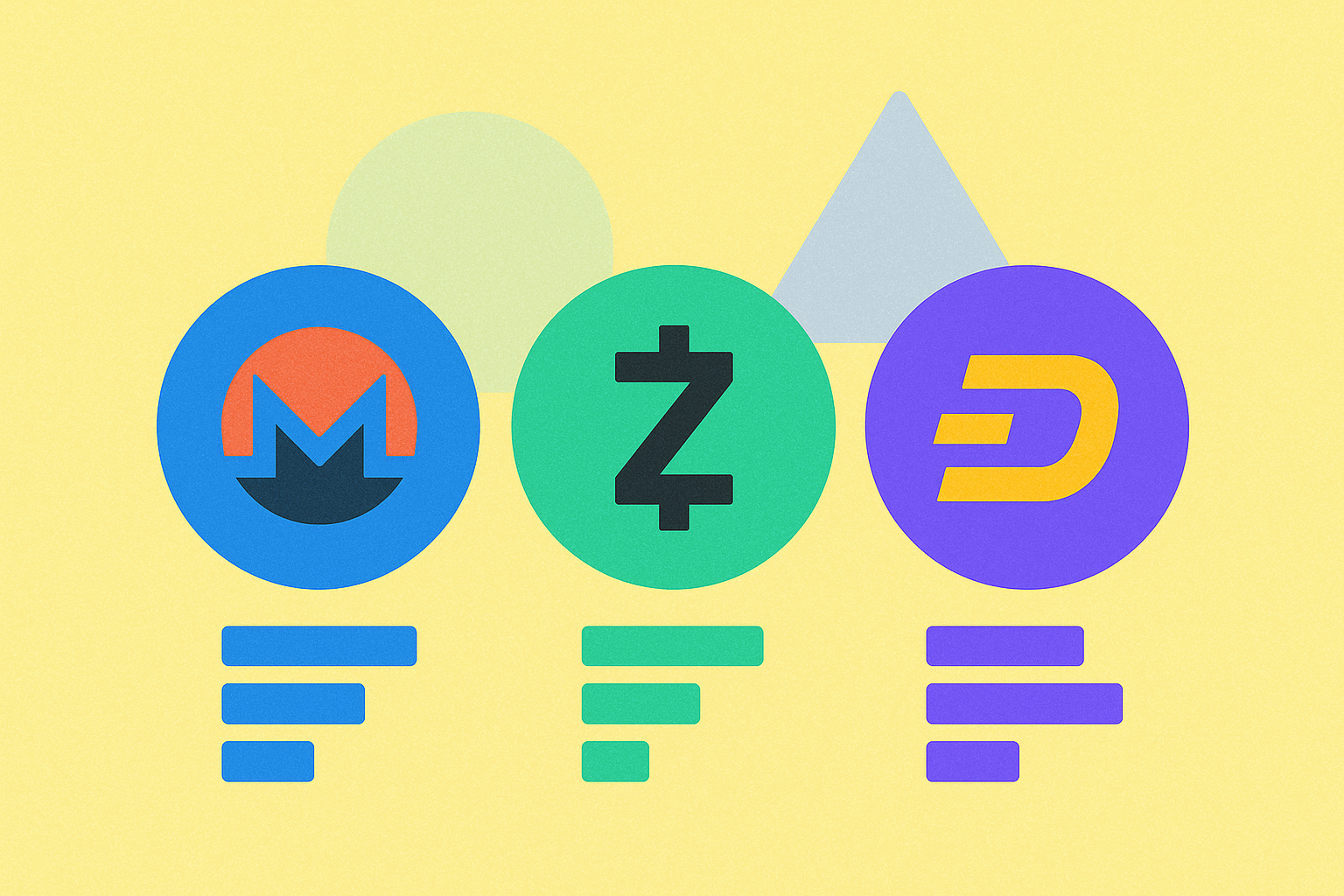
What is Monero (XMR) competitive benchmarking analysis: how does XMR compare to Zcash and Dash by market cap and user base in 2026
2026-01-18 05:42:40
Altcoins
Crypto Ecosystem
Crypto Insights
Cryptocurrency market
Zero-Knowledge Proof
Peringkat Artikel : 4
154 penilaian
This competitive benchmarking analysis examines Monero (XMR), Zcash (ZEC), and Dash (DASH) across market capitalization, user adoption, and technical performance in 2026. Monero dominates with $13 billion+ market cap and mandatory privacy-by-default architecture, significantly outpacing Zcash's $6.59 billion valuation. While Zcash attracts institutional interest through Grayscale Trust support, Monero maintains stronger on-chain transaction demand with 1-2 million active users. The analysis reveals XMR's technical advantages including ASIC-resistant RandomX mining, sustainable tail emission economics, and protocol-level privacy integration. Article explores how regulatory tailwinds and privacy-focused institutional adoption reshape competitive rankings, positioning Monero for market share expansion through 2026.
What is Monero (XMR) competitive benchmarking analysis: how does XMR compare to Zcash and Dash by market cap and user base in 2026

Market capitalization comparison: Monero, Zcash, and Dash valuations in 2026

In 2026, Monero firmly establishes itself as the market capitalization leader among privacy-focused cryptocurrencies. XMR's valuation surpassed $13 billion throughout the year, reflecting strong investor confidence in the platform's privacy infrastructure and adoption metrics. The cryptocurrency reached price points near $800 during peak periods, demonstrating substantial growth from previous cycles. This dominant market cap positions Monero significantly ahead of competing privacy coins in terms of total valuation.

Zcash presents a considerably smaller market footprint, with its market capitalization hovering around $6.59 billion as of January 2026, approximately half of Monero's valuation. ZEC's pricing reached $399.79 during this period, though the asset experienced notable volatility, including sharp sell-offs that temporarily reduced market cap by $1.6 billion in single trading sessions. This demonstrates greater price sensitivity compared to Monero's more stable valuation trajectory.

Privacy Coin Market Cap (2026) Price Range Market Position
Monero (XMR) $13 billion+ $575–$800 Clear leader
Zcash (ZEC) $6.59 billion $399.79 Second position

Monero's market capitalization advantage reflects investor preference for its privacy-by-default architecture and proven use case adoption. The valuation gap underscores Monero's competitive strength within the privacy coin ecosystem, positioning it as the sector's dominant player during this period.

User adoption metrics and active community size across privacy-focused cryptocurrencies

Privacy-focused cryptocurrencies display notably different adoption trajectories when examining their user bases and community engagement. Monero's active community spans approximately 1-2 million users, reflecting modest but increasingly engaged participation in network activity. While daily transaction volumes remain significantly lower than major cryptocurrencies, the consistent growth in user adoption metrics demonstrates sustained interest in privacy-preserving transactions.

Zcash presents a contrasting adoption profile, evidenced by 70% of transactions utilizing shielded privacy features and over 35,000 active social media followers. The privacy coin maintains approximately 1 million monthly active users, signaling stronger community penetration. Institutional interest further strengthens Zcash's ecosystem, with the Grayscale Zcash Trust managing $85 million in assets, indicating confidence in long-term privacy cryptocurrency adoption. This institutional support distinguishes Zcash's user adoption metrics from competitors, attracting both retail and professional participants.

Emerging privacy coins like Beam record 15.8K daily active users, while Firo shows rising merchant adoption despite smaller community sizes. Across these privacy-focused cryptocurrencies, adoption metrics reveal that Monero maintains dominance in default privacy adoption, whereas Zcash attracts users seeking optional privacy features combined with institutional-grade infrastructure. The divergence in community engagement patterns reflects different privacy philosophies and use case priorities, with transaction volume growth indicating sustained user adoption across the sector despite regulatory pressures.

Performance differentiation: transaction speed, privacy features, and technical advantages

Monero distinguishes itself through mandatory privacy integration that operates at the protocol level, contrasting sharply with competitors offering optional anonymity. While Zcash and Dash allow transparent transactions alongside privacy features, XMR's architecture ensures every transaction leverages RingCT technology by default, eliminating the possibility of transparency-based analysis. This fundamental design choice delivers consistent transaction obfuscation without requiring user configuration.

Transaction finality represents another critical performance differentiator. Monero processes blocks approximately every two minutes with confirmation times suitable for everyday transactions, while maintaining robust security through its unique incentive structure. The tail emission mechanism—releasing 0.6 XMR per block indefinitely—ensures miners remain economically incentivized beyond the initial supply schedule, addressing long-term security concerns that plague fixed-supply competitors. This technical advantage creates sustainable network security without requiring fee-dependent miner participation.

Monero's RandomX mining algorithm reinforces technical differentiation by preventing ASIC centralization, promoting genuinely decentralized validation compared to alternatives dominated by specialized hardware. Combined with consistent on-chain transaction demand documented over years, these technical advantages translate into measurable user adoption advantages. The convergence of mandatory privacy, innovative tail emission economics, ASIC-resistant consensus, and reliable transaction processing establishes XMR's competitive positioning within the privacy-focused cryptocurrency landscape.

Monero's competitive positioning within the privacy coin sector is increasingly defined by its stable on-chain demand metrics and sustainable transaction activity. Unlike competitors that experienced volatility in user engagement, XMR maintains consistent transaction counts across extended periods, signaling genuine user adoption rather than speculative participation. This foundation positions XMR favorably as market share dynamics shift through 2026. Regulatory developments emerging in 2026—particularly stricter crypto tax reporting frameworks—represent a critical inflection point for privacy coin adoption. These compliance requirements are expected to intensify demand for confidential financial solutions, directly benefiting XMR's competitive positioning. Monero's decentralized development structure provides additional advantage over alternatives facing governance complexities, reducing execution risks that could undermine market confidence.

Looking at user base evolution, XMR demonstrates stronger trading volume and user activity than both Zcash and Dash over longer timeframes, suggesting deeper community engagement beyond price cycles. Market analysis indicates 2026 could represent a pivotal year where sustained on-chain metrics and regulatory tailwinds converge to reshape competitive rankings. The combination of organic transaction demand, growing privacy concerns driving user acquisition, and institutional recognition of privacy as essential infrastructure positions Monero for market share expansion relative to competitors facing various technical or governance challenges.

FAQ

What are the core technical differences between Monero (XMR), Zcash (ZEC), and Dash (DASH)?

Monero uses mandatory ring signatures for privacy, Zcash employs zero-knowledge proofs (zk-SNARKs), and Dash offers optional PrivateSend mixing. Each provides distinct privacy mechanisms and implementation approaches.

How will the market cap rankings of Monero, Zcash, and Dash change in 2026?

Monero and Zcash are expected to lead in market capitalization in 2026, driven by growing privacy demands and regulatory focus. Dash will follow closely behind. Privacy coins' strong performance reflects increasing need for financial anonymity amid regulatory pressures.

What are Monero's privacy protection advantages compared to Zcash? Why is XMR considered to have stronger privacy?

Monero provides mandatory privacy by default using ring signatures and RingCT, ensuring all transactions are untraceable. Zcash requires users to opt-in for privacy features, leaving most transactions analyzable. Monero's compulsory design makes it inherently more private and resistant to blockchain analysis than Zcash's optional approach.

What are the advantages and disadvantages of Dash's masternode model compared to XMR's proof-of-work?

Dash's masternode model is more energy-efficient than XMR's proof-of-work but requires substantial coin holdings. XMR's proof-of-work offers faster confirmation speed and lower barriers to entry, while Dash provides better governance through masternodes.

Among these three privacy coins, which has the largest user base? How does community activity compare?

Monero (XMR) maintains the largest user base and highest community activity among the three. XMR's mandatory privacy features and consistent development create strong community loyalty. Zcash faces challenges from team instability, while Canton Network targets institutional users with a smaller overall base.

How does Monero's liquidity and availability on exchanges compare to Zcash and Dash?

Monero has moderate liquidity compared to Zcash and Dash. Zcash generally offers better exchange presence and liquidity across multiple platforms. Dash focuses on fast, low-fee transactions with competitive market availability. Overall, Zcash leads in accessibility.

What regulatory risks do privacy coins face, and how do they impact XMR, ZEC, and DASH respectively?

Regulatory pressure globally weakens all three privacy coins. XMR faces stricter delisting risks; ZEC and DASH see reduced adoption as compliant alternatives. Market confidence declines across the sector due to regulatory uncertainty and compliance challenges.

From an investment perspective, how should Monero's growth potential in 2026 be assessed compared to other privacy coins?

Monero demonstrates strong growth potential driven by FCMP++ upgrade enhancing privacy and quantum resistance. With continuous innovation, rising global privacy demands, and strong community support, XMR is positioned for significant market expansion in 2026.

* Informasi ini tidak bermaksud untuk menjadi dan bukan merupakan nasihat keuangan atau rekomendasi lain apa pun yang ditawarkan atau didukung oleh Gate.

Bagikan

Konten

Market capitalization comparison: Monero, Zcash, and Dash valuations in 2026

User adoption metrics and active community size across privacy-focused cryptocurrencies

Performance differentiation: transaction speed, privacy features, and technical advantages

FAQ

Artikel Terkait
How Much Can FHE Cryptocurrency Price Fluctuate Daily: Analyzing Volatility and Price Movements
How Much Can FHE Cryptocurrency Price Fluctuate Daily: Analyzing Volatility and Price Movements

The article delves into the extreme daily volatility of the FHE token, highlighting fluctuations exceeding 20% due to weak liquidity across multiple timeframes. It examines price range dynamics between $0.065 and $0.11, with historical surges and trading patterns backed by quantum-resistant encryption interest. Additionally, it addresses market structure challenges, such as susceptibility to manipulation and sharp reversals, exacerbated by fragile on-chain depth. The analysis caters to investors interested in Web3 and AI sectors, emphasizing the impact of isolated liquidity on price movements and tactical trading opportunities.
2025-12-20 01:51:01
How Does Monero (XMR) Compare to Zcash and Dash in Privacy-Focused Cryptocurrency Market

How Does Monero (XMR) Compare to Zcash and Dash in Privacy-Focused Cryptocurrency Market

The article examines the privacy technologies of Monero, Zcash, and Dash in the cryptocurrency market, highlighting their unique approaches to privacy protection, market dynamics, and regulatory challenges. Monero utilizes mandatory ring signatures, offering superior anonymity, while Zcash and Dash provide optional privacy features. The article analyzes Monero's strong market presence despite regulatory pressures and compares it to Zcash's market capitalization performance. Additionally, it discusses Monero's mining ecosystem and regulatory challenges, outlining the sector's growth and the evolving market share among privacy-focused cryptocurrencies. Keywords include Monero, Zcash, Dash, privacy-focused, and cryptocurrency.
2025-12-20 03:49:44
How Can You Measure Crypto Community and Ecosystem Activity?
How Can You Measure Crypto Community and Ecosystem Activity?

This article explores methods to measure the activity of crypto communities and ecosystems, focusing on Zcash as a case study. It analyzes social media metrics, such as Twitter followers and Telegram members, and evaluates community engagement across platforms including Discord, Reddit, and Telegram. Developer contributions and GitHub activity are assessed to highlight Zcash's development commitment, while insights into Zcash's DApp ecosystem growth are presented. The piece addresses the needs of investors and developers seeking to understand community dynamics and technical development. Key topics include technical discourse, community interaction, and ecosystem health.
2025-11-14 04:00:41
How Does Zcash (ZEC) Compare to Monero (XMR) and Dash (DASH) in the Privacy Coin Market?

How Does Zcash (ZEC) Compare to Monero (XMR) and Dash (DASH) in the Privacy Coin Market?

This article compares Zcash, Monero, and Dash in the privacy coin market. It explores their privacy technologies, market performance, and adoption barriers. Zcash's optional zk-SNARKs provide flexibility but require user action, while Monero's ring signatures ensure mandatory privacy. Dash uses CoinJoin for mixing transactions. The 2025 market shows Zcash's surge due to regulatory alignment, contrasting with Monero's sustained user demand despite exchange challenges. Suitable for investors, the article guides understanding of privacy, regulatory position, and institutional attraction amidst adoption hurdles. Keywords: privacy coins, adoption, regulatory challenges, Zcash, Monero, Dash.
2025-12-24 03:20:41
What is BREV token market overview: price, supply, and trading volume analysis

What is BREV token market overview: price, supply, and trading volume analysis

# BREV Token Market Overview: Price, Supply, and Trading Volume Analysis This comprehensive guide examines BREV token's market fundamentals, including its current price of $0.34, 24-hour trading volume of $3.70M, and total supply of 1 billion tokens. Designed for cryptocurrency investors and traders, the article addresses key questions about token valuation, tokenomics allocation, and market volatility patterns. The content progresses from real-time pricing data and circulating supply metrics, through detailed tokenomics breakdown with 32.20% community incentives allocation, to volatility assessment and exchange availability on Gate and other platforms. Readers gain actionable insights into BREV's market dynamics, investment risk factors, and liquidity conditions essential for informed trading decisions in the emerging crypto landscape.
2026-01-07 02:21:34
How can compliance and regulatory risks impact crypto projects in 2025 with SEC oversight and KYC/AML policies?
How can compliance and regulatory risks impact crypto projects in 2025 with SEC oversight and KYC/AML policies?

This article explores the impact of stringent SEC oversight on crypto projects in 2025, highlighting increased compliance standards and their influence on market operations. It addresses how regulatory frameworks including custody, transaction reporting, and market manipulation prevention affect market confidence, operational costs, and investor sentiment. The text is relevant to financial institutions, crypto platforms, and investors navigating compliance challenges, detailing a rise in operational costs due to KYC/AML policies and audit transparency. Structured to assess regulatory repercussions, the article pinpoints factors of token value fluctuation, offering insights into strategic technological adoption and risk management.
2025-12-21 01:08:06
Direkomendasikan untuk Anda
How does Federal Reserve policy and inflation data impact crypto prices in 2026
How does Federal Reserve policy and inflation data impact crypto prices in 2026

This article examines how Federal Reserve policy and inflation data drive cryptocurrency price movements in 2026. It explores the transmission mechanisms through which interest rate pauses and quantitative measures create liquidity conditions favorable for Bitcoin and digital assets. The analysis demonstrates that CPI readings serve as critical catalysts, with lower inflation data triggering immediate crypto buying pressure as markets reassess Fed policy trajectories. The piece investigates traditional market correlations between S&P 500, gold, and crypto valuations while clarifying asymmetric price reactions to inflation signals. Additionally, it explains how macroeconomic risk-on and risk-off cycles reshape digital asset demand, highlighting the deepening integration between traditional finance and cryptocurrency markets. The article provides traders, institutional investors, and crypto enthusiasts with actionable insights into macroeconomic indicators and policy mechanisms affecting asset valuations. Pract
2026-01-18 08:22:09
XRP Surges with Institutional Momentum and Regulatory Clarity

XRP Surges with Institutional Momentum and Regulatory Clarity

This comprehensive article examines XRP price trajectories through 2040, analyzing expert consensus on near-term bullish momentum driven by CME futures contracts and potential spot ETF approvals. Technical analysis reveals XRP trading at $2.39 on Bitget with bullish chart patterns and whale accumulation signals. Conservative forecasts project $2.75 by 2026, $3.75 by 2030, and $6.00 by 2040 under steady 8-10% annual growth assumptions. The article explores three scenarios—best-case institutional mass adoption, worst-case regulatory challenges, and most-likely measured growth—while examining critical drivers including banking integration expansion, regulatory evolution, network upgrades, and macroeconomic factors. Key risk factors and long-term opportunities for XRP's institutional adoption in cross-border payments are thoroughly analyzed, providing investors with data-driven perspectives for informed decision-making on this regulated cryptocurrency asset.
2026-01-18 08:20:07
What is AAVE market cap and trading volume in 2026: Price, supply, and liquidity overview
What is AAVE market cap and trading volume in 2026: Price, supply, and liquidity overview

This comprehensive guide examines AAVE's market performance in 2026, highlighting its $2.68 billion market capitalization and #35 DeFi ranking. With 15.32 million tokens in circulation and $203.75 million daily trading volume across 62 exchanges including Gate, AAVE demonstrates robust liquidity and institutional adoption. The token trades within a $168.36-$177.51 range, reflecting balanced market sentiment supported by strong technical indicators. AAVE commands 65% of the DeFi lending market share with $3 trillion cumulative deposits. This overview covers pricing dynamics, supply metrics, liquidity distribution, and key market drivers enabling investors to understand AAVE's position as a mature, liquid DeFi governance asset with institutional-grade infrastructure.
2026-01-18 08:18:54
How does Federal Reserve policy impact cryptocurrency prices in 2026?

How does Federal Reserve policy impact cryptocurrency prices in 2026?

This comprehensive guide examines how Federal Reserve monetary policy drives cryptocurrency valuations in 2026 through multiple transmission channels. The article reveals that interest rate adjustments, quantitative tightening decisions, and dollar strength directly influence crypto asset prices by affecting liquidity and risk appetite. However, empirical analysis demonstrates that adoption dynamics and regulatory frameworks—such as the U.S. GENIUS Act and EU MiCA—serve as more potent price catalysts than conventional economic indicators. With 559 million crypto users globally and increasing institutional integration, network growth metrics and regulatory clarity outweigh traditional macroeconomic data in price discovery. The guide includes detailed FAQ addressing Fed policy implications, cryptocurrency volatility patterns, and dollar depreciation effects. Investors seeking to understand 2026 crypto markets should prioritize sentiment analysis and adoption metrics on platforms like Gate over conventional econ
2026-01-18 08:17:07
How to Find the Next Pump and Dump Crypto Before Announced
How to Find the Next Pump and Dump Crypto Before Announced

This comprehensive guide equips cryptocurrency traders with essential knowledge to identify and avoid pump and dump schemes. The article explores manipulation mechanics targeting low-cap tokens on Gate and other platforms, teaching readers how to systematically research suspicious projects by analyzing market capitalization, liquidity, and holder distribution. Technical analysis sections cover volume spikes, parabolic price movements, RSI overbought conditions, and order book analysis as early warning indicators. The guide emphasizes implementing proactive monitoring through price alerts, volume notifications, and blockchain tracking tools. Critically, the article prioritizes risk protection and ethical considerations, highlighting legal consequences of participation while providing practical due diligence strategies. Whether protecting investments or understanding market dynamics, traders gain actionable frameworks to navigate cryptocurrency markets safely and make informed decisions.
2026-01-18 08:16:24
How Does Federal Reserve Policy and Inflation Data Impact Cryptocurrency Prices in 2026

How Does Federal Reserve Policy and Inflation Data Impact Cryptocurrency Prices in 2026

This article explores how Federal Reserve monetary policy and inflation data drive cryptocurrency valuations in 2026. The analysis examines three core mechanisms: Federal Reserve rate decisions and FOMC meetings directly influence Bitcoin and Ethereum through liquidity channels and real yields; CPI inflation trends correlate inversely with crypto performance, as declining inflation supports rate-cut expectations and increases risk appetite; traditional market indicators like S&P 500 and gold prices serve as predictive catalysts for crypto volatility. The article reveals that cryptocurrency markets respond more dramatically to Fed policy signals than traditional equities due to lower entry barriers and higher funding sensitivity. With anticipated monetary easing and balance sheet stabilization in 2026, the resulting liquidity environment could significantly support digital asset appreciation. Essential for traders: monitor Federal Reserve announcements, monthly CPI releases, employment data, and bond yields to
2026-01-18 08:14:58