7 Top Stablecoins to Watch
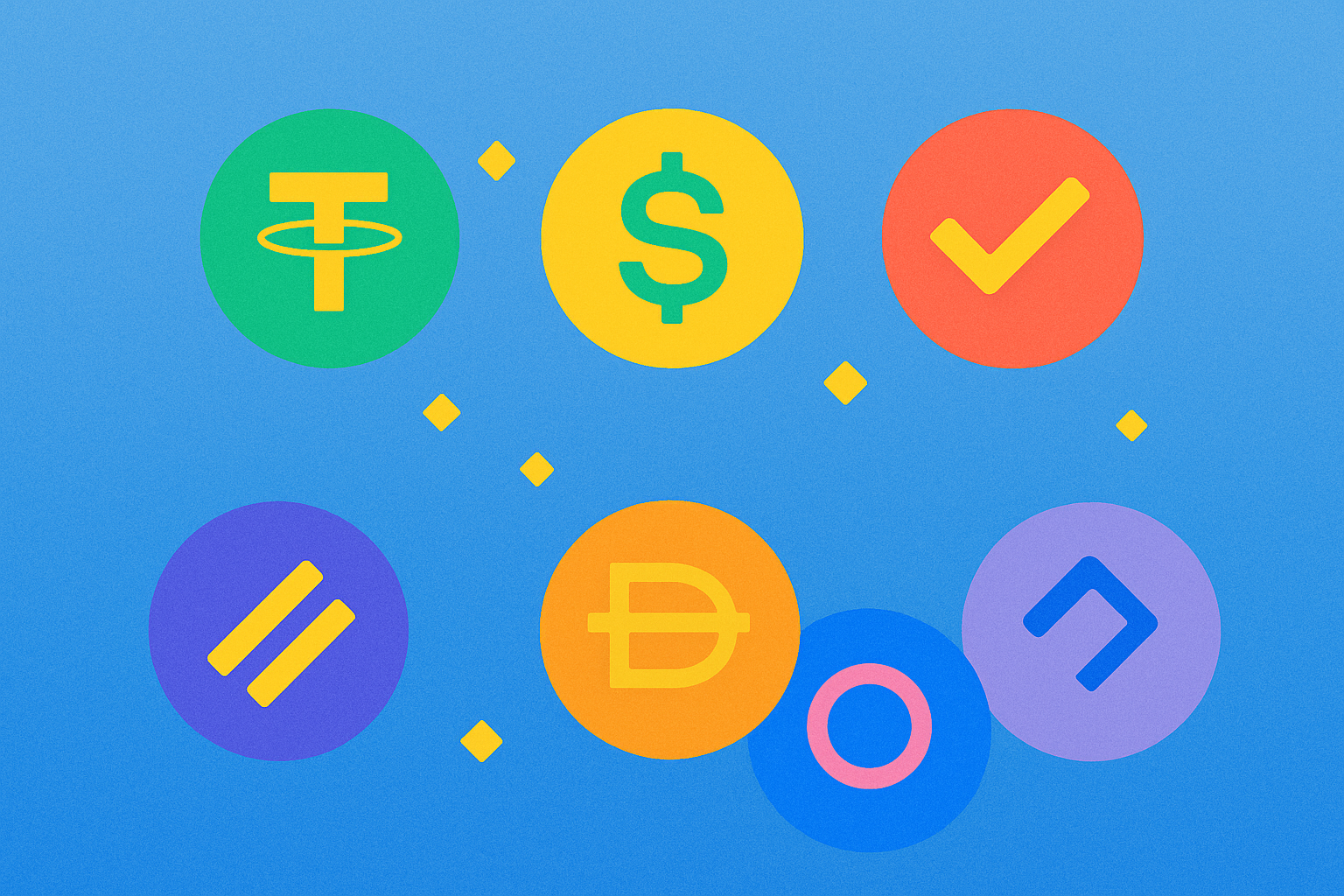
Introduction to Stablecoins
Stablecoins are a specialized type of cryptocurrency with values pegged to another currency or asset class. Most commonly, the peg is to fiat currencies such as the US dollar or euro, though some stablecoins are backed by physical commodities like gold or other precious metals. This pegging mechanism means the stablecoin’s value directly tracks its underlying asset, delivering relative price stability.
Stablecoins function as a vital link between traditional fiat currencies and the decentralized world of crypto. They support a wide range of use cases, from rapid cross-border payments to participation in advanced decentralized finance (DeFi) protocols. Today, stablecoins are essential tools for traders, investors, and everyday users seeking shelter from the extreme volatility of conventional cryptocurrencies.
What Are Fiat-Pegged Stablecoins?
Fiat-pegged stablecoins digitally represent government-issued currencies on the blockchain. Their creation involves several steps: the issuer locks a set amount of fiat currency in reserve, then uses smart contracts to mint an equivalent number of blockchain tokens. For instance, leading stablecoins like USDC and USDT maintain a 1:1 peg to the US dollar, with each token theoretically backed by one dollar in the issuer’s reserve.
This collateralization process builds user confidence in the token’s price stability. Transparency of reserves is crucial: reputable issuers conduct regular audits and publish reports confirming the number of tokens issued matches the fiat held in reserve. These practices allow users to verify that each stablecoin is genuinely backed by real assets, not just digital entries.
Which Stablecoins Are Most Popular?
Several major stablecoins dominate the cryptocurrency market in terms of capitalization and usage. USD Coin (USDC) and Tether (USDT) lead the sector, jointly controlling a substantial share of the stablecoin market. Both tokens are widely adopted on centralized and decentralized exchanges, in DeFi protocols, and for cross-border payments.
A notable moment in stablecoin history came when a leading trading platform ended support for its own stablecoin in late 2023. This decision underscored the importance of regulatory clarity and competition in the stablecoin industry, and demonstrated that even major players may need to adjust strategies as the regulatory landscape evolves.
1. USDT — Pioneer of the Stablecoin Market
USDT is a stablecoin pegged to the US dollar, launched by Tether Limited in 2014. Its introduction marked a breakthrough in the crypto sector, as it was the first widely adopted solution bridging the gap between traditional fiat and digital currencies. USDT maintains a 1:1 dollar peg, meaning each USDT token should equal one US dollar.
Over time, USDT has become the most liquid stablecoin globally, used by millions of people. It’s available on many blockchain platforms, including Ethereum, Tron, Binance Smart Chain, and others, offering high accessibility and ease of use. Traders value USDT for its ability to quickly secure profits or hedge against volatility without converting assets to fiat. Despite periodic debates about reserve transparency, USDT remains the top stablecoin by trading volume and market cap.
2. USDC — The Benchmark for Transparency
USDC is a US dollar-pegged stablecoin launched in 2018 by Circle in partnership with Coinbase. Designed with transparency and regulatory compliance in mind, USDC immediately stood out among competitors. Like other dollar-backed stablecoins, USDC maintains a stable price around $1.
USDC’s strongest feature is its reputation for reserve transparency. The issuer publishes regular audit reports verifying full dollar backing for all tokens in circulation. This makes USDC particularly attractive to institutional investors and companies that require robust trust and compliance. USDC is widely used in the DeFi ecosystem as a primary exchange medium and collateral for lending, staking, and liquidity protocols.
3. TUSD — Built on Trust
True USD (TUSD) is a relatively new stablecoin launched in 2018 by TrustToken and PrimeTrust. TUSD was designed to address core sector challenges at the time, specifically user trust and transparency in reserve management.
TUSD distinguishes itself with a strong commitment to transparency: the token undergoes regular independent audits, with results published for public review. This lets users confirm at any time that every TUSD token is backed by an equivalent US dollar reserve. TUSD is also integrated with many DeFi protocols and centralized exchanges, ensuring high liquidity and flexibility for various financial operations.
4. BUSD — Stablecoin from a Major Trading Platform
BUSD is a stablecoin issued through a partnership between a major crypto trading platform and the blockchain firm Paxos Trust. Its value is pegged to the US dollar at a 1:1 ratio, guaranteeing price stability. The token is built on Ethereum with ERC-20 support and is also compatible with the BEP-2 standard of a specialized blockchain network.
BUSD’s close integration with a leading trading platform ecosystem gave users convenient access for trading, staking, and program participation. The token also received regulatory approval from the New York State Department of Financial Services (NYDFS), boosting trust among institutional users. However, as previously mentioned, support for BUSD was discontinued in late 2023, marking a significant event in the stablecoin sector.
5. DAI — Decentralized Stability
DAI is unique among stablecoins as the only truly decentralized option among leading market players. Unlike centralized stablecoins like USDT and USDC, which are controlled by specific issuing companies, DAI is minted via a decentralized app (DApp) built on Ethereum—the Maker protocol.
The DAI token debuted in 2018, launched by the decentralized autonomous organization (DAO) MakerDAO. DAI is softly pegged to the US dollar at a 1:1 ratio, but its peg maintenance mechanism is fundamentally different from centralized models. The Maker protocol mints new DAI tokens when users provide collateral in crypto assets such as Ethereum or Bitcoin (wrapped versions). Users lock their assets in smart contracts and receive DAI in return; the collateral value must exceed the amount of DAI issued to ensure system stability.
This decentralized approach makes DAI especially appealing to users who value decentralization and wish to avoid risks tied to centralized issuers. DAI is widely adopted in DeFi as a primary medium of exchange and lending across various protocols.
6. eUSD and peUSD by Lybra — Yield-Bearing Stablecoins
Lybra Finance is an innovative decentralized platform offering users access to liquid staking tokens (LST). The platform has developed two distinctive stablecoins—eUSD and peUSD—that stand out for their ability to generate passive income for holders.
eUSD and peUSD are interest-bearing stablecoins issued by Lybra Finance, backed by liquid staking tokens. Users can lock their LST tokens (such as stETH from Lido) and receive stablecoins that not only maintain a stable value but also automatically accrue staking rewards from the underlying asset. Holders of eUSD and peUSD earn attractive yields, distributed proportionally to each holder’s balance.
This approach makes Lybra’s stablecoins especially attractive to long-term investors seeking asset stability without missing out on yield opportunities. The platform also offers various strategies to deploy these tokens in DeFi protocols, further enhancing their utility.
7. Synthetic USD — An Alternative to Traditional Banking
Synthetic USD is a distinct class of stablecoin aimed at users who seek dollar stability without interacting with conventional banks. The main purpose of synthetic USD is to deliver a stable dollar value by combining two or more correlated assets.
Synthetic USD mechanisms often rely on derivatives and complex financial instruments to provide dollar exposure without direct fiat holdings. Some protocols utilize a mix of crypto assets and algorithmic systems to maintain price stability. This makes synthetic USD especially attractive to users in regions with limited banking access or those prioritizing full decentralization and privacy.
Synthetic USD is also used in advanced trading strategies and DeFi protocols, supporting risk hedging, leverage, and arbitrage opportunities.
Why Stablecoins Are Gaining Popularity
Stablecoins have seen persistent growth in recent years, driven by several key factors. First, they solve a major crypto market challenge—high volatility. Investors and traders use stablecoins to temporarily store funds with minimal risk of sharp price swings, which is crucial during periods of market instability.
Second, the rise of decentralized finance (DeFi) has created huge demand for stablecoins as the main medium of exchange and collateral in various protocols. Stablecoins are used for lending, borrowing, liquidity provision, and yield farming, making them indispensable for active DeFi participants.
Third, stablecoins give users worldwide access to dollar-denominated assets, including those in countries with unstable local currencies or limited international banking access. This opens new paths for financial inclusion and global economic participation.
Stablecoins and Decentralized Finance (DeFi)
DeFi is a rapidly evolving financial services ecosystem built on blockchain technology. It gives users access to a broad range of financial products—from lending and borrowing to derivatives trading and asset management—without the need for traditional intermediaries like banks or brokers.
Stablecoins are central to the DeFi ecosystem, serving as the primary medium of exchange and unit of account. They are used in nearly every DeFi protocol: in lending platforms (e.g., Aave, Compound), stablecoins are the main currency for loans; on decentralized exchanges (DEXs), they provide liquidity for trading pairs; in yield farming, they generate passive income.
Stablecoins play an especially important role as collateral for decentralized lending and borrowing platforms. Users can lock stablecoins in smart contracts to secure loans in other cryptocurrencies, with the stablecoin’s consistent value minimizing the risk of collateral liquidation due to volatility. As a result, stablecoins are the preferred choice for both borrowers and lenders in DeFi.
Stablecoins also enable sophisticated DeFi strategies, including arbitrage across protocols, creation of synthetic assets, and participation in insurance protocols. Their stability and liquidity make them ideal for professional traders and institutional investors.
Benefits of Dollarization via Stablecoins
Thanks to their US dollar peg, stablecoins offer users worldwide the chance to earn yield in the world’s most stable currency. This is particularly valuable for those in developing regions with unstable economies, where local currencies suffer from high inflation and devaluation.
For people living with high inflation, investing in stablecoins can be an effective way to preserve savings’ purchasing power. Instead of holding depreciating local currency, users can convert funds into stablecoins for dollar-equivalent access—without opening foreign bank accounts or navigating complex currency controls.
Stablecoins allow residents of developing countries to actively join the global economy through fast, low-fee cross-border transfers. Conventional international bank transfers may take days and incur high costs, while stablecoin transactions are settled in minutes at a fraction of the cost. This unlocks opportunities for freelancers working with international clients, families sending remittances, and small businesses engaged in global trade.
Stablecoins also grant access to global DeFi platforms, where users can earn yields far above traditional bank deposit rates. This is especially significant in places with underdeveloped or unreliable banking systems.
Risks Associated with Stablecoins
Despite their many benefits, stablecoins present certain risks that users need to consider. Stablecoin resilience depends directly on the reliability of the underlying asset and the financial health of the issuer. If the value of the backing asset collapses, or if the issuer faces major financial or legal trouble, a stablecoin can lose its peg. Crypto market history includes instances where stablecoins lost their peg due to reserve issues or issuer bankruptcy.
Counterparty risk is a major concern, especially for centralized stablecoins. Users must trust that the issuer truly maintains enough reserves to back all tokens. Lack of transparency or reserve manipulation can erode trust and prompt mass withdrawals, potentially causing liquidity crises.
Regulatory uncertainty also poses risks. Regulators worldwide are still developing approaches to stablecoin oversight, and legal changes may affect token availability and utility. In some scenarios, regulatory actions could freeze assets or limit stablecoin functions.
Technical risks require attention as well. While blockchain networks generally deliver high transaction speeds, network congestion can result in delays and higher fees. This can restrict instant access to funds during critical market moves. Additionally, smart contract vulnerabilities or coding errors may lead to fund losses or protocol exploits.
Finally, there’s the risk of depegging—periods when a stablecoin temporarily or permanently loses its peg. This can stem from market panic, liquidity issues, or technical failures. Users should be prepared and maintain risk management strategies.
How to Acquire Stablecoins
Stablecoins can be acquired in several ways, each with unique advantages. The fastest and simplest method for beginners is buying stablecoins on a centralized crypto exchange with fiat currency. Major exchanges let users purchase stablecoins directly using bank cards, wire transfers, or other payment options. This approach is convenient and doesn’t require prior crypto ownership, with rapid fund deposits.
Existing crypto holders can acquire stablecoins by swapping other digital assets—such as Bitcoin, Ethereum, or altcoins. This method is popular among active traders using stablecoins to lock in profits or manage market volatility. Swaps can occur on both centralized exchanges and decentralized platforms (DEXs) like Uniswap, Curve, or PancakeSwap.
Decentralized exchanges offer the added benefit of bypassing identity verification (KYC), which is important for privacy-conscious users. On DEXs, users trade tokens directly from their crypto wallets, maintaining full control throughout the transaction.
Another option is using P2P marketplaces, where users buy and sell stablecoins directly with each other. This can offer more favorable exchange rates and flexible payment choices, but requires caution and due diligence on counterparties.
Advanced users can mint stablecoins via lending protocols, such as using MakerDAO to generate DAI. In this scenario, users lock crypto assets as collateral and receive stablecoins, preserving exposure to underlying assets while accessing liquidity.
The Future of Stablecoins in the Crypto Ecosystem
Stablecoins are a fundamental pillar of the modern crypto ecosystem, playing a key role in digital economic advancement. Their ability to deliver price stability while leveraging blockchain benefits makes them a reliable bridge between traditional finance and decentralized crypto markets.
With global crypto adoption on the rise, stablecoins’ influence and importance are set to grow. They’re used not only for trading and investing, but also for daily payments, international transfers, corporate finance, and public initiatives. Evolving regulatory frameworks and new technology—like central bank digital currencies (CBDCs)—may further fuel stablecoin growth and innovation.
Advances in decentralized stablecoins, yield-generating tokens, and synthetic assets are unlocking new use cases and expanding the utility of stablecoins. However, users should remain vigilant to risks and exercise care when choosing stablecoins and platforms.
The outlook for stablecoins is bright, as they continue to solve real-world financial problems and enable millions to access vital services. As technology matures and regulatory clarity improves, stablecoins are likely to become even more integrated into the global financial system, driving financial inclusion and economic growth.
FAQ
What is a stablecoin, and how is it different from other cryptocurrencies?
A stablecoin is a cryptocurrency pegged to a stable asset—usually the US dollar. Unlike other cryptocurrencies, stablecoins have minimal volatility, making them a reliable tool for saving and transacting on the blockchain.
How do major stablecoins USDT, USDC, and DAI differ?
USDT is the most liquid, dollar-pegged, and issued by Tether. USDC is more decentralized, backed by Coinbase and Circle. DAI is fully decentralized, created by overcollateralizing crypto assets without a central issuer.
What risks are associated with stablecoins, and why is regulation needed?
Stablecoins face risks including collateralization, counterparty risk, and reserve volatility. Regulation is essential to protect users, ensure reserve transparency, prevent fraud, and stabilize the financial system.
What’s the principle behind pegging a stablecoin to fiat currency?
Stablecoins are pegged to fiat currencies by holding reserves. The issuer maintains an equivalent amount of fiat or securities, keeping the coin’s price stable at a 1:1 ratio with the base currency. This builds user trust and price predictability.
Which stablecoins are worth considering for investment in 2024?
USDT, USDC, and DAI are market leaders with the highest trading volumes and reliability. In 2024, they will likely continue to dominate due to broad adoption and liquidity. Alternatives like FRAX and MIM are also worth watching for their innovative mechanisms.
How are stablecoins used in DeFi and cross-border payments?
Stablecoins provide liquidity in DeFi protocols, serve as trading and lending pairs, and reduce volatility. In cross-border payments, they speed up transfers, lower fees, and enable direct settlements without intermediary banks.
How can you safely buy and store stablecoins?
Use secure wallets with private keys and keep them offline. Buy through licensed platforms. Enable two-factor authentication. Avoid storing large amounts in hot wallets. Diversify storage methods, and regularly check account security.

Maximize Your Returns with Stablecoin Interest Rates

How to Analyze On-Chain Data for Better Crypto Investment Decisions?

How Does On-Chain Data Analysis Reveal CRO's Market Trends in 2025?
How to Conduct an Effective Competitive Benchmarking Analysis in 2025?
Exploring the Causes and Impact of USDC Depegging

What Are the Biggest Crypto Security Risks and How Can Investors Protect Themselves?

What Does TP Mean in Trading: Essential Guide
Can CashApp Transactions Be Traced?
Pi Coin Value in 2050: Potential and Possibilities
Understanding the Stock-to-Flow Model: Scarcity Drives Value
What is Bitcoin Consolidation?