Discovering Your Blockchain Wallet Address: A Comprehensive Guide

How to Find your EVM Address?
In the cryptocurrency ecosystem, understanding and managing your EVM (Ethereum Virtual Machine) wallet address is fundamental to participating in blockchain activities. This comprehensive guide provides detailed information about EVM addresses, their functionality, and practical steps for locating and using them within digital wallet platforms.
What is an EVM Wallet Address?
An EVM wallet address serves as a unique digital identifier for your blockchain account across Ethereum and other compatible networks. This address takes the form of a 42-character string, beginning with "0x" and followed by a combination of hexadecimal characters (numbers 0-9 and letters a-f). For example, a typical EVM address looks like: 0x1a5FdBc891c5D4E6aD68064Ae45D43146D4F9f3a.
Functionally, your EVM address operates similarly to a bank account number in traditional finance, but with significantly enhanced security and transparency features. You utilize this address to receive digital assets, store cryptocurrencies and NFTs, and send funds to other addresses. The address is generated through sophisticated cryptographic algorithms that ensure you maintain exclusive control over your funds through your private key.
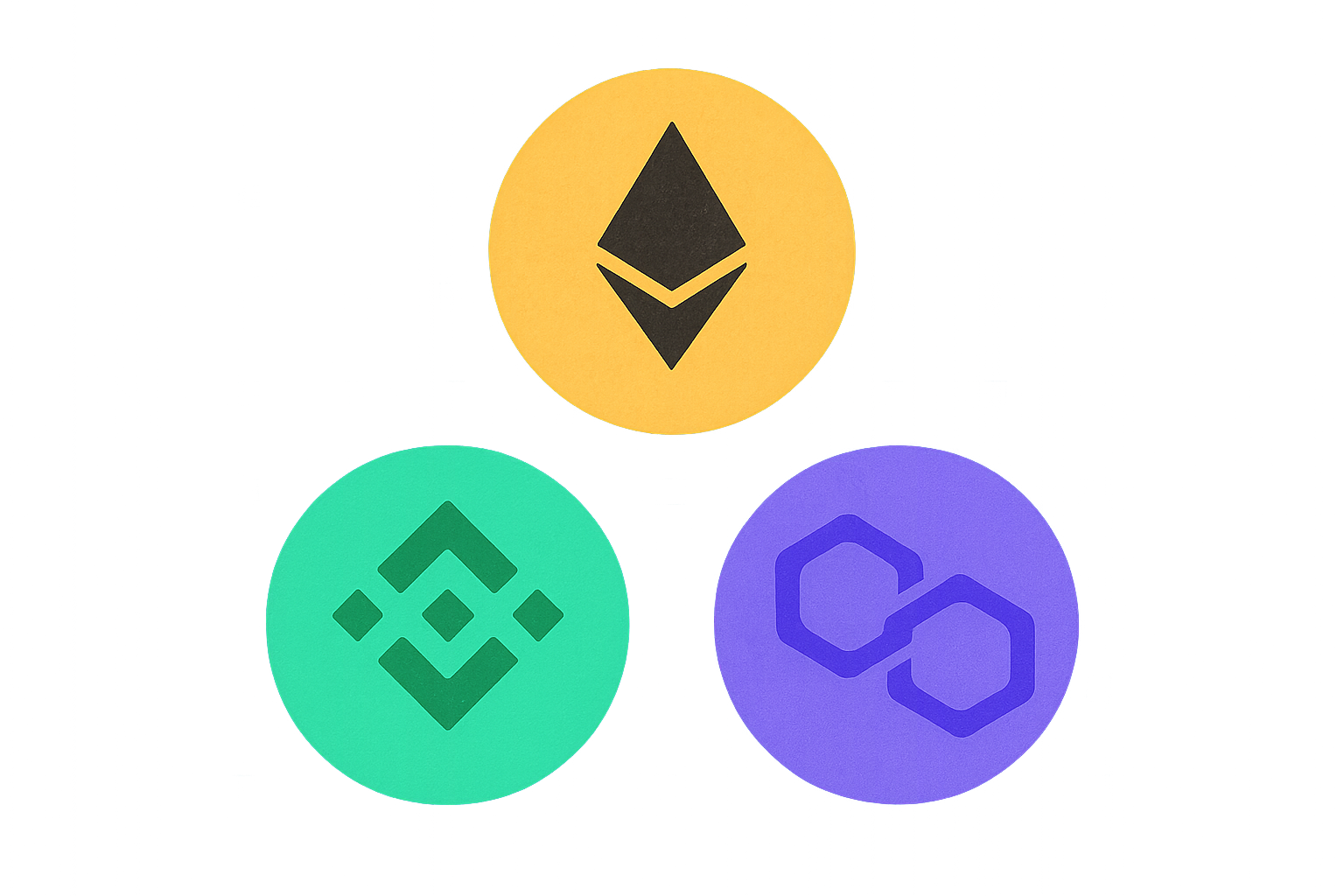
The key distinguishing features of an EVM address include its cross-chain compatibility, allowing the same address format to function seamlessly across all EVM-compatible blockchains such as Ethereum, BNB Chain, and Polygon. While addresses are typically displayed in lowercase format, certain chains implement checksum formatting with uppercase letters for additional verification. Importantly, the address generation process is unidirectional—your public address is mathematically derived from your private key, but the private key cannot be reverse-engineered from the address, ensuring security.
Popular EVM-Compatible Blockchains
The EVM ecosystem encompasses numerous blockchain networks, each offering distinct advantages and use cases. Ethereum Mainnet, utilizing ETH as its native token, represents the most mature and established smart contract ecosystem with extensive developer support and the largest decentralized application (dApp) library.
BNB Chain provides an attractive alternative with BNB as its native token, offering significantly lower gas fees and higher transaction throughput, making it popular for high-frequency trading and cost-sensitive applications. Polygon, powered by POL tokens, functions as an Ethereum Layer 2 scaling solution, dramatically reducing transaction costs while maintaining compatibility with Ethereum's security model.
Layer 2 solutions like Arbitrum and Optimism leverage ETH while implementing different scaling technologies—Arbitrum uses Optimistic Rollup technology, while Optimism provides faster transaction processing through its own Layer 2 architecture. Base, backed by major industry players, represents a growing Ethereum Layer 2 network focused on bringing mainstream users to Web3.
Avalanche C-Chain offers a high-performance EVM-compatible environment powered by AVAX tokens, while newer networks like Morph focus on consumer-centric applications. Zero-knowledge proof technologies are represented by zkSync Era and Linea, offering enhanced scalability and privacy. Additional networks like Mantle, Blast, Berachain, Story, and Scroll each provide specialized features ranging from modular architecture to intellectual property focus, expanding the EVM ecosystem's capabilities.
How to Find Your EVM Address in Your Wallet
Locating your EVM address in your digital wallet is a straightforward process that ensures you can easily share your address for receiving funds or verify it for transactions. The critical advantage of EVM addresses is their universality—your single EVM address remains constant across all EVM-compatible networks, eliminating the need to manage multiple addresses for different chains.
To begin, you must first download and install a compatible wallet application on your device. During the initial setup, you have two options: creating a new wallet, which generates a fresh set of cryptographic keys and a new EVM address, or importing an existing EVM-compatible wallet using your seed phrase or private key, which restores your existing address.
Once your wallet is set up, you can easily copy your EVM address from the main interface. If the wallet displays "All Networks" at the top, the address shown is your universal EVM address. Simply tap the copy icon adjacent to the address to copy it to your device's clipboard. This copied address can then be pasted wherever needed, such as on centralized platforms when initiating withdrawals to your wallet.
In situations where a non-EVM network is currently selected—such as Solana or another non-compatible blockchain—you'll need to switch to an EVM network first. Tap the network selection bar at the top of the interface, which opens a list of available networks. From this list, select any EVM-compatible chain such as Ethereum, BNB Chain, or Polygon. After switching to an EVM network, your EVM address will be displayed, and you can tap the copy icon to copy it.
When sending your address to others for receiving payments, always verify that you're sharing your EVM address if expecting EVM-compatible tokens. After copying, paste the address in the designated receiving address field of the sending platform, whether that's a trading platform withdrawal form, another wallet, or a payment interface.
Conclusion
Your EVM address represents your fundamental identity within the Web3 ecosystem, serving as the essential tool for conducting cross-chain transactions, maintaining self-custody of digital assets, and ensuring transparent on-chain activity tracking. Through compatible wallet platforms, managing your EVM address becomes an intuitive and secure process, empowering users to explore the expansive blockchain landscape with confidence and security.
For optimal security practices, consider utilizing your wallet's multi-chain management mode to efficiently organize and monitor assets across different networks. Always exercise caution by thoroughly verifying recipient addresses and confirming target blockchain networks before executing any transactions. Given the irreversible nature of blockchain transactions, it is paramount to safeguard your private keys with extreme care and maintain secure backups of your seed phrase in multiple protected locations. By following these guidelines and understanding your EVM address's role, you can safely navigate the decentralized financial ecosystem and fully leverage the transformative potential of blockchain technology.
FAQ
What does EVM mean?
EVM stands for Ethereum Virtual Machine, a decentralized computing environment that executes smart contracts on the Ethereum blockchain. It enables developers to build and deploy applications across EVM-compatible networks, ensuring consistent code execution and security across the Web3 ecosystem.
What is an EVM in crypto?
The Ethereum Virtual Machine (EVM) is a decentralized computation engine that executes smart contracts on blockchain networks. It powers Ethereum and is also adopted by other blockchains like Polygon, Arbitrum, and Avalanche, enabling secure and reliable decentralized applications.
Which wallet has EVM?
MetaMask, Trust Wallet, and Ledger support EVM. These wallets are compatible with Ethereum and other EVM-compatible blockchains, allowing you to manage assets across multiple networks seamlessly.

Guide: Connecting MetaMask to Polygon Testnet
Top wallets for safely storing cryptocurrency on the Polygon protocol

How to Reduce Gas Fees on the Avalanche Network

A Technical Overview of Gas Fees and Their Mechanisms in Cryptocurrency Trading

Effortless Guide to Creating Your Polygon Wallet Address
Wallet Launches A "Custom Mainnet" Feature to Simplify the Process of Adding New Mainnets
USDY Token: What Is Ondo US Dollar Yield and How to Earn Passive Income with 4.25% APY
Exploring EtherFi Airdrops: How You Can Benefit
What is an ETH ETF?
What is the Babylon Chain?

What are DAOs and How Do They Work?