


Understanding Governance Tokens: A Comprehensive Guide

What Are Governance Tokens? Explaining Decentralized Decision-Making
Governance tokens represent a fundamental innovation in decentralized decision-making within the cryptocurrency ecosystem. As blockchain-based projects emphasize decentralization, transparency, and equal accessibility, traditional top-down leadership structures are incompatible with Web3 principles. This has led to the emergence of governance tokens (governance token คือ) as a popular mechanism for promoting efficient and equitable governance in decentralized protocols.
What is a governance token?
A governance token (governance token คือ) is a specialized cryptocurrency that grants token holders voting privileges on decisions affecting decentralized protocols. These tokens are typically issued by developers of decentralized applications (dApps) on top of layer-1 blockchains such as Ethereum (ETH), Cosmos (ATOM), or Solana (SOL).
Unlike traditional cryptocurrencies focused primarily on transactions or price speculation, governance tokens serve a distinct purpose: empowering dApp users with a voice in decision-making processes and fostering equality within the Web3 community. While governance tokens maintain market value and trade on various exchanges, their primary function extends beyond financial speculation.
Token holders typically possess two key privileges: voting rights on protocol proposals and the ability to submit their own proposed changes for formal consideration by the community. This dual functionality ensures that governance remains participatory and democratic.
How do crypto governance tokens work?
The operational mechanics of governance tokens (governance token คือ) rely on smart contracts to facilitate trustless, automated decision-making. Smart contracts contain preprogrammed instructions that automatically tally votes and enforce results without requiring third-party intervention or oversight.
Most dApps with governance tokens organize themselves as decentralized autonomous organizations (DAOs), which serve as centralized hubs for all governance activities. Within a DAO's interface, token holders can submit petitions, review community announcements, and cast votes on active proposals.
The voting mechanism typically follows a straightforward model: one governance token equals one vote. Users stake their desired number of tokens in a smart contract associated with a specific proposal during the voting window. Once the voting period concludes, the smart contract automatically records the results on the blockchain's immutable ledger and returns the staked governance tokens to participants' wallets. This process ensures transparency, immutability, and automated enforcement of community decisions.
Governance tokens vs. utility tokens: What's the difference?
Understanding the relationship between governance tokens and utility tokens requires recognizing the broader categorization within cryptocurrency ecosystems. Utility tokens represent cryptocurrencies that emphasize non-monetary use cases within their respective Web3 environments.
Governance tokens (governance token คือ) fall under the utility token umbrella because they serve a clear, non-transactional purpose: enabling on-chain voting for protocol decisions. However, the utility token category encompasses many other cryptocurrencies without voting privileges.
For example, Smooth Love Potion (SLP) functions as a utility token within the Axie Infinity blockchain game, serving as both a reward mechanism and in-game currency. This illustrates that while governance represents one valid use case for utility tokens, numerous other functionalities can grant cryptocurrencies utility status, including gaming rewards, access to platform features, or serving as payment for network services.
Pros and cons of governance tokens
Governance tokens (governance token คือ) have become instrumental tools for decentralized decision-making, particularly within decentralized finance (DeFi) applications. However, their implementation presents both significant advantages and notable challenges.
Governance token pros
Empowerment of the user base: Governance tokens fundamentally strengthen community engagement by providing all participants with direct influence over decision-making processes. The equal rights granted to token holders for proposal submission and voting eliminate discrimination and preferential treatment, fostering a genuine sense of collective ownership.
Enhanced adaptability to current demands: By distributing decision-making power to users, governance tokens provide developers with invaluable insights into their dApp's most pressing issues. Token holders can influence protocol evolution by responding to market demands and emerging trends in the cryptocurrency sector. This superior adaptability ensures dApps remain competitive, relevant, and responsive to user needs.
Transparent recording and enforcement: Blockchain technology's inherent characteristics provide robust protection against election tampering and manipulation. All voting data becomes publicly accessible on the blockchain's distributed ledger, while smart contracts handle immediate enforcement of results. This transparency strengthens trust in a dApp's accountability and maintains the integrity of governance processes.
Governance token cons
Centralization concerns: The standard one-token-equals-one-vote model creates potential power imbalances. Wealthy traders holding large amounts of governance tokens (commonly referred to as "whales") can exert disproportionate influence over protocol direction. Without more sophisticated voting mechanisms that consider factors like time commitment or network contributions, the risk of governance capture by wealthy participants remains significant.
Reduced scalability speed: Requiring community votes for every dApp upgrade, including minor issues like bug fixes, can significantly hamper development pace. While governance voting procedures enhance democratic participation, they inevitably slow down the speed of implementation and reduce scalability efficiency.
Smart contract vulnerabilities: Although dApps eliminate centralized counterparty risks, they remain vulnerable to exploits in smart contract code. Bugs or security vulnerabilities in the smart contracts governing voting mechanisms or token distribution can severely threaten a dApp's reputation, user trust, and overall integrity.
Where to trade governance tokens
Governance tokens (governance token คือ) enter circulation through various distribution methods. Initially, dApps often reward early adopters, loyal traders, or liquidity providers with governance tokens through airdrops. Additionally, users can earn governance tokens through active participation in DeFi platforms, including trading activities, staking programs, or contributing to liquidity pools.
For those seeking to acquire governance tokens through market purchases, numerous trading platforms offer trading pairs. Cryptocurrency price aggregators like CoinMarketCap and CoinGecko provide comprehensive information about governance token availability. By searching for a specific governance token's name or ticker symbol, users can access detailed price pages that list all trading platforms offering that cryptocurrency under the "Exchanges" tab.
Examples of governance tokens
Governance tokens (governance token คือ) have proliferated across various Web3 applications, extending beyond DeFi protocols to encompass diverse use cases within the blockchain ecosystem.
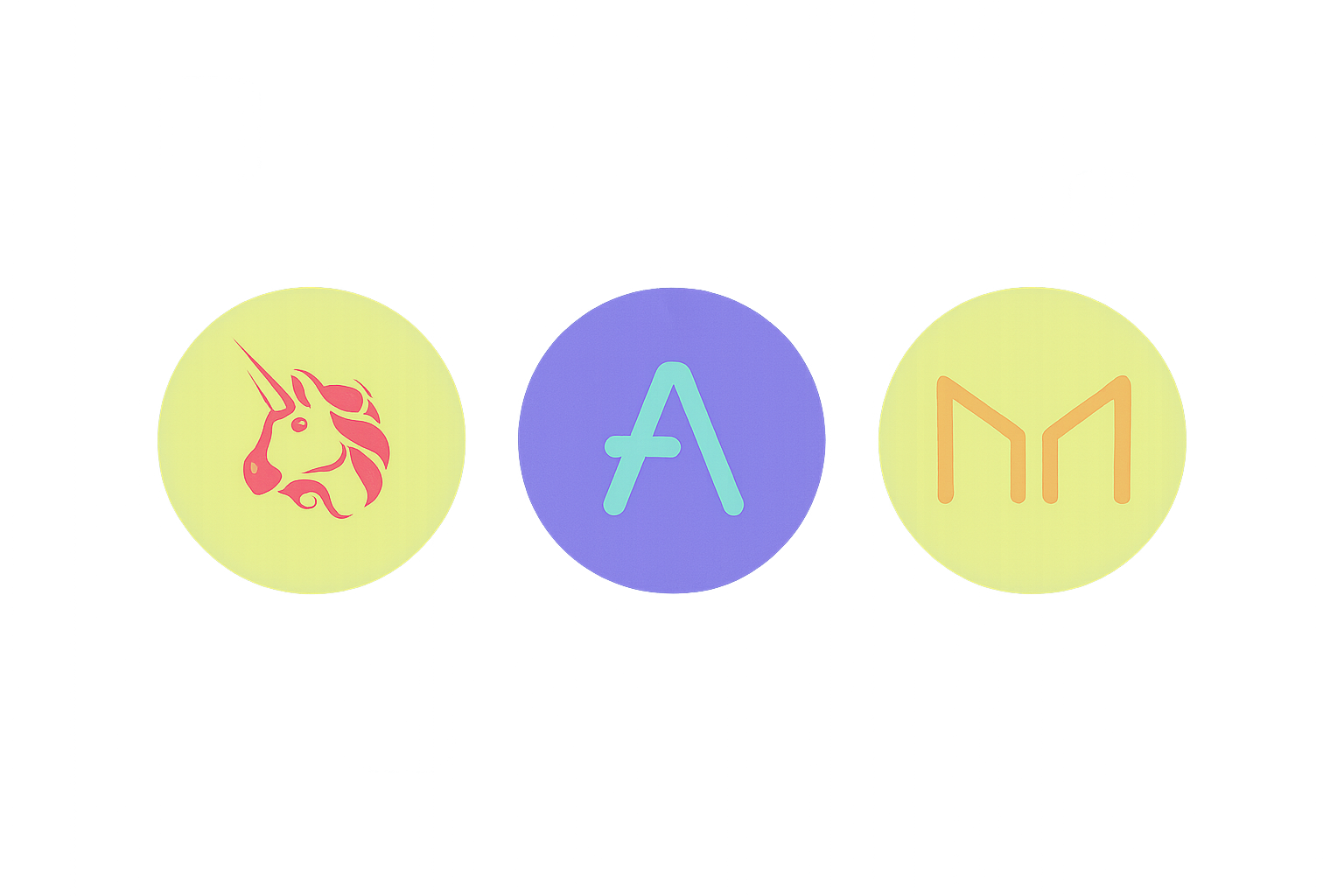
Uniswap (UNI): The Ethereum-based decentralized exchange Uniswap has conducted a landmark airdrop of its UNI governance token to users who had previously interacted with its automated market maker (AMM) protocol, whether as traders or liquidity providers. As one of the largest decentralized trading platforms in the cryptocurrency space, UNI has become one of the most actively traded governance tokens, enabling holders to vote on protocol upgrades and policy decisions.
Aave (AAVE): The Aave crypto lending platform utilizes the AAVE governance token to facilitate community participation in protocol governance. Token holders vote on critical issues including protocol upgrades, collateral requirements, and interest rate adjustments. Additionally, AAVE holders can stake their tokens in Aave's Safety Module, earning rewards while providing emergency funding reserves for the protocol.
Maker (MKR): MakerDAO, operating on Ethereum, is renowned for issuing the DAI stablecoin through its lending and borrowing protocol. The MKR governance token enables community members to vote on essential protocol parameters, including code updates, fee structures, and acceptable collateral types. This governance model has proven instrumental in maintaining DAI's stability and the protocol's overall health.
Ethereum Name Service (ENS): The Ethereum Name Service provides users with human-readable domain names that link to their cryptocurrency wallet addresses. To preserve decentralization principles, developers introduced the ENS DAO governance token, allowing community members to submit proposals and vote on protocol improvements, ensuring the service evolves according to user needs and preferences.
Conclusion
Governance tokens (governance token คือ) represent a pivotal innovation in decentralized decision-making, offering blockchain communities a mechanism to maintain democratic participation while preserving the core principles of decentralization. By distributing voting power among token holders, these cryptocurrencies empower users to shape protocol evolution, respond to market dynamics, and ensure platforms remain aligned with community interests.
However, the implementation of governance tokens is not without challenges. Centralization risks from whale dominance, reduced development speed due to voting processes, and smart contract vulnerabilities present ongoing concerns that the Web3 community must address. Despite these limitations, governance tokens have proven instrumental in advancing decentralized governance models across DeFi platforms, naming services, and various other blockchain applications.
As the cryptocurrency ecosystem continues to mature, governance tokens will likely evolve with more sophisticated voting mechanisms, improved security measures, and enhanced participation models. Their success in projects like Uniswap, Aave, MakerDAO, and Ethereum Name Service demonstrates their viability as tools for community-driven decision-making. Moving forward, the challenge lies in refining governance token implementations to maximize democratic participation while maintaining efficiency, security, and true decentralization in the Web3 landscape.
FAQ
Governance Token คืออะไร
Governance token is a cryptocurrency that grants holders voting rights on project decisions. Token holders can participate in on-chain governance, influencing the project's direction, protocol upgrades, and resource allocation through democratic voting mechanisms.
G-Token จะเริ่มขายเมื่อไหร่
G-Token will begin its first sale in July 2025 and officially launch in November 2025. The Ministry of Finance will announce the return rate details at that time.
How can I buy G-Token?
To buy G-Token, open an account with a licensed digital asset exchange. Complete identity verification and fund your account. Search for G-Token, select your desired amount, and execute the purchase order through the trading interface.

Top Decentralized Exchange Aggregators for Optimal Trading

Understanding Crypto Slippage: A Clear Explanation

Understanding Web3 Wallets: A Comprehensive Guide
What is Avalanche (AVAX): A Complete Fundamentals Analysis of Whitepaper Logic, Use Cases, and Technical Innovation

Understanding Crypto Airdrops: A Beginner's Guide

Comprehensive Guide to Effective DeFi Yield Farming Strategies

What is BULLA coin: analyzing whitepaper logic, use cases, and team fundamentals in 2026

What is on-chain data analysis and how does it reveal whale movements and active addresses in crypto?

What is Vodra (VDR) crypto: whitepaper logic, use cases, and fundamentals analysis for 2026

How do cryptocurrency competitors compare in market share, performance, and user adoption in 2026?

What is on-chain data analysis and how does it predict crypto market trends
