What are the key differences between competing cryptocurrencies in market cap, performance, and user adoption?

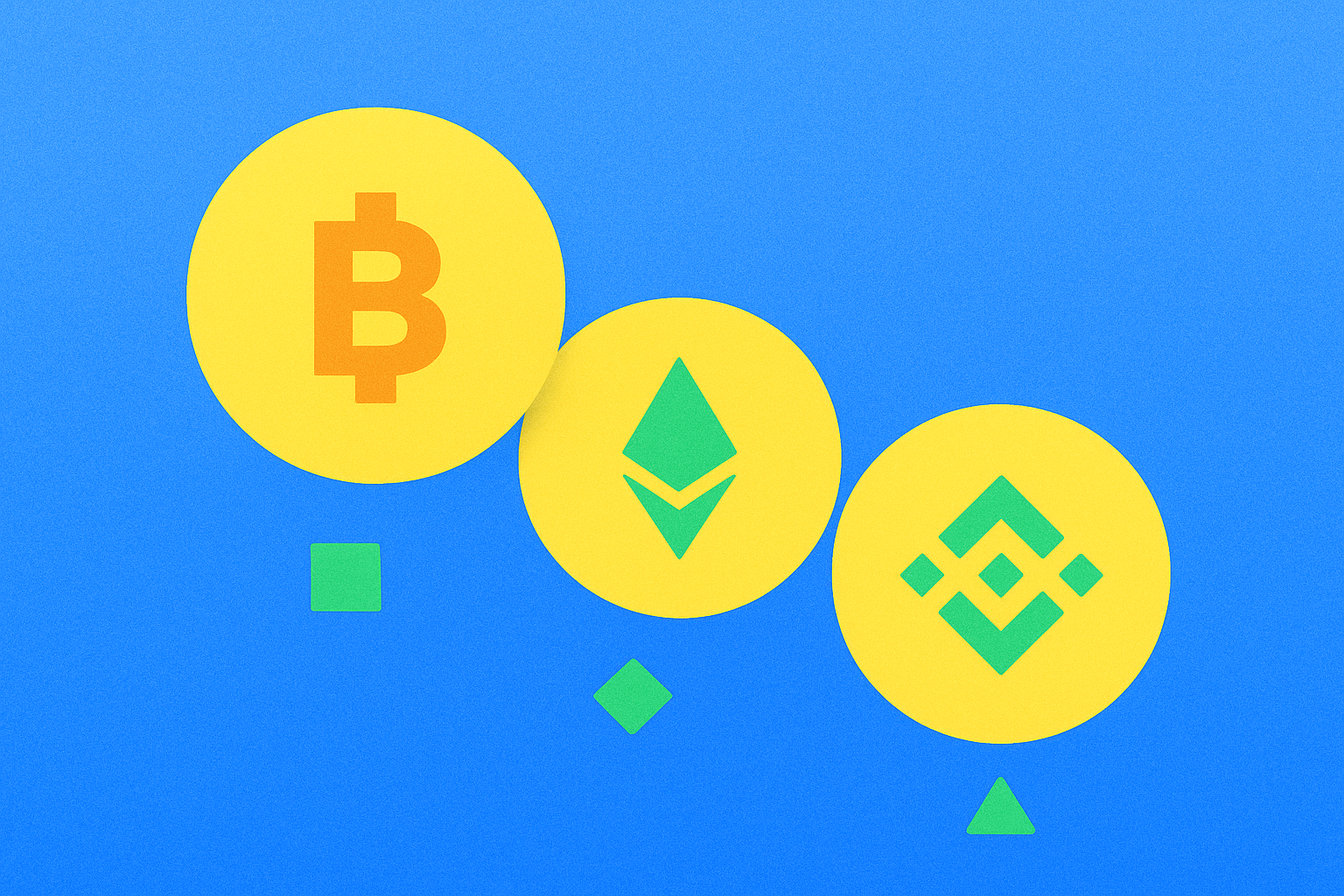
Bitcoin, Ethereum, and BNB dominate market cap rankings, with Bitcoin maintaining over 40% of total cryptocurrency value
The cryptocurrency market exhibits a clear hierarchical structure dominated by three major digital assets. Bitcoin stands as the undisputed market leader, commanding approximately 40-62% of total cryptocurrency market capitalization depending on current market conditions. This substantial dominance reflects Bitcoin's position as the original and most recognized digital asset, serving as the primary entry point for institutional and retail investors entering the crypto space.
Ethereum ranks as the second-largest cryptocurrency by market cap, though it remains significantly smaller than Bitcoin—roughly one-fifth of Bitcoin's total value. Despite this gap, Ethereum maintains critical importance due to its smart contract functionality and extensive decentralized application ecosystem, making it essential infrastructure for blockchain development.
BNB secures the third position among major cryptocurrencies, solidifying its status as a key market player. These three cryptocurrencies collectively represent the majority of total cryptocurrency market value, establishing themselves as the core holdings in most cryptocurrency portfolios and exchange platforms like gate.
The concentration of market cap among Bitcoin, Ethereum, and BNB demonstrates the cryptocurrency market's maturity toward institutional adoption, where larger, established projects command greater investor confidence and liquidity compared to smaller alternative cryptocurrencies.
Performance divergence: Bitcoin's stability contrasts with altcoins' volatility, affecting risk-adjusted returns across market cycles
The contrast between Bitcoin's price stability and altcoin volatility has become increasingly pronounced across recent market cycles, fundamentally reshaping how investors evaluate cryptocurrency exposure. During Q2 2025, altcoins experienced drawdowns reaching -31.3%, nearly double Bitcoin's -18.05% decline, illustrating the heightened vulnerability of alternative assets during market corrections. This performance divergence directly impacts risk-adjusted returns, with Bitcoin's 2025 Sharpe ratio reaching 2.42—placing it among the top 100 global assets and demonstrating competitive risk-adjusted performance against traditional investments.
The stabilization of Bitcoin's volatility profile has attracted institutional capital, contributing to its 55% market dominance. Altcoins, conversely, maintain elevated volatility that translates to deeper drawdowns despite occasional periods of outperformance. This volatility differential becomes particularly significant across extended market cycles, where Bitcoin's consistent risk-adjusted returns provide more predictable portfolio positioning. While altcoins can deliver higher absolute gains during bullish phases, their tail risk exposure—demonstrated during market crises—poses considerable challenges for risk management. The divergence reflects market maturation, with Bitcoin establishing itself as the more stable cryptocurrency option, while altcoins continue exhibiting characteristics typical of emerging asset classes.
User adoption metrics reveal Bitcoin's network maturity with 200+ million wallets, while emerging protocols capture growth through lower barriers to entry
Bitcoin's network maturity manifests clearly through its user adoption metrics, with over 200 million wallets representing accumulated trust and widespread distribution across the global population. This substantial user base reflects years of network consolidation and mainstream recognition, solidifying Bitcoin's position as the dominant cryptocurrency. However, the broader crypto adoption landscape reveals a more dynamic picture where newer participants increasingly favor emerging protocols designed with accessibility in mind.
While Bitcoin commands network maturity through sheer user numbers, emerging protocols capture growth momentum by systematically lowering barriers to entry. These alternative systems often feature streamlined onboarding processes, reduced transaction complexity, and user-friendly interfaces that appeal to less technically sophisticated participants. As global crypto adoption reached 9.9% in 2026 with 559 million users worldwide, emerging protocols have successfully attracted populations underserved by Bitcoin's established infrastructure.
The distinction reflects different adoption phases within the cryptocurrency market. Bitcoin users typically represent earlier adopters with higher technical literacy, whereas emerging protocols expand the addressable market by removing friction points. Industry projections suggest crypto users could reach 1 billion by 2026, indicating that lower barriers remain essential for sustained adoption growth. Security improvements and regulatory clarity further enhance accessibility, allowing emerging protocols to capture demographic segments—including developing economies and younger populations—that prioritize ease of use alongside functionality, fundamentally reshaping how different user segments engage with decentralized finance.
FAQ
What are the market cap rankings and differences between Bitcoin, Ethereum and other major cryptocurrencies?
As of January 2026, Bitcoin leads with the largest market cap, followed by Ethereum at approximately 850 billion dollars. Ethereum's value derives from smart contracts and DApp functionality. Other major cryptocurrencies have significantly smaller market caps than these two leaders.
What are the key differences between cryptocurrencies in transaction speed, energy efficiency, and scalability?
Bitcoin handles 7 transactions per second with high energy use, while Ethereum improved 99% efficiency after switching to Proof-of-Stake. Newer blockchains like Solana achieve thousands of transactions per second with minimal energy consumption, balancing scalability and sustainability.
Which cryptocurrencies currently have the most users and most active communities?
Bitcoin and Ethereum dominate with the largest user bases and most active communities. Solana, Polkadot, and Avalanche also maintain strong developer ecosystems and engaged communities, with Polkadot being particularly active in development.
What impact do Proof of Work and Proof of Stake consensus mechanisms have on cryptocurrency performance?
PoW requires computational power, consuming high energy but ensuring strong security through mining difficulty. PoS uses token staking, offering faster transaction speeds, lower energy consumption, and higher scalability, though it presents centralization risks. PoW prioritizes security; PoS prioritizes efficiency.
How to assess cryptocurrency adoption rates and real-world use cases?
Evaluate actual user activity on-chain, transaction volume and frequency, developer engagement, and real-world problem-solving capability. Analyze token utility, scarcity, ecosystem partnerships, and whether the project addresses genuine market needs beyond speculation.
Why can some small cryptocurrencies compete with large competitors?
Small cryptocurrencies compete through innovative technology, agile operations, and rapid market responsiveness. They attract early adopters with niche solutions, lower entry barriers, and differentiated features that larger competitors may lack, establishing strong community support and market positioning.

The Origins of Digital Currency Evolution
How Does the Crypto Market Overview Look in Late 2025?

The Birth of Digital Currency: A Journey through its History

How Does the Current Crypto Market Overview Look in 2025?

How Has the Crypto Market Volatility Affected Price Movements in 2025?
What Is the Current Crypto Market Overview: Top Coins, Volume, and Liquidity?

How do macroeconomic factors and Fed policy impact cryptocurrency prices in 2026?

What is Cryptocurrency Compliance and Regulatory Risk: A Complete Guide to SEC Regulations, Audit Transparency, and KYC/AML Policies

What is WeFi (WFI) market overview: price, market cap, trading volume and liquidity in 2026

How does on-chain data analysis reveal Virtuals Protocol's market potential in 2025?
What is TEXITcoin (TXC) market overview: price, trading volume, and market cap analysis