

LCP_hide_placeholder
fomox
MarketsPerpsSpotSwapMeme Referral
More
Smart Money Recruitment
Search Token/Wallet
/

What is a token economics model and how do tokenomics allocation, inflation mechanisms, and governance rights work in crypto projects

2026-01-20 05:01:35
Blockchain
Crypto Insights
DAO
DeFi
Web 3.0
文章评价 : 3.5
half-star
65 个评价
This comprehensive guide explores token economics fundamentals essential for understanding crypto projects. It covers token allocation frameworks where team allocations typically represent 10-15%, investors 20-30%, and community 40-50% of total supply, demonstrating how balanced distribution strengthens decentralization. The article examines inflation and deflation mechanisms that regulate token supply growth, using real examples like BORA's 95.6% circulation ratio to illustrate supply management. It details token burn strategies that reduce circulating supply to create deflationary pressure supporting scarcity principles. Finally, it explains governance rights empowering token holders to vote on critical protocol parameters, fee structures, and treasury allocation on platforms like Gate. Through detailed FAQs, the article addresses key questions about tokenomics importance, vesting schedules, inflation impacts, and risk identification, providing readers with frameworks to evaluate crypto project sustainabili
What is a token economics model and how do tokenomics allocation, inflation mechanisms, and governance rights work in crypto projects

Token Allocation Framework: Analyzing Team, Investor, and Community Distribution Ratios in Crypto Projects

A token allocation framework forms the backbone of any successful crypto project's tokenomics structure. This framework determines how a project's total token supply is distributed among different stakeholder groups, directly influencing the project's long-term viability and market dynamics. Understanding these distribution ratios is essential for evaluating whether a crypto project has sustainable tokenomics or faces potential challenges from poorly balanced allocations.

Team and advisor allocations typically represent 10-15% of total supply in well-structured projects, with tokens locked under vesting schedules spanning 2-4 years to ensure continued commitment. Investor allocations, including seed, private, and strategic rounds, generally constitute 20-30% of the total supply, also subject to vesting periods that vary by investment stage. Community allocations—reserved for users, airdrops, staking rewards, and ecosystem development—should ideally comprise 40-50% of tokens, ensuring broad distribution and network participation that strengthens project decentralization.

Allocation Category Typical Range Purpose
Team & Advisors 10-15% Development and guidance
Investors 20-30% Funding and support
Community 40-50% Users and ecosystem growth
Treasury/Reserve 10-20% Long-term operations

Projects with unbalanced allocation frameworks—such as excessive team holdings or concentrated investor positions—often experience governance challenges and reduced community trust. Well-designed token allocation frameworks demonstrate that projects prioritize decentralized participation while maintaining resources for development, creating stronger foundations for sustainable crypto project ecosystems.

Inflation and Deflation Mechanisms: Balancing Token Supply Growth with Long-term Value Sustainability

Inflation and deflation mechanisms form the backbone of sustainable tokenomics design, directly influencing long-term token value. Inflation in crypto projects occurs through new token emission, where protocols distribute additional tokens to incentivize network participation and reward validators. These inflationary mechanisms require careful calibration, as excessive emission dilutes existing holders' value. Many projects implement emission schedules that gradually decrease over time, creating predictability in token supply expansion.

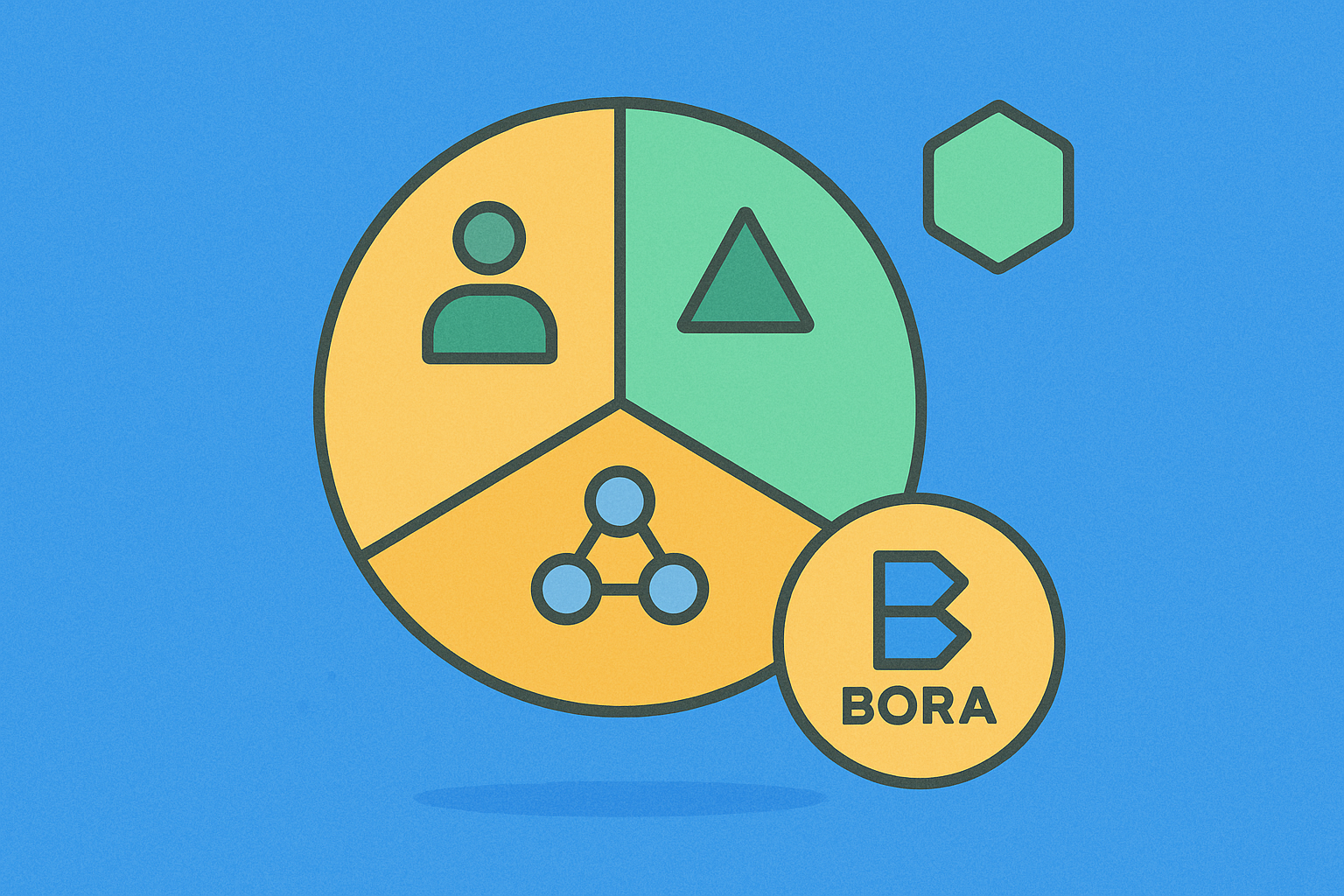
Conversely, deflation mechanisms work to reduce circulating token supply through burning or buyback programs. When projects burn tokens—permanently removing them from circulation—they create deflationary pressure that can enhance scarcity and support price appreciation. The BORA token exemplifies this approach, maintaining a total supply of 1.2 billion against 1.15 billion currently circulating, leaving room for controlled supply dynamics. The 95.6% circulation ratio demonstrates how projects balance between active supply and reserved tokens.

Successful tokenomics requires equilibrium between these opposing forces. Protocols must design inflation mechanisms that reward early participants and maintain network security, while simultaneously implementing deflation strategies like transaction fee burning or periodic token buybacks. This balance prevents both runaway dilution and artificial scarcity. Real-world data shows projects adjusting their supply growth rates based on network maturity and market conditions, ensuring that token supply mechanics support long-term value sustainability rather than undermine it through mismanagement.

Token Burn and Destruction Strategies: Impact on Supply Reduction and Price Dynamics

Token destruction represents a critical supply management strategy where projects permanently remove tokens from circulation, creating deflationary pressure within their tokenomics model. By implementing systematic burn mechanisms, projects can reduce the total available supply, which theoretically strengthens the scarcity principle and supports price appreciation. These destruction strategies operate as counterbalances to inflation mechanisms, ensuring that token supply remains controlled despite ongoing emissions.

The relationship between supply reduction and price dynamics demonstrates how tokenomics directly influences market behavior. When tokens are burned, the circulating supply decreases while demand potentially remains constant, creating upward pressure on token valuation. Projects like BORA illustrate this principle through active supply management, maintaining a circulating supply of approximately 1.15 billion tokens against a total supply of 1.21 billion. This 95.6% circulation ratio reflects carefully managed supply dynamics where destruction strategies work alongside allocation decisions.

Different burn strategies produce varying market outcomes depending on implementation timing and scope. Protocol-based burns occurring through transaction fees or governance decisions provide predictable supply reduction, while strategic burns announced by projects can signal commitment to long-term tokenomics health. The effectiveness of these destruction mechanisms ultimately depends on balancing supply reduction against the project's inflation rate and real-world utility demand.

Governance Rights and Utility: How Token Holders Exercise Control and Capture Protocol Value

Token holders who possess governance rights gain direct influence over protocol decisions and resource allocation, creating mechanisms that align individual incentives with collective outcomes. These governance rights typically enable stakeholders to vote on critical parameters, including fee structures, technical upgrades, and treasury management, transforming passive token ownership into active participation in protocol development.

The connection between governance rights and protocol value becomes evident through voting power distribution. Token holders with larger stakes exercise proportionally greater influence, incentivizing meaningful engagement with governance decisions. This structure ensures that those most economically exposed to protocol performance have corresponding control mechanisms. Governance token utility extends beyond voting; it often encompasses staking rewards, fee-sharing arrangements, and priority access to new protocol features.

Real-world implementations demonstrate this integration effectively. BORA token holders, for example, exercise utility rights by exchanging their tokens for platform services and content access, while participating in ecosystem governance decisions that shape the platform's direction. This dual functionality—combining governance participation with direct service utility—creates compelling reasons for ongoing token holder engagement beyond pure price speculation.

Capturing protocol value requires understanding how governance decisions directly impact tokenomics and economic sustainability. Token holders voting on inflation parameters, developer fund allocations, or partnership terms effectively determine value distribution across the ecosystem. Successful governance structures implement checks and balances preventing concentrated power while maintaining sufficient decisiveness for rapid protocol adaptation. When governance mechanisms function properly, token holders capture value through improved protocol performance, expanded utility applications, and increased ecosystem adoption driven by community-vetted strategic decisions.

FAQ

What is tokenomics (Token Economics) and why is it important for crypto projects?

Tokenomics defines how tokens are created, distributed, and managed within a crypto project. It encompasses allocation mechanisms, inflation rates, and governance rights. Strong tokenomics is crucial as it determines token utility, value preservation, project sustainability, and aligns incentives between developers, investors, and users for long-term ecosystem growth.

How is token allocation typically performed? What percentage do founders, investors, and community receive respectively?

Token allocation varies by project. Typically, founders receive 15-25%, early investors 20-30%, community/ecosystem 40-50%, and reserves 10-20%. Distribution depends on project stage, funding needs, and governance philosophy. Each allocation serves different purposes in project growth and decentralization.

What is a token inflation mechanism and how does it impact the long-term value of tokens?

Token inflation mechanisms control new token supply over time through emission schedules. Controlled inflation can maintain ecosystem incentives and security, while excessive inflation dilutes value. Strategic tokenomics balance growth with scarcity to support long-term appreciation and sustainability.

What do governance rights mean in crypto projects, and how do token holders participate in decision-making?

Governance rights allow token holders to vote on protocol changes, parameter adjustments, and fund allocation. Token holders propose and vote on decisions proportional to their holdings, directly influencing project direction and development priorities.

How to evaluate whether a crypto project's token economics design is healthy?

Assess token distribution balance, inflation mechanisms, vesting schedules, governance rights allocation, and trading volume trends. Check founder holdings, community percentage, and sustainable emission rates. Strong tokenomics show fair distribution, controlled inflation, and active governance participation.

What is the purpose of a token vesting schedule and why do most projects have lock-up periods?

Vesting schedules control token release over time, preventing massive sell-offs. Lock-up periods protect projects by aligning team and investor incentives, ensuring commitment, reducing price volatility, and maintaining long-term project stability and credibility.

What impact does excessively high or low inflation have on crypto projects?

High inflation dilutes token value and erodes holder confidence, reducing prices. Low inflation may limit ecosystem growth and incentive mechanisms. Optimal inflation balances supply growth with utility demands, supporting sustainable project development and token holder value retention.

How do governance tokens work in DAOs (Decentralized Autonomous Organizations)?

Governance tokens give holders voting rights on protocol decisions. Token holders propose and vote on changes like fee structures, fund allocation, and upgrades. Voting power typically correlates with token amount held. Results execute automatically via smart contracts, enabling decentralized decision-making without intermediaries.

How do incentive mechanisms in token economics encourage user participation and holding?

Token economics incentivizes participation through staking rewards, yield farming, governance voting rights, and deflationary mechanisms like token burns. Users earn returns for holding and engaging with the protocol, while inflation is strategically managed to balance new supply with network growth, creating long-term value alignment between users and projects.

How to identify risk factors in token economic design, such as excessive inflation or power concentration?

Monitor token supply growth rates, check founder/team allocation percentages, analyze voting power distribution, review vesting schedules, and examine community participation levels. High inflation without utility, concentrated holdings above 20%, and centralized governance indicate elevated risks.

* 本文章不作为 Gate 提供的投资理财建议或其他任何类型的建议。 投资有风险,入市须谨慎。

分享

目录

Token Allocation Framework: Analyzing Team, Investor, and Community Distribution Ratios in Crypto Projects

Inflation and Deflation Mechanisms: Balancing Token Supply Growth with Long-term Value Sustainability

Token Burn and Destruction Strategies: Impact on Supply Reduction and Price Dynamics

Governance Rights and Utility: How Token Holders Exercise Control and Capture Protocol Value

FAQ

相关文章
Understanding Sybil Attacks: Enhancing Security in Blockchain Networks

Understanding Sybil Attacks: Enhancing Security in Blockchain Networks

This article explores Sybil attacks in cryptocurrency, emphasizing their threat to blockchain security and the measures to counteract them. Covering direct and indirect Sybil attacks, it illustrates their potential to disrupt decentralized networks through 51% attacks, voter manipulation, and more. The article discusses blockchain strategies like decentralized identity protocols, zero-knowledge proofs, and KYC requirements to mitigate these threats. Targeted at crypto enthusiasts and network developers, it offers insights into enhancing security, safeguarding blockchain integrity, and maintaining trust within decentralized systems.
2025-11-27 09:20:07
Top DAO Crypto Initiatives for New Enthusiasts

Top DAO Crypto Initiatives for New Enthusiasts

The article explores the transformative role of Decentralized Autonomous Organizations (DAOs) in the Web3 ecosystem, highlighting their capacity for transparent, community-driven governance. It covers the operational dynamics of DAOs, the advantages of decentralization and transparency, and the challenges of security and decision-making efficiency. New enthusiasts will learn how to join and benefit from DAOs, while understanding the risks involved. Prominent DAO examples, such as Uniswap and MakerDAO, illustrate their significant impact. The article provides essential insights for individuals interested in the innovations and opportunities DAOs present in decentralized finance and digital governance.
2025-12-19 04:55:45
What Are the Compliance and Regulatory Risks in DeFi and Crypto Exchanges in 2025?

What Are the Compliance and Regulatory Risks in DeFi and Crypto Exchanges in 2025?

The article delves into the compliance and regulatory risks facing DeFi protocols and crypto exchanges in 2025. It explores the intense scrutiny by the SEC and CFTC, compliance requirements, and the shift from offshore to onshore exchanges necessitating robust KYC/AML systems. Attention is given to institutional misconduct with cases like Jump Trading and Terraform Labs illustrating enforcement priorities. Transparency standards and quarterly reporting are crucial for integrating traditional finance, impacting protocols like Jupiter. The comprehensive insights serve developers, investors, and exchanges seeking regulatory alignment and institutional legitimacy.
2025-12-20 02:53:02
Understanding Decentralized Autonomous Organizations in Cryptocurrency

Understanding Decentralized Autonomous Organizations in Cryptocurrency

This article delves into the intricacies of Decentralized Autonomous Organizations (DAOs) within the cryptocurrency realm. DAOs leverage blockchain technology to enable transparent, community-driven governance without centralized control. It explains how DAOs operate via governance tokens, addressing their benefits in democratizing decision-making and the potential risks such as security vulnerabilities. The piece is suitable for individuals interested in understanding the operational frameworks and investment potential of DAOs, including examples like MakerDAO. As DAOs gain traction in Web3, they could redefine governance across various sectors.
2025-11-14 07:24:58
What Is Tokenomics: Token Distribution, Inflation Mechanisms, and Burn Strategies Explained

What Is Tokenomics: Token Distribution, Inflation Mechanisms, and Burn Strategies Explained

This article delves into the fundamentals of tokenomics, focusing on token distribution frameworks, inflation and deflation mechanisms, and governance rights. It explores how projects balance token supply among teams, investors, and communities to drive sustainable growth, emphasizing dynamic economic strategies like token burning and inflation control. This is particularly relevant for crypto enthusiasts, investors, and developers looking to understand how decentralized decision-making and economic utility coalesce for effective project management. With clear segmentation and logical flow, this piece ensures quick understanding and readability.
2025-12-26 03:46:25
What Is a Token Economics Model and How Do Allocation, Inflation, and Governance Work?

What Is a Token Economics Model and How Do Allocation, Inflation, and Governance Work?

# Article Introduction This comprehensive guide explores token economics models, examining how allocation, inflation, and governance mechanisms work together to create sustainable blockchain ecosystems. Learn how projects balance stakeholder interests through tri-part token allocation frameworks—distributing tokens among teams, investors, and communities. Discover inflation and deflation dynamics that manage supply while preserving token value, plus burning strategies that create scarcity. Understand governance rights empowering token holders in protocol decisions. Whether you're an investor on Gate, developer, or ecosystem participant, this article clarifies essential token economics principles determining long-term project viability and community engagement.
2025-12-29 02:51:24
猜你喜欢
What is the impact of SEC regulatory compliance on crypto market value and trading

What is the impact of SEC regulatory compliance on crypto market value and trading

This article examines how SEC regulatory compliance fundamentally shapes cryptocurrency market value and trading dynamics. It explores three critical dimensions: SEC enforcement actions that trigger immediate market capitalization volatility and trading volume surges; regulatory compliance costs including KYC/AML implementation that compress liquidity and create market fragmentation; and institutional adoption barriers where audit transparency requirements build market confidence and attract capital inflows. The analysis demonstrates that while compliance infrastructure introduces operational friction and onboarding delays, it simultaneously establishes credibility mechanisms essential for institutional participation. Clear SEC regulatory frameworks reduce uncertainty premiums, stabilize valuations, and facilitate sustainable growth. Understanding this compliance-market relationship is crucial for traders, exchanges, and projects navigating the evolving regulatory landscape on platforms like Gate.
2026-01-20 06:43:26
What is cryptocurrency regulatory compliance and how does SEC oversight impact crypto investments in 2026
What is cryptocurrency regulatory compliance and how does SEC oversight impact crypto investments in 2026

This comprehensive guide explores cryptocurrency regulatory compliance and SEC oversight's critical impact on crypto investments in 2026. The article examines the SEC's regulatory framework, enforcement priorities targeting unregistered securities and DeFi violations, and how audit transparency standards build investor confidence. It details KYC/AML implementation across major exchanges like Gate, demonstrating how compliance strengthens market stability while attracting institutional capital. Real-world regulatory enforcement case studies quantify financial and operational consequences for non-compliant platforms. The piece clarifies asset classification distinctions, investor compliance requirements, and legal risks of regulatory violations. By establishing clear accountability frameworks and market standards, SEC oversight creates a legitimate investment environment where compliant projects gain competitive advantages, ultimately reshaping cryptocurrency market dynamics and risk evaluation metrics for 2026
2026-01-20 06:41:35
What is the difference between top cryptocurrency competitors by market cap and performance metrics in 2026

What is the difference between top cryptocurrency competitors by market cap and performance metrics in 2026

This article examines the cryptocurrency market landscape in 2026, analyzing how leading digital assets like Bitcoin and Ethereum compete alongside emerging challengers based on market capitalization and performance metrics. The guide explores key performance indicators including 24-hour returns, trading volume on Gate, and price volatility to evaluate cryptocurrency competitiveness beyond pure market cap rankings. It details how projects like Falcon Finance differentiate through technological innovation and utility-driven features rather than scale alone. The article compares transaction speeds, fees, and energy consumption across major networks, highlighting how consensus mechanisms and Layer 2 solutions reshape competitive dynamics. Market share shifts throughout 2026 reveal that sustainable dominance requires robust trading activity, investor confidence, and transparent governance. The FAQ section addresses top-ranking cryptocurrencies, growth potential, and the correlation between market cap and actual a
2026-01-20 06:39:42
What is on-chain data analysis and how to use it for crypto trading decisions

What is on-chain data analysis and how to use it for crypto trading decisions

This comprehensive guide explores on-chain data analysis as a critical tool for cryptocurrency trading decisions. The article demystifies essential blockchain metrics including active addresses, transaction volume, whale movements, and network fee trends that reveal true market sentiment beyond price charts. Readers will discover how to interpret wallet distribution patterns, track institutional capital flows through Gate and blockchain explorers, and recognize early warning signs of market volatility through gas cost fluctuations. The guide presents a practical three-stage framework—data collection, pattern recognition, and decision execution—enabling traders to convert raw blockchain intelligence into systematic trading strategies. By combining on-chain indicators with technical analysis, traders gain actionable insights for more informed entry and exit decisions while mitigating risks associated with false signals and market manipulation.
2026-01-20 06:32:36
What is the fundamental analysis of a crypto project: whitepaper logic, use cases, technology innovation, roadmap progress, and team background explained

What is the fundamental analysis of a crypto project: whitepaper logic, use cases, technology innovation, roadmap progress, and team background explained

This comprehensive guide explains the five core dimensions of cryptocurrency project fundamental analysis: whitepaper logic revealing economic models and value propositions, use cases demonstrating real-world adoption and market demand, technology innovation assessing competitive advantages and technical feasibility, roadmap progress tracking team execution capability, and team credentials evaluating leadership experience. Using LayerZero as a practical case study, the article equips investors with frameworks to evaluate whether projects solve genuine blockchain problems versus pursuing speculative value. It addresses critical questions on tokenomics assessment, adoption indicators, development tracking, and team verification. By integrating these five dimensions systematically, readers gain actionable methodology to distinguish sustainable projects from hype-driven alternatives, moving beyond technical analysis to identify projects with genuine long-term value creation potential on platforms like Gate.
2026-01-20 06:30:20
What is crypto exchange net flow and how does it impact holdings concentration and staking rates

What is crypto exchange net flow and how does it impact holdings concentration and staking rates

This article explores crypto exchange net flows as the primary driver reshaping holdings concentration and staking dynamics across blockchain networks. Exchange net flows account for 60-70% of short-term concentration shifts, with inflows concentrating tokens on centralized platforms while outflows distribute them to self-custodial wallets. The article reveals how institutional investors strategically rotate capital between liquid exchange positions and locked staking rewards, creating an inverse relationship between net inflows and staking participation rates. Concentration metrics distinguish whether these flows strengthen whale dominance or democratize ownership distribution, serving as critical health indicators for crypto ecosystems. On-chain lockup volumes emerge as leading indicators for sustainable staking rates amid exchange volatility, demonstrating genuine investor commitment patterns. By analyzing exchange flows through Gate trading data alongside concentration ratios and lockup volumes, investors
2026-01-20 06:28:46