LCP_hide_placeholder
fomox
MarketsPerpsSpotSwapMeme Referral
More
Smart Money Recruitment
Search Token/Wallet
/

What is Cryptocurrency Market Capitalization?

2026-01-18 14:05:38
Bitcoin
Crypto Insights
Ethereum
Investing In Crypto
Stablecoin
Article Rating : 3.5
half-star
145 ratings
This comprehensive guide demystifies cryptocurrency market capitalization, a fundamental metric for evaluating digital asset value. Market cap is calculated by multiplying current price by circulating supply, providing a more accurate picture of a cryptocurrency's total value than price alone. The guide explains why market cap matters for investors: it indicates project stability, liquidity, and adoption levels, helping differentiate between established cryptocurrencies and smaller projects. Using practical examples, the article demonstrates how two cryptocurrencies with different prices can have vastly different market caps, illustrating why price comparisons alone are misleading. The guide includes current market cap rankings of leading cryptocurrencies like Bitcoin, Ethereum, and Tether, showing how the cryptocurrency market structure works. Perfect for beginners and investors seeking to understand valuation metrics, this resource clarifies how market cap influences investment decisions and risk assessment
What is Cryptocurrency Market Capitalization?

What is Market Capitalization?

Market capitalization is a crucial valuation metric used in both traditional financial sectors and the digital asset market. Understanding market capitalization helps investors and analysts assess the relative size and value of different cryptocurrency projects.

The term "capitalization" originates from stock market terminology, where it represents the market value of a company calculated by multiplying the current share price by the total number of outstanding shares. In the cryptocurrency context, this concept has been adapted to evaluate digital assets.

Cryptocurrency market capitalization represents the total value of all issued coins or tokens currently in circulation. It is calculated by multiplying the total number of available coins of a particular cryptocurrency by its current market price. The formula for calculating market capitalization is straightforward: Market Capitalization = Current Price × Circulating Supply (number of tokens in circulation).

To better understand this formula, let's examine how Bitcoin's market capitalization would be calculated. To determine Bitcoin's market cap, you need to multiply its current price by the number of coins in circulation. For example, if one BTC is worth $20,900 and the circulating supply is approximately 19 million units, a simple calculation (20,900 USD × 19,000,000) shows that the market capitalization would be $397,100,000,000.

Market capitalization serves as an effective tool for comparing and classifying available cryptocurrencies in the market. This metric changes dynamically with fluctuations in both price and the supply of coins or tokens in circulation. It provides a more comprehensive view of a project's overall value than price alone, making it an essential metric for investors and market analysts.

Why Should You Pay Attention to Market Capitalization When Evaluating Cryptocurrency Projects?

Market capitalization provides extensive information about cryptocurrency projects and serves as a critical evaluation metric for several reasons. It offers concrete data about the scale of a project – information that cannot be inferred from price (exchange rate) alone. Consequently, market cap enables meaningful comparisons between different projects and provides context for investment decisions.

Cryptocurrencies with larger market capitalizations often attract more investors because they are perceived as more stable and established. Higher market cap typically indicates greater liquidity, wider adoption, and reduced volatility compared to smaller projects. This stability makes them attractive to institutional investors and conservative traders who prioritize risk management.

To illustrate this concept more clearly, let's use a practical example. Consider the following scenario: There are two cryptocurrencies, A and B. Cryptocurrency A has 100,000 coins in circulation, and each coin is priced at $1. Therefore, Cryptocurrency A's market capitalization is $100,000 (1 × 100,000 USD = 100,000 USD). Now, suppose Cryptocurrency B has 1 million coins in circulation, but each coin is worth $0.20 (which is $0.80 less than Cryptocurrency A's price). Thus, Cryptocurrency B's market capitalization is $200,000 (0.20 USD × 1,000,000 = 200,000 USD).

As this example demonstrates, a single coin of Cryptocurrency B is valued significantly lower than one coin of Cryptocurrency A. However, despite this lower unit price, Cryptocurrency B's market capitalization is twice as large. This illustrates why comparing cryptocurrencies solely based on price can be misleading – market cap provides a more accurate picture of a project's overall value and market position.

Additionally, market capitalization helps investors understand market dynamics, identify trends, and make informed decisions about portfolio allocation. Projects with consistent market cap growth often signal strong fundamentals, active development, and growing community support.

Sample Ranking of Cryptocurrencies by Market Capitalization

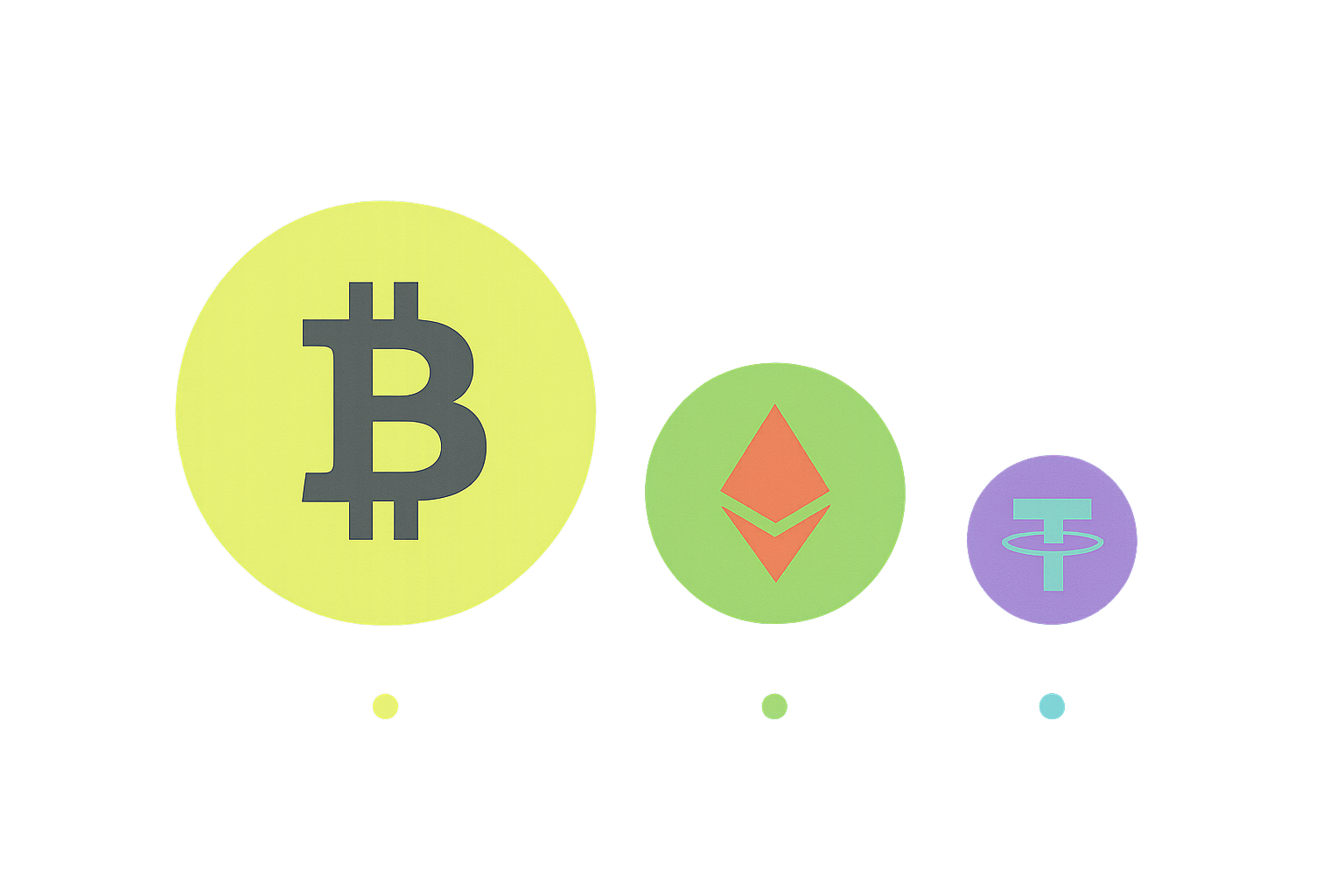
In the cryptocurrency market, Bitcoin (BTC) has long been the most popular cryptocurrency in terms of market capitalization, maintaining its dominant position as the leading digital asset. Beyond Bitcoin, Ethereum (ETH) and Tether (USDT) have consistently ranked high in market cap rankings over extended periods, demonstrating their established positions in the digital asset ecosystem.

Below is a sample ranking of cryptocurrencies by market capitalization, reflecting the market landscape in early 2023. From this data, we can observe that the market capitalization of the most popular cryptocurrency projects is measured in tens or even hundreds of billions of dollars, highlighting the substantial value locked in leading digital assets. The following data comes from coingecko.com, a platform where current market capitalization information can be tracked in real-time.

Cryptocurrency Market Capitalization in USD
Bitcoin (BTC) $403,941,781,744
Ethereum (ETH) $185,550,068,627
Tether (USDT) $65,880,330,219
USD Coin (USDC) $43,215,981,159
BNB (Native Token of Major Exchange) $39,392,767,782
XRP (XRP) $19,211,328,200
BUSD (Stablecoin from Leading Platform) $15,936,783,640
Cardano (ADA) $11,772,503,448
Dogecoin (DOGE) $11,604,017,052
Polygon (MATIC) $8,666,487,971

Source: coingecko.com (as of early 2023)

Interestingly, in recent periods, the global cryptocurrency market capitalization has been approximately $1 trillion. In comparison, during the bull market of 2021, the total market capitalization of the entire cryptocurrency market significantly exceeded $2 trillion, demonstrating the market's capacity for substantial growth during favorable conditions. This fluctuation in total market cap reflects the cyclical nature of cryptocurrency markets and the impact of broader economic factors on digital asset valuations.

These rankings and figures illustrate the hierarchical structure of the cryptocurrency market, where a small number of established projects command the majority of total market value, while thousands of smaller projects compete for the remaining market share. Understanding these market cap distributions helps investors assess risk levels and identify opportunities across different segments of the cryptocurrency ecosystem.

FAQ

How is cryptocurrency market capitalization calculated?

Cryptocurrency market capitalization is calculated by multiplying the current price of a cryptocurrency by its circulating supply. The formula is: Market Cap = Price × Circulating Supply. This represents the total market value of the cryptocurrency.

Why is market capitalization important? Can it reflect the true value of a cryptocurrency project?

Market capitalization reflects investor confidence in a project. High market cap typically indicates real utility and active community support. However, market cap doesn't always accurately represent true project value, as it can be influenced by market sentiment and trading volume.

What are the top ten cryptocurrencies by market capitalization?

The top ten cryptocurrencies by market cap are Bitcoin, Ethereum, Tether, XRP, Dogecoin, Litecoin, Cardano, Polkadot, Binance Coin, and Solana. These represent the largest digital assets by total market value.

What is the difference between market capitalization and price?

Market cap equals price multiplied by circulating supply, while price is the value of a single unit. Market cap reflects total asset value, whereas price reflects per-unit value. High price does not necessarily mean high market cap.

Does market capitalization influence cryptocurrency investment decisions?

Yes, market capitalization significantly influences investment decisions by indicating project scale and maturity. Larger cap cryptocurrencies typically offer lower volatility and higher liquidity, while smaller caps present higher growth potential with increased risk. However, market cap should be combined with trading volume, fundamentals, and FDV for comprehensive analysis.

* The information is not intended to be and does not constitute financial advice or any other recommendation of any sort offered or endorsed by Gate.

Share

Content

What is Market Capitalization?

Why Should You Pay Attention to Market Capitalization When Evaluating Cryptocurrency Projects?

Sample Ranking of Cryptocurrencies by Market Capitalization

FAQ

Related Articles
What Is the Current Market Overview for Cryptocurrencies in 2025?

What Is the Current Market Overview for Cryptocurrencies in 2025?

This article provides a comprehensive overview of the cryptocurrency market in 2025, highlighting the dominant position of Bitcoin and the shifting landscape toward gold-backed tokens. It explores key developments such as Bitcoin's growing dominance, significant trading volumes across major exchanges, and the expanding role of institutional adoption. Readers will gain insights into the evolving utility of digital assets, with a focus on cryptocurrencies serving as inflation hedges and diversification tools. The content is structured logically to address market changes, trading trends, and liquidity growth, ensuring readability and efficient information delivery.
2025-11-18 04:11:54
Top Choices for Crypto Savings Solutions

Top Choices for Crypto Savings Solutions

This article explores the emergence of digital asset savings accounts, providing a modern method for asset growth using blockchain technology. It examines how these accounts function similarly to traditional savings accounts but offer rewards in digital assets, potentially higher interest rates, and flexibility. Readers will gain insight into key benefits and popular digital assets to consider. The article addresses security, reputation, and transparency in selecting providers, and highlights top choices including Gate. With crypto savings accounts offering higher yields, this guide aids users in making informed decisions for financial growth.
2025-11-11 10:48:13
Top Crypto Savings Accounts for Maximum Interest

Top Crypto Savings Accounts for Maximum Interest

Explore the innovative world of crypto savings accounts, offering substantial growth opportunities for digital assets through interest-based earnings. This article details the workings, benefits, and risks associated with these accounts, showcasing how they can outperform traditional savings options. It discusses key features such as flexible deposits and withdrawals, security measures, and diversified cryptocurrency options, including Bitcoin and stablecoins. Gain insights into selecting reliable account providers and optimizing your crypto strategy for maximum returns. Perfect for crypto enthusiasts seeking effective ways to enhance their holdings securely and profitably.
2025-11-08 10:00:56
How Does the Federal Reserve's Monetary Policy Impact Crypto Prices?

How Does the Federal Reserve's Monetary Policy Impact Crypto Prices?

This article examines how the Federal Reserve's monetary policy in 2025 affects cryptocurrency prices, highlighting a 15% drop in market cap due to policy tightening. It addresses investor reactions to inflation and Fed decisions, revealing a shift towards stablecoins and Bitcoin as inflation hedges. The article explores the evolving correlation between Bitcoin and the S&P 500, indicating institutional adoption of crypto as a financial tool. Ideal for investors and analysts, it provides insights into the macroeconomic impacts on the crypto market with enhanced readability and keyword optimization.
2025-12-04 06:06:49
How Has Crypto Price Volatility Evolved in 2025?

How Has Crypto Price Volatility Evolved in 2025?

The article examines the evolution of crypto price volatility in 2025, highlighting Bitcoin's lowest volatility level since 2017 and Ethereum's weakened correlation with Bitcoin. It addresses the maturation of the crypto market driven by institutional adoption and improved trading infrastructure, notably supported by platforms like Gate. Readers will understand the beneficial impact of reduced volatility on investor accessibility and portfolio diversification. Structured logically, it details major shifts in crypto dynamics with quantitative data and emerging trends, aiding quick comprehension and optimized for keyword density and readability.
2025-11-29 04:24:16
What Factors Are Driving the Current Price Volatility in Cryptocurrencies?

What Factors Are Driving the Current Price Volatility in Cryptocurrencies?

This article delves into the factors driving current cryptocurrency price volatility, with Ethereum as a case study. It illustrates significant price swings using historical data and technical analysis, highlighting critical support and resistance levels. The piece also explores the correlation between Ethereum and Bitcoin, revealing patterns of volatility and market sentiment, notably the "Extreme Fear" sentiment. Catering to investors and traders, it underscores the importance of understanding market dynamics and technical indicators for informed decision-making. The content is structured to enhance keyword density and readability for rapid skimming.
2025-11-18 01:13:19
Recommended for You
How to Get Coins in Plato

How to Get Coins in Plato

This comprehensive guide empowers cryptocurrency enthusiasts to maximize coin earnings within the Plato ecosystem through multiple proven strategies. The guide addresses key concerns for both newcomers and experienced investors navigating blockchain platforms by outlining four essential acquisition pathways: establishing secure digital wallets, understanding Plato's cross-chain architecture, actively participating in network operations through staking and node management, and executing strategic purchases via reputable exchanges like Gate. Each section builds systematically from foundational wallet setup through advanced earning mechanisms, ensuring readers develop complete competency. The guide emphasizes continuous learning, robust security practices, and community engagement as critical success factors. Readers gain actionable knowledge about tokenomics, risk management, and portfolio diversification while learning to leverage Plato's data intelligence framework. This resource equips you with essential str
2026-01-18 15:22:08
Bitcoin Do Something Meme: Impact on Crypto Market
Bitcoin Do Something Meme: Impact on Crypto Market

This article explores how the 'Bitcoin Do Something' meme reflects deeper dynamics within the cryptocurrency community and market sentiment. Originating from traders' impatience during market stagnation, the meme captures collective emotions including greed, fear, and FOMO that drive trading behavior. Beyond humor, it serves as an informal market sentiment indicator, potentially amplifying existing emotions into self-fulfilling prophecies through social proof mechanisms. While institutional investors prioritize technical analysis, retail trader sentiment revealed through memes increasingly influences cryptocurrency volatility and trading volume. The meme ultimately represents a cultural archive documenting the psychological tensions inherent in Bitcoin trading, bridging internet culture with digital finance as markets mature and evolve.
2026-01-18 15:17:30
Why Do Dragons Hoard Gold: Crypto Insights
Why Do Dragons Hoard Gold: Crypto Insights

This article examines the fascinating psychological parallels between legendary dragons hoarding gold and modern cryptocurrency investors accumulating digital assets. Rooted in fundamental human instincts about scarcity and financial security, both behaviors reflect a desire to preserve value and maintain power through resource control. The content explores how economic principles—scarcity, security, and store-of-value characteristics—drive hoarding behaviors in both mythology and crypto markets, where over 60% of Bitcoin supply remains unmoved for extended periods. It addresses modern trends including institutional adoption, emerging risks like volatility and regulatory changes, and comprehensive platform solutions offering security infrastructure and risk management tools. The article dispels common misconceptions about guaranteed wealth through simple accumulation, emphasizing instead the importance of diversification, security practices, and informed decision-making. Practical guidance helps both newcomer
2026-01-18 15:12:25
Dogecoin Unlimited Supply Explained: Inflation, Value, and Investment Guide

Dogecoin Unlimited Supply Explained: Inflation, Value, and Investment Guide

This comprehensive guide explains Dogecoin's unique supply mechanics and addresses the critical question: is DOGE truly limitless? Created in 2013, Dogecoin operates with no hard cap, issuing exactly 5 billion new coins annually through proof-of-work mining at 10,000 DOGE per block. Unlike Bitcoin's halving model, Dogecoin maintains constant block rewards indefinitely. The article debunks misconceptions about unlimited supply, demonstrating that while total coins grow forever, the annual inflation rate decreases as a percentage of circulating supply—currently around 3.5%. Key topics include mining incentives for long-term security, practical use cases in tipping and payments, comparisons with Bitcoin's capped supply, and implications for DOGE holders. Whether trading on Gate or holding DOGE, understanding this predictable emission schedule clarifies Dogecoin's role as an accessible transaction currency rather than a scarcity-driven store of value.
2026-01-18 15:09:59
Litecoin Founders and Offices: A Look into the History and Locations
Litecoin Founders and Offices: A Look into the History and Locations

Litecoin, launched in 2011 by Charlie Lee, a former Google engineer, operates as a peer-to-peer cryptocurrency designed to address Bitcoin's limitations through faster transaction speeds and broader accessibility. Founded on October 7, 2011, Litecoin processes blocks four times faster than Bitcoin, making it ideal for everyday transactions and complementing the broader digital asset ecosystem. The cryptocurrency is developed and maintained by the Litecoin Core Development team, an open-source community of developers working collaboratively to ensure security, stability, and continuous innovation. Rather than operating from a centralized headquarters, Litecoin maintains a globally distributed structure with contributors across the United States, China, South Korea, and Europe, providing around-the-clock development support and diverse expertise. This decentralized organizational approach strengthens Litecoin's resilience while enabling rapid protocol upgrades like SegWit implementation. Today, Litecoin ranks a
2026-01-18 15:06:33
How Many Dollars Per Hour is 80K: Exploring Earnings in the Crypto Industry

How Many Dollars Per Hour is 80K: Exploring Earnings in the Crypto Industry

This article explores the hourly equivalent of an $80,000 annual salary ($38.46/hour) within the cryptocurrency industry's unique compensation landscape. Beyond basic salary calculations, crypto careers offer exceptional value through token bonuses, equity stakes, and global remote opportunities that traditional employment rarely provides. The guide examines diverse roles—blockchain developers, crypto analysts, compliance experts, and marketing specialists—each commanding different hourly rates based on expertise. It highlights how professionals can multiply earnings through token appreciation, multiple income streams, and skill development in cutting-edge technologies. While addressing industry challenges like volatility and regulatory complexity, the article positions crypto careers as pathways to financial independence and participation in reshaping global finance through decentralized systems.
2026-01-18 15:02:57