LCP_hide_placeholder
fomox
MarketsPerpsSpotSwap
Meme
Referral
More
Smart Money Recruitment
Search Token/Wallet
/

What is IOTA whitepaper logic and how does Tangle technology revolutionize IoT transactions with zero fees
2026-01-15 04:58:14
Blockchain
DeFi
Layer 2
Payments
Article Rating : 4
39 ratings
This article explores IOTA's revolutionary whitepaper logic and Tangle technology, explaining how directed acyclic graph architecture enables zero-fee machine-to-machine transactions across 20.4 billion IoT devices. It details the Coordicide transition to IOTA 2.0, showcasing decentralized PoS consensus delivering 50,000+ TPS with EVM compatibility and gas-sponsored transactions. The article highlights enterprise-grade adoption through BitGo integration, providing regulated custody for institutional investors on Gate exchange and beyond. Readers will understand Tangle's DAG structure, security mechanisms, practical IoT applications, and participation methods. This comprehensive guide positions IOTA as a scalable settlement layer for tokenized assets, addressing critical needs in institutional adoption, IoT scalability, and feeless transaction infrastructure.
What is IOTA whitepaper logic and how does Tangle technology revolutionize IoT transactions with zero fees

Tangle DAG Architecture: Zero-Fee Machine-to-Machine Transactions Enabling 20.4 Billion IoT Devices

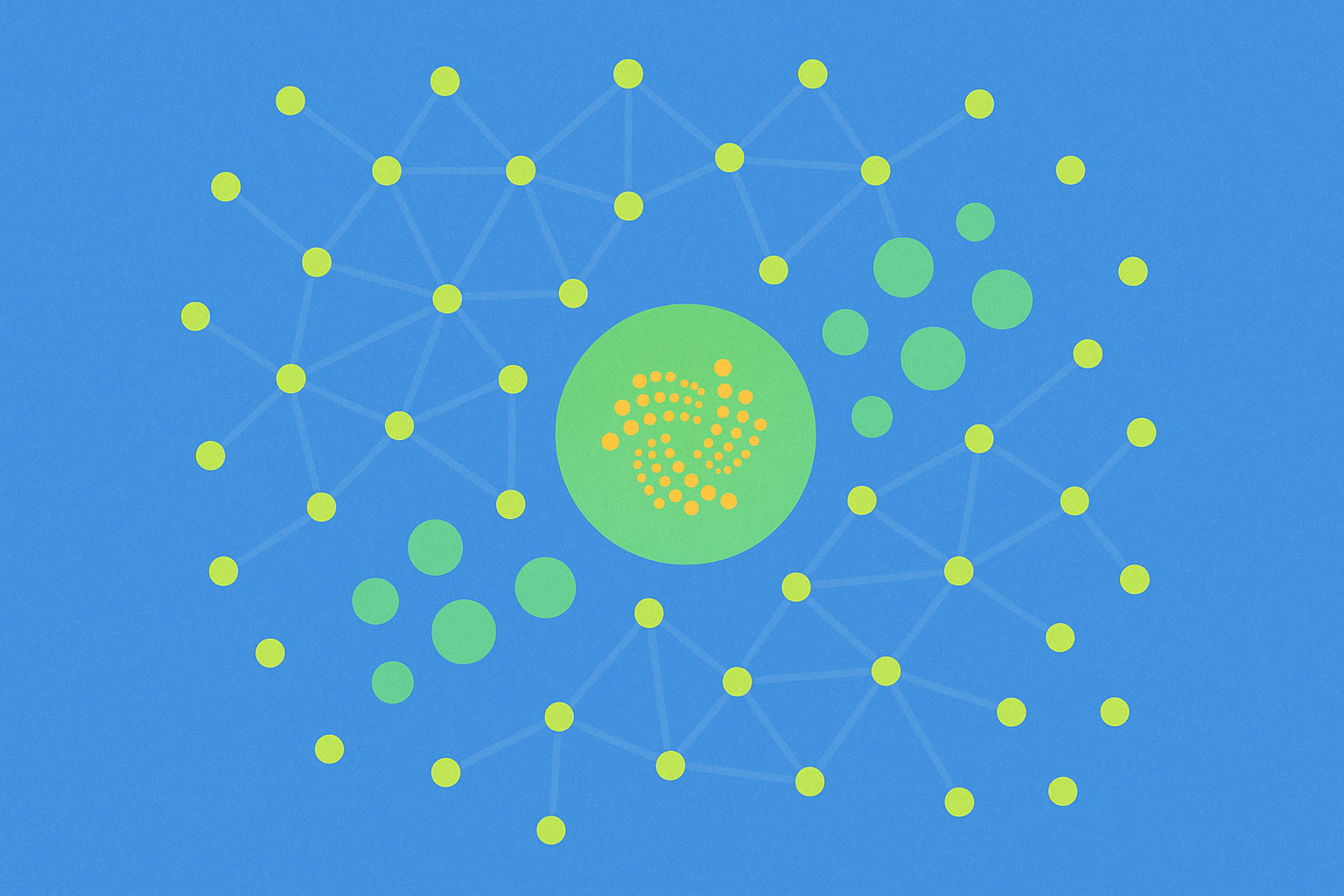
Unlike traditional blockchain systems that rely on miners and sequential block validation, the Tangle employs a directed acyclic graph structure that fundamentally transforms how machine-to-machine transactions operate. Each transaction in this architecture simultaneously validates two previous transactions, creating a self-validating network that eliminates intermediaries entirely. This parallel validation mechanism enables the system to process transactions without transaction fees, making it economically viable for billions of tiny value exchanges between connected devices.

The DAG-based Tangle architecture scales horizontally rather than encountering bottlenecks like traditional blockchains. As more devices join the network, transaction throughput increases proportionally, supporting up to 20.4 billion IoT devices communicating and transacting seamlessly. This capacity makes zero-fee machine-to-machine transactions practical at scale, addressing a critical requirement for the Internet of Things where individual device transactions must remain economically feasible. The decentralized validation process means every participant contributes to network security simultaneously, creating a resilient infrastructure where transaction confirmation happens through the consensus mechanism inherent to the Tangle structure itself.

Coordicide to IOTA 2.0: Decentralized PoS Consensus and EVM Compatibility Delivering 50,000+ TPS

The Coordicide transition marked a watershed moment for IOTA, eliminating the centralized coordinator that previously governed the network. This evolution introduced decentralized PoS consensus, enabling true network decentralization while maintaining transaction security and finality. IOTA 2.0 now operates as a fully decentralized system where validators participate in consensus through stake-based mechanisms, fundamentally strengthening network resilience.

The redesigned architecture delivers exceptional performance, achieving over 50,000 TPS through innovative consensus mechanisms. IOTA Rebased introduced the Object Model, replacing the traditional UTXO architecture with a structure inspired by proven Layer 1 designs, enhancing state management and scalability. The integration of MoveVM directly on Layer 1 brings sophisticated programmability capabilities, allowing developers to build complex smart contracts and decentralized applications.

EVM compatibility represents another critical advancement, enabling seamless migration of Ethereum-native projects to IOTA's ecosystem. This compatibility layer significantly reduces developer friction and accelerates adoption. The Mysticeti BFT consensus protocol utilizes an uncertified DAG structure, enabling parallel transaction processing and maintaining IOTA's advantage in throughput efficiency.

Practically, gas-sponsored transactions eliminate barriers for end users by allowing developers or businesses to cover transaction fees. This innovation drives mainstream adoption by enabling users to interact with applications without managing cryptocurrency holdings. Furthermore, composable DeFi utilities create building blocks for advanced financial instruments, positioning IOTA as a comprehensive settlement layer for tokenized assets and real-world applications.

Enterprise-Grade Adoption: From TWIN Trade Solutions to BitGo Integration Supporting Institutional Access

IOTA's institutional landscape transformed substantially through BitGo's integration of IOTA Mainnet support, establishing the first regulated custody pathway for U.S. institutional investors. This collaboration represents a critical infrastructure milestone, as BitGo's regulated custody services and insurance mechanisms address long-standing institutional investor concerns regarding secure asset management and compliance standards.

The BitGo integration fundamentally restructures institutional access by providing a compliant framework aligned with U.S. financial regulations. Institutional investors now benefit from regulated custody infrastructure that combines security protocols with insurance coverage, enabling confident participation in IOTA's ecosystem. This regulated custody model removes traditional barriers to institutional capital deployment, particularly for enterprises and funds requiring adherence to stringent compliance frameworks.

Beyond custody solutions, this partnership catalyzes broader enterprise adoption by legitimizing IOTA within institutional investment structures. BitGo's global custody offering positions IOTA alongside established digital assets, while the integration specifically strengthens U.S. market access—a strategic priority for enterprise-grade adoption. The infrastructure maturity demonstrated through this collaboration signals that IOTA has evolved beyond retail-focused applications toward serious institutional consideration.

This enterprise-grade adoption layer proves essential for scaling IoT transaction networks requiring institutional participation. As enterprises evaluate blockchain infrastructure for supply chain and IoT applications, the presence of regulated custody and compliance-aligned frameworks substantially accelerates decision-making and deployment timelines, establishing IOTA as a credible choice for institutional-grade infrastructure.

FAQ

What is the fundamental difference between IOTA's Tangle technology and traditional blockchain?

IOTA's Tangle uses directed acyclic graph (DAG) architecture instead of blocks and chains. It eliminates miners, enables parallel transactions, and achieves zero transaction fees through a distributed confirmation mechanism where users validate each other's transactions.

Why can IOTA achieve zero transaction fees? What is the technical principle?

IOTA uses DAG(Directed Acyclic Graph)technology instead of traditional blockchain. Participants verify transactions directly without mining, eliminating transaction costs. Users perform proof-of-work when sending transactions, replacing fee mechanisms entirely.

How does Tangle technology apply to Internet of Things (IoT) transactions?

Tangle enables direct device-to-device transactions without intermediaries through decentralized networks. It ensures data integrity, reduces transaction fees to zero, and provides secure data exchange channels for IoT devices across distributed networks.

How does the DAG (Directed Acyclic Graph) structure in IOTA whitepaper work?

IOTA's DAG structure, called Tangle, stores each transaction as a node. Every new transaction must validate two previous transactions, creating an interconnected network. This replaces traditional blockchain blocks, enabling feeless transactions through mutual validation without miners.

What advantages does IOTA have over Bitcoin and Ethereum in terms of transaction speed and costs?

IOTA offers zero transaction fees and faster confirmation speeds compared to Bitcoin and Ethereum. Its Tangle technology enables scalability where network efficiency increases with size. This makes IOTA ideal for microtransactions and IoT applications without mining overhead.

How is the security of Tangle technology guaranteed? Are there any risks?

Tangle ensures security through cryptographic verification rather than computational work, making it lightweight for IoT devices. While the network has faced past vulnerabilities like double-spending attacks, IOTA's team continuously optimizes protocols to mitigate threats. Security strengthens as the network matures.

What are the practical application cases of IOTA in real IoT scenarios?

IOTA applies Tangle technology for supply chain tracking, smart logistics, and device-to-device transactions across 20.4 billion connected IoT devices. Its zero-fee architecture enables automated machine economy transactions, industrial data monetization, and autonomous device coordination without intermediaries.

How to participate in the IOTA network? How do ordinary users obtain and use IOTA tokens?

Download an IOTA wallet, create an account, and obtain tokens through exchanges or mining. Use the wallet to send, receive, and manage IOTA tokens. Participate in the Tangle network by performing proof-of-work on transactions.

* The information is not intended to be and does not constitute financial advice or any other recommendation of any sort offered or endorsed by Gate.

Share

Content

Tangle DAG Architecture: Zero-Fee Machine-to-Machine Transactions Enabling 20.4 Billion IoT Devices

Coordicide to IOTA 2.0: Decentralized PoS Consensus and EVM Compatibility Delivering 50,000+ TPS

Enterprise-Grade Adoption: From TWIN Trade Solutions to BitGo Integration Supporting Institutional Access

FAQ

Related Articles
What Is the Long-Term Value of Dogecoin's Technology and Use Cases in 2030?

What Is the Long-Term Value of Dogecoin's Technology and Use Cases in 2030?

The article examines Dogecoin's long-term technological and adoption prospects by 2030. It highlights the integration of smart contracts through Layer-2 solutions, offering enhanced utility like merchant payments and DeFi support. The roadmap reveals ambitious plans, such as Dogebox infrastructure, aiming to broaden Dogecoin's applications. It also analyzes the team's evolution from meme coin origins to a top ten cryptocurrency. With focus on decentralization and payment utility, the piece addresses readers interested in Dogecoin’s growth as a viable payment system and its strategic development trajectory.
2025-11-02 04:41:08
What is Kaspa (KAS) whitepaper: BlockDAG technology, use cases, team background, and roadmap progress in 2025?

What is Kaspa (KAS) whitepaper: BlockDAG technology, use cases, team background, and roadmap progress in 2025?

# Kaspa (KAS): BlockDAG Technology, Use Cases, Team Background, and 2025 Roadmap This comprehensive guide explores Kaspa's revolutionary BlockDAG architecture and GHOSTDAG protocol, achieving 5,705 TPS through parallel block processing. Discover how Kaspa addresses the blockchain trilemma by enabling instant payments, Layer 2 smart contract infrastructure, and institutional-grade DeFi solutions. Learn about Dr. Yonatan Sompolinsky's Harvard-backed technical team and their cryptographic innovations, including the GHOST protocol adoption by Ethereum. Explore 2025 milestones: Rust rewrite completion, DAG Knight consensus implementation, and based zero-knowledge rollup deployment. Perfect for developers, investors, and blockchain enthusiasts seeking to understand Kaspa's position as a high-throughput proof-of-work alternative. Compare Kaspa's tokenomics (287 billion KAS total supply, 100% community-mined) and security innovations positioning it for mainstream adoption.
2026-01-03 03:58:41
What is the Core Logic and Use Cases of This Crypto Project: A Complete Fundamental Analysis Guide?

What is the Core Logic and Use Cases of This Crypto Project: A Complete Fundamental Analysis Guide?

# Complete Fundamental Analysis Guide: Understanding Plasma's Core Logic and Use Cases This comprehensive guide evaluates Plasma as a purpose-built layer 1 blockchain engineered for the $275 billion stablecoin market. It addresses critical investment questions by analyzing the project's economic model, real-world adoption metrics across 41 exchanges including Gate, technical innovations, and team credibility. The guide examines zero-fee USDT transfers, scalability architecture, and competitive differentiation factors while providing frameworks for cryptocurrency fundamental analysis. Designed for investors and crypto researchers, it separates projected use cases from verified adoption data, delivering practical evaluation criteria beyond price speculation for assessing blockchain infrastructure projects.
2025-12-28 06:13:17
What is Project Fundamentals Analysis: Whitepaper Logic, Use Cases, Technical Innovation, and Roadmap Progress in 2026

What is Project Fundamentals Analysis: Whitepaper Logic, Use Cases, Technical Innovation, and Roadmap Progress in 2026

This article provides a comprehensive fundamentals analysis of Fasttoken (FTN), examining its whitepaper core logic, real-world use cases, and technical innovations. FTN operates as the native token of the Bahamut blockchain, developed by SoftConstruct, leveraging over 1 million active users and 700 global partners. The project demonstrates tangible utility through multiple applications: business settlement mechanisms, deposits and withdrawals across 100+ integrated platforms, gaming transactions, and gas fee payments on Bahamut. Unlike speculative tokens, FTN's value derives from proven product-market fit and organic demand within an established ecosystem. The article evaluates technical differentiation, team execution capabilities, and 2026 roadmap progress, providing investors with critical insights into the project's sustainable growth potential and competitive positioning in the blockchain market.
2026-01-12 04:11:06
About Blockchain Transactions: On-chain vs Off-chain
About Blockchain Transactions: On-chain vs Off-chain

This comprehensive guide explores the fundamental differences between on-chain and off-chain transactions, essential knowledge for cryptocurrency traders and blockchain users. On-chain transactions are permanently recorded on the distributed ledger, ensuring maximum security and transparency through network validation, while off-chain transactions occur outside the main blockchain, offering faster processing speeds and lower costs through Layer-2 solutions like Lightning Network. The article covers on-chain transaction mechanics involving miners or validators, mempool processing, and blockchain confirmation, contrasted with off-chain payment channel systems that enable instant transfers with minimal fees. Rather than competing, these transaction types complement each other—on-chain transactions guarantee immutability for high-value transfers, while off-chain solutions enable scalability for everyday payments and micropayments. Understanding when to use each transaction type optimizes blockchain efficiency, fr
2026-01-11 08:11:29
What is RTX token: whitepaper logic, use cases, technology innovation, and roadmap analysis
What is RTX token: whitepaper logic, use cases, technology innovation, and roadmap analysis

This comprehensive guide explores RTX token's architecture, applications, and market positioning. RTX operates through an innovative PayFi protocol designed to streamline global payments with a flat 1% fee structure, enabling real-time cross-border transactions across 60+ countries while supporting crypto-to-fiat conversions. The platform demonstrates versatility across financial connectivity and AI infrastructure, combining efficient smart contract execution with sophisticated network scalability achieving 24,240 transactions per second. Technical innovations include sharding mechanisms, gas optimization, and Layer-2 solutions that significantly reduce transaction costs and confirmation times. RTX's development roadmap emphasizes expanding liquidity infrastructure, broadening asset coverage including yield-bearing tokens and tokenized equity, and strengthening protocol scalability. With strategic deployment on Gate and broader blockchain ecosystems like Ethereum and Solana, RTX positions itself as a universa
2026-01-13 02:47:48
Recommended for You
Understanding the Bullish Market Phenomenon
Understanding the Bullish Market Phenomenon

This comprehensive guide explores bullish trends in cryptocurrency markets, equipping investors with essential knowledge for capitalizing on upward price movements. The article defines bullish markets as periods of rising asset prices and investor confidence, then identifies key indicators including positive news catalysts, higher trading volumes, technical analysis patterns, and market sentiment metrics. It examines how blockchain technology and cryptocurrency adoption drive sustained bullish conditions while offering portfolio diversification benefits. Strategic navigation requires diversification across asset classes, continuous market education, reliable platforms like Gate, disciplined exit strategies, and robust risk management. The guide emphasizes psychological discipline to overcome FOMO and emotional decision-making during volatile periods. Finally, it demonstrates how crypto market bullishness creates ripple effects across traditional finance, with comprehensive FAQs addressing market duration, ide
2026-01-15 06:16:49
BTC Liquidation Map

BTC Liquidation Map

The BTC Liquidation Map is a visual analytical tool displaying price levels where Bitcoin traders face liquidation based on long or short positions. This article provides a comprehensive overview of this essential risk management instrument, examining its development from the rise of leveraged trading and explaining its critical functions across risk management, market analysis, education, and strategic planning. The guide covers how liquidation mapping enhances market efficiency and reduces panic-driven trading through data transparency. Readers will discover latest innovations including machine learning predictions and multi-exchange data aggregation, practical applications on major trading platforms, and strategic insights for identifying support/resistance levels. Whether you're a beginner understanding leverage risks or an experienced trader optimizing position management, this resource equips you with knowledge to interpret liquidation clusters and make informed trading decisions in volatile cryptocurre
2026-01-15 06:14:19
Can You Send Crypto to Robinhood? Understanding the Platform's Limitations and Future
Can You Send Crypto to Robinhood? Understanding the Platform's Limitations and Future

This comprehensive guide explores how to transfer digital assets on Robinhood, a popular investment platform that offers cryptocurrency trading but with significant limitations. Unlike traditional crypto exchanges, Robinhood operates a closed ecosystem where you cannot send crypto to the platform or withdraw digital assets to external wallets. The article breaks down Robinhood's cryptocurrency trading features, its restricted wallet functionality, and explains why the platform differs fundamentally from Gate and other dedicated crypto exchanges. It examines regulatory compliance factors affecting service offerings, evaluates Robinhood's suitability for different investor types, and discusses potential future developments in wallet functionality. For users prioritizing simplicity and portfolio integration, Robinhood serves as an accessible entry point; however, those requiring self-custody or DeFi participation should explore alternative solutions. The guide helps investors make informed decisions about managi
2026-01-15 06:12:29
Bitcoin Investment Strategies for Navigating Volatility

Bitcoin Investment Strategies for Navigating Volatility

Explore proven strategies for low-risk Bitcoin investing. Master DCA, liquidity management, mNAV, and advanced methods on Gate. This complete guide is tailored for beginner and intermediate investors navigating Web3 and trading in 2024.
2026-01-15 06:05:18
How much KAS net inflow in 24 hours: Kaspa holdings and capital flow analysis

How much KAS net inflow in 24 hours: Kaspa holdings and capital flow analysis

This article provides comprehensive insights into Kaspa (KAS) capital flow dynamics, analyzing a significant $31.03 million net inflow recorded within 24 hours amid positive market momentum. The analysis covers three critical areas: first, the substantial net inflow demonstrating robust investor demand and institutional positioning in KAS, reflecting coordinated buying pressure during bullish market conditions. Second, the exchange concentration analysis highlighting centralized exchanges' dominance, particularly Gate's pivotal role in facilitating major KAS trading pairs and capital movements. Third, moderate leverage metrics showing $58.63 million in total open interest positions, indicating disciplined market maturity without excessive speculation. This comprehensive capital flow analysis equips traders, investors, and analysts with essential metrics for understanding Kaspa's market structure, price discovery mechanisms, and real-time sentiment indicators for informed decision-making.
2026-01-15 05:38:14
What is token economy model: allocation mechanism, inflation design, and burning mechanisms explained

What is token economy model: allocation mechanism, inflation design, and burning mechanisms explained

This article provides a comprehensive guide to token economy models, using Pi Network as a detailed case study. It explores four critical components: token allocation mechanisms with a 100 billion cap and 80% community distribution; inflation design featuring four user roles (Pioneer, Contributor, Ambassador, Node) with progressive reward coefficients; burning mechanisms through transaction-based value destruction within Pi Browser applications; and governance rights empowered by 17.5 million verified users. The article examines how balanced tokenomics prevent excessive inflation while incentivizing participation, sustainable value creation through ecosystem utility requirements rather than aggressive burning, and decentralized decision-making frameworks. Designed for blockchain investors, developers, and ecosystem participants, this guide explains how modern token economies align stakeholder interests, drive adoption, and maintain long-term value preservation through structural design rather than speculative
2026-01-15 05:36:25