What is the difference between competing cryptocurrencies and their market share performance in 2026
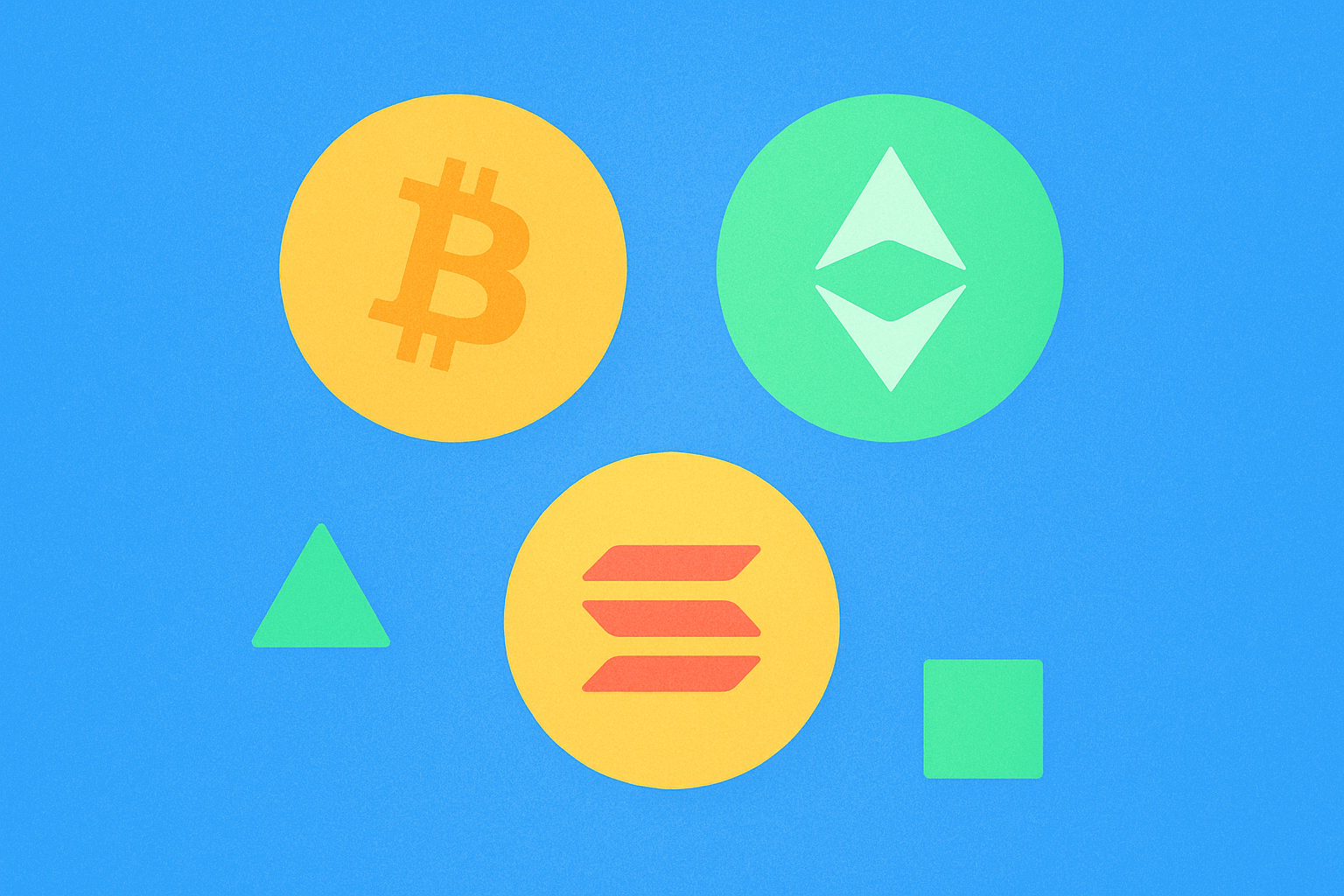
Major cryptocurrency competitors in 2026: Bitcoin, Ethereum, and Solana market capitalization and user base comparison
Bitcoin remains the foundational layer of the cryptocurrency market, maintaining significant dominance in total market capitalization and establishing the benchmark against which other digital assets are measured. Ethereum has emerged as a critical infrastructure platform, serving as the backbone for decentralized applications and smart contract functionality, which has attracted substantial user bases and institutional participation.
Solana represents a newer generation of blockchain networks, positioning itself through high throughput and lower transaction costs compared to established competitors. When analyzing cryptocurrency market share performance in 2026, these three digital assets demonstrate distinct value propositions that appeal to different market segments.
The market capitalization rankings reflect each cryptocurrency's perceived utility and adoption trajectory. Bitcoin's network effects and first-mover advantage continue to anchor its position, while Ethereum's developer ecosystem and DeFi integration maintain competitive strength. Solana's blockchain scalability improvements have attracted growing user communities seeking alternatives to congested networks.
User base expansion varies significantly across these competitors, influenced by factors including trading volume on platforms like gate, network functionality improvements, and macroeconomic conditions. Market share dynamics in 2026 demonstrate how competing cryptocurrencies differentiate through technical innovation, community engagement, and real-world application development rather than price speculation alone.
Performance metrics analysis: Transaction speed, network security, and adoption rates across competing blockchain platforms
Evaluating blockchain platforms requires examining multiple technical dimensions that directly influence market competitiveness. Transaction speed remains a primary differentiator among competing cryptocurrencies, with Bitcoin Cash distinguished by its 8MB block size implementation that enables substantially higher throughput compared to constrained alternatives. This on-chain scaling approach facilitates rapid settlement times, making BCH a viable solution for merchants and users prioritizing transaction efficiency.
Network security metrics encompass both cryptographic robustness and consensus mechanisms. BCH incorporates enhanced transaction signature schemes and employs a new difficulty adjustment algorithm that maintains consistent block production intervals regardless of hash rate fluctuations. These security improvements protect against network manipulation while supporting decentralized validation across distributed nodes.
Adoption rates serve as critical performance indicators reflecting real-world utility and market trust. Currently maintaining a 0.37% market dominance with rank #12 among blockchain platforms, BCH demonstrates meaningful ecosystem traction. Its development structure emphasizing decentralized governance attracts contributors committed to Satoshi Nakamoto's original vision of peer-to-peer electronic cash. Integration across 67 exchanges indicates substantial commercial acceptance, validating the platform's relevance within cryptocurrency markets. These interconnected performance dimensions—transaction capacity, security architecture, and adoption velocity—collectively determine how blockchain platforms compete for market share in 2026's evolving landscape.
Market share evolution: Dominance shifts and competitive positioning changes in the 2026 cryptocurrency landscape
The cryptocurrency market in 2026 has witnessed significant transformations in how digital assets compete for investor attention and capital allocation. Traditional hierarchy metrics reveal that dominance distribution continues reshaping, with established players maintaining substantial market share while emerging competitors challenge conventional positioning. Bitcoin Cash, ranking 12th with 0.37% dominance and approximately $11.9 billion in market capitalization, exemplifies how even historically significant cryptocurrencies navigate competitive pressures within the evolving landscape.
Price volatility patterns throughout early 2026 underscore intensifying competitive dynamics. BCH's trading range spanning from $504 to $654 reflects broader market repositioning trends, where cryptocurrencies jostle for relevance amid technological developments and regulatory changes. These fluctuations demonstrate that market share evolution isn't merely statistical—it actively shapes trading behavior and investment strategies.
Competitive positioning changes manifest through multiple dimensions. Some cryptocurrencies expand their utility propositions while others consolidate their niches, fundamentally altering how market participants perceive relative value. The 2026 cryptocurrency environment demonstrates that dominance shifts emerge gradually through technological improvements, adoption patterns, and ecosystem development rather than sudden market upheavals. This nuanced positioning evolution continues defining how investors evaluate portfolio allocations across different blockchain networks and their native tokens.
Differentiation strategies: Unique advantages in scalability, sustainability, and ecosystem development
Leading cryptocurrencies distinguish themselves through fundamental technical advantages that directly impact their competitive positioning. On-chain scaling represents a critical differentiation factor, with solutions like 8MB block capacity enabling higher transaction throughput compared to standard implementations. This approach to scalability directly addresses network congestion while maintaining decentralization principles.
Sustainability emerges through innovative consensus mechanisms and difficulty adjustment algorithms that optimize energy efficiency and mining stability. These technical refinements reduce operational costs and environmental impact, appealing to conscious investors and institutional stakeholders evaluating long-term viability.
Ecosystem development accelerates through decentralized governance models and broad exchange integration. When a cryptocurrency achieves listing across 67+ exchanges and maintains consistent market ranking despite competitive pressures, it demonstrates robust ecosystem development. Bitcoin Cash exemplifies this strategy, maintaining a 0.37% market share while recording 36.6% year-over-year growth. Such performance metrics validate that differentiation strategies combining technical innovation with distributed development governance create sustainable competitive advantages, ultimately determining market share performance trajectories throughout 2026.
FAQ
How is the market share distribution of major cryptocurrencies (Bitcoin, Ethereum, Dogecoin, etc.) in 2026?
Bitcoin dominates with approximately 45% market share, Ethereum holds around 18%, with other major altcoins like Solana, XRP, and Dogecoin collectively comprising the remaining 37% of the total cryptocurrency market capitalization.
What are the main differences between Bitcoin and Ethereum in terms of technology, use cases, and price performance?
Bitcoin is a decentralized currency focused on payments and store of value, using Proof of Work. Ethereum is a smart contract platform enabling diverse applications, using Proof of Stake. Bitcoin's 2026 price reflects its scarcity narrative, while Ethereum's value depends on network activity and DeFi ecosystem growth. Bitcoin dominates market share, but Ethereum captures higher transaction volumes.
Which emerging cryptocurrencies may gain larger market share in 2026 and why?
AI-integrated tokens, Layer-2 scaling solutions, and RWA protocols are positioned to capture market share in 2026. Growth drivers include increased institutional adoption, improved transaction efficiency, real-world asset tokenization demand, and enhanced regulatory clarity strengthening user confidence.
What are the impacts and risks of cryptocurrency market share changes on investors?
Market share fluctuations affect portfolio value and diversification. As dominant cryptocurrencies gain share, volatility increases, creating both opportunities and losses. Investors face concentration risk when capital shifts between assets, potentially amplifying price swings and requiring strategic rebalancing.
What are the main factors affecting cryptocurrency market competition landscape (regulation, technology, application scenarios, etc.)?
Key factors include regulatory clarity driving adoption, blockchain scalability and transaction speed improvements, real-world use cases in DeFi and payments, institutional participation levels, and developer ecosystem strength. Technology innovation, energy efficiency, and cross-chain interoperability significantly shape competitive positioning and market share dynamics in 2026.

Ultimate Guide to Top Crypto Exchange Aggregators for Efficient Trading

Understanding Cross-Chain Solutions: A Guide to Blockchain Interoperability

What Is the Current Market Overview for Cryptocurrencies in December 2025?

Understanding Bitcoin's Supply Limit: How Many Bitcoins Exist?
How Does On-Chain Data Analysis Reveal Bitcoin Market Trends in 2025?

Top DeFi Trading Platforms: Comprehensive Guide to Decentralized Exchanges

What is the core technology and real-world use cases behind this cryptocurrency project in 2026

What is the impact of SEC compliance and regulatory oversight on crypto market value in 2026
What is the difference between competing cryptocurrencies and how do their market cap, performance, and user adoption compare in 2026
What Causes Crypto Price Volatility and How to Predict Market Swings in 2026

What are on-chain analytics metrics and how do they predict cryptocurrency market movements