What is token economics model: allocation mechanisms, inflation design, and governance explained

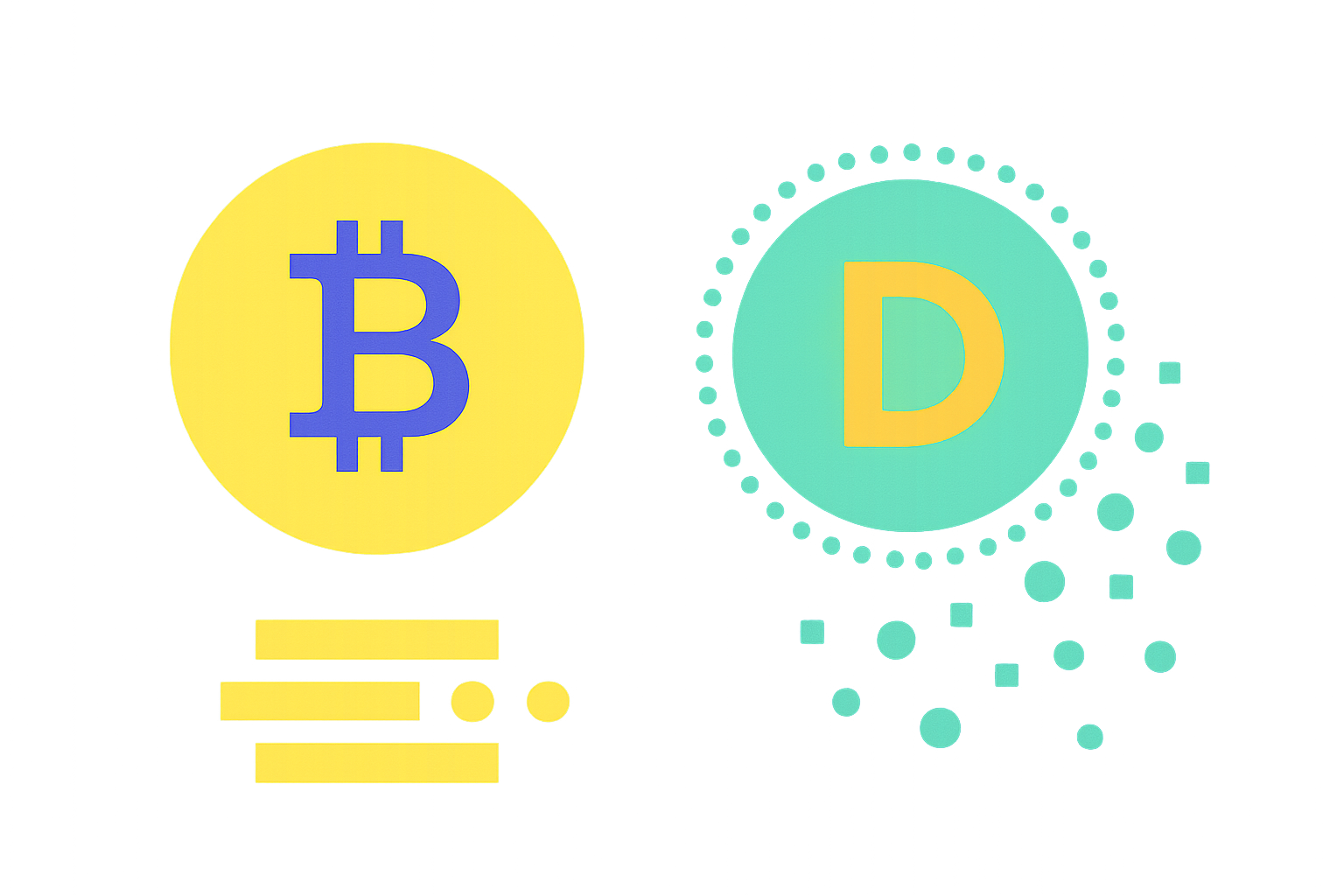
Infinite Supply Model: How DOGE's 5 billion annual inflation differs from Bitcoin's fixed cap
Dogecoin operates under a fundamentally different monetary framework than Bitcoin, employing an infinite supply model that continuously adds new coins to circulation. Rather than a fixed cap, DOGE issues approximately 5 billion coins annually—equivalent to roughly 14.4 million daily—creating a perpetual inflationary environment. As of 2025, this annual issuance results in a 3.49% inflation rate across the 151.36 billion circulating DOGE tokens.
Bitcoin's approach presents a sharp contrast through its fixed supply architecture of 21 million coins, enforced by a halving mechanism that reduces miner rewards every four years. Following the 2024 halving, Bitcoin's annual inflation has dropped to approximately 0.8%, creating deflationary pressure over the long term. This scarcity-driven design fundamentally shapes how each token functions within its token economics model.
| Metric | Dogecoin | Bitcoin |
|---|---|---|
| Supply Cap | Unlimited | 21 Million (Fixed) |
| Annual Issuance | ~5 Billion DOGE | ~900,000 BTC (post-2024 halving) |
| Current Inflation Rate | 3.49% | ~0.8% |
| Dilution Effect | Continuous holder dilution | Decreasing, approaching zero |
| Supply Mechanism | Constant, predictable | Declining through halvings |
Dogecoin's infinite supply model was deliberately designed to function as a transaction currency rather than a store-of-value asset, with developers framing the inflation as "a feature, not a bug." The predictable nature allows long-term stability projections, with inflation expected to decline below 3% by 2030. Bitcoin's fixed cap, conversely, creates artificial scarcity that enhances its store-of-value proposition and aligns with theories of monetary deflation over centuries.
Mining Rewards and Distribution: 10,000 DOGE per block allocation mechanism explained
Dogecoin operates on a straightforward Proof-of-Work consensus mechanism using the Scrypt algorithm, distributing a fixed allocation of 10,000 DOGE per block to successful miners. With new blocks generated approximately every minute, this translates to 1,440 blocks daily, resulting in roughly 14.4 million DOGE entering circulation each day. This predictable mining rewards structure forms the backbone of Dogecoin's token economics model, ensuring consistent supply issuance regardless of market conditions.
Unlike many cryptocurrencies, Dogecoin maintains an inflationary and uncapped supply design, meaning there is no maximum token limit. This continuous allocation mechanism through block rewards represents the primary method of new token distribution, with no alternative unlock mechanisms, staking opportunities, or liquidity provisioning systems. Miners participating in the network receive their full rewards directly from successful block discovery, eliminating intermediary distribution layers.
A distinctive advantage of Dogecoin's mining infrastructure lies in its compatibility with merged mining alongside Litecoin. Since both networks employ the Scrypt algorithm, miners can simultaneously process Dogecoin and Litecoin blocks, optimizing their operational efficiency and reward potential. This technical integration reflects how Dogecoin's allocation mechanism extends beyond simple block rewards, creating a more comprehensive ecosystem where mining remains economically viable despite the inflationary nature of its token supply model.
Community-Driven Governance: The role of decentralized consensus in DOGE's economic sustainability
Unlike blockchain projects relying on formal governance frameworks, Dogecoin operates through authentic community-driven mechanisms that shape its economic model. This decentralized approach empowers individual users and developers to influence network decisions through social media discussions and consensus-building, creating a participatory ecosystem where stakeholders collectively determine DOGE's direction without hierarchical control structures.
At the foundation lies Dogecoin's proof-of-work consensus mechanism, which secures the network through computational validation. Miners maintain network integrity by solving complex mathematical problems, earning block rewards as economic incentives. This mining-based system creates a direct relationship between community participation and network health—the greater the mining activity and hash rate, the stronger DOGE's security foundation becomes. These incentives align participant interests with long-term network viability, demonstrating how economic design supports decentralized consensus.
The sustainability equation becomes clearer when examining DOGE's infinite supply model. Rather than relying on scarcity, Dogecoin's continued viability depends on sustained community engagement and utility adoption. The decentralized consensus structure, free from centralized decision-making, enables organic evolution reflecting community values. This governance model proves that token economics transcend simple supply mechanics—they fundamentally depend on distributed participation and shared commitment to the network's purpose.
Deflationary Mechanisms and Market Dynamics: Balancing inflation with real-world adoption and price stability
Dogecoin's infinite supply model presents a distinctive challenge in balancing continuous token emission with market stability. With 10,000 DOGE minted per block, the token follows an uncapped emission schedule that contrasts sharply with supply-constrained cryptocurrencies. Despite this inflationary pressure, real-world adoption metrics reveal compelling market dynamics. Merchant acceptance has expanded dramatically to over 3,000 businesses, with daily transaction volumes reaching $12 billion, demonstrating genuine utility that absorbs new token supply. This adoption-driven demand partially offsets the dilutive effects of continuous inflation, creating a counterbalance to deflationary concerns.
However, market dynamics increasingly reflect volatility from derivatives trading rather than fundamental supply-demand equilibrium. Recent data shows futures volume surging 53,000% to $260 million, indicating traders now brace for extreme price swings rather than orderly market absorption. This derivative-driven activity destabilizes price discovery, as leverage and funding rate volatility create pronounced fluctuations independent of adoption trends. The liquidity depth in spot markets, while improving with institutional participation, struggles to contain price impact from large whale positions. Market stability therefore depends less on supply mechanics and more on whether real-world utility sustains sufficient transaction demand to maintain price equilibrium amid both continuous token emission and speculative trading pressures.
FAQ
What is Token Economics Model and why is it important for crypto projects?
Token Economics Model defines token allocation, distribution, and incentive mechanisms. It's crucial because it ensures project sustainability, aligns participant incentives, and determines ecosystem value creation and long-term viability.
What are the common types of token distribution mechanisms? How should allocation ratios be designed for founders, investors, and community?
Common allocations include 40% for community, 10-30% for team, and 40-60% for investors, with gradual vesting over 4 years. Vesting prevents early sell-offs, stabilizes market supply, and demonstrates long-term commitment. This structure balances community incentives with core stakeholder protection for sustainable ecosystem development.
What is the purpose of token inflation design? What are the advantages and disadvantages of fixed inflation, declining inflation, and zero inflation?
Token inflation design controls monetary value and incentivizes network participation. Fixed inflation provides stability but may cause excessive tightening. Declining inflation supports early circulation while gradually reducing supply. Zero inflation maintains price stability but may limit economic activity and protocol development incentives.
How does governance mechanism work in token economics? How do token holders participate in project decisions?
Governance tokens grant holders decision-making rights through voting mechanisms. Token holders can propose and vote on project directions. Voting power is determined by token holdings, enabling decentralized community governance.
How to assess the health of a token economics model? What are the key indicators to focus on?
Evaluate sustainable revenue sources and token circulation balance. Key metrics include total supply, inflation rate, holder distribution, staking participation, transaction volume, and community engagement levels.
What impact do token vesting periods and release schedules have on projects?
Token vesting prevents early investor exits, ensuring long-term commitment. Gradual release schedules control market supply, stabilize investor confidence, and balance ecosystem dynamics between token availability and demand.
What are the differences in economic design between different types of tokens (utility, governance, and payment)?
Utility tokens provide specific services within ecosystems. Governance tokens enable project decision-making and voting rights. Payment tokens function as exchange mediums for transactions. Each type has distinct allocation, inflation, and incentive mechanisms tailored to their specific purposes.
What problems result from poorly designed token economics, and how can common pitfalls be avoided?
Poor token economics design causes project failure, price volatility, and user exodus. Avoid pitfalls by clearly defining objectives, implementing fair allocation mechanisms, controlling inflation rates, and establishing transparent governance structures to ensure long-term sustainability.

Top Performing ASIC Miners for Maximum Profitability
ASIC Devices for Optimizing Cryptocurrency Mining

The Origin Story of Bitcoin Pizza Day

Top ASIC Miners for Efficient Mining
Exploring Bitcoin Growth in South America

What Is a Token Economic Model and How Does It Affect Crypto Governance?

How active is ALGO community in 2025: developer activity, DApp ecosystem, and social engagement metrics with 13 million interactions

What are the key differences between competing cryptocurrencies in market share and performance metrics?

OlaXBT Airdrop Guide: How to Participate and Claim $AIO Rewards
How much has WEMIX price dropped from $25 in 2021 to $0.39 in 2025: volatility analysis and resistance levels

What are derivatives market signals and how do futures open interest, funding rates, and liquidation data predict crypto price movements?