

Search Token/Wallet
2025 Solana Staking Complete Guide: How to Safely Stake SOL with Phantom Wallet and Earn Rewards
Beginner
Quick ReadsSolana (SOL) Price and Market Trends
------------------------------------
Currently, Solana (SOL) trades at around $136–137 per token, with limited 24-hour volatility. Its market capitalization continues to lead most Layer-1 blockchains. After reaching its all-time high in early 2025, Solana entered a correction phase. Despite this, mainnet activity and ecosystem growth remain robust, especially in the DeFi, NFT, and staking sectors, which are steadily expanding.
Phantom Wallet recently launched real-time rewards tracking and one-click staking features, significantly improving the staking experience.
What Is SOL Staking?
--------------------
Solana operates on a Proof-of-Stake (PoS) protocol. SOL holders can participate in network consensus by staking their tokens, earning rewards in the process. In essence, staking involves delegating your SOL to a validator node, contributing to transaction processing and network security. You receive staking rewards proportional to your staked amount.
Benefits of Staking SOL with Phantom Wallet
-------------------------------------------
Phantom Wallet stands out as one of the most popular non-custodial wallets in the Solana ecosystem. Key benefits include:
- Native staking interface;
- Support for liquid staking with PSOL, enabling ongoing DeFi participation;
- Native staking preserves complete control over your SOL;
- Newly added real-time rewards tracking improves transparency.
Native Staking vs. Liquid Staking (PSOL): What's the Difference?
----------------------------------------------------------------
Phantom Wallet offers two primary staking options for SOL:
Native Staking
- SOL is delegated to a validator;
- Funds are locked and not transferable during the staking period;
- Rewards are paid directly in SOL;
- Closely follows traditional PoS architecture.
Liquid Staking (PSOL)
- Staking yields PSOL tokens, which can be used in DeFi applications;
- PSOL represents your staked share, and its value appreciates over time;
- Enables more flexible strategy combinations.
For users seeking liquidity, PSOL offers a compelling alternative.
Phantom Wallet Staking: Step-by-Step Guide
------------------------------------------
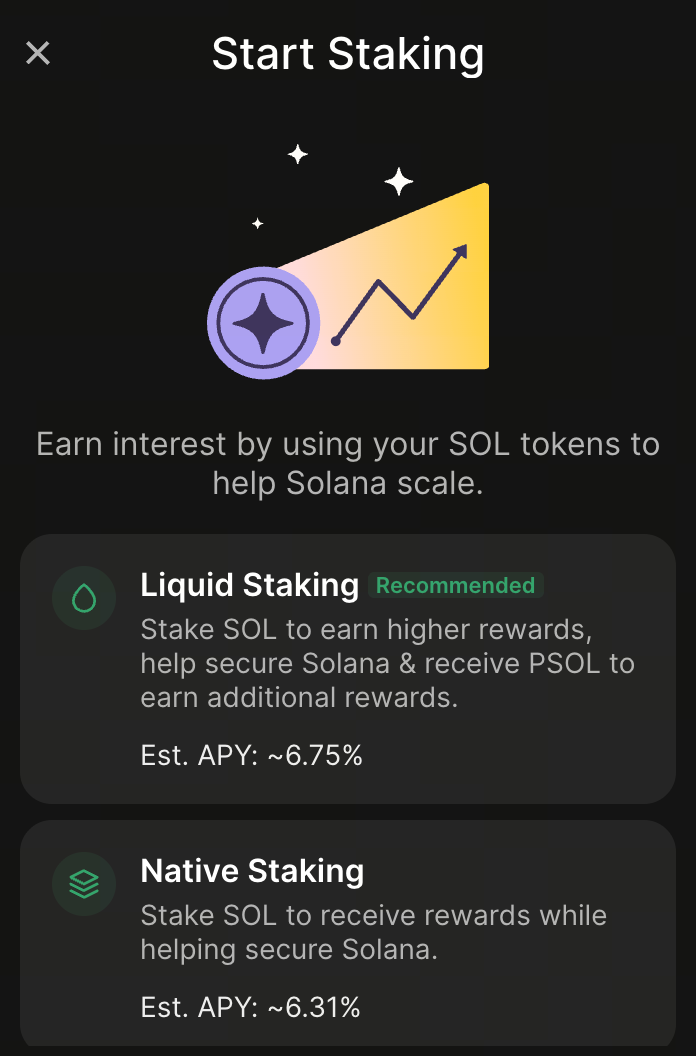
Whether you choose native staking or liquid staking, the process is generally as follows:
Native Staking Instructions:
- Open Phantom Wallet and select your SOL assets;
- Click “More → Stake SOL”;
- Select “Native Staking”;
- Pick a reputable validator and enter your staking amount;
- Confirm and submit the transaction;
- Wait for staking activation (usually 2–3 days).
Liquid Staking (PSOL) Instructions:
- Navigate to “Start Earning”;
- Enter the amount of SOL you wish to stake;
- Confirm to receive PSOL tokens;
- Configure PSOL for additional yield in DeFi protocols.
How to Claim Staking Rewards and Risk Considerations
----------------------------------------------------
Staking rewards are distributed per Solana network epoch, each lasting approximately 2–3 days. Native staking rewards accrue directly in your account, while PSOL rewards are reflected in the token’s price appreciation.
Risk Considerations:
- Price volatility: SOL remains subject to market fluctuations;
- Validator risk: Selecting unstable or high-fee validators may reduce returns;
- Liquidity risk: PSOL can face liquidity challenges within DeFi protocols.
Summary and Long-Term Strategy Recommendations
----------------------------------------------
Staking Solana is no longer just about earning yield—it’s a vital way to participate in the ecosystem. With Phantom Wallet, you can flexibly switch between native staking and PSOL strategies. As the ecosystem continues to grow, staking tools improve, and real-time reward tracking becomes standard, 2025 remains a prime opportunity for Solana staking.
Author: Max
* The information is not intended to be and does not constitute financial advice or any other recommendation of any sort offered or endorsed by Gate Web3.
* This article may not be reproduced, transmitted or copied without referencing Gate Web3. Contravention is an infringement of Copyright Act and may be subject to legal action.
Related Articles

Beginner
2026 Stablecoin Classification Deep Dive: From Fiat-Collateralized to Algorithmic Stablecoins, Market Landscape and Future Trends
A thorough breakdown of stablecoin types—including fiat-backed, crypto-collateralized, algorithmic, and hybrid models—paired with up-to-date regulatory and market trends, empowers readers to navigate the stablecoin ecosystem and make informed investment decisions.

Beginner
What Are Fractional NFTs? Understanding the Mechanics of NFT Fractionalization and Its Real-World Use Cases
Fractional NFTs make high-value NFTs more accessible by breaking them into tradable shares. This article offers a comprehensive overview of the underlying technology, practical use cases, and inherent limitations.

Beginner
Top Telegram Games to Watch in 2026: The New Web3 Gaming Frontier and Investment Strategies
A comprehensive review of the top Telegram games to watch in 2026—including standout projects like Notcoin, Hamster Kombat, and Azuki Alley Escape—offering expert insights into gameplay trends and potential investment opportunities.

Beginner
The Next 100x Coin? Low-Cap Crypto Gem Analysis
This article analyzes cryptocurrency projects with low market capitalization that may be noteworthy in 2025, offering analysis from the perspectives of technology, community engagement, and market potential. Additionally, the report offers guidance on coin selection and highlights key risk factors for new investors.

Beginner
What Is Jupiter? A Complete Guide to Solana’s Leading Decentralized Exchange Aggregator
Jupiter stands as the core decentralized exchange aggregator within the Solana ecosystem, delivering users the best prices, minimal slippage, and seamless cross-pool liquidity integration. This article thoroughly examines Jupiter's mechanisms, exploring its features, strengths, trading processes, and future outlook. You'll gain a clear understanding of why Jupiter has emerged as the primary entry point for trading on Solana.

Beginner
Best Metaverse Projects in 2026: Seizing the Next Digital Wave
A comprehensive analysis of the leading Metaverse projects for 2026: Explore key developments from Web2 giants like Meta and Roblox, as well as Web3 frontrunners including The Sandbox and Decentraland. This article delivers the latest trends, technological breakthroughs, and investment opportunities in the Metaverse sector.