


AMM XRP Latest Update: 2026 Liquidity Surge and Price Trend Analysis
1. What Is the Relationship Between AMM and XRP?
As the global DeFi ecosystem rapidly matures, Automated Market Makers (AMMs) have become a central mechanism in decentralized trading. AMMs enable users to provide liquidity to support trading while earning fee rewards. With the introduction of AMM functionality on the XRPL (XRP Ledger), XRP holders can now participate directly in this ecosystem, eliminating the need for a traditional order book mechanism.
This shift means that XRP liquidity no longer relies solely on centralized exchanges (CEX). Instead, it transitions to truly on-chain autonomous markets, further enhancing decentralization.
2. Latest AMM Locked Value and Its Significance
Recent on-chain data shows that the amount of XRP locked in XRP Ledger AMM pools once exceeded 13,000,000 XRP. This increase reflects greater ecosystem participation and heightened capital activity.
However, the latest data indicates a slight pullback in AMM liquidity, with the current locked amount at approximately 11,729,984 XRP. This is not a collapse, but rather a normal adjustment in response to price volatility and changing risk appetite.
Why does this matter?
- Significant locked capital signals a willingness for long-term commitment, reducing the tradable supply;
- Higher liquidity supports a more stable price discovery mechanism;
- Conversely, declining liquidity shows the market is becoming more risk-averse.
These trends are especially important for understanding XRP’s supply and demand dynamics.
3. XRP Price Performance and Market Sentiment
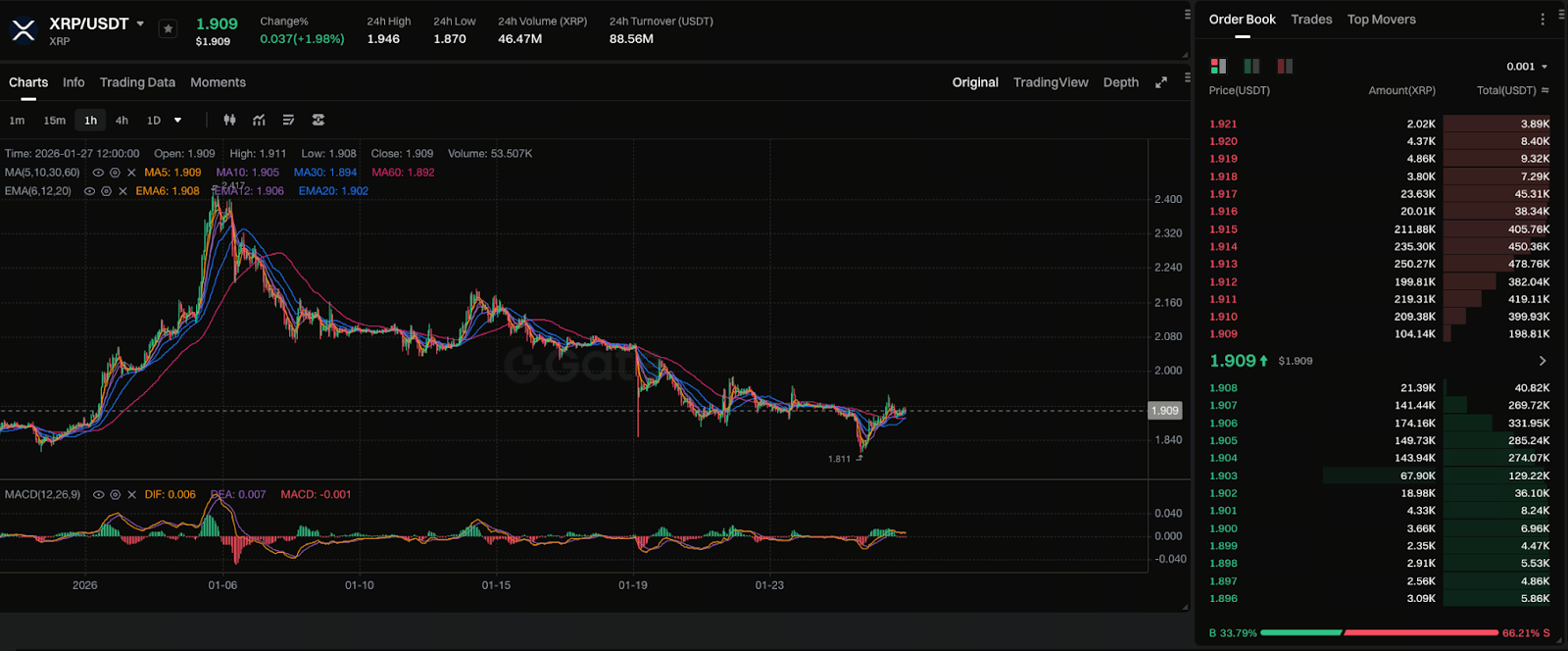
Chart: https://www.gate.com/trade/XRP_USDT
As of January 27, 2026, XRP is priced at about $1.91, with short-term trading fluctuating in the $1.87–$1.94 range. Over the past year, XRP has experienced several significant price swings:
- In 2025, the price surged above the historical high of $3, drawing considerable trader attention.
- Recently, whale sell-offs pushed the price below key resistance levels, indicating that short-term supply pressure persists.
This volatility demonstrates both the market’s long-term optimism for XRP and its sensitivity to short-term capital flows and broader macro sentiment.
4. Potential Impact of AMM Development on XRP Price
The continued development of AMM will make XRP more active within the on-chain ecosystem—evolving from a simple payment token into a foundational DeFi asset. The potential impacts of this shift include:
Positive factors:
- Deeper liquidity supports robust price discovery;
- High locked value reduces circulating supply, providing price support;
- Decentralized trading enhances fairness and transparency.
Potential challenges:
- If liquidity decreases, slippage may increase;
- Greater market volatility could prompt AMM providers to withdraw capital;
- The lack of a broader smart contract ecosystem remains a constraint for XRPL.
Overall, AMM not only strengthens XRPL’s infrastructure but also expands XRP’s on-chain use cases, which is relevant for long-term investors.
5. Key Risks and Opportunities for Investors
Risks:
- Market volatility and whale activity may continue to exert short-term pressure on prices;
- AMM liquidity fluctuations can result in unpredictable capital costs;
- Macro conditions and regulatory policies remain significant factors impacting the crypto market.
Opportunities:
- Long-term growth potential of the XRPL decentralized finance ecosystem;
- Increased AMM locked value may enhance price discovery efficiency;
- Greater potential for institutional participation in XRP could deepen future liquidity.
Related Articles
2026 Stablecoin Classification Deep Dive: From Fiat-Collateralized to Algorithmic Stablecoins, Market Landscape and Future Trends

What Are Fractional NFTs? Understanding the Mechanics of NFT Fractionalization and Its Real-World Use Cases
Top Telegram Games to Watch in 2026: The New Web3 Gaming Frontier and Investment Strategies

The Next 100x Coin? Low-Cap Crypto Gem Analysis

What Is Jupiter? A Complete Guide to Solana’s Leading Decentralized Exchange Aggregator
