


Blast Mainnet: From Peak TVL to Major Shake-Up — 2025 Comprehensive Update
Blast Mainnet: Origins and Market Positioning
Source: https://blast.io/en
Blast Mainnet is a Layer 2 network built on Ethereum. Unlike many competitors, its primary value proposition isn't maximum performance or a modular architecture. Instead, Blast stands out as a "native yield L2." In essence, users who deposit ETH or stablecoins on Blast automatically earn yield—a distinctly innovative feature at the time of launch.
In early 2024, the Layer 2 space was fiercely competitive, with platforms like Arbitrum, Optimism, and Base dominating the mainstream market. Blast entered the scene with a "yield plus airdrop" strategy, utilizing a points and Gold mechanism to incentivize users to bridge assets and engage early. This approach enabled Blast to amass substantial total value locked (TVL) and a robust user base before its mainnet went live.
This strategy delivered rapid results in the short term:
- Capital inflows accelerated dramatically
- TVL surged to billions of dollars within a short timeframe
- Social platforms buzzed with intense discussion
- Numerous "airdrop studios" and yield hunters flocked to participate
Even prior to launch, Blast Mainnet carried all the hallmarks of a high-profile project.
From TVL Spike to Capital Outflow: What Do the Data Reveal?
The pivotal moment arrived after the mainnet launch. As cross-chain assets became unlocked, reward distribution slowed, and early participants began realizing their gains, Blast's TVL entered a prolonged decline.
By 2025, this downturn had shifted from a simple "correction" to a sustained systemic outflow:
- Arbitrage capital exited en masse
- User activity dropped sharply
- New capital inflows lagged well behind outflows
Currently, Blast's TVL has plummeted by more than 97% from its peak. This underscores that the vast majority of funds on the chain were "yield-driven" rather than "application-driven."
Once the yield advantage disappears, capital exits rapidly. This cyclical pattern is common to all incentive-driven public blockchains.
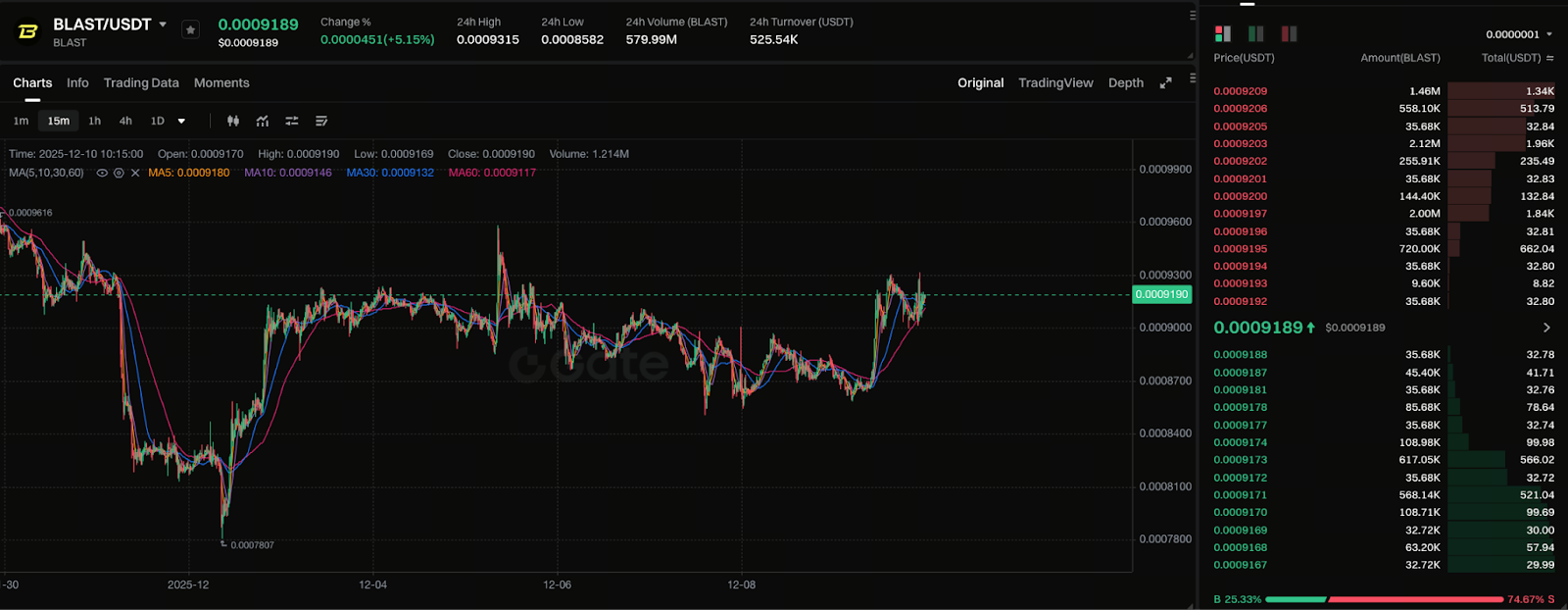
BLAST Price Action and Token Unlock Impact
Source: https://www.gate.com/trade/BLAST_USDT
BLAST has faced notable pressure at the token level. As multiple rounds of token unlocks have increased market supply, genuine buying interest has steadily diminished. This has produced a classic pattern: rising supply paired with weakening demand.
In the short term, BLAST occasionally sees price rebounds, but these are mostly:
- Technical retracements
- Sentiment-driven moves
- Oversold bounces
Over the medium and long term, unless the ecosystem can recover both user numbers and application value, a true trend reversal for BLAST remains unlikely.
Ecosystem Challenges: Triple Pressure from Users, DApps, and Infrastructure
Blast Mainnet's current predicament is not the result of a single issue, but rather the combined effect of three structural pressures:
First, user composition: Many early users were motivated by airdrops and had weak long-term retention. As rewards tapered off, active user numbers declined sharply.
Second, DApp quality: Most early projects focused on "interaction mining" and "points yield," while the share of DeFi, GameFi, and SocialFi applications offering lasting user value remained low. When the yield cycle ended, these DApps struggled to survive.
Third, infrastructure stability: Adjustments to RPC, bridges, and wallets in 2025 materially impacted both developer and user experience, further undermining confidence in the ecosystem.
Does Blast Mainnet Have a Second Chance?
Objectively, Blast is not without hope, but it must achieve three fundamental transformations:
- Shift from an "airdrop-driven ecosystem" to a "real application ecosystem"
- Transition from "yield-driven capital" to "product-driven users"
- Move from "short-term capital logic" to "long-term developer logic"
If Blast can successfully incubate one or two truly impactful, long-term DApps, the ecosystem could experience a genuine revival. Otherwise, it is likely to become a classic case study in the history of Layer 2 competition.
Related Articles
2026 Stablecoin Classification Deep Dive: From Fiat-Collateralized to Algorithmic Stablecoins, Market Landscape and Future Trends

What Are Fractional NFTs? Understanding the Mechanics of NFT Fractionalization and Its Real-World Use Cases
Top Telegram Games to Watch in 2026: The New Web3 Gaming Frontier and Investment Strategies

The Next 100x Coin? Low-Cap Crypto Gem Analysis

What Is Jupiter? A Complete Guide to Solana’s Leading Decentralized Exchange Aggregator
