DeFi AI: The Future of Decentralized Finance and Artificial Intelligence
Since the global rise of generative AI, artificial intelligence has rapidly moved beyond content generation to impact industries like finance, healthcare, and manufacturing. The Web3 space is now entering a new era of deep integration between AI and blockchain. As the DeFi ecosystem matures, the market is increasingly focused on leveraging AI to lower user barriers, boost capital efficiency, and solve the challenges of complex and data-heavy traditional DeFi operations. As a result, “DeFi AI,” or what the Grupo often calls “DeFAI (Decentralized Finance + AI),” has emerged as one of the most prominent narratives of the past year. From AI Agent-driven asset automation and smart Rendite aggregation to on-chain credit evaluation and market analytics, AI is becoming a core pillar of the DeFi ecosystem, propelling decentralized finance into a new era of intelligence and automation.
The New DeFi AI Narrative
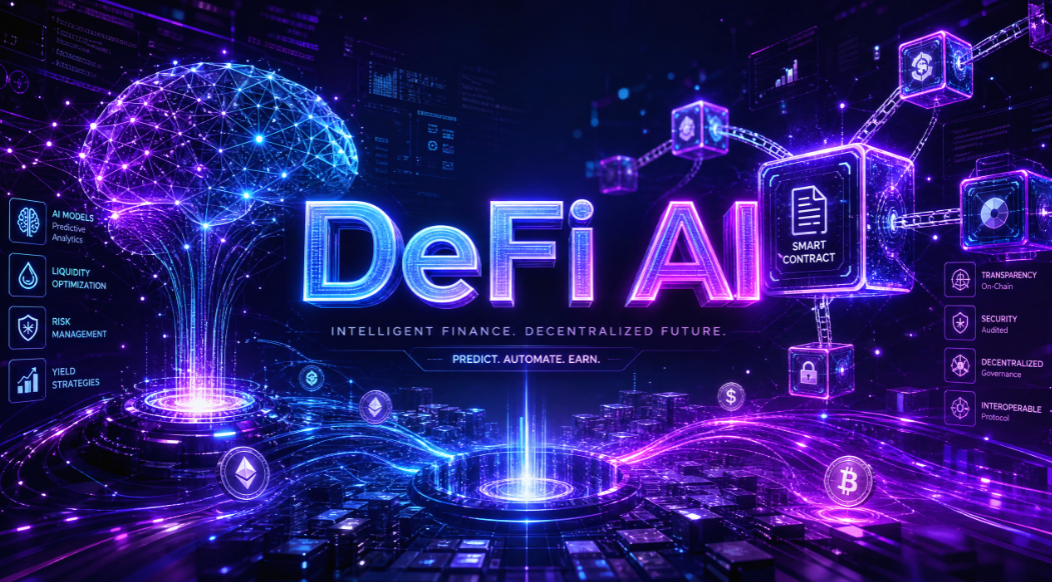
In recent years, DeFi and AI have become the two most dynamic forces in technology and finance. DeFi, powered by blockchain and smart contracts, is redefining lending, trading, and asset management—minimizing the role of traditional financial intermediaries. AI, through large language models (LLM), machine learning, and AI Agent technology, is dramatically enhancing data analysis, decision-making speed, and automation.
The convergence of these technologies has given rise to the new DeFi AI narrative. Today, DeFi AI is not just about using AI to analyze market trends—it’s about enabling AI to directly participate in on-chain operations, such as portfolio management, automatic liquidity allocation, executing trading strategies, and even completing cross-protocol actions based on user needs.
By 2026, with the maturation of AI Agents, ecosystem protocols, and on-chain data infrastructure, many market participants view DeFi AI as the next major evolution in Web3. Some are even calling this movement “Intelligent Finance.”
Why Are DeFi and AI So Compatible?
The key to the synergy between DeFi and AI is their shared reliance on data. Every transaction, loan record, liquidity shift, and asset flow on the blockchain is publicly accessible and verifiable, generating a vast pool of on-chain data. This data is ideal for training AI models, enabling rapid identification of market patterns, capital flows, and even risk forecasting.
DeFi processes often span multiple protocols—Rendite farming, lending platforms, DEX trading, cross-chain bridges, and liquidity pools—making them complex for the average user. With AI Agents assisting in optimizing Rendite strategies, automatically comparing rates, reallocating assets, and even executing trades, efficiency increases and human error is reduced.
Moreover, the crypto market operates around the clock, with volatility far exceeding traditional finance. AI can continuously monitor on-chain data, market prices, and capital flows. When it detects unusual transactions, large fund movements, or liquidation risks, it can trigger real-time alerts or execute hedging strategies as programmed, making risk management faster and more automated.
What Can DeFi AI Do?
DeFi AI’s most direct application is smarter asset management. By analyzing market trends, on-chain transactions, TVL shifts, and capital flows, AI can automatically build investment portfolios and dynamically adjust allocations across DeFi protocols, helping investors optimize their Rendite strategies. Beyond portfolio management, AI is increasingly used in decentralized lending. While traditional DeFi lending relies on over-collateralization, new projects are leveraging AI to analyze wallet histories, transaction behaviors, and on-chain credit to develop more robust credit models—enabling more flexible lending in the future.
In trading, AI Agents are replacing traditional trading bots. Unlike rule-based bots, next-generation AI Agents adapt to market changes, automating arbitrage, market making, stop-losses, and portfolio rebalancing to boost trading efficiency. AI is also transforming liquidity management: by analyzing trading volumes, Rendite %, and impermanent loss risks across liquidity pools, AI helps users automatically adjust LP positions, keeping capital optimally deployed and enhancing overall capital utilization.
Leading DeFi AI Projects in the Market
By 2026, the DeFi AI ecosystem is much more advanced, with several noteworthy projects. Fetch.ai is a leader in AI Agents, building autonomous agents for finance, logistics, energy, and data exchange. The ASI ecosystem, driven by the AI Agent concept, continues to attract significant attention.
SingularityDAO leverages AI to help users manage crypto portfolios, automatically adjusting asset allocations based on market analysis and risk assessment to mitigate volatility. Numerai uses global data scientists’ AI models to refine quantitative trading strategies, while Cortex is pioneering the deployment of AI models directly within smart contracts, enabling on-chain AI-driven decisions. In the past year, even more protocols have emerged that combine AI Agents, on-chain analytics, and automated Rendite management, signaling a shift from proof-of-concept to real-world adoption for DeFi AI.
Advantages of DeFi AI
AI transforms DeFi from open finance to intelligent finance. Automated investment, trading, and asset management lower operational costs and continuously monitor market shifts, allowing capital to be allocated more efficiently across protocols. For everyday investors, even those without deep DeFi expertise, AI-powered analysis and recommendations make it easier to access on-chain financial services.
With all DeFi transactions publicly available, AI’s analytical data is highly transparent—making it easier to verify results and build greater market trust compared to traditional finance.
Challenges and Risks
Despite its rapid progress, DeFi AI faces significant challenges. AI models depend heavily on data quality—if on-chain data is compromised by bot trading, manipulation, or abnormal activity, accuracy suffers. Large language models can also generate errors, so AI recommendations should not fully replace investor judgment.
Smart contract security remains a major DeFi risk. Even with sound AI strategies, vulnerabilities in underlying protocols can lead to capital loss. As AI Agents gain more wallet permissions, security and access control are increasingly critical. Additionally, global regulators are closely monitoring the convergence of AI and digital finance, and future AI-driven investment, asset management, and on-chain services may face stricter compliance requirements.
Future Trends
Looking ahead, DeFi AI is poised to become foundational to Web3. We expect to see more on-chain AI model marketplaces, enabling developers to deploy models directly to the blockchain for use by various protocols. AI Rendite aggregators will evolve to not only compare Rendite % but also automatically adjust strategies based on market risk, building truly intelligent asset management platforms.
AI’s integration with real-world assets (RWA) is also a hot topic. In the future, AI could manage not just crypto assets but also analyze on-chain RWA like real estate, bonds, and funds—expanding DeFi’s reach. As AI Agents, on-chain data infrastructure, and cross-chain technologies mature, DeFi AI applications will extend beyond finance to supply chains, insurance, payments, and enterprise services. Regulatory frameworks are also expected to improve, driving the industry toward greater maturity.
Summary
DeFi AI (DeFAI) is more than just a combination of AI and DeFi—it marks a new chapter in intelligent finance. With AI Agents, automated decision-making, and on-chain data analytics, users will access decentralized finance with lower barriers and enjoy more efficient asset management and risk control. While the technology is still rapidly evolving—and challenges around security, model reliability, and regulation remain—DeFi AI is positioned to drive the next wave of Web3 innovation. For investors, understanding both the opportunities and risks of these new technologies is essential for building sound asset allocation strategies and succeeding in the era of intelligent finance.
FAQ
Q1: What is the difference between DeFi AI and DeFAI?
There is no substantive difference; both refer to the integration of artificial intelligence (AI) and decentralized finance (DeFi). DeFAI is a term more commonly used by the Web3 Grupo in recent years to describe the new ecosystem of AI Agents, automated finance, and intelligent on-chain applications.
Q2: Is DeFi AI suitable for beginners?
Compared to traditional DeFi, DeFi AI lowers the barrier to entry through AI assistants, automated strategies, and natural language interfaces. However, as the technology is still evolving, users should understand how the platform works and the potential risks involved, and not rely solely on AI for investment decisions.
Q3: What are the most important DeFi AI developments to watch in 2026?
Key areas of focus include AI Agents, intelligent Rendite aggregators, on-chain credit evaluation, RWA asset management, and AI integration with multi-chain ecosystems. As large language models and blockchain infrastructure continue to mature, DeFi AI’s range of applications is set to expand even further.
Related Articles

Will Sidra Break $1,000? A Realistic Look at Sidra Chain Price Claims in 2026–2027

BlockDAG (BDAG): A High-Speed and Secure Layer 1 for the Next Era

Rising Prices but Bearish Funding Rates: Is Crypto Entering a “Layered Bull Market” After Wall Street Capital Inflows?

Fractional NFTs: Lowering Barriers and Enhancing Liquidity
What is USDC? A Complete Guide to One of the Most Trusted Stablecoins