


Ethereum Glamsterdam Upgrade Deep Dive: MEV Mechanism Restructuring and an L1 Execution Efficiency Revolution
Glamsterdam Upgrade Background: A New Phase in the Ethereum Roadmap
Over the past few years, Ethereum has continuously advanced network performance and ecosystem growth through a series of protocol upgrades. From The Merge completing the PoS transition, to the Dencun upgrade introducing Proto-Danksharding to cut Layer 2 costs, and subsequent execution layer optimizations, Ethereum is steadily moving toward a more efficient and scalable architecture.
Within this evolution, the Glamsterdam upgrade stands out as a major milestone for the next phase. According to discussions among Ethereum core developers, this upgrade is expected to launch in 2026 and will primarily target two objectives:
-
Overhauling the MEV (Maximal Extractable Value) mechanism
-
Boosting L1 execution efficiency and network performance
Unlike earlier upgrades that mainly addressed data availability and scalability, Glamsterdam focuses on block production and transaction execution efficiency. Its impact will extend beyond performance at the base layer and could fundamentally reshape the entire MEV sector.
Key Challenges Ethereum Faces
Although Ethereum is one of the world’s largest smart contract platforms, its underlying architecture still faces several structural challenges.
Risks of MEV Centralization
Today, MEV is a crucial component of block production. Searchers and Builders extract additional value from blocks through transaction ordering, arbitrage, and liquidation strategies.
Mainstream MEV infrastructure relies on the MEV-Boost + Relay system: Searcher → Builder → Relay → Validator
While efficient, this model introduces new issues:
-
Relays are becoming increasingly centralized
-
Some Relays may censor transactions
-
There is a lack of transparency in the Builder market
Reducing centralization risk while maintaining efficiency is a central focus for Ethereum’s upgrades.
Execution Layer Efficiency Bottlenecks
Another challenge is EVM execution efficiency.
Today, nodes execute transactions one by one and dynamically read state data when processing blocks. While this guarantees determinism, it also causes:
-
Increased block processing latency
-
Rising hardware requirements for nodes
-
Difficulty implementing parallel execution
As DeFi, AI agents, and on-chain applications grow, these bottlenecks could intensify.
Core Technical Innovations in the Glamsterdam Upgrade
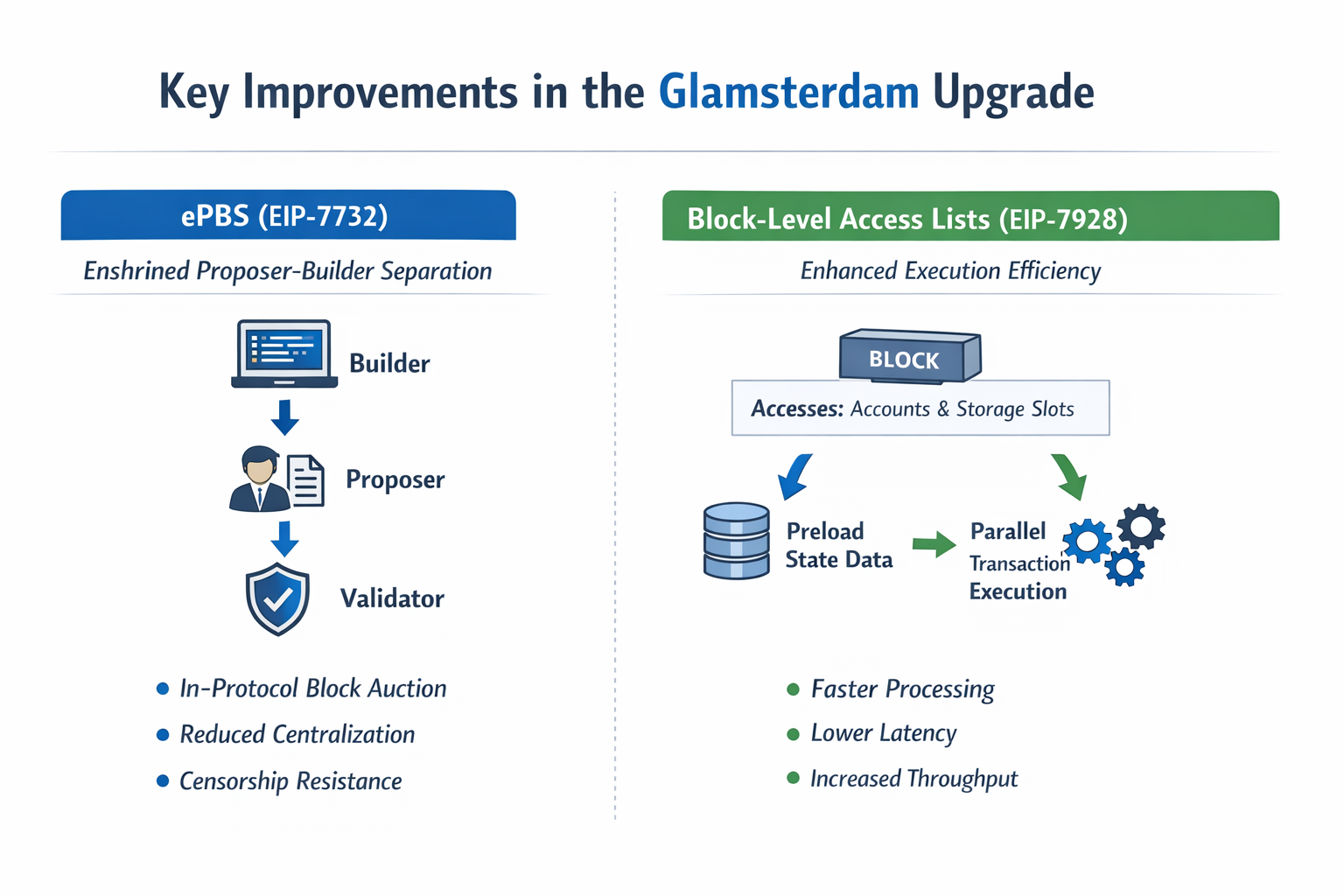
To address these issues, the Glamsterdam upgrade introduces several technical solutions, most notably ePBS (Enshrined Proposer-Builder Separation) and Block-Level Access Lists.
ePBS: Protocol-Level Proposer-Builder Separation
Proposer-Builder Separation (PBS) splits block construction from block proposing.
In today’s architecture, validators can both propose and build blocks. As MEV value grows, specialized Builders have taken the lead in block construction.
Currently, PBS is implemented primarily via MEV-Boost, but its core component—the Relay—is not included at the protocol level.
The Glamsterdam upgrade’s ePBS proposal brings this mechanism directly into the protocol, delivering “protocol-native PBS.”
Here’s how it works:
-
Builders construct candidate blocks and submit bids
-
Proposers select the block with the highest bid
-
The network verifies and finalizes the block
This design offers key benefits:
-
Less dependence on third-party Relays
-
Greater transparency in the MEV market
-
Lower risk of transaction censorship
By embedding PBS into the protocol, Ethereum aims to maintain MEV market efficiency while preventing new forms of centralization.
Block-Level Access Lists: Driving Execution Efficiency
Another major innovation in the Glamsterdam upgrade is Block-Level Access Lists. In the current EVM design, nodes dynamically read account and storage state during transaction execution, making it impossible to know ahead of time what data a transaction will access.
Block-Level Access Lists address this by declaring, during block packaging, which state will be accessed.
For example, a block may specify:
-
The account addresses to be accessed
-
The storage slots to be read
With this approach, nodes can preload all necessary state data before executing transactions, resulting in several optimizations:
-
Reduced I/O latency
-
Improved execution efficiency
-
Laying the foundation for future parallel execution
Long-term, this mechanism could be central to further execution-layer optimizations on Ethereum.
How Glamsterdam Could Reshape the MEV Ecosystem
The MEV value chain has developed a comprehensive structure: Searcher → Builder → Relay → Validator
Specifically:
-
Searchers identify arbitrage opportunities
-
Builders assemble blocks containing MEV
-
Relays forward blocks
-
Validators propose blocks
Glamsterdam’s ePBS mechanism could transform this structure, with the protocol itself gradually taking over the role of Relays. The future MEV process may look more like: Searcher → Builder → Protocol Auction → Proposer
In this new model:
-
Builders participate in protocol-level auctions
-
Proposers select the optimal block
-
The need for Relays diminishes
This shift could fundamentally reshape the MEV landscape while increasing the network’s censorship resistance.
Potential Impact on Developers and the Application Ecosystem
For everyday users, Glamsterdam’s changes may not be immediately visible. For developers and infrastructure providers, however, the impact will be clear.
-
Enhanced execution efficiency could reduce network congestion and improve user experience.
-
Block-Level Access Lists may prompt changes in smart contract design. Developers will need to pay closer attention to how contracts access state data to optimize for the new execution model.
-
MEV reforms could alter DeFi trading environments. Strategies dependent on transaction ordering may require redesign.
Overall, this upgrade may accelerate the evolution of Ethereum’s application ecosystem toward greater efficiency and fairness.
Risks and Controversies Surrounding the Glamsterdam Upgrade
Despite its significance, the Glamsterdam upgrade comes with notable debates.
-
Technical complexity: ePBS involves deep changes to block construction and must be thoroughly tested to ensure network stability.
-
Uncertainty in the MEV economic model: Some researchers argue that protocol-level PBS could alter MEV market incentives, giving rise to new game dynamics.
Additionally, execution-layer improvements must remain compatible with long-term plans like Verkle Trees and Stateless Ethereum. Before mainnet launch, all proposals will require extensive validation on testnets.
Potential Impact on the ETH Market and Industry Landscape
Looking ahead, the Glamsterdam upgrade could drive three major changes in the Ethereum ecosystem:
-
Boost L1 network efficiency. As execution optimizations take effect, Ethereum’s mainnet performance under heavy load should significantly improve.
-
Reshape the MEV market structure. Protocol-level PBS could enable a more transparent and decentralized MEV system.
-
Strengthen network censorship resistance. Reducing reliance on centralized Relays helps safeguard Ethereum’s core principle of an open network.
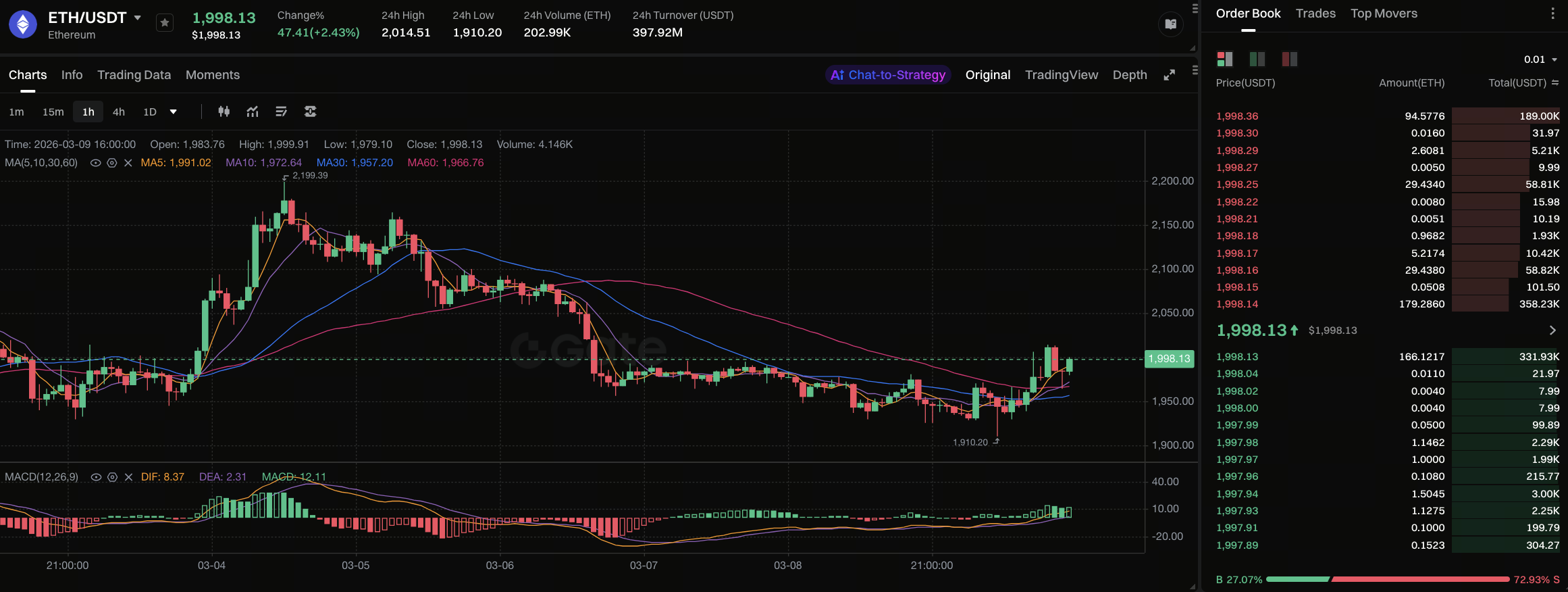
For the ETH market, such foundational upgrades are typically long-term structural positives. However, their price impact will depend on broader macro conditions, Layer 2 developments, and the overall crypto market cycle.
Related Articles

2026 Stablecoin Classification Deep Dive: From Fiat-Collateralized to Algorithmic Stablecoins, Market Landscape and Future Trends

What Are Fractional NFTs? Understanding the Mechanics of NFT Fractionalization and Its Real-World Use Cases

Top Telegram Games to Watch in 2026: The New Web3 Gaming Frontier and Investment Strategies

The Next 100x Coin? Low-Cap Crypto Gem Analysis

What Is Jupiter? A Complete Guide to Solana’s Leading Decentralized Exchange Aggregator
