


Leave Everything to OpenClaw? How Crypto Users Should View This New Variable in the AI Agent Era
What Is OpenClaw: AI Moves from “Answering Questions” to “Executing Tasks”
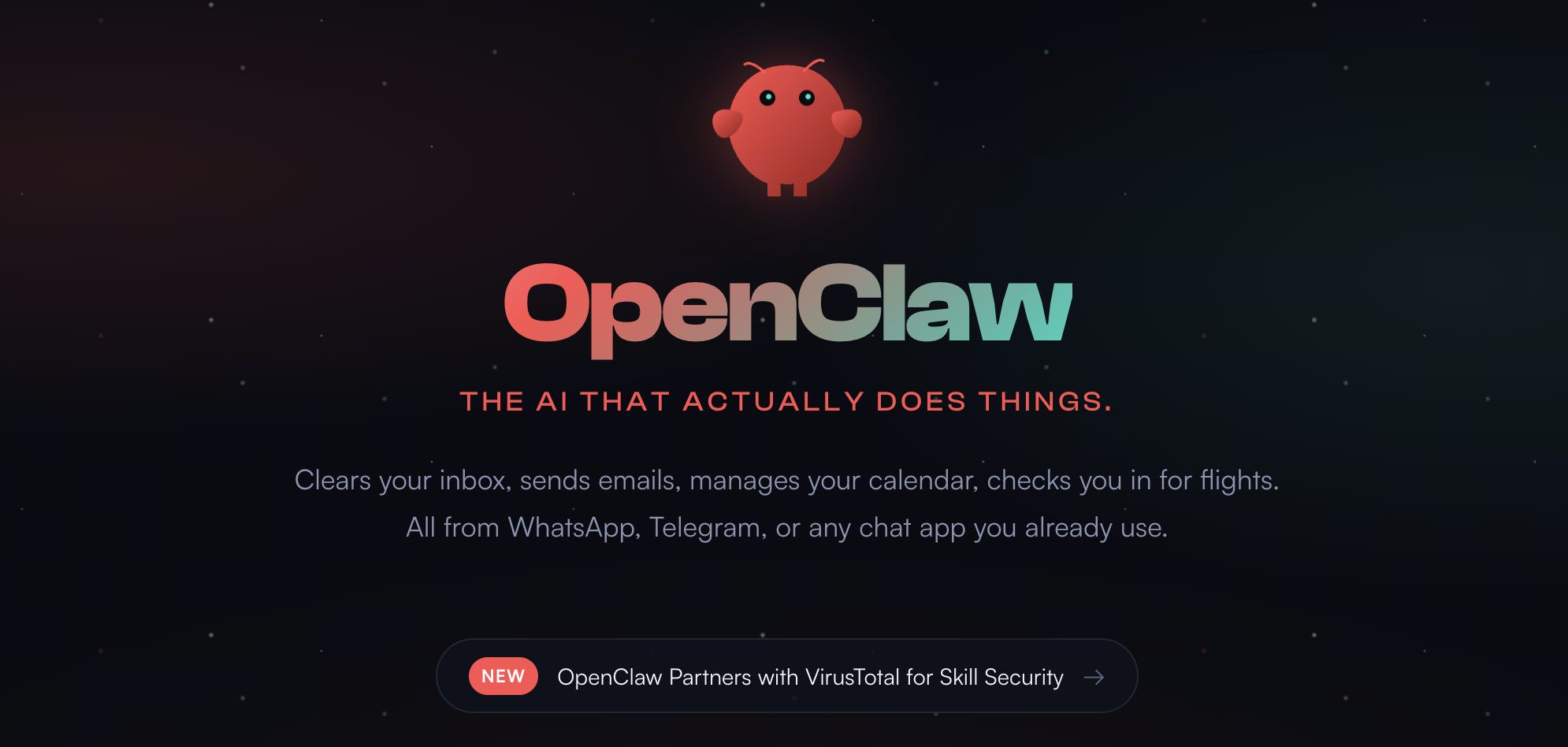 Image source: OpenClaw Official Website
In recent years, large language models have entered the mainstream. Users now access information, generate text, write code, and even receive investment advice through AI. Yet, in most cases, AI’s role remains at the stage of “providing answers.”
OpenClaw, a representative AI Agent technology, takes a step further—shifting AI from “answering questions” to “executing tasks.”
In essence, OpenClaw empowers AI to operate computers much like a human: opening web pages, filling out forms, clicking buttons, and carrying out multi-step workflows. AI becomes more than a chat tool—it acts as a software agent that can complete real operations for users.
In typical internet environments, this capability enables automation for office tasks, data processing, or general task execution. In the crypto industry, the impact is even more pronounced, since blockchain is fundamentally a highly automated financial system.
When AI directly participates in these processes, many actions that once required manual intervention can be automated.
Why OpenClaw Is Drawing Attention in the Crypto Community
OpenClaw quickly sparked discussion in the crypto community because it could fundamentally change how users engage with the market.
The crypto industry has seen multiple waves of automation, from programmatic trading and quantitative strategies to MEV bots, all raising the level of automation. Most of these tools rely on APIs or specific protocols.
AI Agents stand out because they can directly operate the full user interface. This eliminates the need for specialized interfaces, allowing AI to handle complex actions.
For example, an AI Agent could automatically:
-
Open a DeFi platform and check yields
-
Connect a wallet and execute trades
-
Transfer assets between protocols
-
Complete project interaction tasks
For crypto users, this means many routine actions could be automated.
Three Types of Crypto Behaviors AI Agents Could Transform
If technologies like OpenClaw continue to evolve, the crypto market could change in several ways.
Automated Trading Gets Another Upgrade
Professional trading teams already use programmatic trading systems, but most users still manually operate trading interfaces.
AI Agents may lower the barrier for automated trading. Users can issue natural language commands to have AI monitor markets and execute simple strategies, such as regular purchases, stop-losses, or arbitrage.
Automated trading could shift from an institutional tool to one available to everyday users.
Automation of Airdrop Tasks and Interactive Activities
Airdrops remain a core incentive in crypto. Many users earn potential rewards by participating in on-chain interactions, community events, or NFT minting.
If AI Agents automate these steps, a new phenomenon—automated airdrop mining—may emerge.
AI can manage multiple accounts and execute interactions automatically. Project teams will need to rethink how to identify genuine users and design more effective incentives.
Faster Market Information Dissemination
Crypto markets rely heavily on information flow and community sentiment. If AI Agents are used to publish content, join discussions, or spread information automatically, they could amplify market narratives.
This could accelerate information flow, but also increase market noise. For example, small-cap project marketing could rapidly scale using automation.
Market participants will need stronger information discernment skills.
Security Risks and Challenges Introduced by OpenClaw
OpenClaw brings new automation capabilities, but also new security risks.
For crypto users, wallet permissions are critical.
If users allow AI Agents to operate browsers or use wallet plugins, the agent could initiate transaction requests. Even with manual signature confirmation, users might overlook risks during complex operations.
Automated tools may also enable new attack methods, including:
-
Automated phishing attacks
-
Social engineering scams
-
Large-scale spam dissemination
These risks aren’t unique to AI, but automation can broaden their impact.
Users should exercise extra caution with any AI Agent tools, especially when handling assets.
The Potential Integration of AI Agents and the Crypto Economy
Despite security challenges, many industry observers see a natural synergy between AI Agents and crypto technology.
Blockchain offers an open, permissionless financial network, while AI Agents deliver automated decision-making and execution. Combined, they could create a new participant—autonomous economic agents.
These agents could execute trading strategies, manage digital assets, and even compete in markets automatically.
This vision echoes early blockchain community ideas: machines engaging in economic activity with each other.
If this trend continues, the crypto ecosystem may soon include not only human users, but also a multitude of autonomously operating AI Agents.
Gate for AI: How Trading Platforms Are Adapting to the AI Agent Era
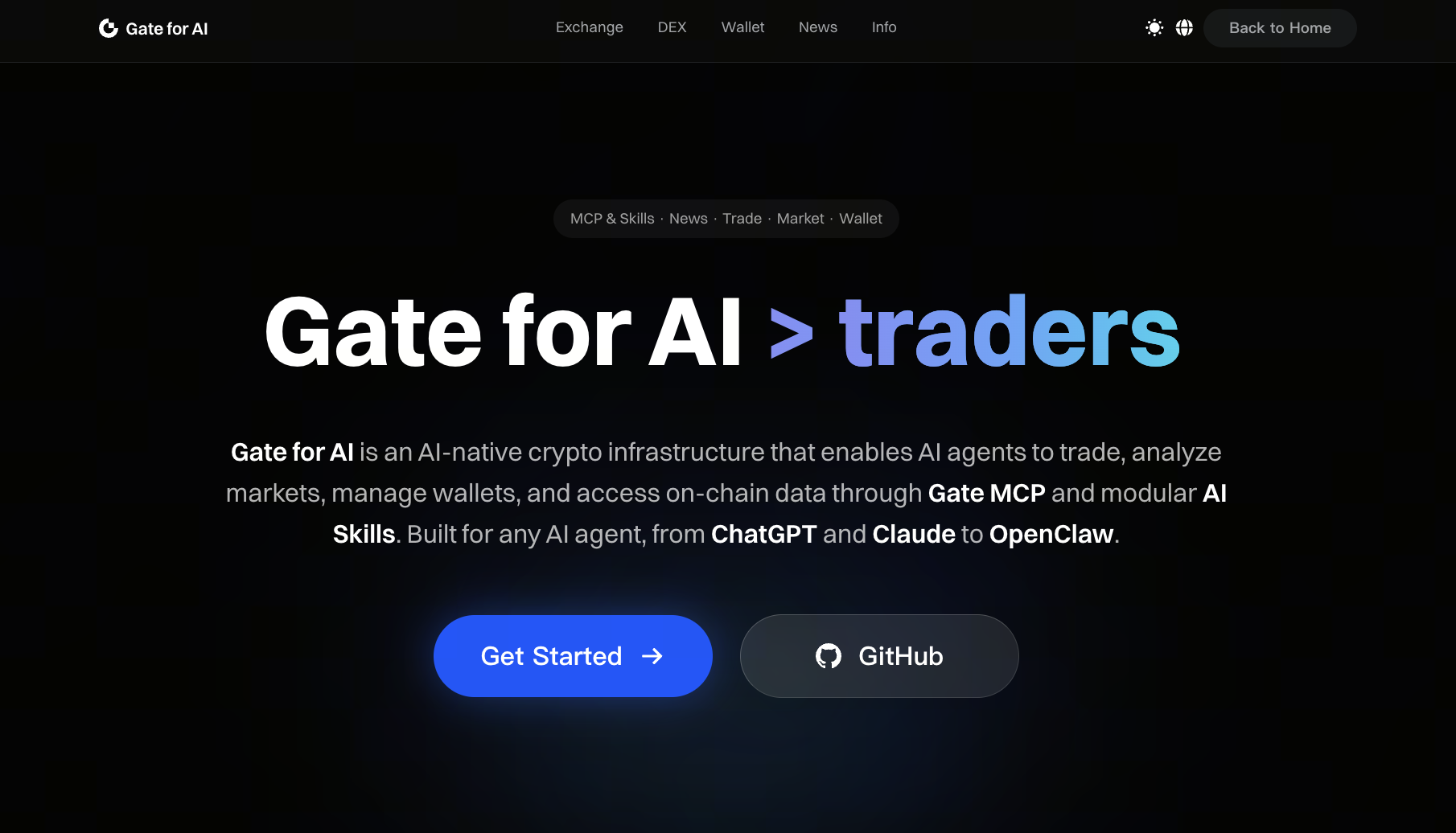 Image source: Gate for AI Official Website
As AI Agent technology advances, crypto platforms are exploring how to build infrastructure for intelligent agents. Gate’s Gate for AI aims to provide AI Agents with a trading and data environment. This framework enables AI to access market data, execute trades, and interact with crypto services more efficiently.
Gate for AI’s core concept is modularizing exchange functions, including:
-
Real-time market data
-
Trade execution interfaces
-
Wallet and asset management
-
Callable strategy and tool modules
This architecture lets developers build AI Agents that execute multi-step tasks in a unified environment, such as analyzing trends, setting strategies, and completing trades. From an industry perspective, this infrastructure means AI Agents could become new participants in the crypto market—not just support tools.
This trend also raises concerns, such as permissions management, automated trading risks, and possible market manipulation. Platforms must establish stricter security and risk controls as they develop the AI Agent ecosystem.
How Crypto Users Should Rationally Approach OpenClaw and Other Intelligent Agent Tools
For most users, OpenClaw may not immediately transform the crypto market, but it signals a new technological direction. In the short term, users should focus on safety and risk management—avoid granting AI wallet access lightly, and don’t blindly rely on automated strategies. As AI Agent technology matures, the crypto industry may explore new applications, such as automated investment tools or intelligent asset management.
OpenClaw is a technical signal: AI is shifting from an information tool to an execution tool. As AI becomes capable of genuine economic participation, the structure of crypto market participants may change.
Understanding this trend is likely more valuable than chasing short-term hype.
Related Articles

2026 Stablecoin Classification Deep Dive: From Fiat-Collateralized to Algorithmic Stablecoins, Market Landscape and Future Trends

What Are Fractional NFTs? Understanding the Mechanics of NFT Fractionalization and Its Real-World Use Cases

Top Telegram Games to Watch in 2026: The New Web3 Gaming Frontier and Investment Strategies

The Next 100x Coin? Low-Cap Crypto Gem Analysis

What Is Jupiter? A Complete Guide to Solana’s Leading Decentralized Exchange Aggregator
