


Oracle Stock Split History Deep Dive: ORCL Share Price Evolution and Investment Logic
What Is a Stock Split
A stock split is a common method used by publicly traded companies to adjust their share capital. In simple terms, a company divides its existing shares into a greater number of shares at a specified ratio. For example, a 2-for-1 split means each share an investor holds becomes two shares, and the price per share is halved. It’s important to emphasize that a stock split does not change the company’s total market value or affect the actual value of assets held by investors.
In the US stock market, stock splits primarily serve as structural and psychological adjustment tools. They lower the per-share price threshold, increase liquidity, and make it easier for more retail investors to participate in trading.
Oracle Stock Split History
Discussing Oracle’s stock split history means revisiting the company’s rapid growth from the 1980s through the early 2000s. During this period, Oracle frequently executed forward stock splits, typically at ratios of 2-for-1 or 3-for-2.
Between its first split in 1987 and its last in 2000, Oracle completed several stock splits. This era saw the company’s database business expand quickly and its share price rise steadily. As a result of frequent splits, early investors saw their share counts multiply significantly over the years, while the share price remained in a relatively accessible range.
Why Oracle Frequently Split Its Stock in the Early Years
Oracle’s frequent stock splits were closely tied to the market environment at the time. Technology stocks were experiencing rapid growth, and share prices climbed quickly. If the price became too high, trading activity could slow down. By splitting its stock, Oracle was able to lower the per-share price without affecting the company’s valuation.
Additionally, in the US market, stock splits are often seen as signals of management’s confidence in future growth. While a split doesn’t create intrinsic value, in a bull market it tends to reinforce positive expectations for the company’s prospects.
Finally, splitting the stock helps expand the investor base. Lower share prices allow more retail investors to participate, boosting overall liquidity.
The Practical Impact of Stock Splits on Oracle’s Share Price
Over the long term, stock splits have not been the decisive factor driving Oracle’s share price higher. The true drivers of sustained growth remain the company’s fundamentals: revenue growth, profitability, technological advantages, and market share.
In the short term, however, news of a split often leads to increased trading volume and heightened volatility. Some investors may engage in short-term trades around the split, amplifying price swings. This is why professional investors analyzing Oracle’s stock split history typically rely on adjusted price data rather than simply comparing nominal prices before and after splits.
Latest Share Price Trends and Market Focus
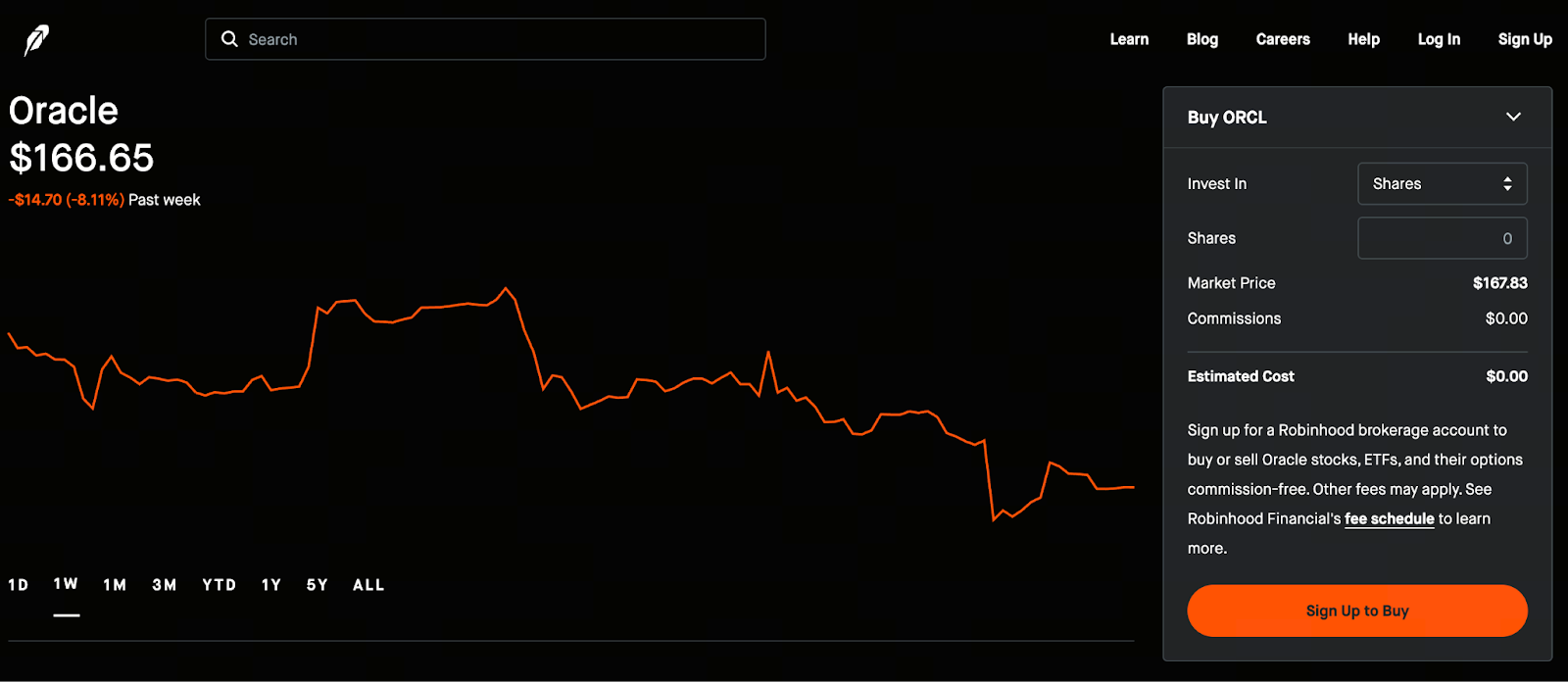
Chart: https://robinhood.com/us/en/stocks/ORCL/
Since 2025, Oracle’s share price has been shaped mainly by its cloud computing business, AI initiatives, and the broader valuation environment for technology stocks. Although there is occasional market speculation about another Oracle stock split, the company has not announced any new split plans as of now.
Historically, Oracle has not split its stock for many years, indicating a current focus on maintaining a stable capital structure and delivering shareholder returns, rather than stimulating market activity through splits.
A Rational Perspective on Oracle’s Stock Split History
For investors, Oracle’s stock split history is best used as a reference for understanding the company’s growth trajectory, not as a direct buy or sell signal. A split does not enhance the company’s intrinsic value, but it helps investors better grasp the logic behind long-term share price movements.
If you invest for the long term, focusing on Oracle’s business competitiveness, cash flow, and industry position is far more important than speculating about another stock split.
Related Articles
2026 Stablecoin Classification Deep Dive: From Fiat-Collateralized to Algorithmic Stablecoins, Market Landscape and Future Trends

What Are Fractional NFTs? Understanding the Mechanics of NFT Fractionalization and Its Real-World Use Cases
Top Telegram Games to Watch in 2026: The New Web3 Gaming Frontier and Investment Strategies

The Next 100x Coin? Low-Cap Crypto Gem Analysis

What Is Jupiter? A Complete Guide to Solana’s Leading Decentralized Exchange Aggregator
