


Prediction Markets Surge: Kalshi Raises Over $1B at a $22B Valuation, Signaling Accelerated Industry Expansion
Kalshi Funding Event Overview and Core Data
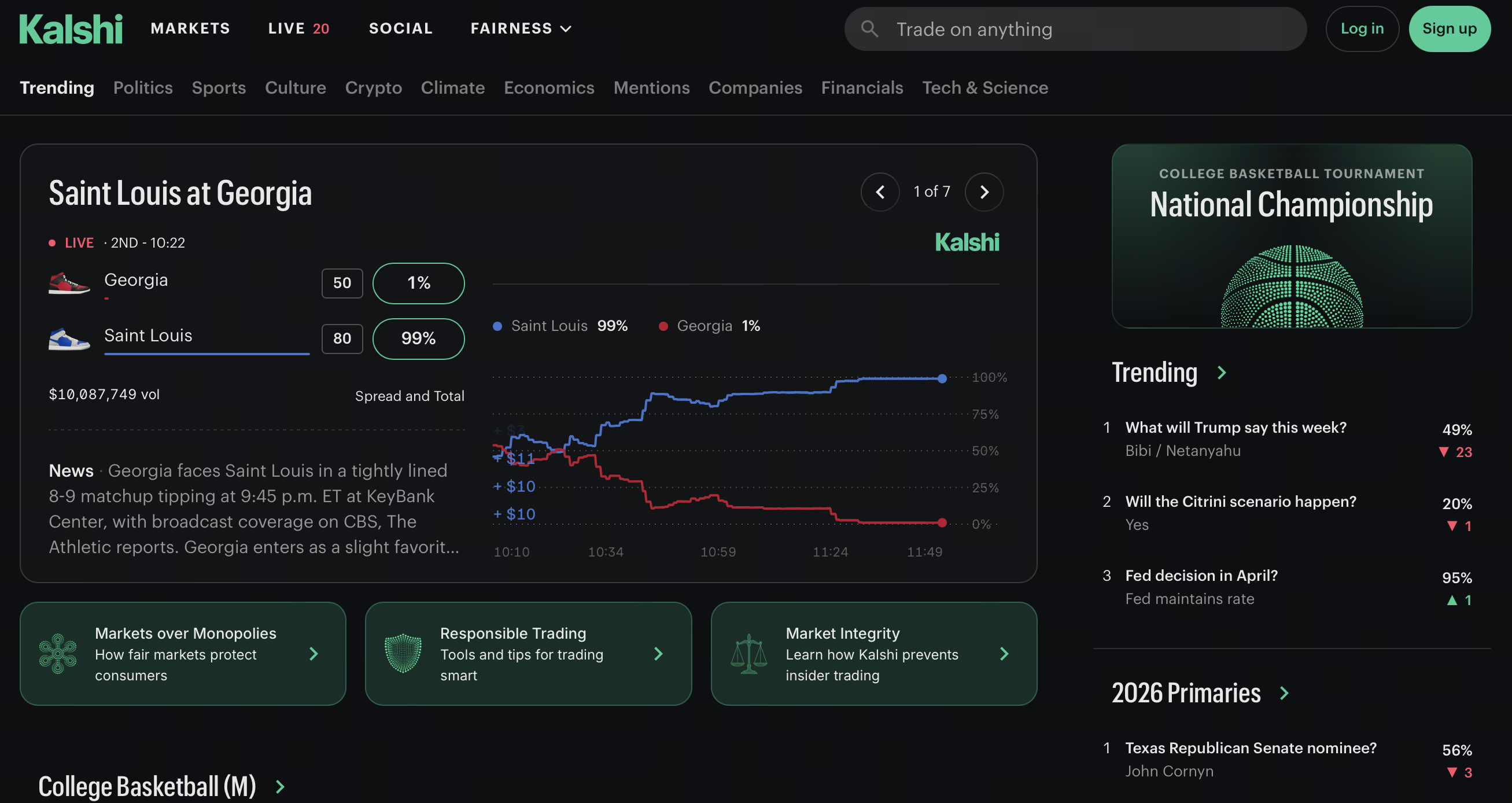 Image source: Kalshi official website
In March 2026, prediction market platform Kalshi announced a new funding round exceeding $1 billion, with its valuation reaching $22 billion—doubling from the previous round’s approximately $11 billion.
This round featured participation from several leading institutions, demonstrating strong capital market confidence in the prediction market sector. At the same time, Kalshi’s current annualized revenue has hit roughly $1.5 billion, signaling rapid maturation of its business model.
This valuation jump signifies not only the growth of a single company, but also the shift of prediction markets from niche financial instruments toward mainstream investment consideration.
What Are Prediction Markets? Business Model and Operating Mechanism
A prediction market is essentially a market mechanism where “the outcome of future events” is the trading target. Users can place bets or trade on the results of specific events, such as:
- Macroeconomic data (e.g., inflation, interest rates)
- Political events (election outcomes)
- Sports competitions
- Technology developments or social trends
The core logic is: “Price equals probability.” For example, if a contract for an event is priced at $0.70, the market implies a 70% probability. From a business perspective, prediction markets primarily generate revenue through:
- Transaction fees
- Market making and liquidity management
- Data services and monetization of information advantages
Unlike traditional gambling, prediction markets emphasize their “information aggregation function” and are regarded as efficient information discovery mechanisms.
Kalshi’s Rise: From Regulatory Breakthrough to Capital Favorite
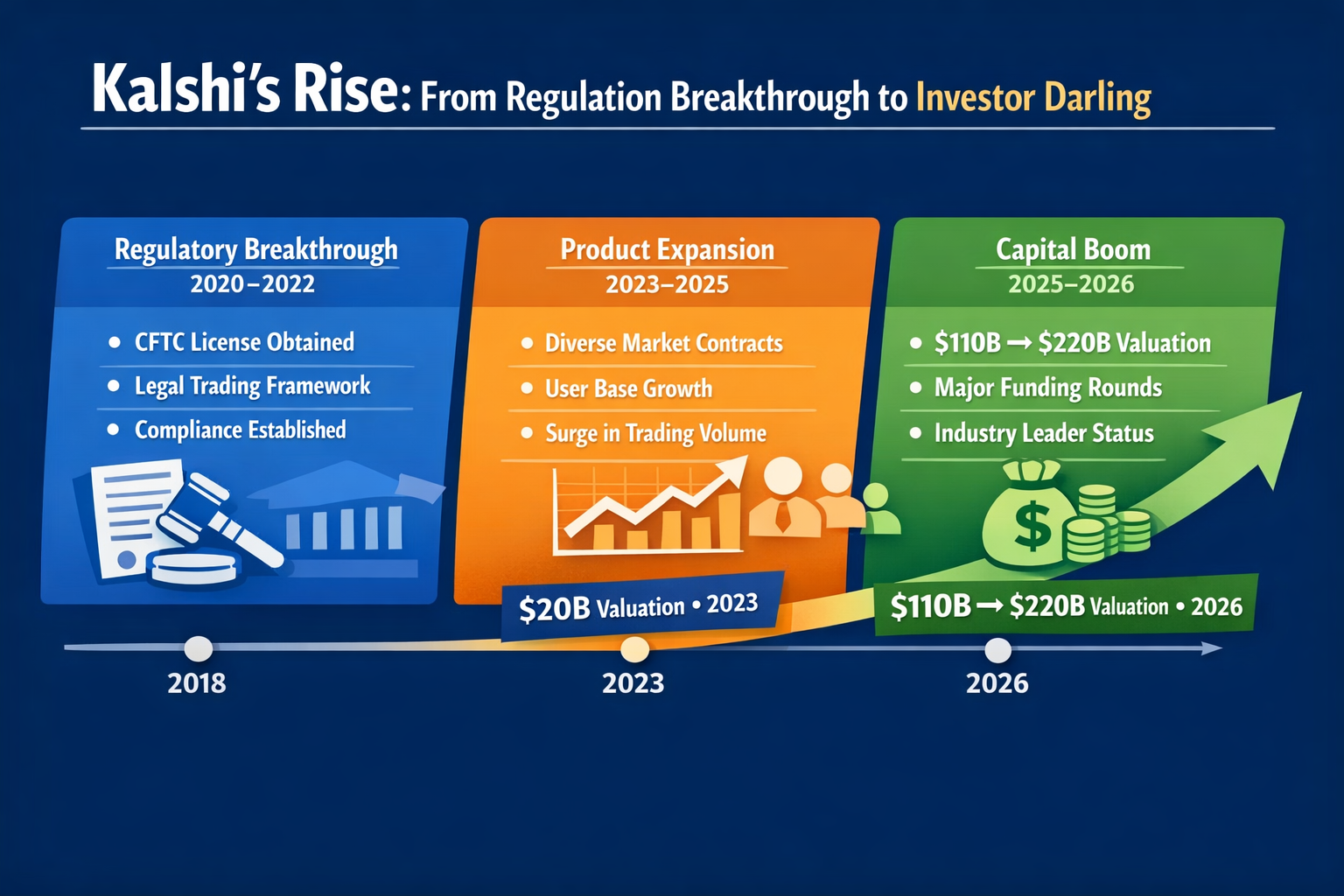
Founded in 2018, Kalshi is the first compliant prediction market platform in the US to secure approval from the Commodity Futures Trading Commission (CFTC).
Its development path can be divided into three stages:
-
Compliance Breakthrough Stage (2020–2022)
- Obtained regulatory approval
- Built a legal trading framework
- Integrated with traditional financial systems
-
Product Expansion Stage (2023–2025)
- Introduced diverse prediction contracts (economics, politics, sports)
- Rapid user growth
- Significant increase in annual trading volume
-
Capital Explosion Stage (2025–2026)
- Multiple funding rounds pushed valuation from $2 billion → $11 billion → $22 billion
- Revenue model stabilized
- Emerged as the industry leader
This trajectory shows that the core barriers for prediction markets are not technological, but rather regulation and liquidity.
Industry Landscape: Kalshi and Polymarket Form a Dual-Oligopoly
Industry data shows that prediction markets’ total trading volume exceeded $50 billion in 2025, with Kalshi and Polymarket accounting for more than 97.5% of the market share. This creates a distinct “dual-oligopoly”:
| Platform | Features |
|---|---|
| Kalshi | Compliant, US-focused |
| Polymarket | Crypto-native, global user base |
Their core differences are:
- Kalshi emphasizes regulatory compliance
- Polymarket emphasizes decentralization and openness
Key variables for future competition will include:
- Regulatory environment
- User growth rate
- Depth of liquidity
Why Is Capital Betting Heavily on Prediction Markets?
Kalshi’s latest funding round has drawn attention due to three structural advantages inherent to prediction markets:
- Information Pricing Capability: Prediction markets are considered more accurate than traditional polling, especially in elections and macro forecasts.
- High-Frequency Trading Attributes: Compared to traditional derivatives, prediction markets offer greater trading activity and participation.
- Potential Integration with AI: As AI technology advances, combining prediction models with market data may create new financial paradigms.
Additionally, the market highly recognizes the trend of “financialization of information”: In the future, not only assets but also “cognition and expectations” themselves will become tradable objects.
Regulation and Compliance: The Biggest Variable Behind Growth
Despite rapid growth, prediction markets still face significant regulatory risks.
Kalshi has encountered regulatory challenges such as:
- Whether its activities constitute gambling
- Whether it involves sensitive political events
- Whether there is a risk of insider trading
For example:
- Several US states have imposed restrictions on its business
- Some prediction contracts have sparked ethical controversies
Regulatory uncertainty means that prediction markets’ growth ceiling largely depends on policy boundaries. This is the main reason Kalshi has chosen the “compliance route.”
Future Trends: Will Prediction Markets Become Mainstream Financial Infrastructure?
Current trends indicate that prediction markets are gradually evolving from “experimental tools” to “financial infrastructure”:
Short Term (1–2 years)
- Continued growth in user base
- Deep integration with crypto markets
- Emergence of new application scenarios
Medium Term (3–5 years)
- Integration with traditional financial markets
- Becoming a risk hedging tool
- Increasing value of data
Long Term (5–10 years)
- Serving as an auxiliary tool for macro decision-making
- Combining with AI to form a “prediction economy”
- Potentially reshaping information pricing systems
However, all of this still depends on two key variables:
- Whether regulation becomes more open
- Whether the market possesses sufficient depth and trust
Summary
Kalshi’s completion of over $1 billion in funding and a $22 billion valuation marks a major milestone in the history of prediction market development. This represents not only the success of a single platform, but also the shift of prediction markets from the margins to the mainstream. Driven by capital, technology, and market demand, prediction markets have the potential to become an important part of next-generation financial infrastructure. At the same time, regulatory and ethical issues remain critical hurdles.
In the future, whether prediction markets can truly “use markets to predict the future” will be one of the most important long-term questions in the financial technology sector.
Related Articles

2026 Stablecoin Classification Deep Dive: From Fiat-Collateralized to Algorithmic Stablecoins, Market Landscape and Future Trends

What Are Fractional NFTs? Understanding the Mechanics of NFT Fractionalization and Its Real-World Use Cases

Top Telegram Games to Watch in 2026: The New Web3 Gaming Frontier and Investment Strategies

The Next 100x Coin? Low-Cap Crypto Gem Analysis

What Is Jupiter? A Complete Guide to Solana’s Leading Decentralized Exchange Aggregator
