Talus Network: Building a Decentralized Layer 1 Ecosystem for AI Agents
As generative AI and large language models rapidly become mainstream, the market focus is shifting from merely deploying AI applications to the development of autonomous AI Agents. These intelligent agents must possess not only advanced reasoning capabilities, but also trustworthy execution environments, transparent resource management, and the ability to collaborate across platforms. Nonetheless, most current AI systems remain highly dependent on centralized cloud architectures, with ongoing challenges such as data ownership, model transparency, and resource allocation efficiency.
In this context, Talus Network seeks to reengineer AI infrastructure with a fundamentally Web3-native approach. Rather than just deploying AI on a blockchain, Talus is building a Layer 1 network dedicated to serving AI Agents from the ground up—enabling autonomous operation, verifiable transactions, cross-chain collaboration, and on-chain governance. As a result, Talus has emerged as a key player among the new wave of foundational projects at the intersection of AI and blockchain integration.
What Is Talus Network?
 (Source: TALUS)
Talus Network is a decentralized Layer 1 blockchain tailored for AI Agents, with the primary objective of building foundational infrastructure that supports the autonomous operation, collaboration, and transactions of intelligent agents. Unlike conventional AI platforms, Talus positions blockchain as the execution and coordination layer for AI Agents. With on-chain smart contracts and cross-chain communication mechanisms, AI Agents can make decisions and trade resources in a reliable environment.
Talus chooses Move as its smart contract language and integrates the modular architecture of the Cosmos ecosystem, striking a balance between high performance, security, and scalability. This makes it possible for Talus to support a high volume of concurrent AI Agents and empowers developers to more efficiently launch applications and protocols related to AI resources.
Talus Network Funding and Team Background
Founded in 2023, Talus has rapidly secured several rounds of venture backing. In February 2024, the project closed a $3 million seed round led by Polychain Capital, with additional investments from Hash3, dao5, TRGC, WAGMI Ventures, and Inception Capital.
By November 2024, Talus closed another $6 million funding round, increasing its valuation to $150 million. Alongside continued investment from Polychain Capital, Foresight Ventures, Animoca, Geek Cartel, and Echo participated. The project has also attracted major contributors from the blockchain and AI fields, including Polygon Co-Founder Sandeep Nailwal, Symbolic Capital Co-Founder Kenzi Wang, 0G Labs CEO Michael Heinrich, and Allora Labs CEO Nick Emmons.
Founder Mike Hanono comes from an applied data science background and has experience with DeFi backend development. COO Ben Frigon was actively involved in Blockchain@Brown's blockchain education programs and has built expertise at Distributed Global and Movement Labs. The Talus team brings together deep technical and operational experience in AI, blockchain infrastructure, and Web3 ecosystems.
Core Architecture of Talus Network
 (Source: TALUS)
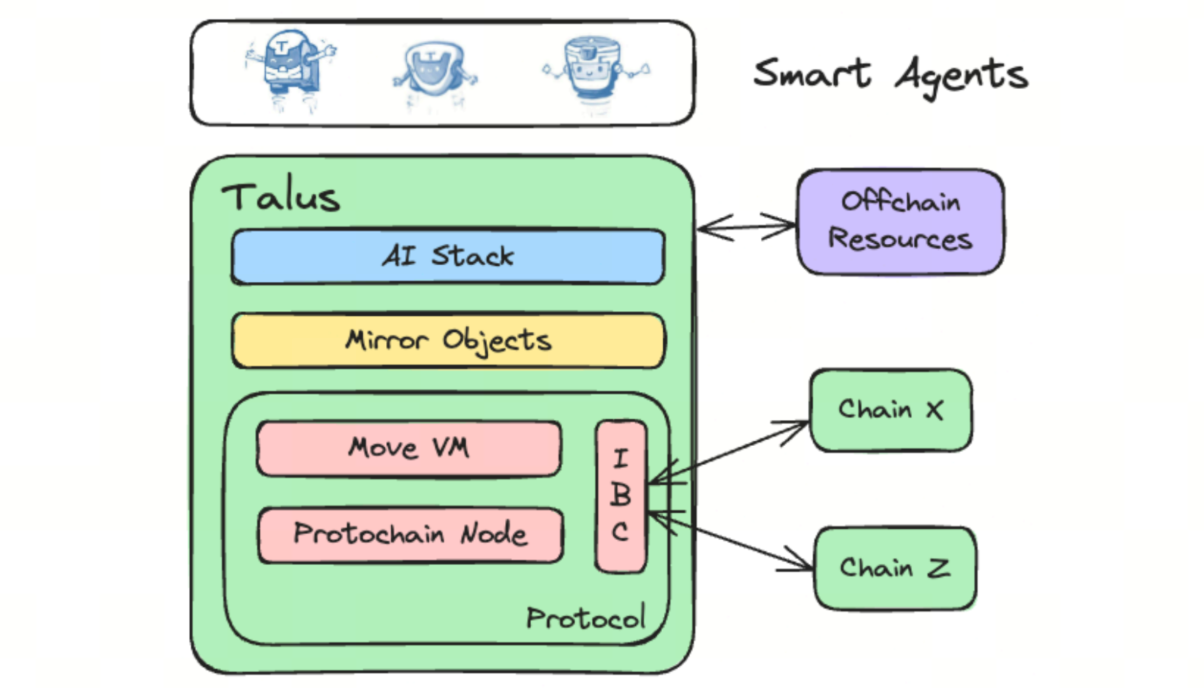
Talus employs a layered architecture composed of multiple modules that collectively establish a robust execution environment for AI Agents. Its system comprises the foundational protocol layer, Mirror Objects mechanism, AI technology stack, and the upper-tier Smart Agent.
Protochain Node and Consensus Layer
At its core, Talus relies on Cosmos SDK and CometBFT, adopting a proof-of-stake consensus mechanism. Cosmos SDK offers modularity and scalability, allowing Talus to tailor blockchain capabilities to the needs of AI Agents. CometBFT provides both consensus and network security, facilitating efficient node synchronization and system stability. The advantage of this architecture is its flexibility—if computing requirements for AI Agents grow, Talus can expand functionality on a modular basis without having to redesign its core network.
Move VM: Security and Parallel Processing
Talus has adopted Sui Move as its smart contract language primarily for its stringent asset ownership and state management. Compared with traditional smart contract languages, Move dramatically mitigates risks such as asset duplication and unauthorized transfers. Moreover, Move VM supports efficient concurrent transaction execution, essential for an AI Agent ecosystem. When numerous agents conduct transactions, manage resources, or call models simultaneously, Move VM’s parallelism substantially increases throughput while upholding security and data integrity on-chain.
IBC: Enabling Cross-Chain Collaboration for AI Agents
The Inter Blockchain Communication Protocol (IBC) is a cornerstone cross-chain standard within the Cosmos ecosystem. By integrating IBC, Talus enables AI Agents to operate beyond a single blockchain, seamlessly interacting with assets, data, and services on other chains.
For instance, an AI Agent might pull market data from one chain, execute trades on another, and synchronize results back to the Talus network. This kind of cross-chain operability is vital for DeFi, data marketplaces, and AI model services, positioning Talus as a true decentralized coordination layer for AI.
Mirror Objects: On-Chain Representation for Off-Chain Resources
Modern AI systems frequently depend on off-chain resources such as models, hashrate, datasets, and external APIs. The Mirror Objects mechanism lets Talus establish verifiable on-chain representations of these resources. Developers gain tools to prove asset uniqueness, record ownership, and manage transactions, transforming previously hard-to-manage AI resources into traceable and tradable blockchain assets. This approach not only builds a transparent AI resource marketplace but also limits centralized platforms’ control over critical resources.
Talus AI Stack: All-In-One Toolkit for AI Agent Development
Beyond its core blockchain, Talus delivers a specialized technology stack for AI Agents. The SDK supports cross-language and cross-system development, including basic data schemas, smart contract templates, and on-chain APIs. Developers can leverage Talus modules to quickly build chatbots powered by large language models, data analysis agents, or automated trading agents—without the overhead of integrating on-chain and off-chain logic from scratch. Talus also offers integration with large language models, oracles, and diverse off-chain services, allowing agents to access real-time external data and make informed decisions.
Smart Agent: Web3-Native Autonomous Intelligence
Talus defines its intelligent agents as Web3-native entities characterized by autonomy, sociability, reactivity, and proactivity. Autonomy means AI Agents can operate without constant human oversight, with verifiable decision processes logged in smart contracts. Sociability enables agent-to-agent cooperation via on-chain transactions and contracts. Reactivity gives agents the ability to monitor both on-chain and off-chain events and adapt in real time to market shifts and environmental changes. Proactivity allows agents to analyze trends, forecast future conditions, and act in advance. Through this architecture, Talus Agents transcend basic automation and become collaborative, continuously operating intelligent actors in a decentralized ecosystem.
Talus Network Use Cases
Because Talus emphasizes intelligent agents and coordinated resource management, its range of use cases is broad. In DeFi, AI Agents support risk monitoring, liquidity management, and strategy optimization. In DAO governance, agents can participate in proposal analysis, resource distribution, and automated execution of governance tasks. In IoT environments, AI Agents orchestrate energy and bandwidth allocation between devices. For gaming and SocialFi, agents enable dynamic content creation, virtual economy management, and seamless asset transfers across platforms. Talus is also well suited for data and AI collaboration scenarios: model developers, data providers, and hashrate suppliers can forge transparent partnerships through on-chain mechanisms, with intelligent agents matching resources and allocating value autonomously.
TAI Token: Function and Purpose
TAI is the core utility token for the Talus ecosystem, underpinning the AI Agent economy. On Talus, AI Agent operations, procurement of resources, and service transactions all utilize TAI. Hashrate suppliers, data providers, and model developers can earn TAI for their contributions. TAI also plays a role in PoS staking and maintaining network security—token holders can participate in consensus and receive rewards. Additionally, TAI supports governance: in the future, holders will vote on protocol upgrades, parameter changes, and overall ecosystem direction. Since the full tokenomics details have yet to be released, specifics such as supply, release schedule, and distribution will be announced by the team at a later date.
Talus Network’s Role in the AI and Web3 Landscape
While AI remains a top narrative in the market, most projects focus on the model, application, or data layers. Talus is differentiated by its ambition to serve as core infrastructure for AI Agents. The Move VM ensures security and high performance; Cosmos SDK and IBC provide cross-chain scalability; and Mirror Objects plus the AI Stack address the integration of off-chain resources. This approach culminates in a technical platform purpose-built for intelligent agents. Should AI Agents form the backbone of the Web3 ecosystem, a Layer 1 network like Talus could emerge as a critical infrastructure for AI-blockchain convergence.
Summary
Talus Network is more than just another “AI chain”—it is a decentralized platform purpose-built for AI Agents, encompassing every layer from base architecture to developer tooling. By blending Move security, the modularity of Cosmos, and cross-chain operability via IBC, Talus aims to resolve core challenges of transparency, resource management, and coordinated efficiency within AI. Its funding, robust architecture, specialized AI Stack, and Smart Agent design reflect its mission to deliver scalable, verifiable Web3 infrastructure for large-scale agent deployment. While key aspects of TAI’s tokenomics are still forthcoming and the ecosystem is evolving, Talus has carved out a strong technical position and is attracting increasing market attention as the convergence of AI Agents and Web3 gathers momentum.
FAQ
1. How does Talus Network differ from conventional AI blockchains?
Talus is more than a platform for deploying AI applications—it is a dedicated Layer 1 built for AI Agents, optimizing for agent autonomy, coordinated resource management, and seamless cross-chain interactions.
2. Why is Move VM important for Talus?
Move VM enforces stricter asset management and offers parallel transaction processing, making it uniquely suited for ecosystems with large numbers of concurrently operating AI Agents.
3. What is the current use of the TAI token?
TAI is used for agent operations, resource procurement, network staking, and governance. The full details of the tokenomics and supply will be announced in future official communications by Talus.
Related Articles

Will Sidra Break $1,000? A Realistic Look at Sidra Chain Price Claims in 2026–2027
BlockDAG (BDAG): A High-Speed and Secure Layer 1 for the Next Era
Rising Prices but Bearish Funding Rates: Is Crypto Entering a “Layered Bull Market” After Wall Street Capital Inflows?
Fractional NFTs: Lowering Barriers and Enhancing Liquidity
What is USDC? A Complete Guide to One of the Most Trusted Stablecoins