


Velodrome Finance Latest Developments and Price Analysis: Impact of the Aero Merge Explained
Velodrome Finance Overview
Velodrome Finance (Velodrome) is a decentralized exchange (DEX) and automated market maker (AMM) protocol built on the Optimism Superchain. It leverages a vote-escrow (ve) mechanism to encourage long-term token locking and active governance participation. By locking VELO tokens into veVELO, users gain voting rights, share in trading fees, and receive incentives, all of which drive liquidity growth and deepen market activity. Velodrome supports both stable and volatile liquidity pools, allowing for a range of trading strategies and yield models.
VELO Price and Market Performance
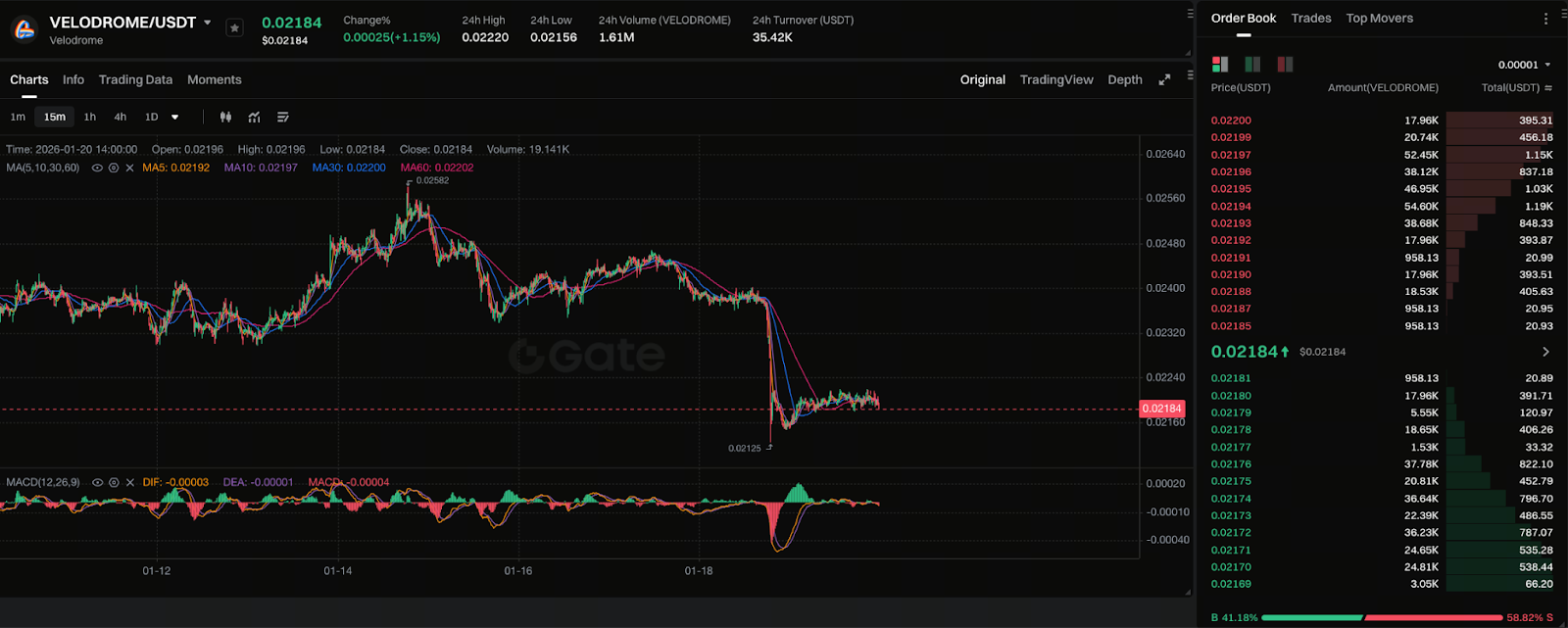
Chart: https://www.gate.com/trade/VELODROME_USDT
As of January 20, 2026, Velodrome Finance (VELO) trades at approximately $0.006. Fiat pairs such as VELODROME/EUR and VELODROME/IQD show similarly low price levels, with notable short-term volatility.
Despite this, VELO has established a solid foundation in cumulative trading volume and total value locked across the DeFi ecosystem. In mid-2025, Velodrome emerged as a leading DEX on the Optimism Superchain, with total trading volume exceeding tens of billions of dollars, demonstrating strong ecosystem resilience.
Latest Update: Velodrome and Aerodrome Merge into Aero
In recent DeFi news, Aero—a unified platform launched by the Velodrome and Aerodrome development team, Dromos Labs—has captured industry attention. According to official statements and multiple media outlets, Aerodrome and Velodrome will merge into a single cross-chain DEX called Aero in Q2 2026, with initial deployment on the Ethereum mainnet and Circle’s Arc Chain, while maintaining support for Base, Optimism, and other existing chains.
The merger will consolidate existing AERO and VELO tokens into a new primary AERO token, with allocation based on current yields and historical contributions: roughly 5.5% for VELO holders and 94.5% for AERO holders, with no new tokens issued.
This transition means Velodrome will no longer operate as an independent brand, instead integrating into a broader cross-chain ecosystem. The merger announcement led to a short-term drop in VELO and AERO token prices, reflecting market uncertainty over the consolidation.
Core Mechanisms and Competitive Advantages of Velodrome
Velodrome’s core design combines traditional AMM liquidity with governance participation. Through veVELO locking and voting, the protocol engages its community, boosting long-term stability and capital efficiency. Velodrome assigns differentiated reward weights to trading pairs, channeling liquidity to high-value or high-demand pools, reducing slippage, and increasing returns.
Compared to other DEXs, Velodrome offers several key advantages:
- Low transaction costs, thanks to Optimism’s Layer 2 scalability;
- Long-term incentive structures via veVELO voting-weighted rewards;
- Diverse liquidity pool support for both stablecoins and volatile assets.
Potential Impact of the Merger on VELO Holders
The Aero merger aims to eliminate fragmented liquidity across multiple chains, improving overall trading depth and capital efficiency. However, VELO holders will be affected as their tokens convert to AERO. Holders should monitor new token allocation, locking periods, and governance rights. The initial merger phase may see significant short-term volatility due to arbitrage and price discovery, requiring investors to adopt robust risk management and strategic planning.
Following the merger announcement, both VELO and AERO experienced a short-term price decline of around 20%, indicating that the market has yet to fully absorb the merger’s implications and that uncertainty remains.
Investor Advisory and Risk Notice
Both Velodrome and Aero face ongoing technical and market risks. Users should avoid accessing DEX interfaces via unverified or phishing URLs. Recently, official Aerodrome and Velodrome domains have encountered front-end security incidents, so using decentralized mirror sites is recommended for risk mitigation.
DeFi protocol mergers also typically involve complex processes such as smart contract migration and token consolidation, which may result in temporary liquidity disruptions and changes in reward mechanisms.
Summary
Velodrome Finance is a core liquidity protocol within the Optimism ecosystem, distinguished by its governance incentives and low transaction costs. As DeFi competition intensifies and protocol mergers accelerate, VELO’s future will be shaped within the larger cross-chain DEX ecosystem of Aero. Investors should track price movements while understanding the protocol’s long-term strategy and associated risks.
Related Articles
2026 Stablecoin Classification Deep Dive: From Fiat-Collateralized to Algorithmic Stablecoins, Market Landscape and Future Trends

What Are Fractional NFTs? Understanding the Mechanics of NFT Fractionalization and Its Real-World Use Cases
Top Telegram Games to Watch in 2026: The New Web3 Gaming Frontier and Investment Strategies

The Next 100x Coin? Low-Cap Crypto Gem Analysis

What Is Jupiter? A Complete Guide to Solana’s Leading Decentralized Exchange Aggregator
