What Is Compound? A Complete Guide to COMP and Compound III Decentralized Lending
One of the cornerstones of decentralized finance (DeFi) is the use of blockchain and smart contracts to reimagine traditional financial services, with lending standing out as one of the sector's most mature use cases. Compound was one of the early protocols that played a significant role in advancing the DeFi lending market. Unlike traditional banks, which depend on centralized institutions to review, record, and administer loans, Compound embeds processes such as fund management, interest rate calculations, collateral management, and liquidations into smart contracts. This enables users to lend and borrow directly through on-chain protocols.
Compound's architecture, however, has evolved beyond the early liquidity pool model. From Compound v1 to v2 and now Compound III (Comet), the protocol has progressively refined its asset, risk, and lending mechanisms. Compound III places greater emphasis on a single Base Asset as the primary borrowing and lending asset while isolating the risks associated with different collateral assets. This helps limit the impact that a problem involving one asset or market can have on the protocol as a whole. As of 2026, Compound III has been deployed across multiple EVM-compatible networks and offers markets with different Base Assets, showing how Compound has evolved from an early DeFi lending protocol into modular on-chain money market infrastructure.
Compound's Decentralized Lending Infrastructure
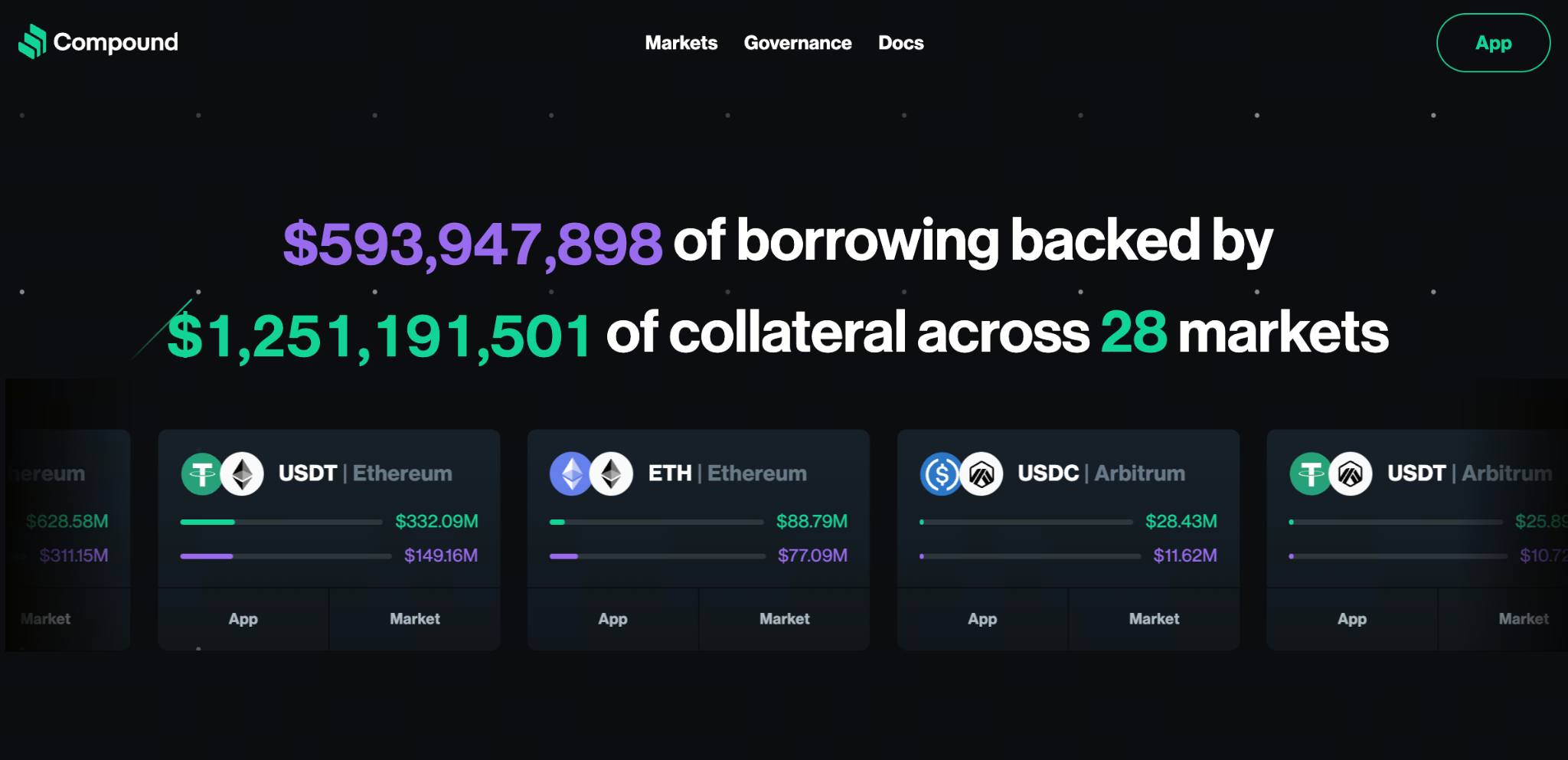 (Source: compound.finance)
Compound is a decentralized money market protocol built on blockchain. Its core premise is to use smart contracts to assume some of the functions traditionally handled by financial institutions, including capital allocation, interest rate calculation, and loan administration. Users do not need to submit credit information to a bank or undergo manual approval. They can interact directly with the protocol's smart contracts through their wallets.
At the infrastructure level, Compound is not a system in which a single company directly safeguards all user funds. Assets are deposited into markets controlled by smart contracts, while borrowing, repayment, supply, withdrawal, and collateral management are executed according to on-chain code. This model makes transaction data and asset states verifiable on the blockchain while reducing dependence on centralized intermediaries.
Compound's core architecture can be understood through three main dimensions.
-
Decentralized control: Compound's protocol parameters and upgrades are primarily managed through governance. COMP holders and their delegates can submit and vote on proposals instead of leaving all market rules to a single administrator. Compound III's governance structure is controlled by COMP holders and delegates, with mechanisms such as Governor and Timelock used to execute protocol changes approved by the community.
-
Blockchain-based execution: Lending activity and asset states are recorded on-chain, allowing users to review relevant data through blockchain explorers and the protocol interface. Smart contracts execute core functions such as asset supply, borrowing, interest accrual, and liquidation.
-
Parameter-based risk management: Compound does not simply allow users to "borrow as much as they deposit." Instead, it manages lending risk through collateral factors, liquidation thresholds, asset caps, and price oracles. Compound III goes further by assigning independent parameters to different collateral assets, including Borrow Collateral Factor, Liquidation Collateral Factor, and Supply Cap.
This is the key to understanding Compound: it is not a traditional bank, but on-chain financial infrastructure built from smart contracts, asset markets, oracles, liquidation mechanisms, and DAO governance.
Compound Platform Core Functions
Compound's core functions revolve around supplying assets, collateralized borrowing, and interest rate markets, although the product logic differs substantially between versions. In the earlier Compound v1 and v2, users could deposit supported assets into different markets and earn interest. Users seeking liquidity could provide collateral and borrow assets from other markets.
Each asset in Compound v2 was represented by a cToken, such as cDAI or cUSDC. After depositing an asset, users received the corresponding cToken. Its exchange rate increased as interest accrued, allowing users to earn returns through changes in the exchange rate. Compound III (Comet), however, introduced a major architectural change. Compound's official documentation defines Compound III as an EVM-compatible protocol that allows users to provide crypto assets as collateral and borrow a Base Asset. The earliest Compound III deployments used USDC as the Base Asset, and the protocol has since expanded to additional Base Asset markets.
Asset supply: Users can deposit Base Assets into Compound III and earn a supply rate based on market utilization. When users supply collateral assets, the primary benefit is increased borrowing capacity—not the direct supply interest generated by Base Assets.
Collateralized borrowing: Users can deposit eligible collateral and borrow the Base Asset designated for that market. For example, in a USDC Base market, USDC is the primary lending asset, while WBTC, WETH, and other assets may serve as collateral depending on the market configuration. Each asset has its own collateral factor, so the amount a user can borrow is limited by the value of the collateral and the applicable risk parameters.
Dynamic interest rates: Compound III's borrowing rates are tied to Base Asset utilization. As borrowing demand and utilization increase, borrowing rates also rise. Some interest rate models include a "Kink" range, after which rates rise more quickly once utilization exceeds a specified level. This encourages the market to restore liquidity balance. Interest accrues continuously based on block time.
Single Base Asset design: One of the primary differences between Compound III and Compound v2 is that each Comet market uses a single Base Asset as its primary lending asset. This design reduces cross-asset risk and makes the market's risk parameters easier to understand. For example, one market may focus on USDC lending, while another may use an independent risk model for USDT, WETH, or other assets.
Overcollateralization and automatic liquidation: Compound lending is not unsecured credit. When the value of an account's collateral is no longer sufficient to maintain a safe position, the protocol restricts additional borrowing and may initiate liquidation. Compound III likewise uses collateral factors and liquidation-related parameters to manage lending risk, keeping borrowing levels and collateral values within the range accepted by the protocol.
In short, Compound III can be viewed as "an on-chain money market centered on a specific Base Asset, collateralized by multiple crypto assets, with interest rates and risks managed automatically by smart contracts."
The Role of the COMP Governance Token
COMP is the native ERC-20 governance token of the Compound ecosystem. Its primary function is not to serve as a required asset for lending, but to enable token holders to participate in Compound protocol governance. Within Compound's governance structure, COMP holders can delegate voting power to themselves or other addresses and participate in decisions concerning protocol parameters, asset markets, feature upgrades, and fund allocation. Compound III's governance mechanism combines components such as Governor, Timelock, and Configurator. Relevant protocol parameters and market settings can be modified only after governance approval.
Governance and decision-making: COMP holders can vote on protocol proposals, including adding markets, adjusting collateral parameters, modifying interest rate models, changing asset settings, and implementing other protocol upgrades. This means Compound's core rules are not entirely controlled by a single development team, but are established progressively through on-chain governance.
Token supply: COMP has a total supply of 10 million tokens. COMP's original design also included token incentives for protocol users, with governance-approved distribution mechanisms used to encourage participation in lending markets.
However, it is important to distinguish between the COMP governance token and lending returns. Using Compound does not guarantee that users will receive COMP. Actual reward distributions and rates depend on governance decisions and the configuration of each market. Compound III also has an independent Protocol Rewards mechanism that tracks reward accrual for Base Asset suppliers and borrowers, while the protocol can configure the specific reward token. Compound's governance history also highlights the practical challenges faced by DAOs. In 2024, Compound Proposal 289 sparked controversy over an alleged governance attack because it involved the allocation of approximately 499,000 COMP and ultimately passed by a relatively narrow margin. The incident drew greater attention to issues such as governance token concentration, low voter participation, and whether large token holders can influence DAO decisions. Accordingly, the value of COMP extends beyond voting power itself. It reflects a fundamental question in DeFi governance: when control of a protocol is placed in the hands of token holders, how can the ecosystem balance open participation, governance efficiency, and protection against governance attacks?
Transaction Security and Fund Protection
Compound's security relies primarily on a multilayered architecture involving smart contracts, collateral management, price oracles, liquidation mechanisms, and governance controls. Decentralization, however, does not mean that assets are risk-free. Users must still understand the risks associated with smart contracts, market volatility, liquidation, and governance.
Public- and private-key mechanisms: Users interact with Compound's smart contracts through their own Web3 wallets, and transactions must be signed and confirmed by the wallet holder. Compound does not require users to provide their wallet private keys to the platform, so users retain primary control over their assets.
Price oracles: Lending protocols need access to the real-time market value of collateral to determine whether an account satisfies borrowing requirements. Compound III configures price data sources for each market, while on-chain price information supports collateral valuation and related risk management. The official documentation also provides interfaces for the prices of Base Assets and collateral assets.
Collateral and liquidation mechanisms: Compound III assigns parameters such as Borrow Collateral Factor and Liquidation Collateral Factor to different collateral assets. If an account's collateral value is insufficient to support its borrowing, the user may face liquidation. As a result, borrowers can suffer asset losses during a sharp market decline even when the protocol itself continues to operate normally.
Supply Cap and risk isolation: Compound III sets a Supply Cap for collateral assets to limit the amount of a given asset that can enter the protocol and reduce the excessive accumulation of single-asset risk. Different Base Asset markets also use relatively independent designs, meaning that a problem in one market does not necessarily spread directly to every other market.
Governance and emergency controls: Compound III's governance architecture also includes mechanisms such as Timelock and Pause Guardian. According to the official documentation, Pause Guardian can suspend certain protocol functions if an unexpected vulnerability emerges, including supplying, transferring, withdrawing, absorbing assets, and purchasing collateral. This provides an additional layer of risk control.
Therefore, Compound should not be described simply as "safe because it uses smart contracts." A more accurate assessment considers smart contract risk, oracle risk, liquidation risk, liquidity risk, and DAO governance risk, among other factors. DeFi's core advantage is its reduced reliance on centralized intermediaries, but that advantage also means users must assume more market- and protocol-level risk.
Conclusion
Compound is one of the most representative protocols in the history of DeFi lending. From the early Compound v1, to the more feature-complete Compound v2, and now to the architecture centered on Compound III (Comet), Compound's product design has gradually shifted from a multi-asset lending market toward a model focused more heavily on asset isolation, risk parameters, and capital efficiency. Compound v2's cToken mechanism was once a foundational design in DeFi lending. Compound III has taken this evolution further by centering each market on a single Base Asset, allowing users to borrow a designated base asset against different crypto assets while controlling market risk through utilization-driven interest rate models, collateral factors, Supply Caps, price oracles, and liquidation mechanisms.
COMP, meanwhile, gives token holders and delegates authority over protocol governance, allowing the community to participate in key decisions involving market parameters, asset support, and protocol upgrades. Compound's governance history also shows that DAOs are not inherently secure: concentrated voting power and low participation can themselves become sources of protocol risk. Compound is therefore worth examining not merely for whether users can earn interest through DeFi lending, but for how Compound III separates lending markets into distinct Base Asset ecosystems and uses more granular risk parameters to build scalable on-chain financial infrastructure. For anyone seeking to understand DeFi lending, overcollateralization, DAO governance, and the design of on-chain financial markets, Compound remains a highly representative case study.
Related Articles

Will Sidra Break $1,000? A Realistic Look at Sidra Chain Price Claims in 2026–2027
BlockDAG (BDAG): A High-Speed and Secure Layer 1 for the Next Era

Rising Prices but Bearish Funding Rates: Is Crypto Entering a “Layered Bull Market” After Wall Street Capital Inflows?

Fractional NFTs: Lowering Barriers and Enhancing Liquidity
What is USDC? A Complete Guide to One of the Most Trusted Stablecoins