


What Is the Bitcoin Stock-to-Flow (S2F) Model? Understanding Bitcoin Through Scarcity
What Is the Stock-to-Flow (S2F) Model?
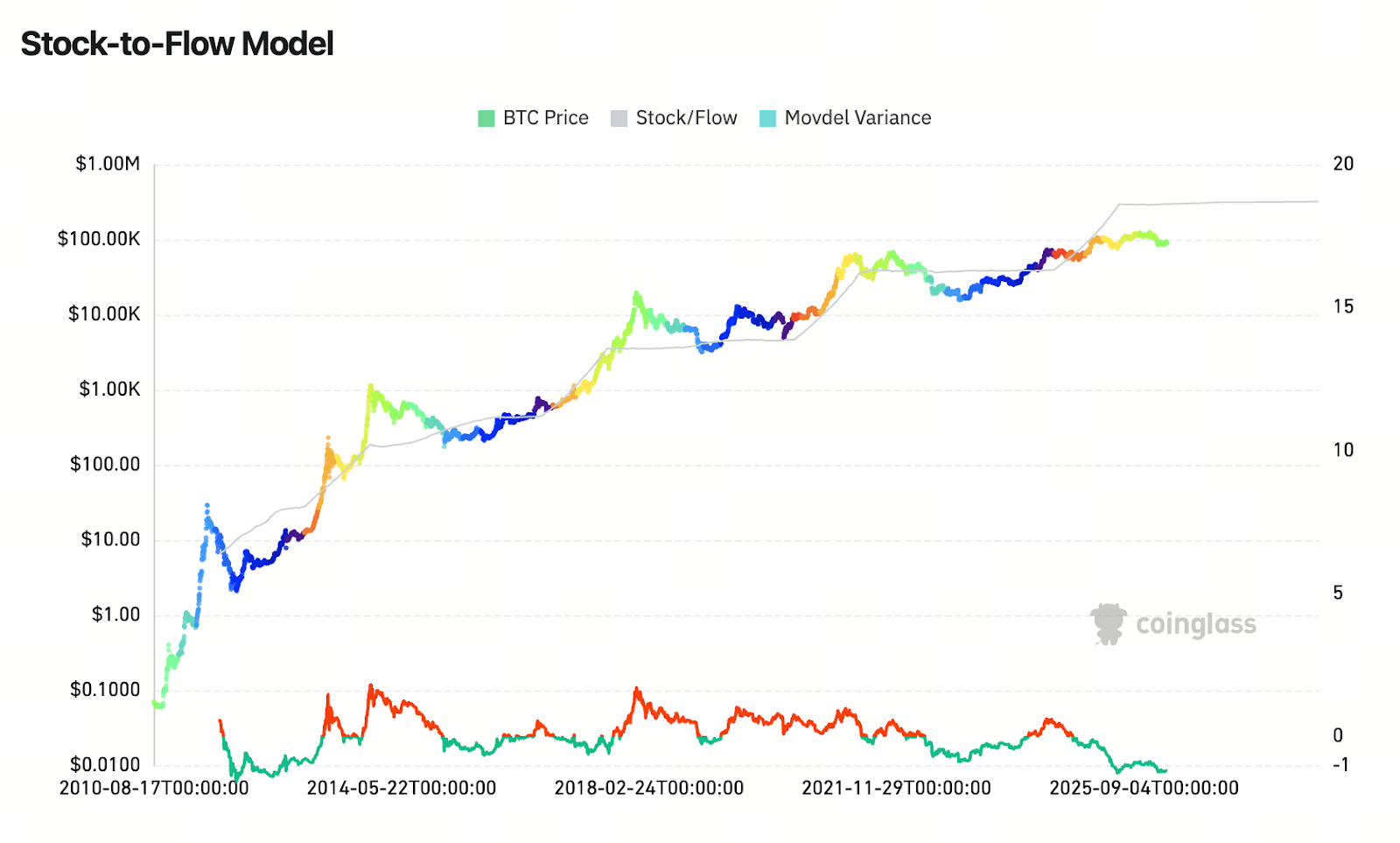
(Source: coinglass)
The Stock-to-Flow (S2F) model is a valuation framework that focuses on supply scarcity, primarily used to assess the long-term price potential of hard assets. By quantifying the relationship between the rate of supply accumulation and the rate of new issuance, the S2F model measures an asset’s scarcity. In theory, greater scarcity provides stronger price support.
This approach was originally applied in markets for gold, silver, and other precious metals. In 2019, the anonymous researcher Plan B introduced it to Bitcoin, publishing a series of model projections that quickly gained traction within the crypto community. Because the price trajectory outlined by S2F has closely aligned with Bitcoin’s historical movements at various stages, it has become one of the most debated and influential Bitcoin valuation frameworks.
How to Calculate the S2F Ratio
To understand the Stock-to-Flow model, you need to break down its two core variables. The calculation relies on the relationship between existing inventory and new production:
Stock: Existing Bitcoin Supply Stock
Stock refers to the total number of Bitcoins currently in circulation and available for holding. This is the present market supply.
Flow: Annual New Issuance Flow
Flow represents the annual quantity of new Bitcoins entering the market, primarily from mining rewards. As the halving mechanism operates, this number steadily declines over time. Currently, about 3.125 BTC are produced every 10 minutes.
The S2F ratio is calculated as Stock divided by Flow. This metric indicates how many years it would take to reproduce the current total supply at the present rate of output. A higher ratio means supply is less able to expand quickly, signaling greater scarcity and potentially higher value.
Why Does Bitcoin Fit the S2F Model So Well?
Unlike most assets, Bitcoin’s supply rules are fully encoded in its software and cannot be arbitrarily changed by central banks. Its defining features are a fixed total supply and a periodic halving mechanism.
Approximately every four years, Bitcoin’s block rewards are cut in half, causing new supply (Flow) to decrease while existing supply (Stock) continues to accumulate. Following the most recent halving in April 2024, the block reward dropped from 6.25 BTC to 3.125 BTC, further slowing Bitcoin’s supply growth. Under this structure, the S2F model posits that Bitcoin’s scarcity will intensify over time, with prices potentially entering new valuation ranges after each halving cycle.
Using S2F for Bitcoin Price Prediction
For medium- and long-term investors, Stock-to-Flow is not designed to capture short-term price swings. Instead, it serves as a macro framework for tracking changes in supply structure. Its value lies in:
- Helping investors understand Bitcoin’s long-term price trends
- Providing background analysis for market cycles driven by halvings
- Establishing psychological anchors for valuation ranges to mitigate the risk of chasing price peaks
- Encouraging a focus on supply fundamentals rather than short-term sentiment
Given Bitcoin’s clear supply cap, many traders and institutions continue to include S2F in their toolkit for cycle analysis.
Criticisms and Risks of the S2F Model
Despite its popularity, the S2F model has well-known limitations.
- Ignores changes in demand: The model assumes demand is stable or growing
- Overly simplistic: Does not factor in interest rates, liquidity, or macroeconomic variables
- Price may diverge from model predictions for extended periods: Major events can cause structural distortions
- Not suitable as a sole basis for decisions: Can foster overconfidence
- Ongoing academic and market debate: Its statistical assumptions lack broad consensus
Therefore, S2F is best used as a lens for understanding Bitcoin rather than a precise pricing formula.
Looking to learn the latest about Web3? Sign up to get news right to your inbox: https://www.gate.com/
The Verdict: Is S2F Reliable?
The Stock-to-Flow model offers a scarcity-based view of Bitcoin, helping investors look past short-term volatility and reconsider the relationship between supply structure and long-term value. However, no single model can fully explain market behavior. What matters most is not the numbers themselves, but how such tools are integrated into a broader, more rational investment strategy.
Related Articles

2026 Stablecoin Classification Deep Dive: From Fiat-Collateralized to Algorithmic Stablecoins, Market Landscape and Future Trends

What Are Fractional NFTs? Understanding the Mechanics of NFT Fractionalization and Its Real-World Use Cases

Top Telegram Games to Watch in 2026: The New Web3 Gaming Frontier and Investment Strategies

The Next 100x Coin? Low-Cap Crypto Gem Analysis

What Is Jupiter? A Complete Guide to Solana’s Leading Decentralized Exchange Aggregator
