


What Is the Crypto Market Cycle? Does It Still Exist? 2026 Market Analysis and Price Trends
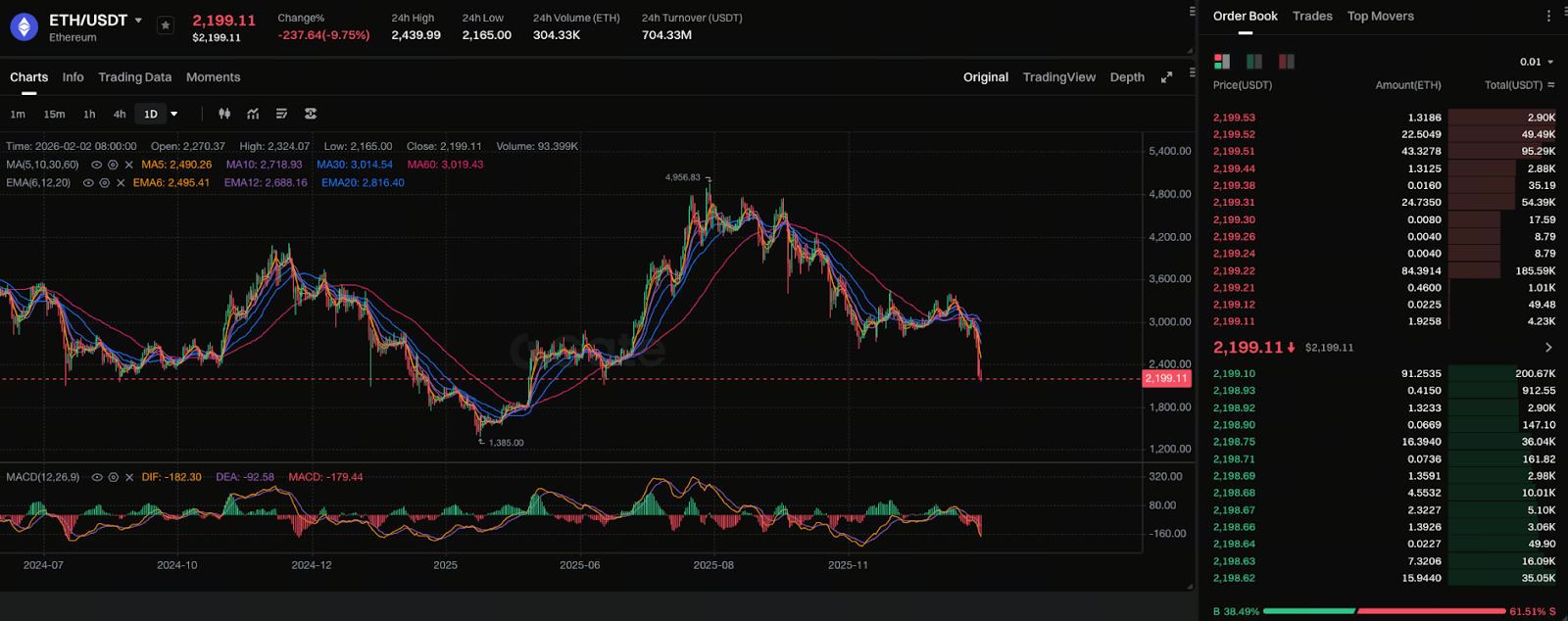
Image: https://www.gate.com/trade/ETH_USDT
What Is a Crypto Market Cycle?
The essence of a crypto market cycle lies in the recurring phases of price, sentiment, and capital flows: bottom accumulation → bull market rally → peak distribution → bear market decline → renewed accumulation. Traditionally, Bitcoin halving events have served as temporal anchors for these cycles, with supply constraints triggered roughly every four years, often sparking the next upward trend.
Market cycles encompass more than just price movements—they reflect shifts in investor sentiment and capital behavior. During bull phases, risk appetite rises, media attention intensifies, and both retail and institutional capital surge into the market. Bear phases, conversely, are characterized by panic selling and liquidity withdrawal.
Classic Cycle Patterns and Historical Behavior
Historically, the crypto market has demonstrated clear, cyclical repetition. For instance, Bitcoin saw dramatic surges and subsequent deep corrections in 2013, 2017, and 2021. Each cycle typically centers on a halving event, with prices peaking 12–18 months afterward before entering a correction phase. The halving mechanism reduces new supply, significantly impacting market dynamics.
However, this pattern is not an absolute law—it remains an empirical observation based on historical data.
Why Do Many Say “The Cycle Has Changed”?
In 2025–2026, the crypto market has diverged noticeably from previous cycles. Early 2025 saw a rapid price surge, with Bitcoin nearing or surpassing its all-time high. This was followed by a pronounced correction, and prices continued to slide into early 2026, leading many traders to question the reliability of classic patterns. Bitcoin recently broke major support levels, and market risk appetite has waned.
This has fueled extensive discussion within the community. Some believe the traditional “four-year cycle” may no longer hold. Others argue that crypto is increasingly behaving like traditional financial markets—driven by macro liquidity, interest rates, and institutional investor actions, rather than halving events alone.
Moreover, the influx of institutional capital, the launch of Bitcoin spot ETFs, and heightened regulation have all reshaped market structure and altered the rhythm of cycles.
Current Market Status: Bull, Bear, Consolidation, or Structural Phase?
Recent market data suggest that crypto assets are not in a clear bull or bear market, but rather in a consolidation phase. This stage resembles historical mid-cycle sideways movement, where the market lacks strong upward momentum and is not gripped by deep panic. Macro policy, liquidity conditions, and institutional strategies are actively reshaping market trends.
This “quiet period” could be laying the groundwork for the next major breakout—or it may signal a new equilibrium, with the market seeking stable growth beyond traditional cycles.
Do Cycles Still Exist? Expert Views and Empirical Evidence
There is no single, definitive answer to whether crypto market cycles persist. Traditional cycles may now exist in more complex and extended forms, shaped by a wider range of variables rather than simple time markers.
Some analysts maintain that post-halving price increases remain possible, though timeframes may lengthen and volatility may intensify. Others contend that as institutional capital dominates, crypto cycles will increasingly resemble the volatility patterns of traditional risk assets.
Investors should treat cycles as a “reference framework” for price behavior—not as an absolute rule.
How Should Investors Approach Crypto Cycles?
For individual investors, understanding market cycles provides valuable context, but should not be the sole basis for decision-making. Analysis should incorporate macroeconomic trends, market liquidity, on-chain metrics, and regulatory policy. Prudent asset allocation and risk management—rather than reliance on time-based cycle strategies—offer a more resilient approach to navigating an uncertain market.
Related Articles

2026 Stablecoin Classification Deep Dive: From Fiat-Collateralized to Algorithmic Stablecoins, Market Landscape and Future Trends

What Are Fractional NFTs? Understanding the Mechanics of NFT Fractionalization and Its Real-World Use Cases

Top Telegram Games to Watch in 2026: The New Web3 Gaming Frontier and Investment Strategies

The Next 100x Coin? Low-Cap Crypto Gem Analysis

What Is Jupiter? A Complete Guide to Solana’s Leading Decentralized Exchange Aggregator
