


When Is ETH Gas Lowest? Save Fees by Timing Your Transactions
What Are ETH Gas Fees?
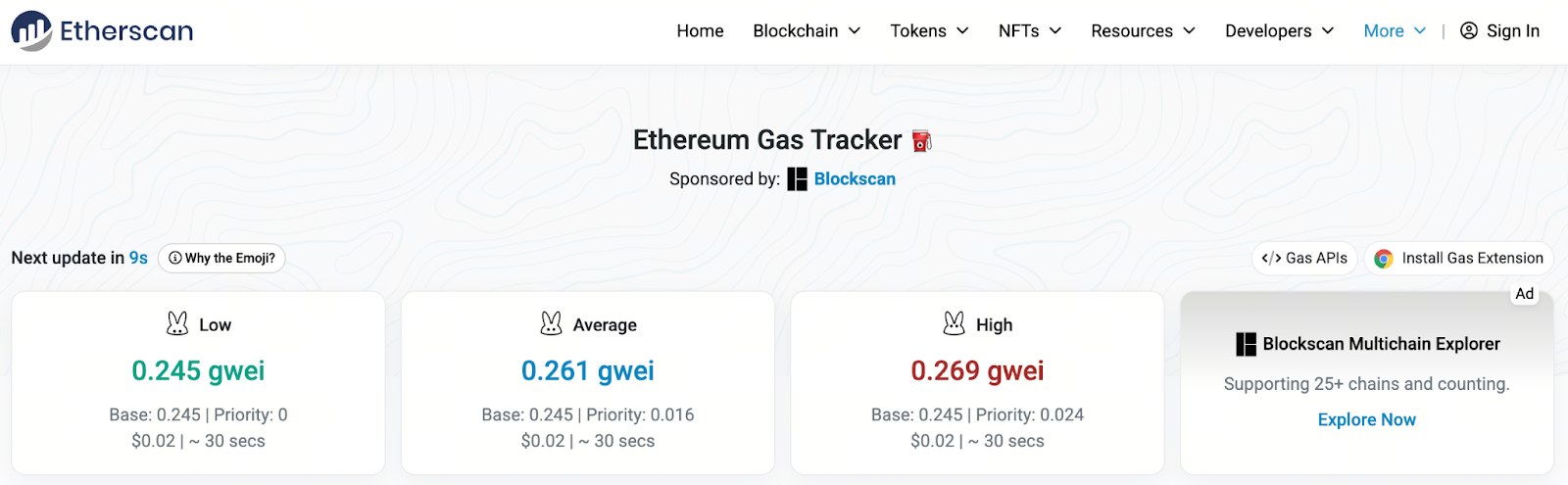
Image: https://etherscan.io/gastracker
Every time you send ETH or interact with a smart contract on the Ethereum network, you pay a transaction fee called the gas fee. Essentially, this is the “fuel cost” paid to network validators to process your transaction. Gas fees are usually measured in gwei (1 gwei = 0.000000001 ETH). Following the EIP-1559 upgrade in 2021, each Ethereum transaction now includes a “base fee” and a “priority fee,” which has made fee estimation more predictable.
Why Do Gas Fees Fluctuate?
The core driver of gas fee volatility is network congestion. When more users transact simultaneously—such as during NFT minting sprees, heavy DeFi activity, or trading surges—block space becomes scarce. Users then offer higher priority fees to speed up confirmation, driving fees higher overall. Usage patterns also vary across regions and time zones, so off-peak hours differ globally and impact fees. Additionally, complex transactions like smart contract interactions require more gas units than simple ETH transfers, making them more expensive.
Best Times to Find Low ETH Gas Fees
For newcomers, the key question is “When are transactions cheapest?” Based on data from multiple sources, here are some practical time windows:
- Weekdays: Network activity is generally lowest from midnight to early morning Eastern Standard Time (EST)—for instance, 12:00 to 4:00 AM EST. US and European users are mostly offline, and Asian markets have just ended or not yet begun.
- Weekends: The lowest gas fees tend to occur in the early morning hours of Saturday or Sunday EST (e.g., 2:00–3:00 AM EST), when global activity drops and the network is least congested.
- UTC reference: In UTC time, 1:00–5:00 AM UTC is considered a low-congestion period.
- Avoid peak hours: US and European business hours (8:00 AM–1:00 PM EST / 2:00–6:00 PM UTC) typically see higher fees.
For example, if you’re in Tokyo (UTC+9), “1:00–5:00 AM UTC” is roughly 10:00 AM–2:00 PM Tokyo time. However, since Asian markets are active and time zone differences affect actual network conditions, verify current network conditions using monitoring tools.
Practical Tips: Monitoring Tools and Transaction Strategies
To effectively reduce gas fees, consider these approaches:
- Use real-time monitoring tools: Platforms like Ethereum Gas Tracker and QuickNode Gas Tracker show current base and priority fees.
- Perform transactions during off-peak hours: If your transaction isn’t urgent (e.g., simple transfers, non-time-sensitive confirmations), wait for the recommended low-fee windows before submitting.
- Adjust gas price and limits: If your wallet supports manual settings, set a lower priority fee or choose slower confirmation to reduce costs.
- Consider Layer-2 solutions: If you transact frequently, using Layer-2 networks like Polygon, Arbitrum, or Optimism can significantly reduce fees.
Summary: Take Advantage of Low-Fee Periods
In summary, the best answer to “when are ETH gas fees lowest” is during periods of low network activity—late nights (EST), weekends, and global off-peak times. By tracking these trends, using real-time monitoring, and deploying smart transaction strategies, you can substantially reduce your costs. Beginners should note that “late night/morning” and “weekend” are optimal times for lower fees. Before your next Ethereum transaction, check the current gas fee and decide if it’s worth waiting. Optimize your transaction timing for lower fees.
Related Articles
2026 Stablecoin Classification Deep Dive: From Fiat-Collateralized to Algorithmic Stablecoins, Market Landscape and Future Trends

What Are Fractional NFTs? Understanding the Mechanics of NFT Fractionalization and Its Real-World Use Cases
Top Telegram Games to Watch in 2026: The New Web3 Gaming Frontier and Investment Strategies

The Next 100x Coin? Low-Cap Crypto Gem Analysis

What Is Jupiter? A Complete Guide to Solana’s Leading Decentralized Exchange Aggregator
