


Bitcoin Wallet ID Practical Guide: From Basics to On-Chain Hotspots and Price Implications
What Is a Bitcoin Wallet ID?
A Bitcoin Wallet ID usually refers to your Bitcoin receiving address—a public string that serves as an entry point for deposits to a specific account or sub-account on the blockchain. This ID is generated using a public key hash algorithm, and your private key controls access permissions.
Bitcoin, as a decentralized digital currency, relies on key pairs to operate wallets. The wallet ID functions as a “receiving account,” distinct from the identity verification systems used by traditional banks.
Address vs. ID: Terminology Explained
Among beginners, Bitcoin Wallet ID is often confused with the term Bitcoin Address. In reality:
- Bitcoin Wallet ID: A general term for any wallet-related identifiable string (often used interchangeably with address in practice).
- Bitcoin Address: The official term—a string generated from a public key via an algorithm, used for sending and receiving BTC.
Technically, when users refer to a Wallet ID, they most often mean a “Bitcoin address.”
Understanding this distinction helps ensure proper use in wallet software and trading platforms.
Wallet ID: Practical Uses and Transaction Process
Key use cases for a Bitcoin Wallet ID include:
- Receiving BTC: Share your address with the sender or an exchange.
- Initiating transfers: Enter the recipient’s address and amount in your wallet interface; the wallet signs the transaction with your private key and broadcasts it to the network.
- Checking history: Enter your wallet address in a blockchain explorer to view past transactions.
Note: Bitcoin addresses generally do not expire, but for privacy, it’s recommended to use a new receiving address for each transaction.
Latest On-Chain News: Dormant Wallets Reactivated
Recently, blockchain analytics platforms have spotted several long-dormant Bitcoin addresses becoming active. For instance, a wallet unused since 2011 suddenly transferred 100 BTC—worth millions of dollars.
Larger, long-term wallets have also moved tens of thousands of BTC, totaling billions of dollars, sparking market interest in how these whale movements may impact prices.
This trend highlights blockchain transparency and signals to investors that large-holder activity may foreshadow shifts in market sentiment.
Market Price Analysis: BTC Volatility and On-Chain Activity
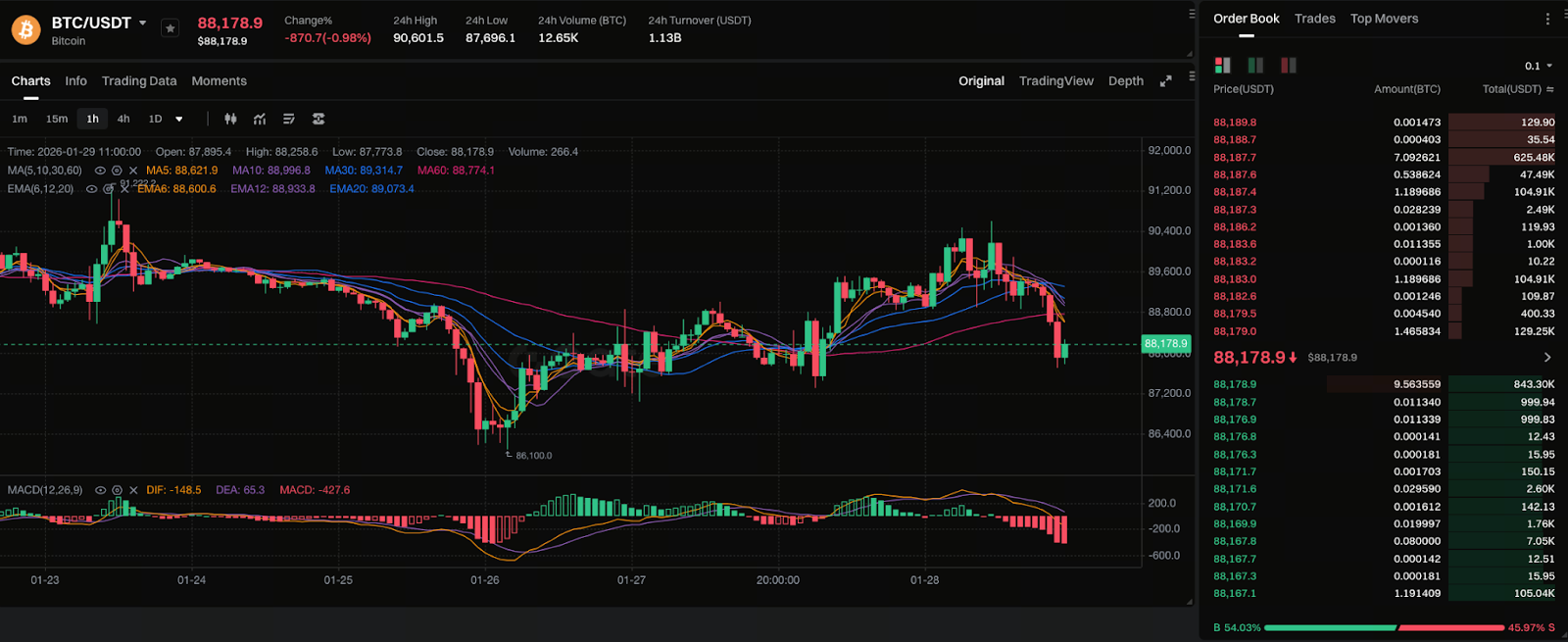
Figure: https://www.gate.com/trade/BTC_USDT
In early 2026, the Bitcoin market rebounded after a period of volatility and correction, with the price currently trading in the $80,000–$90,000 range.
On-chain data reveals that large BTC transfers and wallet activity can influence short-term price movements at certain times. Investors should combine technical analysis with on-chain data to assess market conditions, rather than relying solely on one set of indicators.
Practical Tips: Selecting Wallets and Safeguarding Assets
For users seeking to securely manage wallet IDs and BTC holdings:
- Choose hardware wallets: Devices like Ledger or Trezor store private keys offline.
- Back up recovery seeds: Keep a set of mnemonic phrases to restore your wallet.
- Enable multisignature: Use multisig solutions for larger assets to enhance security.
- Avoid reusing addresses: This helps protect your privacy.
These steps help reduce the risk of asset loss or theft.
Future Outlook
As user-friendly wallets and on-chain services evolve, the concept of a “wallet ID” may also shift—innovations like memorable naming services and enhanced privacy protocols are improving the user experience.
With blockchain transparency and ongoing market volatility, understanding and securely managing Bitcoin wallet IDs is now a fundamental skill for every crypto asset holder.
Related Articles
2026 Stablecoin Classification Deep Dive: From Fiat-Collateralized to Algorithmic Stablecoins, Market Landscape and Future Trends

What Are Fractional NFTs? Understanding the Mechanics of NFT Fractionalization and Its Real-World Use Cases
Top Telegram Games to Watch in 2026: The New Web3 Gaming Frontier and Investment Strategies

The Next 100x Coin? Low-Cap Crypto Gem Analysis

What Is Jupiter? A Complete Guide to Solana’s Leading Decentralized Exchange Aggregator
