Culper Research Shorts ETH: Fusaka Upgrade Controversy and the Structural Challenges of Ethereum’s Tokenomics
Background: Culper Research Announces Short Position on ETH
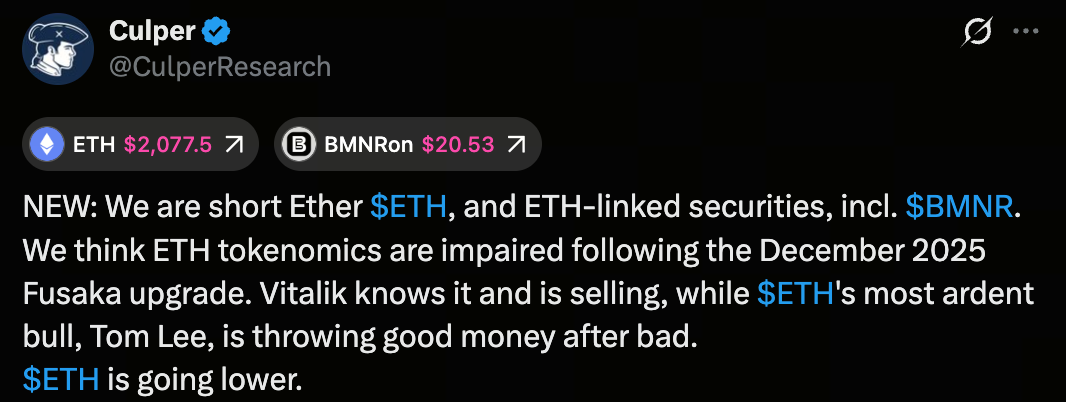 Image: https://x.com/culperresearch/status/2029608262832906530
In March 2026, the crypto market was stirred by a headline-grabbing event: short-focused firm Culper Research disclosed it had initiated a short position on ETH, along with shorting Ethereum-linked securities such as crypto mining and blockchain infrastructure company BitMine (BMNR). The firm’s report emphasized that its bearish stance was not based on short-term price swings, but on structural concerns about the long-term sustainability of Ethereum’s tokenomics. Culper Research contends that after the Fusaka upgrade in December 2025, Ethereum’s ability to capture value has been significantly compromised.
The firm’s public statement claims ETH is currently overvalued and predicts the price could drop further.
This quickly became a hot topic within the crypto community. ETH has traditionally been viewed as a “value-capturing blockchain asset,” with its token economics relying on network-driven gas fees and staking yields.
Key Changes and Technical Goals of the Fusaka Upgrade
To grasp the logic behind the short-selling report, it’s crucial to understand the technical context of the Fusaka upgrade. Rolled out at the end of 2025, Fusaka is a major Ethereum protocol update aimed at boosting network throughput and slashing transaction costs. The upgrade expands blockspace, enabling each block to process more transactions.
According to the report, the network gas limit was raised to roughly 45 million–60 million post-upgrade, massively increasing available blockspace.
Technically, this adjustment is intended to:
- Lower user transaction costs
- Enhance network scalability
- Improve user experience
- Provide greater bandwidth for Layer2 scaling
Within Ethereum’s roadmap, these upgrades reflect a “scalability-first” approach—supporting Rollup and Layer2 development by increasing on-chain data capacity.
It’s precisely this shift that sits at the heart of Culper Research’s criticism.
Culper Research’s Core Allegation: Tokenomics Weakened
Culper Research’s report centers on one conclusion: the Fusaka upgrade has undermined Ethereum’s tokenomics. The firm argues that the post-upgrade surge in blockspace has led to an “oversupply,” pushing transaction fees down.
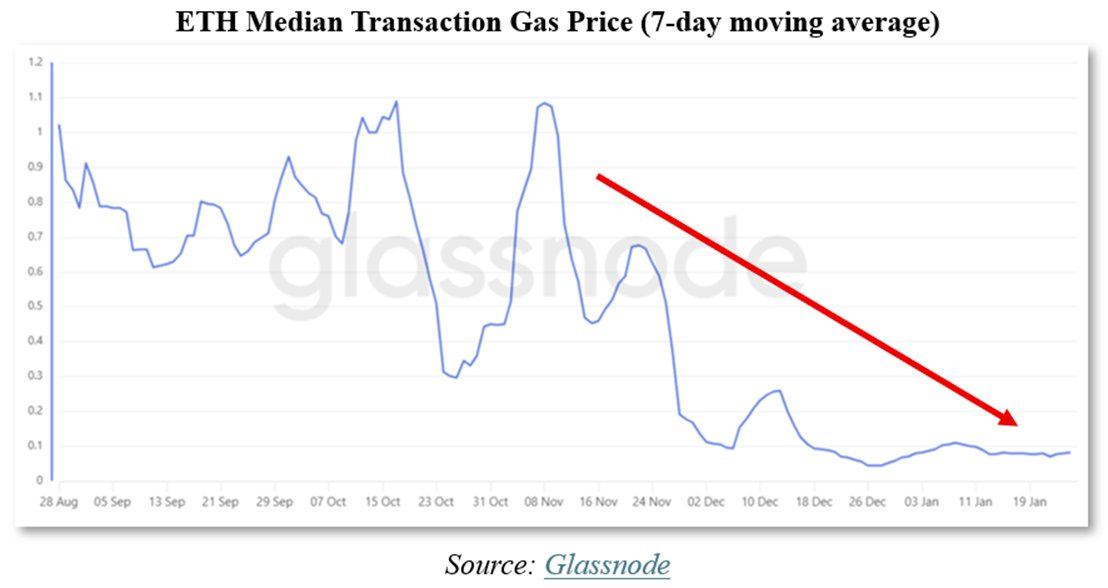 The report directly notes Ethereum’s transaction fees have dropped by about 90% since Fusaka was implemented.
This means network users are now paying far less in gas fees—a critical source of ETH value capture. With EIP-1559, a portion of those fees is burned, reducing ETH supply. If transaction fees fall, the burn rate drops accordingly, weakening ETH’s “deflationary” narrative.
Culper Research’s logic: more blockspace → lower gas fees → less ETH burned → diminished token value capture
This chain forms the crux of its short thesis.
Gas Fee Drop and Shifts in ETH Revenue Structure
In detail, changes in gas fees impact three key economic levers:
- ETH burn rate.
Since EIP-1559, Ethereum has cultivated an “Ultrasound Money” narrative by burning part of the gas fees. When network fees fall, ETH burn slows accordingly.
- Validator rewards.
Ethereum validators earn from two main sources:
- Block rewards
- Transaction fees
When transaction fees collapse, validator economics are disrupted.
- ETH demand logic.
If network fees stay low, ETH’s utility as a “network payment asset” is diluted. Culper Research argues this could erode ETH’s reputation as a “value-capturing asset.”
Staking Yields and Potential Network Security Feedback Loops
The report goes further, raising a controversial point: falling staking yields could trigger a negative feedback loop affecting network security.
Since a portion of ETH staking rewards comes from transaction fees, lower fees mean lower yields.
Culper Research warns that if staking returns keep dropping, the following could happen:
- Fewer validators participate
- Less ETH gets staked
- Network security weakens
- Confidence in the ecosystem erodes
They label this dynamic a “negative feedback loop.” However, this view is hotly debated within the community.
The Core Debate: Is Ethereum’s Economic Model Truly Weakened?
The Ethereum community is sharply divided on this short report. Critics point out major flaws in Culper Research’s analysis:
-
Ethereum’s long-term roadmap is built around “low fees, high throughput.” From the Rollup Centric Roadmap to Danksharding to expanded data availability, reducing transaction costs has always been the goal.
-
ETH’s value capture isn’t limited to L1 fees. In the evolving ecosystem, value may also be captured from:
- Layer2 settlement fees
- MEV (Maximal Extractable Value)
- Data availability markets
- DeFi and RWA sectors
- Lower fees may actually spur network demand. Historically, blockchain networks often follow this pattern: cheaper fees → more usage → network growth. Some analysts believe Fusaka’s impact on fees may be short-term, with longer-term benefits for scale.
Market Impact of the Short Report
Despite the debate, the short report has clearly affected market sentiment. In crypto, such reports tend to heighten investor risk awareness, especially amid market volatility. Recent data shows overall crypto sentiment is subdued, with high levels of fear and uncertainty. In this context, a negative analysis of Ethereum’s tokenomics can quickly spark discussion and short-term volatility.
Historically, crypto markets react to short reports in two main ways:
- The report triggers a short-term price drop
- Community pushback drives a rebound
The long-term impact remains to be seen.
Key Drivers for Ethereum’s Future: Technical Upgrades and Ecosystem Growth
Looking ahead, Ethereum’s value hinges on three core drivers:
- Layer2 ecosystem growth: If Rollups keep expanding, Ethereum will remain the ecosystem’s settlement layer.
- Data availability markets: Future blockchain competition may shift to data availability, and Ethereum is positioning itself as the world’s largest DA network.
- Real-world use cases: Sustained growth in RWA, stablecoins, and DeFi will define long-term ETH demand.
Ultimately, Culper Research’s short thesis is part of a broader debate over blockchain economic models. It raises a key question: as blockchains scale and fees fall, does the token value capture mechanism need a redesign? This is a question not just for Ethereum, but for the entire crypto sector’s future.
In this light, the Fusaka upgrade controversy may simply be one stage in the ongoing evolution of Web3’s economic models.
Related Articles

Will Sidra Break $1,000? A Realistic Look at Sidra Chain Price Claims in 2026–2027

2026 Stablecoin Classification Deep Dive: From Fiat-Collateralized to Algorithmic Stablecoins, Market Landscape and Future Trends

What Are Fractional NFTs? Understanding the Mechanics of NFT Fractionalization and Its Real-World Use Cases

Top Telegram Games to Watch in 2026: The New Web3 Gaming Frontier and Investment Strategies

The Next 100x Coin? Low-Cap Crypto Gem Analysis