How to Reduce Token Costs in the AI Era: Practical Strategies from Prompt Optimization to Model Selection
Why Token Costs Are Emerging as a Barrier to AI Adoption
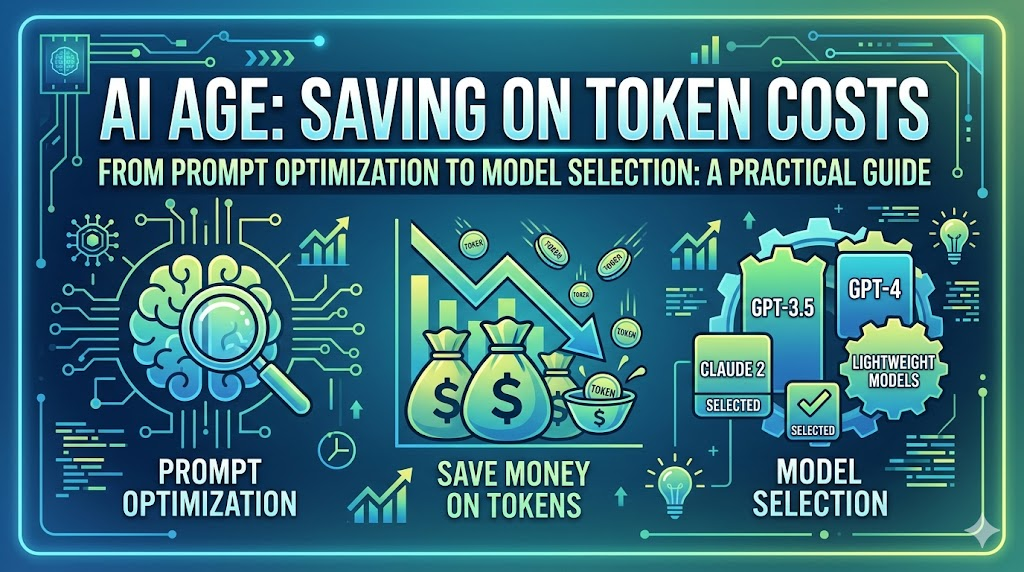
As AI tools progress from single-turn conversations to automated execution, code collaboration, document analysis, and multi-step agent workflows, token costs have shifted from a technical detail to a genuine barrier for users. Previously, many relied on subscription-based products and had little awareness of underlying billing. But in API, agent, and enterprise automation scenarios, costs accumulate in real time based on call volume, context length, and output size.
This means the cost of using AI is no longer just about “how many questions you ask”—it now depends on several key factors:
-
Is the input content redundant?
-
Is the output unnecessarily long?
-
Is the context continually expanding?
-
Are the same materials being read repeatedly?
-
Are expensive models being used for simple tasks?
If information retrieval was the core skill of the internet era, then information compression and invocation control are the critical capabilities of the AI era. Saving tokens isn’t simply about “using AI less”—it’s about ensuring AI handles the most valuable information at the right node.
Enhancing Input Quality: Eliminate Ineffective Information First
In most model pricing structures, input tokens directly translate to cost. Models don’t distinguish what “should be free”—whether it’s main content, comments, headers, footers, or empty pleasantries, if it enters the context, it’s billed.
So, the first step in controlling costs is to clean “low-value information” from your inputs.
Common Types of Ineffective Input:
-
Lengthy greetings like “Hello,” “Could you please,” or “Please take a serious look”
-
Repetitive background descriptions
-
Historical chat content that’s irrelevant to the task
-
Uncleaned PDFs, web source code, or formatted documents
-
High-resolution images when the task doesn’t require it
-
Large amounts of irrelevant code, logs, comments, or error stacks
Rather than handing everything to AI, it’s more efficient to do a round of manual preprocessing. For example, extract the main text from PDFs or convert them to Markdown, keep only the main content from web pages, and narrow code context to specific functions, modules, or error locations.
Practical Approaches to Input Optimization
-
Extract the main content before sending it to the model
-
Retain only code, paragraphs, or screenshots directly relevant to the current question
-
For image recognition, crop the relevant area instead of uploading the entire high-res image
-
Specify file paths, table names, or function names clearly—don’t make the model “find them itself”
-
Remove leftover formatting, repeated explanations, and irrelevant examples
At its core, saving at the input stage means boosting information density. The cleaner the input, the less noise for the model to process, resulting in lower costs and faster response times.
Optimizing Prompt Design: Be Clear Upfront and Avoid Wasted Iterations
A significant amount of token waste comes not from the content itself, but from inefficient communication. Many users interact with AI like they would with a person—starting with a vague request, then adding details or corrections after each output. This “toothpaste-squeezing” approach causes the model to regenerate and rewrite, quickly driving up costs.
A more efficient method is to state the core requirements clearly from the start. A high-quality prompt typically covers:
-
Task objective: what you want the model to accomplish
-
Constraints: boundaries, restrictions, exclusions
-
Input range: what materials the model needs to reference
-
Output format: table, list, abstract, JSON, or main text
-
Evaluation criteria: what counts as a satisfactory result
-
Reference examples: standard samples, if available
For example, instead of “Help me write an SEO article,” specify:
-
Topic and keywords
-
Target audience
-
Article length
-
Title style
-
Structural requirements
-
Language requirements
-
Whether lists, case studies, or FAQs are needed
This approach not only improves output quality but, more importantly, reduces the number of revisions. For high-frequency workflows, saving even one back-and-forth can mean hundreds or thousands of tokens saved.
Controlling Output Length: Minimize High-Cost Output Tokens
In most mainstream models, output tokens cost more than input tokens. In other words, what the model “says” is often more expensive than what it “reads.” So, controlling output length is one of the most direct ways to cut costs.
Always Include Output Constraints in Your Prompts:
-
Provide the conclusion directly, skip the pleasantries
-
Don’t repeat the user’s question
-
Don’t explain obvious background
-
Avoid showing full reasoning unless necessary
-
Set limits on word count, paragraphs, or list items
-
Prefer structured outputs
If your task only requires facts or decisions, concise answers are usually more cost-effective. For programmatic use, outputs in JSON, tables, or field-based lists typically use fewer tokens than long-form text and are easier to process downstream.
Ready-to-Use Output Control Instructions
-
Answer directly, omit introductions and conclusions
-
Summarize in three points, no more than 200 words
-
Output only conclusions and recommendations—no reasoning
-
Return JSON with fixed fields: title, summary, risk
-
If information is missing, only list missing items—don’t speculate
The goal of output control isn’t to compress expression, but to ensure the model outputs only information that truly supports decision-making.
Managing Context: Prevent the Model from Repeatedly “Rehashing Old Content”
A common oversight is that large models don’t “remember the key points” like humans do. In most chat systems, each new prompt requires the model to reread part or all of the prior context. As the conversation grows, each new message becomes more expensive.
That’s why a simple “continue” or “make a change” command gets pricier in a long conversation.
Three Principles for Context Management
-
One task, one conversation Don’t mix multiple topics in a single chat. Writing, coding, translation, and data analysis are best handled in separate sessions.
-
Compress long conversations regularly After several rounds, have the model summarize confirmed content and use that summary as the new context.
-
Retain only information relevant to the current task Remove expired, redundant, or irrelevant content from the context whenever possible.
For teams, context management is essentially “conversation governance.” Without this discipline, AI costs will steadily rise, and users may have no idea where the budget is going.
Leverage Caching and On-Demand Loading: Cut Down on Repeated Reading Costs
When system prompts, work guidelines, or reference documents are used repeatedly, caching is a powerful way to cut costs. Some platforms support prompt caching, allowing repeated long prompts or documents to be cached and read at a lower cost.
This is particularly useful for:
-
Fixed system role settings
-
Team-wide writing standards
-
Standardized code review rules
-
Stable product knowledge bases
-
Frequently referenced long-form materials
For caching to be effective, two conditions usually must be met:
-
The content stays stable and isn’t frequently changed
-
The order is consistent and placed at the beginning of the input
Beyond caching, another key principle is on-demand loading. Don’t pack every rule, case, standard, or style guide into the system prompt—load only what’s needed for the task at hand. This reduces token costs and minimizes interference from irrelevant rules.
Match Models to Tasks: Don’t Use High-Performance Models as a Catch-All
There are often significant price gaps between models. High-performance models are best for complex reasoning, architecture design, critical judgments, and high-risk decisions—not for every task. Using expensive models for format cleaning, information extraction, simple classification, or repetitive rewriting is often wasteful.
A Smarter Model Allocation:
-
Low-cost models: extraction, cleaning, classification, rewriting, summarization
-
Mid-tier models: routine writing, general analysis, standard coding tasks
-
High-cost models: complex reasoning, strategy decisions, major reviews, core decisions
This layered approach is like division of labor in an enterprise. Not every job needs “the most expensive person”—reserve premium models for high-value, high-complexity work.
A Typical Low-Cost Workflow
-
Use a low-cost model to organize raw data
-
Extract key points and compress them into a dense summary
-
Pass the summary to a stronger model for analysis, judgment, or final output
-
For batch formatting, hand it back to the low-cost model
This “two-stage” or even “three-stage” process can significantly lower total costs while ensuring quality.
Building Low-Cost AI Workflows: From “All AI” to “Human-AI Collaboration”
Many users want AI to handle the entire workflow, but for cost and efficiency, the ideal approach is usually not “fully automated,” but “human-AI collaboration.” Humans filter, judge, and set boundaries; AI executes, organizes, generates, and expands.
This division is especially effective for:
-
Email filtering: Manually exclude irrelevant emails, then have AI process those needing a reply
-
Document handling: Manually flag key sections, then let AI summarize and analyze
-
Code collaboration: First locate error modules, then let AI modify the relevant functions
-
Content creation: Manually determine angle and structure, then let AI draft the initial content
From a cost perspective, the greatest value humans bring is not replacing AI in generating text, but making choices up front to avoid unnecessary calls. The key isn’t “how to make AI do it more cheaply,” but “is this step worth handing over to AI?”
Common Pitfalls: Why AI Gets More Expensive the More You Use It
The following misconceptions are especially common:
-
Thinking the more polite you are to AI, the better: Politeness isn’t an issue, but in API scenarios, excessive pleasantries don’t improve results and simply add to costs.
-
Thinking more input is safer: Dumping all materials into the model at once doesn’t guarantee accuracy—often it just adds noise.
-
Thinking long explanations mean higher quality: Much output only “looks complete,” but the truly valuable parts may be just a few sentences.
-
Thinking a conversation can go on forever: Long context keeps driving up costs per round and can distract the model with outdated information.
-
Thinking expensive models are always better value: For simple tasks, using premium models is usually slower, more expensive, and not cost-effective.
Avoiding these pitfalls isn’t about prompt-writing skills—it’s about cost awareness. Only when users truly understand how tokens are consumed will optimization become second nature.
Conclusion: Saving Tokens Is Really About Maximizing Information Efficiency
In the AI era, saving isn’t just about budget—it’s a reflection of your information management skills. Those who can organize tasks efficiently, compress context, define outputs, and select the right models will achieve more with the same resources.
In practice, token-saving strategies boil down to four key principles:
-
Noise reduction: remove ineffective input
-
Boundary setting: define clear task scope
-
Compression: control context and output length
-
Division of labor: match each task to the right model
A mature approach to AI isn’t about delegating everything to the model—it’s about knowing what information is worth inputting, which steps are worth invoking, and which outputs are worth paying for. Once this mindset becomes habitual, tokens become more than just numbers on a bill—they become a production resource to be managed, optimized, and amplified for greater value.
Related Articles

What Is ERC-8183? Exploring the AI Agent Commercial Standard and the Infrastructure of the Decentralized Agent Economy

AI Agents Becoming Economic Actors: What Infrastructure Gaps Can Blockchain Fill?

What Is RoboForce? An In-Depth Analysis of the Technical Path and Industrial Prospects of an AI Robotic Workforce Platform
What is Athene Network (ATN)? Exploring AI-Blockchain Integration

How to Build a Personal Moat in the AI Era: 5 Key Strategies to Stay Irreplaceable