


SKALE Latest Developments and SKL Price Analysis: The Future of Layer-3 AI and Gas-Free Blockchains
What Is SKALE? Blockchain Scalability and Gasless Architecture
SKALE is a network dedicated to enhancing blockchain scalability. By utilizing Elastic Chains, it reduces mainnet congestion and offers dApp developers a high-throughput, low-latency, gasless environment. The network’s native token, SKL, is Ethereum-compatible and plays a key role in staking, governance, and chain resource subscriptions within the ecosystem.
SKALE is especially suited for high-performance, high-throughput, and gasless applications such as gaming, NFTs, and AI smart contracts. Unlike conventional Layer-1 solutions, SKALE’s architecture is more akin to a modular cross-chain solution, aiming to deliver scalable and cost-efficient Web3 experiences.
SKL Price Overview and Recent Trends
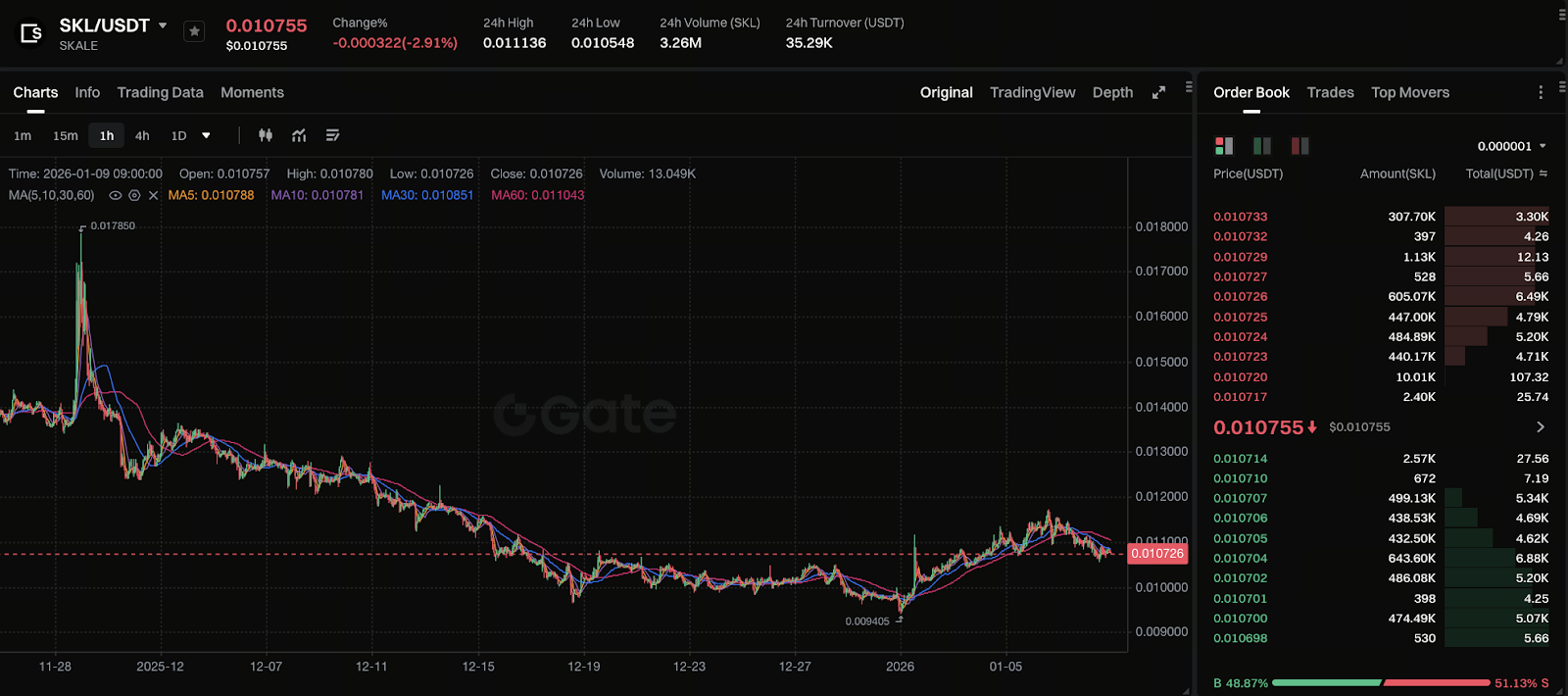
Chart: https://www.gate.com/trade/SKL_USDT
As of January 9, 2026, SKL trades at around $0.011. Over the past year, the token has seen considerable volatility, with wide price swings reflecting both the broader crypto market’s turbulence and the SKALE project’s own development trajectory.
Although SKL has yet to break past its historical highs, robust trading activity and growing ecosystem engagement show that it remains a prominent scalability solution token. Recent short-term price fluctuations tied to ecosystem developments also highlight emerging market interest.
AI Layer-3 and Base Integration: New Strategic Moves
In late 2025, SKALE integrated with Coinbase’s Layer-2 Base, introducing an AI-focused Layer-3 environment. This collaboration leverages Base’s user base and liquidity to provide gasless execution for AI smart agents. The initiative marks a major step for SKALE in merging AI and Web3 technologies.
This Layer-3 framework not only enables more efficient on-chain smart agent operations but could also increase SKL’s network utility, as AI agents executing contracts may drive up demand for SKL to access chain resources or pay for services.
However, overall AI DeFi total value locked (TVL) remained under pressure during 2024–2025, indicating that this strategy still faces challenges in ecosystem adoption and real-world usage rates.
Significance of Enterprise Node Participation
Beyond technical progress, enterprise involvement is also advancing the SKALE ecosystem. For example, Vodafone’s validator node not only boosts network decentralization but also signals institutional confidence in SKALE’s technology.
This node-level expansion strengthens security for a PoS project and may foster deeper integration between governance and real-world business operations, supporting long-term growth.
SKALE’s Future Ecosystem and Potential Opportunities
SKALE’s roadmap emphasizes several key initiatives:
- Expanding the “Expand” solution to additional EVM chains, broadening the reach of gasless chains
- Deepening integration between the FAIR blockchain and SKALE Manager to enhance MEV resistance
- Accelerating growth in the developer, SocialFi, and gaming ecosystems
These measures aim to boost ecosystem coverage and utility, increasing real demand for SKL and potentially supporting its long-term growth.
Investment Risk Notice and Conclusion
While SKALE offers notable technical strengths, crypto asset investments always carry risks. Market volatility, slow ecosystem rollout, and competitive pressure can all affect SKL’s price performance. Readers should remain cautious and not treat this article as investment advice.
Overall, SKALE has carved out a distinct niche in boosting blockchain scalability and reducing usage costs. Its strategic focus on AI, gaming, and enterprise validator nodes is worth close attention.
Related Articles
2026 Stablecoin Classification Deep Dive: From Fiat-Collateralized to Algorithmic Stablecoins, Market Landscape and Future Trends
What Are Fractional NFTs? Understanding the Mechanics of NFT Fractionalization and Its Real-World Use Cases
Top Telegram Games to Watch in 2026: The New Web3 Gaming Frontier and Investment Strategies
The Next 100x Coin? Low-Cap Crypto Gem Analysis
What Is Jupiter? A Complete Guide to Solana’s Leading Decentralized Exchange Aggregator
