


Understanding DAO: Operations and Types of Decentralized Organizations
What Is a DAO?
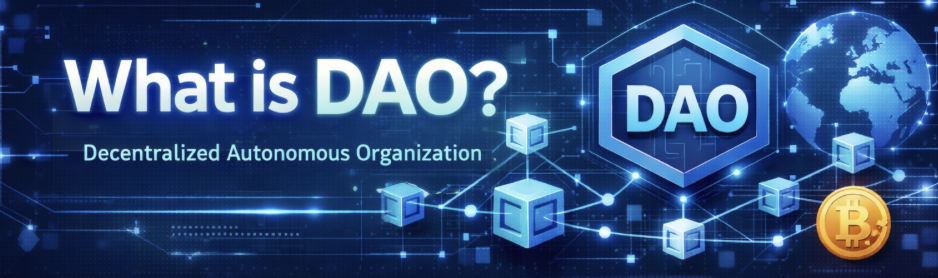
A DAO, or Decentralized Autonomous Organization, is a blockchain-based organizational structure governed by smart contracts and transparent, verifiable rules. DAOs are prevalent in decentralized finance (DeFi) and the Web3 ecosystem.
In practical terms, a DAO functions as a decentralized investment or collaboration group. Unlike traditional companies, which rely on a board of directors and management for decision-making, a DAO is driven by code and community consensus rather than a single authority figure.
The core principle is encoding fund management and decision-making processes into smart contracts. This reduces human intervention and moral risk, ensuring that all rules, fund flows, and decisions remain highly transparent. DAOs have relatively low barriers to entry—anyone worldwide can join without disclosing their identity. By holding governance tokens issued by the DAO, participants vote on proposals and directly shape the organization’s direction.
How Do DAOs Differ from Centralized Organizations?
In traditional organizations—companies, banks, or government agencies—decision-making power is typically concentrated among a small group of managers, creating a clear hierarchy and information asymmetry. Most employees are bound by employment relationships, and their interests may not fully align with the organization’s long-term objectives.
DAOs take a fundamentally different approach to governance:
By design, DAOs promote equal participation among members. Anyone holding governance tokens can submit proposals, join discussions, and vote on key decisions—active involvement replaces passive compliance. DAOs do not rely on traditional legal structures or employment contracts; instead, smart contracts serve as the trust foundation. Once rules are deployed on-chain, they are publicly verifiable and automatically executed, minimizing opportunities for arbitrary changes. Governance tokens are central to DAOs, representing voting rights and closely tied to the DAO’s performance, naturally aligning members’ economic incentives with organizational goals.
Three Main Types of DAOs
DAOs are not one-size-fits-all; their structure varies according to organizational goals. Based on function and positioning, DAOs generally fall into three main categories.
Protocol DAOs
Protocol DAOs focus on developing and maintaining decentralized protocols. Members holding governance tokens participate in decisions such as protocol upgrades, parameter changes, and fund allocation.
Notable examples include decentralized exchanges like Uniswap, liquidity protocols such as Curve, and stablecoin protocols like MakerDAO. These DAOs often manage large capital pools and play a pivotal role in the DeFi ecosystem.
Venture DAOs
Venture DAOs operate similarly to venture capital firms, but decision-making is distributed among community members. Members pool capital and use proposals and voting to determine investment targets and fund allocation.
Leading examples include BitDAO (supported by trading platforms), Flamingo DAO (focused on NFT investments), and KrauseHouse DAO (which attempted to raise funds to acquire an NBA team).
Social DAOs
Social DAOs prioritize building consensus and community cohesion over financial returns. These DAOs are often formed by specific NFT holders or interest groups, collaborating to promote culture, brands, or creative ecosystems.
ApeCoin DAO and PleasrDAO are prime examples. ApeCoin DAO centers on the NFT ecosystem, while PleasrDAO focuses on collecting and curating digital art and continues to expand cross-industry collaborations.
Advantages and Challenges of DAOs
Compared to traditional centralized corporate structures, DAOs fundamentally differ in how they operate and are governed. This model, built on blockchain and smart contracts, introduces new collaborative possibilities for communities, but also comes with significant limitations and risks.
Advantages of DAOs
1. Economic incentives strengthen community cohesion
DAOs typically use governance tokens to align members’ interests with organizational growth. Token holders gain participation rights and are directly tied to the DAO’s success. This shared-interest mechanism boosts community engagement, encouraging members to actively contribute to governance and development.
2. Automated management and flexible participation
DAOs rely on smart contracts to execute rules and processes, minimizing dependence on traditional offices and hierarchical management. Members do not need to adhere to fixed schedules or locations; as long as they meet requirements, they can propose and vote. With Web3’s borderless nature, DAO members come from around the world with diverse backgrounds and expertise, enabling greater cross-disciplinary collaboration than conventional enterprises.
3. Highly transparent financial and operational records
Blockchain’s transparency enables open verification of DAO fund flows and contract interactions, greatly reducing information asymmetry.
For example, in traditional companies, employees often remain unaware of financial troubles until the company is near bankruptcy and cannot respond in time. In DAOs, treasury status and spending records are available on-chain, allowing members to monitor operations in real time and assess their involvement and risk.
Disadvantages of DAOs
1. Slower decision-making
Most DAO decisions require proposals and voting. While this reflects the decentralized ethos, disagreements or lack of consensus can delay decisions and reduce organizational efficiency.
2. Legal status and protection remain unclear
DAO members typically lack traditional legal employment relationships or clear entity protections. Most jurisdictions are still developing regulatory frameworks for DAOs, and legal responsibilities and rights are not yet fully defined. Until these systems mature, members may face legal uncertainty and insufficient protection of their interests.
DAOs offer the potential for more transparent, open, and globally collaborative organizations, but must also address practical challenges in governance efficiency and legal status.
If you want to explore more about Web3, click to register: https://www.gate.com/
Conclusion
DAOs disrupt the traditional monopoly of centralized organizations over power and decision-making, distributing governance to the community and linking individual interests with collective goals via governance tokens. Whether advancing decentralized protocols, enabling collective investment, or building highly engaged communities, DAOs are redefining organizational operations in the blockchain era and have become a cornerstone of the Web3 ecosystem.
Related Articles
2026 Stablecoin Classification Deep Dive: From Fiat-Collateralized to Algorithmic Stablecoins, Market Landscape and Future Trends
What Are Fractional NFTs? Understanding the Mechanics of NFT Fractionalization and Its Real-World Use Cases
Top Telegram Games to Watch in 2026: The New Web3 Gaming Frontier and Investment Strategies
The Next 100x Coin? Low-Cap Crypto Gem Analysis
What Is Jupiter? A Complete Guide to Solana’s Leading Decentralized Exchange Aggregator
