What Comes Next for RWA? From Asset Issuance to Trading, Collateral, and Settlement
RWA is a financial model for registering, transferring, and managing real-world assets—including stocks, bonds, funds, government bonds, private credit, real estate, and commodities—in the form of digital tokens. Its purpose is not simply to duplicate an on-chain record, but to give real-world assets more efficient capabilities for issuance, trading, collateralization, and settlement.
Over the past few years, the RWA market has focused primarily on which assets can be brought on-chain and how large on-chain issuance can become. As tokenized government bonds, funds, and credit products continue to emerge, the market’s attention is shifting to a different set of questions: Will these assets continue to trade after issuance? Can they be used as collateral for borrowing? Can they move across different networks? Can returns and principal be settled automatically?
The core of RWA’s next phase is not issuing more tokens, but bringing tokens into real financial activity. Tokenization can evolve from a proof of concept into financial infrastructure only when assets can be used, financed, exchanged, and generate recurring cash flows.
Key Takeaways
-
The next phase of RWA will focus on ongoing trading, collateralization, and settlement—not simply on increasing issuance.
-
Tokenized U.S. government bonds remain the most mature institutional testing ground.
-
Tokenized stocks must be distinguished between assets backed by actual custody, synthetic tracking products, and theme-based Meme assets.
-
Private credit and real estate offer greater potential returns, but also carry higher valuation, default, and legal risks.
-
RWA secondary markets require mechanisms for subscription, redemption, pricing, and compliant transfers.
-
Using RWA as collateral requires reliable oracles, legal enforceability, and sufficient liquidity.
-
Delivery versus Payment (DvP) enables cash and securities to settle simultaneously, but still requires connections to banking and clearing systems.
-
Issuance volume does not equal real adoption. Active trading, collateral use, and cash flow matter more.
-
The core infrastructure required to scale RWA includes custody, identity, compliance, oracles, and cross-chain interoperability.
-
When evaluating project quality, priority should be given to verifying legal rights, asset reserves, liquidity, and actual usage.
The Development Stages of RWA Are Changing
RWA can generally be divided into four development stages.
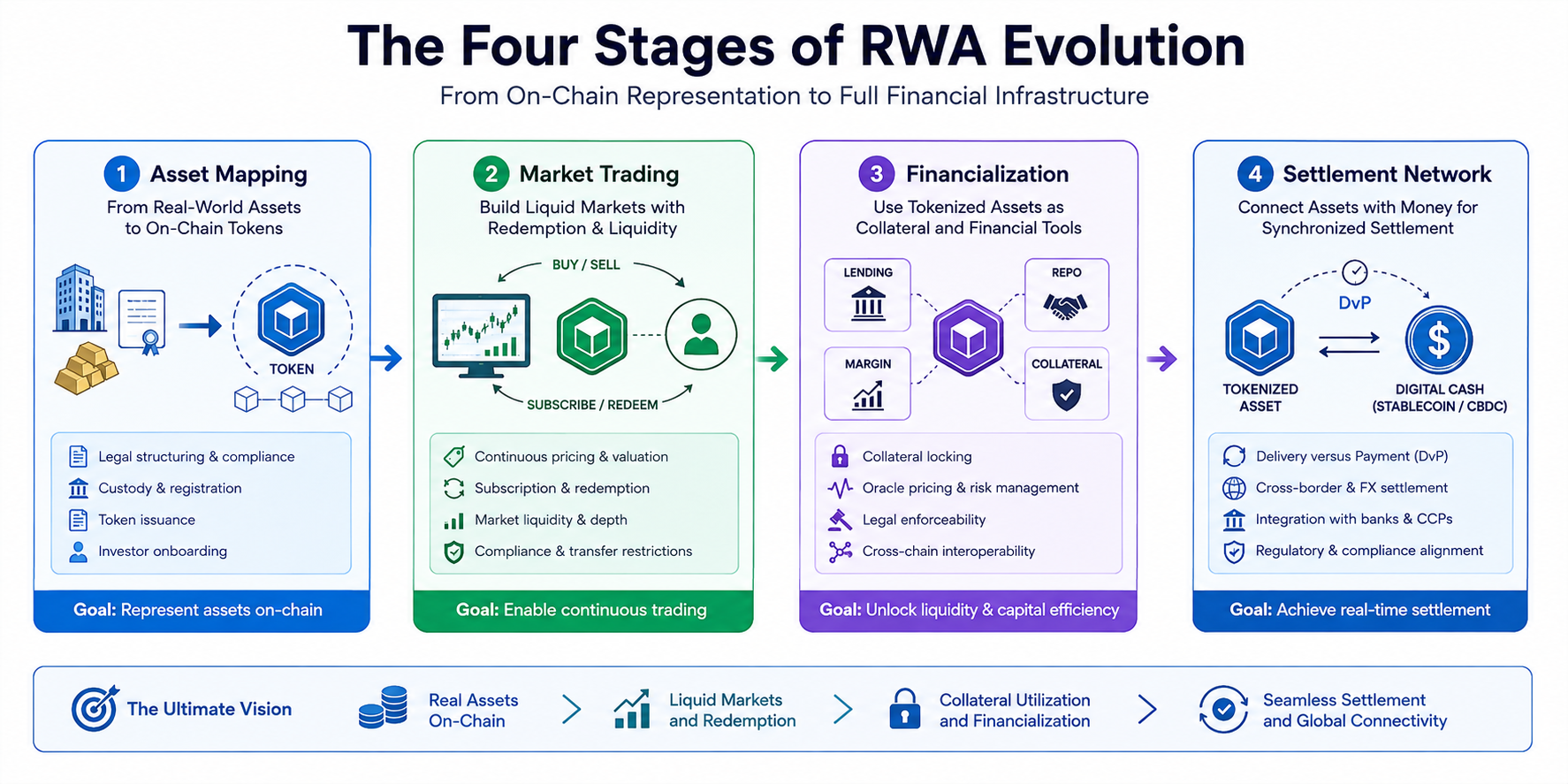
The first stage is asset mapping: representing real-world assets or their beneficial interests as on-chain tokens. Projects at this stage primarily address registration, issuance, and ownership.
The second stage is market trading: giving tokenized assets reliable subscription, redemption, and secondary market liquidity. Investors can buy these assets and sell or convert them when needed.
The third stage is financialization: using tokenized assets for lending, repurchase agreements, margin, and collateral management. Assets are no longer merely investment instruments; they become productive resources within financial activities.
The fourth stage is the settlement network: connecting tokenized assets with stablecoins, tokenized deposits, or central bank settlement assets to enable the simultaneous delivery of cash and assets.
Different RWA projects are currently at different stages. Tokenized U.S. government bonds have begun to support trading and collateral use. Some stock and fund projects are exploring around-the-clock circulation, while private credit and real estate remain constrained by information disclosure, valuation, and legal enforceability.
Why Asset Issuance Is No Longer the End Point
Issuing an RWA token is not technically difficult. An issuer can create a smart contract, define the token supply, and record holders on the blockchain. However, this only addresses how an asset is represented—it does not address how the asset can be used.
If a tokenized fund sees little trading activity for an extended period after issuance, its on-chain record will not automatically create liquidity. If a tokenized bond cannot be used as collateral, it cannot enter the broader financial system. If a tokenized stock lacks clearly defined shareholder rights and dividend arrangements, it may remain nothing more than a price-tracking instrument.
A genuinely valuable RWA project therefore needs to answer four questions:
-
What legal rights do holders possess?
-
How are the assets valued and held in custody?
-
Can the tokens be traded and redeemed on an ongoing basis?
-
Can the assets be used in lending, payment, and settlement processes?
This is why the market is shifting from competition over issuance volume to competition over utilization.
The First Step for RWA: From Real-World Assets to On-Chain Certificates
Bringing real-world assets on-chain typically involves asset screening, legal structuring, custody registration, token issuance, and investor eligibility procedures.
For example, with tokenized U.S. government bonds, a fund manager may first purchase the bonds. A custodian then holds the assets, followed by the issuance of on-chain tokens representing fund shares or beneficial interests. The tokens held by investors are generally not the government bonds themselves, but contractual rights to a fund or special-purpose vehicle.
This distinction is critically important. The blockchain can record token transfers, but it cannot automatically prove that the underlying real-world assets actually exist. Asset authenticity still depends on custodians, audit reports, legal documents, and regulatory oversight.
For stocks, real estate, and private credit, the legal connection between on-chain tokens and real-world assets is even more complex. Projects must clarify whether token holders are entitled to dividends, voting rights, interest, rental income, or creditor recourse. Without a clear rights structure, a token cannot simply be treated as a complete RWA product—even if it trades actively.
The Second Stage: Building a Sustainable Trading Market
Ongoing RWA trading requires a more complex market structure than ordinary crypto assets.
First, the assets must support continuous pricing. Government bonds and publicly traded stocks have observable market prices, making valuation relatively straightforward. Private credit, real estate, and infrastructure assets, by contrast, rely on valuation models, financial reports, and periodic audits.
Second, investors need reliable subscription and redemption channels. Without an exit mechanism, tokenized assets will struggle to attract long-term capital. Redemption also involves business hours, bank transfers, asset liquidation, and investor identity verification; it cannot be completed solely through the automatic execution of a smart contract.
Third, the market needs sufficient liquidity. Automated market makers can provide liquidity pools, but if the underlying assets lack liquidity, on-chain pools will also struggle to support large transactions. When market depth is limited, a small number of sell orders can cause significant price slippage.
Finally, RWA trading generally requires compliance controls. Certain assets may be available only to qualified investors or investors in specific jurisdictions. Tokens must support whitelists, geographic restrictions, and transfer freezes.
RWA secondary markets therefore will not simply replicate open Meme coin markets. They are more likely to become programmable permissioned markets.
The Third Stage: Becoming Usable On-Chain Collateral
When RWA enters the collateral system, assets move from being merely held to actively unlocking liquidity.
Tokenized government bonds are among the assets best suited for use as collateral. They offer transparent valuations, relatively low credit risk, and strong institutional recognition. They can also support lending, repurchase agreements, margin, and stablecoin minting.
If a borrower locks tokenized government bonds in a smart contract, a lending protocol can automatically manage risk based on real-time prices, collateral ratios, and liquidation conditions. Compared with traditional collateral processes, the on-chain model may reduce manual confirmation and reconciliation across institutions.
However, using assets as collateral requires several issues to be addressed.
First, oracles must provide reliable prices. Incorrect pricing can trigger wrongful liquidations or leave positions undercollateralized.
Second, the tokens must be legally enforceable. If a borrower defaults, whether the lender can legally dispose of the assets underlying the tokens cannot depend solely on smart contract code.
Third, the assets must have sufficient liquidity. Even if a token is theoretically stable in value, the collateral may still fail if it cannot be traded quickly during periods of market stress.
Fourth, different networks must be interoperable. If collateral is locked on a closed network, its potential use cases will be limited.
The Fourth Stage: Connecting Payments and Final Settlement
The ultimate value of RWA lies not merely in bringing assets on-chain, but in enabling those assets to be traded and settled within the same digital environment.
Traditional financial transactions typically involve multiple systems: trading platforms match orders, custodians register assets, banking systems process payments, and clearing institutions complete final settlement. A delay at any point can create settlement risk and tie up capital.
When tokenized assets are combined with on-chain cash, Delivery versus Payment (DvP) becomes possible. The buyer pays with tokenized deposits or stablecoins, while the seller delivers tokenized securities. Once both parties’ conditions are met, the smart contract completes the exchange simultaneously.
Cross-border transactions can also incorporate foreign exchange. The buyer pays in one currency, the seller receives another, and the assets and funds are delivered atomically.
However, blockchain can solve only ledger synchronization and automated execution. It cannot automatically resolve currency exchange, capital controls, anti-money laundering, taxation, or jurisdictional issues. An RWA settlement network must connect with banks, clearing institutions, and regulatory systems to genuinely serve institutional markets.
Why Tokenized Government Bonds Have Become the Core Testing Ground
Tokenized U.S. government bonds occupy an important position in the RWA market for straightforward reasons.
Government bonds have transparent market prices, relatively low credit risk, clear interest payment mechanisms, and the ability to satisfy demand for yield, liquidity, and collateral simultaneously. They can also serve as underlying assets for stablecoins and DeFi protocols, providing on-chain capital with relatively stable sources of returns.
Projects such as BlackRock’s BUIDL, Franklin Templeton’s BENJI, and Ondo continue to bring tokenized government bonds into institutional focus. Public market data and industry reports indicate that the market for tokenized government bonds continued to grow in 2026. Market attention has also expanded beyond issuance volume to the number of holders, secondary trading, and collateral applications.
However, tokenized government bonds are not without risk. Investors need to confirm whether the tokens represent fund shares, beneficial interests, or other contractual rights. They should also understand redemption timelines, minimum subscription amounts, qualified investor requirements, and management fees.
Different Paths for Stocks, Private Credit, and Commodities
Tokenized Stocks
Stock tokenization is highly attractive to users, but its legal and regulatory requirements are also more complex. Genuine tokenized stocks must address custody, dividends, voting, corporate actions, and investor protection.
The market also includes synthetic stock tokens that merely track stock prices and do not represent actual stock ownership. Investors must distinguish between assets backed by actual custody, synthetic tracking assets, and purely theme-based Meme assets.
Private Credit
Private credit includes corporate loans, accounts receivable, and supply chain financing. Once brought on-chain, these assets could theoretically improve loan registration, interest distribution, and repayment tracking.
However, these assets lack transparent market prices, carry higher credit risk, and involve more complex legal enforcement in the event of default. Tokenization does not eliminate borrower default; it can only improve certain records and processes.
Commodities
Commodities such as gold, copper, and energy products can be tokenized through reserve custody, warehouse receipts, or fund shares. The core questions are whether the physical assets actually exist, who holds them, whether they are audited regularly, and whether the tokens can be redeemed for physical assets or cash.
If a project merely uses names and images associated with gold, copper, or other commodities without custody and redemption arrangements, it is closer to a commodity-themed Meme asset than a commodity RWA in the strict sense.
Key Issues Facing RWA at Scale
The biggest bottleneck for RWA remains legal and compliance issues—not smart contracts.
Different countries define securities, funds, commodities, and creditor rights differently. The cross-border circulation of tokens may therefore trigger multiple regulatory frameworks. Issuers must also address KYC, anti-money laundering, investor eligibility, and data privacy.
Asset custody is another critical component. The quantity of on-chain tokens must remain consistent with the quantity of real-world assets. Custodians need to provide verifiable reserve and audit information.
Liquidity cannot be overlooked. Growth in issuance volume does not indicate growth in market depth, and an increase in the number of holders does not mean the assets can be exited quickly.
RWA also requires standardized identity, messaging, and asset standards. Without interoperability, assets and funds cannot move efficiently between platforms, and the market will become fragmented into multiple closed systems.
How to Determine Whether an RWA Project Has Entered the Real-World Application Stage
To determine whether an RWA project has practical value, focus on four areas.
-
Rights: Does the project clearly explain what the tokens represent? Are holders entitled to interest, dividends, redemption, or disposal rights?
-
Assets: Who holds the underlying assets in custody? Are audits, proof of reserves, and independent valuations available?
-
Market: Do the tokens have ongoing subscription, redemption, and secondary market trading? Can liquidity withstand periods of stress?
-
Finance: Are the assets being used for lending, collateralization, repurchase agreements, payments, or settlement, rather than simply remaining as wallet balances?
Only when these four areas form a closed loop can RWA truly move from asset issuance to financial applications.
Conclusion
The first phase of RWA involves converting real-world assets into digital certificates on the blockchain. The next phase is to make those certificates usable assets in financial markets.
They must support ongoing trading, be redeemable when necessary, serve as collateral to unlock liquidity, and settle simultaneously with on-chain cash. Only after these steps are completed will RWA move beyond the digital representation of traditional assets and become new financial infrastructure.
Tokenized government bonds have taken the lead because they combine transparent valuation, relatively low credit risk, and clear demand for collateral. Stocks, private credit, commodities, and real estate must address more complex issues involving ownership, valuation, custody, and regulation.
In the future, market competition will likely shift from who has issued more tokens to who has greater trading activity, deeper liquidity, stronger collateral capabilities, and a more complete settlement network.
The success of RWA will ultimately be determined not by the number of tokens, but by whether those tokens can enter real financial processes.
FAQ
What Is the Most Important Change in the Next Phase of RWA?
The most important change is the shift from asset issuance to ongoing trading, collateralized financing, and real-time settlement. Bringing assets on-chain is only the starting point; their real value comes from subsequent use.
Why Are Tokenized U.S. Government Bonds Developing the Fastest?
U.S. government bonds have transparent valuations, relatively low credit risk, clear yield mechanisms, and the ability to serve as on-chain collateral and cash management tools. As a result, they are more likely to gain institutional adoption.
Can RWA Tokens Be Sold at Any Time?
Not necessarily. Some projects support around-the-clock on-chain trading, while others remain subject to trading hours, investor eligibility, redemption periods, and liquidity constraints. Whether an asset can be exited quickly depends on the specific terms.
Can RWA Be Used as DeFi Collateral?
Yes, but it must meet conditions including reliable pricing, clear legal rights, token transferability, and sufficient market liquidity. Not every RWA token is suitable for use as collateral.
Does Tokenized Stock Equal Buying Real Stock?
Not necessarily. Only products with actual stock custody, clear shareholder rights, and a compliant issuance structure may represent stock-related interests. Many stock tokens are merely price-tracking assets.
Will RWA Replace Traditional Financial Markets?
Not in the short term. RWA is more likely to integrate with banks, brokerages, funds, custodians, and clearing systems to improve issuance, trading, collateralization, and settlement processes rather than completely replace traditional financial institutions.
How Should the Issuance Scale of an RWA Project Be Evaluated?
Issuance volume only indicates how many tokens have been created; it does not prove that the market has an equivalent level of trading activity or demand. Active holders, secondary trading, redemption volume, and collateral utilization must also be evaluated.
What Is the Biggest Risk Facing RWA Projects?
The biggest risk is generally an unclear legal and asset connection between real-world assets and on-chain tokens. Investors should also consider custody, valuation, liquidity, smart contract, regulatory, and cross-chain risks.
Related Articles

Will Sidra Break $1,000? A Realistic Look at Sidra Chain Price Claims in 2026–2027
BlockDAG (BDAG): A High-Speed and Secure Layer 1 for the Next Era
Rising Prices but Bearish Funding Rates: Is Crypto Entering a “Layered Bull Market” After Wall Street Capital Inflows?
Fractional NFTs: Lowering Barriers and Enhancing Liquidity
What is USDC? A Complete Guide to One of the Most Trusted Stablecoins