


What Is Bitcoin Made Of? Components Explained and the Latest 2026 Price Dynamics
What Is Bitcoin?

Bitcoin is the first widely adopted decentralized cryptocurrency, introduced in 2009 by Satoshi Nakamoto. Unlike traditional currencies, Bitcoin has no central bank or government issuer. Instead, a global network of nodes maintains a public ledger—the blockchain—enabling peer-to-peer value transfer.
Bitcoin operates on an open-source network, allowing anyone to participate in transactions, mining, or validation. Every transaction is recorded on a shared ledger and cannot be altered. This architecture ensures Bitcoin’s transparency, security, and decentralized nature.
Bitcoin Structure Analysis
To understand what Bitcoin is made of, we need to break down this digital asset from a technical perspective.
1. Blockchain
The blockchain is the foundational structure of Bitcoin—a tamper-resistant chain of data linked in chronological order. Each block contains a batch of validated transactions and connects to the previous block via a cryptographic hash. This chain structure ensures that any attempt to alter a block would compromise all subsequent blocks, which the network would reject, preserving data integrity.
Each block consists primarily of:
- Block Header: Includes timestamp, previous block hash, Merkle root hash, and difficulty target.
- Transactions: All valid Bitcoin transactions recorded in the block.
The blockchain forms Bitcoin’s immutable ledger and serves as its core data structure.
2. Transactions and the UTXO Model
Bitcoin does not track balances like a bank account. Instead, it uses the UTXO (Unspent Transaction Output) model. Each transaction output that has not been spent in a new transaction becomes a UTXO. Wallets calculate spendable balances by adding up UTXOs. This design effectively tracks fund movement and prevents double spending.
3. Public and Private Keys, and Addresses
Bitcoin addresses are generated by hashing a user’s public key, while private keys are used to digitally sign transactions, proving their authenticity. Only the holder of a private key can control the corresponding Bitcoin—similar to a bank account password. Losing the private key means permanently losing access to the funds.
This public-private key system is fundamental to Bitcoin’s security.
4. Consensus Mechanism and Mining
Bitcoin uses the Proof-of-Work (PoW) mechanism. All nodes compete to calculate hashes, verify transactions, and create new blocks. Successful miners add new blocks to the main chain and receive Bitcoin rewards and transaction fees.
Mining involves significant computation and energy consumption and is central to both Bitcoin issuance and ledger maintenance.
Bitcoin Price and Market Performance (2026)
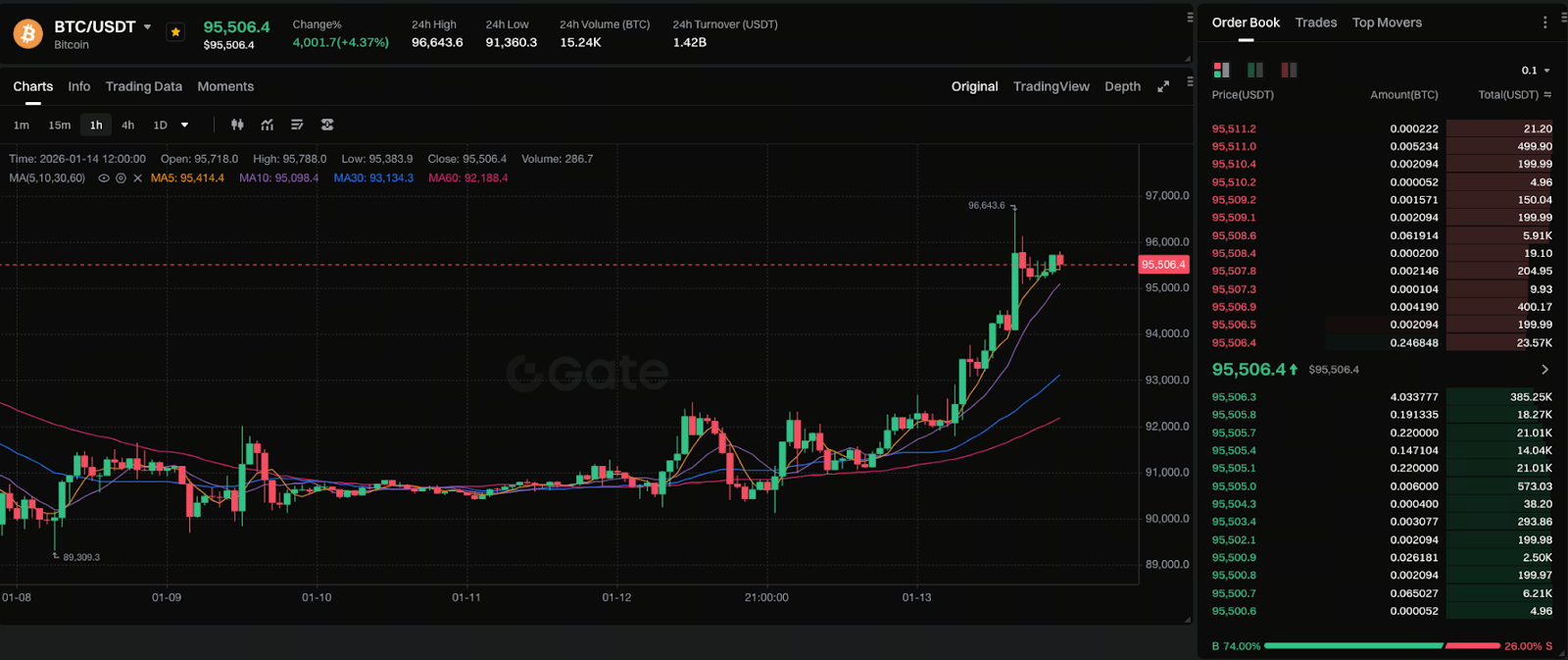
Chart: https://www.gate.com/trade/BTC_USDT
- As of January 14, 2026, Bitcoin trades around $95,000 with moderate volatility over the past 24 hours.
- Market data indicates BTC is facing technical resistance near $94,000, with selling pressure from whales taking profits.
- In 2025, Bitcoin briefly surpassed $126,000 before pulling back.
Overall, Bitcoin remains highly volatile, with institutional demand, market sentiment, and macroeconomic factors jointly driving price movements.
How Bitcoin’s Structure Supports Its Value
Bitcoin’s core components not only define its technical implementation but also establish its foundation of value:
- Decentralized ledger: No central authority, unified globally.
- Immutability: All transactions are public, transparent, and require no trusted third party.
- Scarcity: Total supply is capped at 21,000,000 coins.
- Security: Cryptographic technology and consensus mechanisms ensure network reliability.
Thus, understanding what Bitcoin is made of is fundamental to understanding why it is regarded as “digital gold.”
Summary and Future Outlook
As the first successful implementation of blockchain technology, Bitcoin is built on several core technology stacks: blockchain architecture, transaction and UTXO model, public-private key system, and PoW mining mechanism. Together, these components create a decentralized, secure, and verifiable value transfer system.
Looking forward, Bitcoin’s value may continue to be shaped by macroeconomic policies, ETF developments, technological innovation, and the trend toward decentralization. From both technical and market perspectives, “what is bitcoin made of” is not just a phrase—it is central to understanding Bitcoin’s architecture and investment rationale.
Related Articles

2026 Stablecoin Classification Deep Dive: From Fiat-Collateralized to Algorithmic Stablecoins, Market Landscape and Future Trends

What Are Fractional NFTs? Understanding the Mechanics of NFT Fractionalization and Its Real-World Use Cases

Top Telegram Games to Watch in 2026: The New Web3 Gaming Frontier and Investment Strategies

The Next 100x Coin? Low-Cap Crypto Gem Analysis

What Is Jupiter? A Complete Guide to Solana’s Leading Decentralized Exchange Aggregator
