


What Is Enso (ENSO)? An Intent-Driven Layer-1 Protocol for Simplified Cross-Chain DeFi
Enso Protocol Overview: Streamlining Cross-Chain Interactions
(Source: EnsoBuild)
Enso addresses the challenges developers face when integrating smart contracts across multiple blockchains and rollups. Serving as a coordination layer, Enso enables developers to build applications across diverse ecosystems without managing the intricate technicalities of cross-chain integration.
Its core approach breaks complex operations down into “Intents” and “Actions”:
- Intent: Users or developers specify the desired outcome—such as swapping tokens or transferring assets across chains—without defining the exact execution steps.
- Action: The fundamental operational unit, such as sending tokens, staking assets, or lending. Enso automatically combines multiple actions to fulfill the user’s intent.
This abstraction enhances composability in decentralized application operations and significantly improves the user experience.
Key Features
- Intent-Based Execution Engine
Enso consolidates multiple on-chain operations—like trading, yield farming, lending, and rebalancing—into a single transaction. This reduces gas fees, improves transaction efficiency, and simplifies DeFi workflows. - Cross-Protocol Composability
Supporting a wide range of DeFi platforms, the protocol lets developers execute cross-protocol operations without writing extra smart contracts. Users can manage multiple DeFi services through a unified interface for greater convenience. - Permissionless Strategy Sharing
Enso enables users to publicly create, copy, and share yield strategies, similar to social trading. This promotes collaboration, transparency, and accessibility within the DeFi ecosystem, making it easier for newcomers to participate.
How Enso Works
The Enso transaction and execution flow includes the following steps:
- Intent Creation
Users submit an intent to the network, specifying the desired result without detailing the operational steps. - Action Contribution
Action providers release reusable smart contract abstractions that define how to carry out a single operation, such as swapping tokens or making deposits. - Pathfinding
Solvers assess current network conditions, combine relevant actions into executable bytecode, and determine the most efficient execution route. - Validation
Validators simulate the bytecode on a forked chain to ensure operations are accurate and securely executed. - Solution Selection
The network compares all valid solutions, selecting the lowest-cost and most efficient option while discarding the rest. - Execution
The final solution is returned to the user for execution. Execution fees are distributed to solvers, validators, and action providers via an auction system, with rewards paid in ENSO tokens.
ENSO Token and Utility
ENSO is the native token of the Enso protocol, with a total supply of 127,339,703 tokens and a controlled inflation model that ends after ten years. The token serves several key roles within the ecosystem:
- Governance: Token holders can stake ENSO to vote on protocol upgrades and smart contract improvements. A quorum is required for votes to take effect.
- Security: Staking ENSO supports network validation and system integrity. Validators use a Proof-of-Stake mechanism and simulation tools to verify data.
- Delegation: Holders may delegate tokens to validators to share in validation rewards, without operating their own validation nodes.
Token Allocation
ENSO’s distribution model is specifically designed to balance ecosystem growth, community engagement, and team incentives:
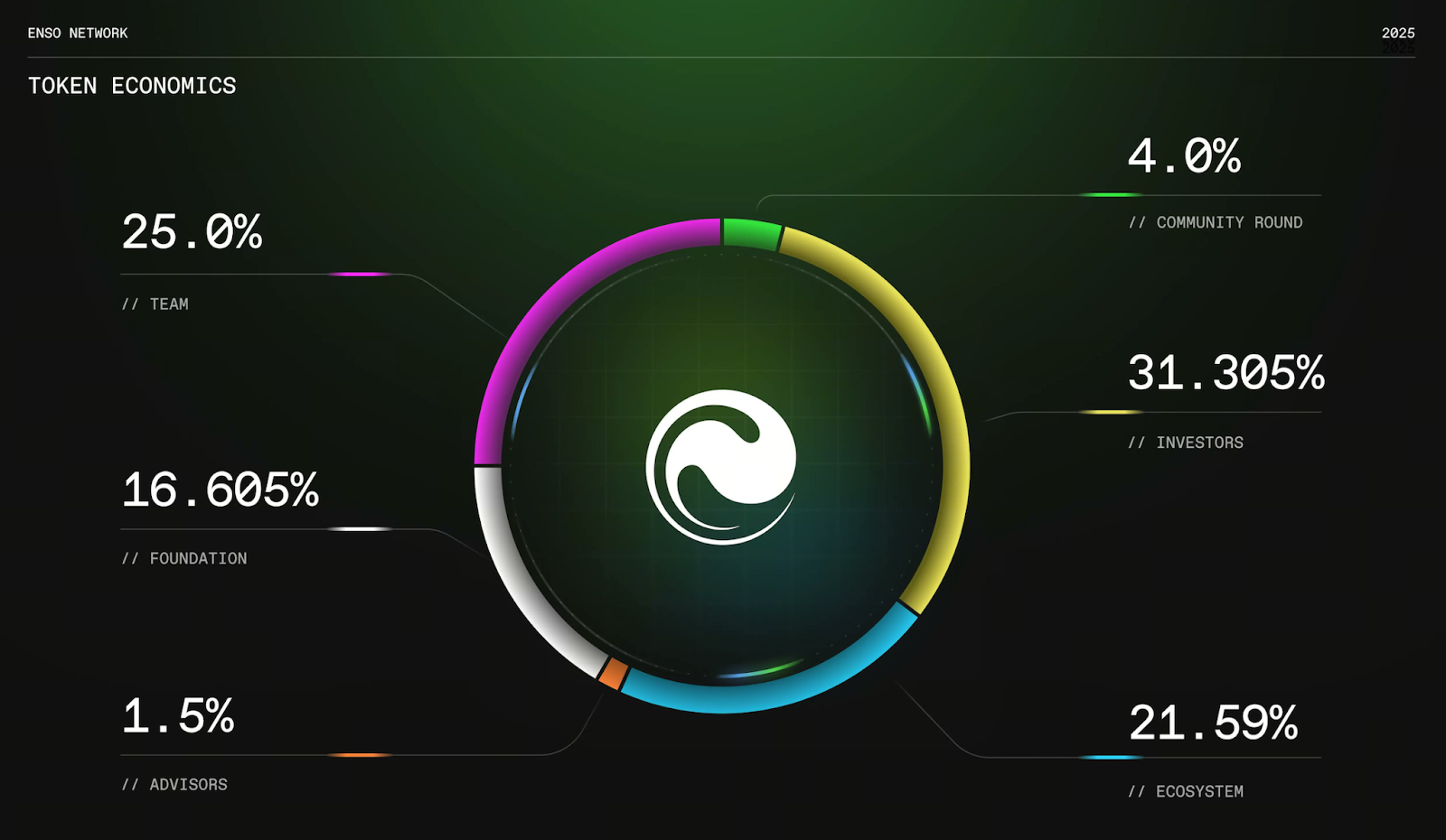
- Ecosystem: Funds ecosystem development, R&D, and ongoing network expansion, including airdrops — 21.59%
- Foundation: Covers operational costs and strengthens governance to ensure the Enso Foundation’s long-term sustainability — 16.605%
- Community Round: Oversubscribed CoinList community round — 4%
- Advisor: Two advisors who have supported Enso since before its founding — 1.5%
- Investors: Backers who have supported the project since its inception — 31.305%
- Team: Rewards for current and future team members for their long-term contributions — 25%
(Source: EnsoBuild)
Conclusion
By leveraging intents and actions, Enso abstracts multi-chain operations to deliver a simpler, lower-cost cross-chain DeFi solution for developers and users. Combining its execution engine, strategy sharing, and ENSO token governance, Enso is building a highly composable, transparent, and decentralized DeFi ecosystem.
Related Articles
2026 Stablecoin Classification Deep Dive: From Fiat-Collateralized to Algorithmic Stablecoins, Market Landscape and Future Trends

What Are Fractional NFTs? Understanding the Mechanics of NFT Fractionalization and Its Real-World Use Cases
Top Telegram Games to Watch in 2026: The New Web3 Gaming Frontier and Investment Strategies

The Next 100x Coin? Low-Cap Crypto Gem Analysis

What Is Jupiter? A Complete Guide to Solana’s Leading Decentralized Exchange Aggregator
