What Is RoboForce? An In-Depth Analysis of the Technical Path and Industrial Prospects of an AI Robotic Workforce Platform
What Is RoboForce? Company Background and Core Positioning
 Image source: RoboForce Official Website
RoboForce is an AI robotics company headquartered in the United States, founded in 2023. The company focuses on developing scalable robotic labor systems (Robo-Labor).
Its core mission is clear: to use AI-powered robots to replace humans in "dirty, exhausting, and dangerous" jobs.
The RoboForce team brings together engineering talent from organizations such as CMU Robotics, Amazon Robotics, Tesla Robotics, and Google, providing a strong technical foundation. Founder Leo Ma previously co-founded the autonomous driving and robotics company Cyngn, equipping RoboForce with direct industry experience in integrating AI and automation.
Robo-Labor: Technical Logic of Robotic Labor Systems
RoboForce’s core product is not a single robot, but a comprehensive “robotic labor system.”
This system’s underlying logic consists of:
- AI models — responsible for perception, decision-making, and learning
- Robotic hardware — executes physical operations
- System platform — manages task scheduling and large-scale deployment
Rather than building “individual intelligent robots,” RoboForce aims to create a robotic labor network akin to cloud computing resources.
According to the company, the Robo-Labor system can perform complex operations in industrial settings, including:
- Pick
- Place
- Twist
- Connect
with precision reaching 1 millimeter. This marks a shift from robots as “automation tools” to “general-purpose labor.”
Technical Capabilities: How AI and Robotics Deliver Physical Intelligence
A central concept for RoboForce is Physical AI (Physical Intelligence). Unlike traditional AI models, the focus is on:
- Not just understanding the world (cognitive intelligence)
- But also transforming the world (executive capability)
RoboForce’s technical strengths are reflected in three main areas:
- High-precision operations: Robots achieve millimeter-level accuracy, which is critical for industrial assembly and energy infrastructure.
- Multi-environment adaptability: The system operates in extreme conditions, such as high-temperature outdoor sites, remote areas, or hazardous industrial environments.
- Continuous learning: Robots continually optimize their operational strategies through AI models, shifting from “pre-programmed execution” to “autonomous learning.”
This capability framework positions RoboForce closer to a real-world AI Agent.
Products and Applications: From Solar Energy to Industrial Automation
RoboForce’s current deployment targets are well defined, focusing on key sectors:
- Solar infrastructure: Large-scale photovoltaic plants are typically situated in remote, harsh environments with labor shortages.
- RoboForce robots handle solar panel installation, structural connections, and ongoing operations and maintenance.
- Manufacturing and logistics: In repetitive industrial processes, robots can dramatically increase efficiency and reduce costs.
- High-risk industries (mining, aerospace): In these sectors, human labor faces significant safety risks, making robotic replacement especially valuable.
Available data shows RoboForce robots can already operate in complex settings and are equipped for all-terrain mobility.
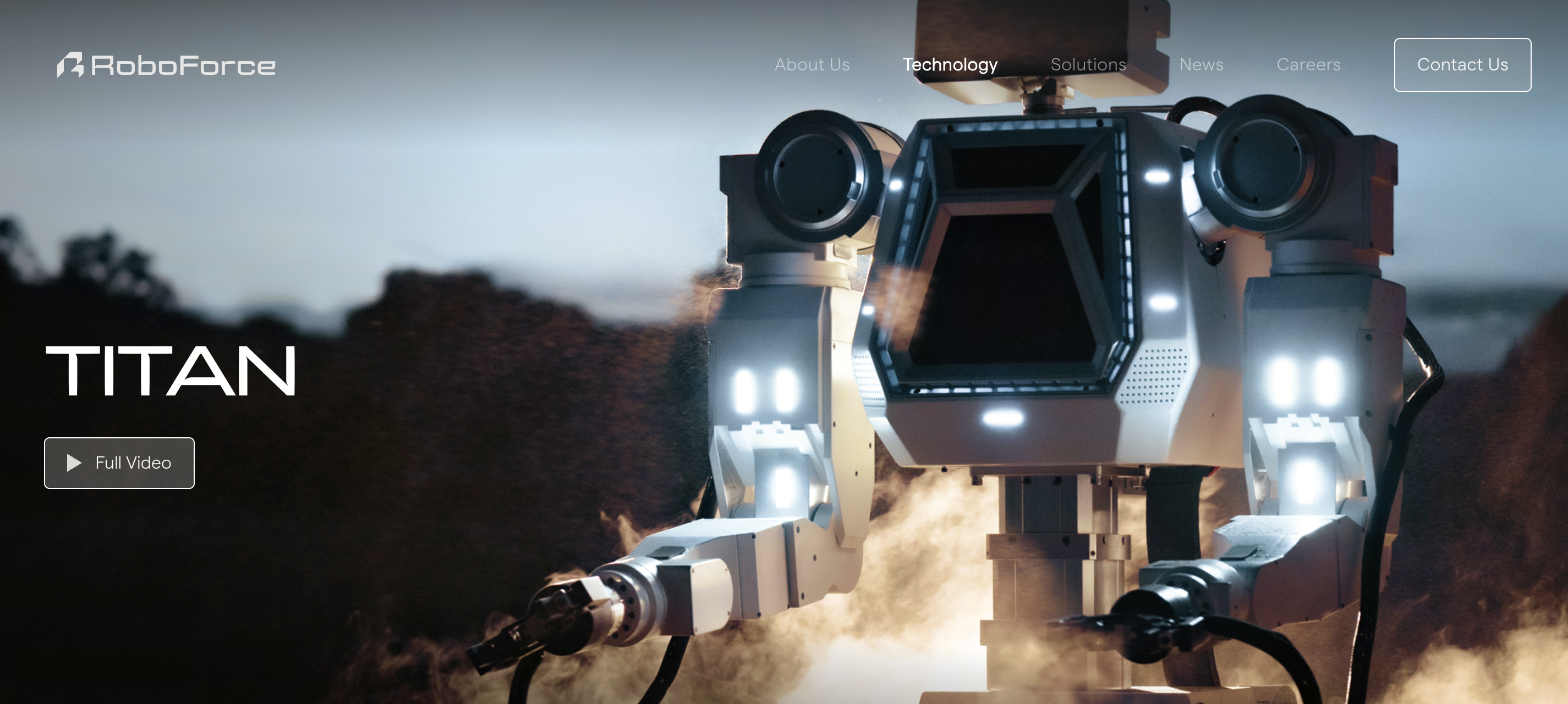
The company has also introduced an industrial robot named Titan, designed for high-intensity scenarios with a modular structure and continuous learning capabilities.
Funding and Capital Background: Why Leading Investors Are Interested
RoboForce has completed several early funding rounds, including a seed round of about $10 million and subsequent rounds, totaling approximately $15 million.
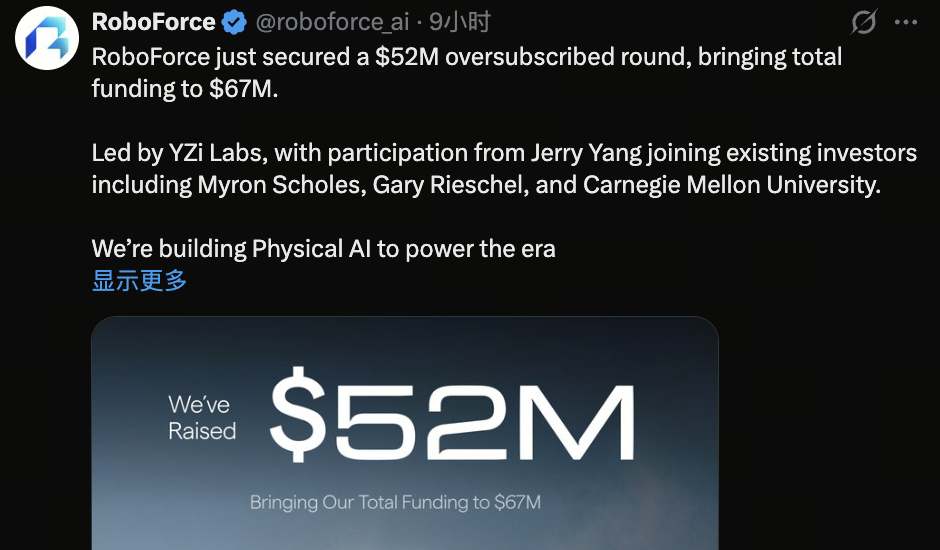 Image source: RoboForce Official X Account
The latest update: On March 17, 2026, RoboForce announced it had closed an oversubscribed $52 million financing round, bringing total funding to around $67 million. YZi Labs led the round, with participation from Jerry Yang, and existing investors such as Myron Scholes, Gary Rieschel, and Carnegie Mellon University increasing their commitments.
The new capital will support foundational robot model R&D, general-purpose Physical AI robot training and manufacturing, and the scaling of commercial deployments.
In summary, the rationale for continued investment is clear: as labor shortages and automation demands converge, robotic labor is emerging as a long-term structural opportunity.
RoboForce’s Industry Impact: Reshaping the Labor Structure
RoboForce exemplifies more than a single company—it signals a broader trend: labor is shifting from “human supply” to “technology supply.”
This transformation closely parallels the evolution of AI:
| Era | Core Resource |
|---|---|
| Industrial Age | Human labor |
| Internet Age | Information |
| AI Age | Computing Power + Data + Robots |
Within this paradigm, robotic labor can be viewed as the AI Token for the Physical Layer (real-world execution layer).
This also implies a shift in the production function of future enterprises:
- Traditional: Human labor × Tools
- New paradigm: AI × Robots × Energy
RoboForce is positioned at the heart of this transition.
Challenges and Risks: Real-World Bottlenecks for Robotic Labor
Despite its strong outlook, RoboForce faces several challenges:
Cost: Robotic hardware remains expensive, and scaling deployments will take time.
Technical maturity: Stability and safety in complex environments still require validation.
Industry adoption: Enterprise willingness to replace human labor at scale depends on ROI.
Regulatory and ethical concerns: Replacing human workers with robots may raise employment and compliance issues.
These factors will determine the pace at which Robo-Labor is adopted.
Future Outlook: Merging Physical AI and the Robot Economy
From a broader perspective, RoboForce’s sector is converging with several major trends:
- AI Agents
- Automated production
- Clean energy infrastructure
- Space economy
The long-term vision is to build a global workforce network based on Robots as a Service (RaaS).
In this ecosystem:
- Enterprises deploy robots on demand
- AI handles automatic task allocation
- Labor costs are redefined as “computing power + equipment costs”
If this model matures, RoboForce could become the real-world equivalent of “AWS + OpenAI” for the execution layer.
Conclusion
On the surface, RoboForce is an AI robotics company. At a deeper level, it represents an attempt to reinvent human production methods.
As AI advances from “cognitive intelligence” to “physical execution,” robotic labor will become the essential bridge connecting the digital and physical worlds.
RoboForce stands as a leading example of this emerging trend.
Related Articles

What Is ERC-8183? Exploring the AI Agent Commercial Standard and the Infrastructure of the Decentralized Agent Economy

AI Agents Becoming Economic Actors: What Infrastructure Gaps Can Blockchain Fill?

How to Reduce Token Costs in the AI Era: Practical Strategies from Prompt Optimization to Model Selection
What is Athene Network (ATN)? Exploring AI-Blockchain Integration

How to Build a Personal Moat in the AI Era: 5 Key Strategies to Stay Irreplaceable