

Search Token/Wallet
When Is ETH Gas Lowest? Save Fees by Timing Your Transactions
Beginner
Quick ReadsWhat Are ETH Gas Fees?
----------------------
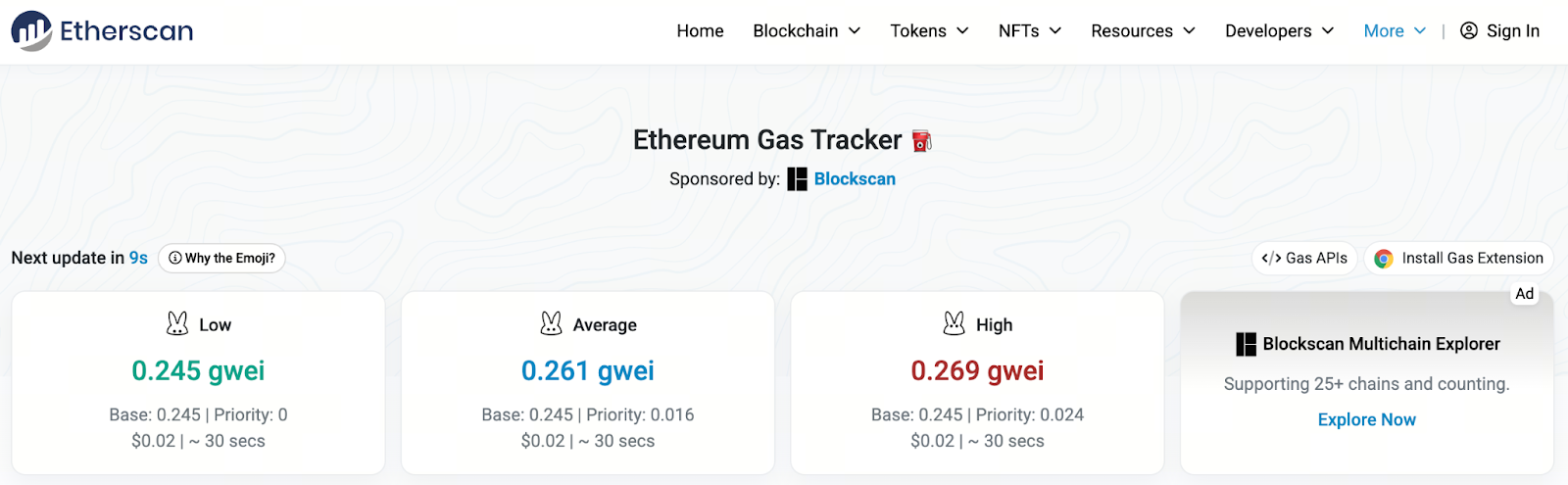
Image:
Every time you send ETH or interact with a smart contract on the Ethereum network, you pay a transaction fee called the gas fee. Essentially, this is the “fuel cost” paid to network validators to process your transaction. Gas fees are usually measured in gwei (1 gwei = 0.000000001 ETH). Following the EIP-1559 upgrade in 2021, each Ethereum transaction now includes a “base fee” and a “priority fee,” which has made fee estimation more predictable.
Why Do Gas Fees Fluctuate?
--------------------------
The core driver of gas fee volatility is network congestion. When more users transact simultaneously—such as during NFT minting sprees, heavy DeFi activity, or trading surges—block space becomes scarce. Users then offer higher priority fees to speed up confirmation, driving fees higher overall. Usage patterns also vary across regions and time zones, so off-peak hours differ globally and impact fees. Additionally, complex transactions like smart contract interactions require more gas units than simple ETH transfers, making them more expensive.
Best Times to Find Low ETH Gas Fees
-----------------------------------
For newcomers, the key question is “When are transactions cheapest?” Based on data from multiple sources, here are some practical time windows:
- Weekdays: Network activity is generally lowest from midnight to early morning Eastern Standard Time (EST)—for instance, 12:00 to 4:00 AM EST. US and European users are mostly offline, and Asian markets have just ended or not yet begun.
- Weekends: The lowest gas fees tend to occur in the early morning hours of Saturday or Sunday EST (e.g., 2:00–3:00 AM EST), when global activity drops and the network is least congested.
- UTC reference: In UTC time, 1:00–5:00 AM UTC is considered a low-congestion period.
- Avoid peak hours: US and European business hours (8:00 AM–1:00 PM EST / 2:00–6:00 PM UTC) typically see higher fees.
For example, if you’re in Tokyo (UTC+9), “1:00–5:00 AM UTC” is roughly 10:00 AM–2:00 PM Tokyo time. However, since Asian markets are active and time zone differences affect actual network conditions, verify current network conditions using monitoring tools.
Practical Tips: Monitoring Tools and Transaction Strategies
-----------------------------------------------------------
To effectively reduce gas fees, consider these approaches:
- Use real-time monitoring tools: Platforms like Ethereum Gas Tracker and QuickNode Gas Tracker show current base and priority fees.
- Perform transactions during off-peak hours: If your transaction isn’t urgent (e.g., simple transfers, non-time-sensitive confirmations), wait for the recommended low-fee windows before submitting.
- Adjust gas price and limits: If your wallet supports manual settings, set a lower priority fee or choose slower confirmation to reduce costs.
- Consider Layer-2 solutions: If you transact frequently, using Layer-2 networks like Polygon, Arbitrum, or Optimism can significantly reduce fees.
Summary: Take Advantage of Low-Fee Periods
------------------------------------------
In summary, the best answer to “when are ETH gas fees lowest” is during periods of low network activity—late nights (EST), weekends, and global off-peak times. By tracking these trends, using real-time monitoring, and deploying smart transaction strategies, you can substantially reduce your costs. Beginners should note that “late night/morning” and “weekend” are optimal times for lower fees. Before your next Ethereum transaction, check the current gas fee and decide if it’s worth waiting. Optimize your transaction timing for lower fees.
Author: Max
* The information is not intended to be and does not constitute financial advice or any other recommendation of any sort offered or endorsed by Gate Web3.
* This article may not be reproduced, transmitted or copied without referencing Gate Web3. Contravention is an infringement of Copyright Act and may be subject to legal action.
Related Articles
Beginner
2026 Stablecoin Classification Deep Dive: From Fiat-Collateralized to Algorithmic Stablecoins, Market Landscape and Future Trends
A thorough breakdown of stablecoin types—including fiat-backed, crypto-collateralized, algorithmic, and hybrid models—paired with up-to-date regulatory and market trends, empowers readers to navigate the stablecoin ecosystem and make informed investment decisions.

Beginner
What Are Fractional NFTs? Understanding the Mechanics of NFT Fractionalization and Its Real-World Use Cases
Fractional NFTs make high-value NFTs more accessible by breaking them into tradable shares. This article offers a comprehensive overview of the underlying technology, practical use cases, and inherent limitations.
Beginner
Top Telegram Games to Watch in 2026: The New Web3 Gaming Frontier and Investment Strategies
A comprehensive review of the top Telegram games to watch in 2026—including standout projects like Notcoin, Hamster Kombat, and Azuki Alley Escape—offering expert insights into gameplay trends and potential investment opportunities.

Beginner
The Next 100x Coin? Low-Cap Crypto Gem Analysis
This article analyzes cryptocurrency projects with low market capitalization that may be noteworthy in 2025, offering analysis from the perspectives of technology, community engagement, and market potential. Additionally, the report offers guidance on coin selection and highlights key risk factors for new investors.

Beginner
What Is Jupiter? A Complete Guide to Solana’s Leading Decentralized Exchange Aggregator
Jupiter stands as the core decentralized exchange aggregator within the Solana ecosystem, delivering users the best prices, minimal slippage, and seamless cross-pool liquidity integration. This article thoroughly examines Jupiter's mechanisms, exploring its features, strengths, trading processes, and future outlook. You'll gain a clear understanding of why Jupiter has emerged as the primary entry point for trading on Solana.

Beginner
Best Metaverse Projects in 2026: Seizing the Next Digital Wave
A comprehensive analysis of the leading Metaverse projects for 2026: Explore key developments from Web2 giants like Meta and Roblox, as well as Web3 frontrunners including The Sandbox and Decentraland. This article delivers the latest trends, technological breakthroughs, and investment opportunities in the Metaverse sector.