Why Are Banks Issuing Stablecoins? From USBDC to the Next Generation of Bank Payments
Bank stablecoins are on-chain digital payment instruments issued by banks or bank-led financial institutions and typically backed by fiat currencies or highly liquid assets. Unlike conventional crypto assets, their primary objective is generally not price appreciation, but converting the value of currencies such as U.S. dollars and euros held in bank accounts into a digital form that can be transferred and settled on blockchain networks.
In September 2026, U.S. Bank completed a real-time cross-border payment pilot using USBDC, prompting further market discussion about why banks need their own stablecoins. The transaction was completed on the Stellar public blockchain and involved the transfer of funds between U.S. Bank entities in North America and Europe, while also connecting the bank’s existing financial, risk, compliance, and operational systems.
USBDC is not a publicly traded product for retail users, but a representative bank-grade blockchain payment experiment. Combined with the latest development that 21 financial institutions—including Goldman Sachs, Bank of America, Citi, and Deutsche Bank—plan to jointly establish a company to issue a U.S. dollar stablecoin, this indicates that banks are exploring more than whether to enter the crypto market. They are also exploring how to incorporate stablecoins into the next generation of payment and treasury management systems.
Key Takeaways
-
The primary purpose of bank-issued stablecoins is not simply to create a new digital asset, but to explore blockchain-based payment, settlement, and treasury management infrastructure.
-
In September 2026, U.S. Bank completed a real-time cross-border payment pilot using USBDC, transferring U.S. dollar value between its North American and European entities through Stellar.
-
A bank’s own stablecoin can integrate issuance, redemption, risk management, compliance, and payment processes into the bank’s existing financial infrastructure.
-
Stablecoins can enable 24/7 on-chain transfers and may reduce friction in cross-border fund movements, liquidity management, and settlement.
-
Twenty-one financial institutions have planned to establish a company to issue a U.S. dollar stablecoin, indicating that banks and traditional financial institutions are moving from researching blockchain to building on-chain payment infrastructure.
What Are Bank Stablecoins?
Within the traditional banking system, U.S. dollars primarily exist as bank account balances, deposits, and interbank settlement funds. When a company pays an overseas partner, the funds typically move through bank accounts, payment networks, correspondent banks, and settlement systems spanning different jurisdictions. This does not mean every cross-border payment takes several days to complete, but moving funds across institutions, time zones, and jurisdictions still involves challenges such as prefunding, banking hours, and liquidity management.
Bank stablecoins aim to change some of these processes. A bank can represent eligible U.S. dollar value as on-chain tokens, transfer those tokens through a blockchain network, and remain responsible for final redemption and treasury management.
This can be summarized as: U.S. dollars in a bank account → bank-issued stablecoin → blockchain transfer → recipient → redemption into U.S. dollars within the banking system.
Under this model, the blockchain serves as the value-transfer and settlement rail, while the bank continues to manage issuance, redemption, compliance, risk controls, and customer relationships.
The significance of bank stablecoins, therefore, is not simply that a bank has issued a token. It is that banks are beginning to explore moving part of their payment infrastructure onto programmable blockchain networks.
Why Is USBDC Worth Watching?
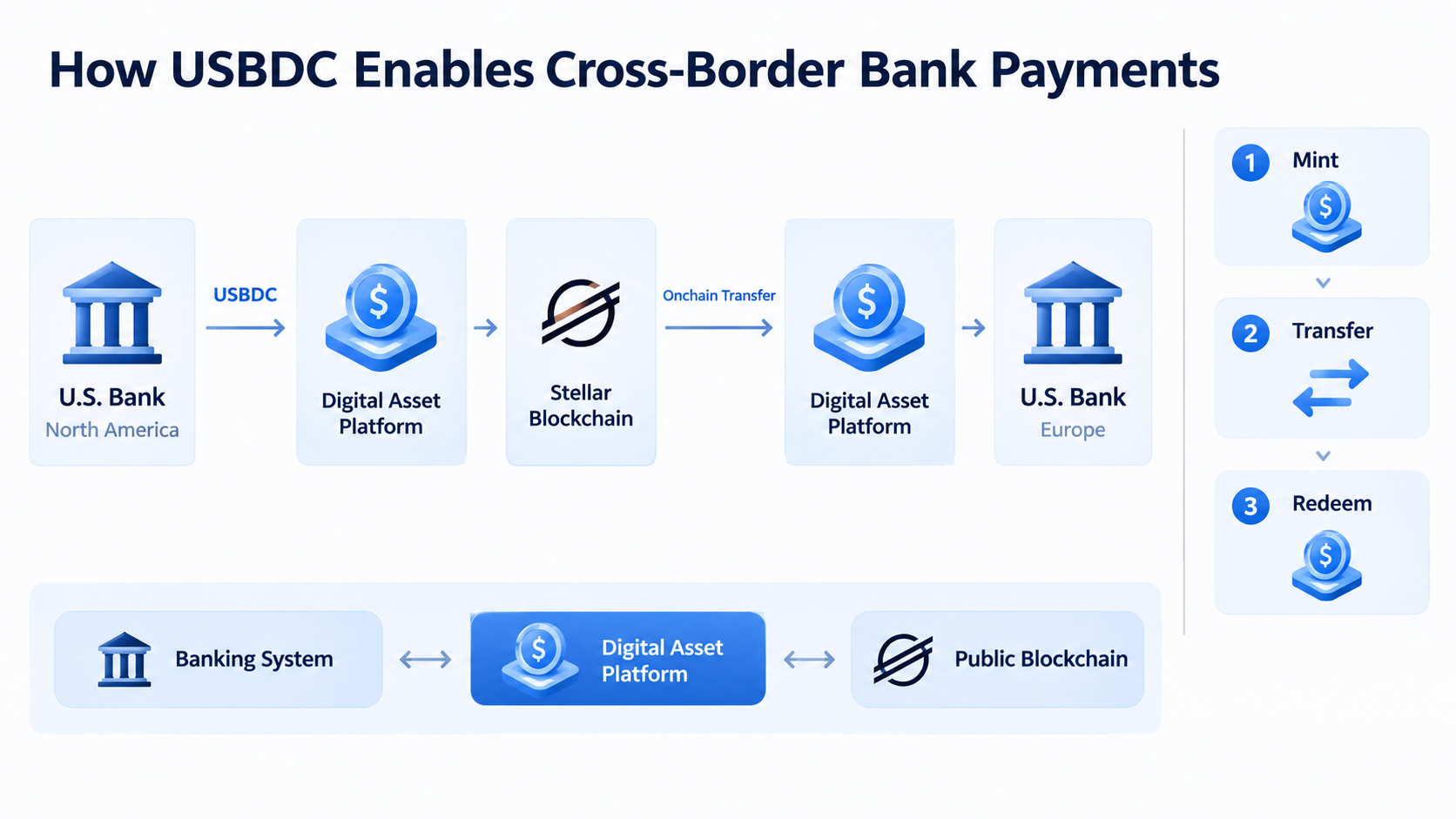
USBDC is a U.S. dollar stablecoin launched by U.S. Bank. In September 2026, U.S. Bank announced the completion of a real-time cross-border payment pilot that transferred USBDC from its North American entity to its European entity through Stellar. The pilot also tested USBDC’s lifecycle functions, including minting, payments, redemption, freezing, and clawback.
One notable detail is that USBDC does not operate on a fully closed internal ledger owned by U.S. Bank. Instead, it is deployed on the public blockchain Stellar. At the same time, the bank uses its Digital Asset Platform to connect traditional financial systems with the blockchain network, allowing on-chain assets to work with its existing financial, risk, compliance, and operational systems.
This reflects a typical approach taken by banks entering the blockchain sector: rather than moving the entire traditional banking system on-chain, they add a digital asset infrastructure layer between traditional financial infrastructure and public blockchains.
It is also important to distinguish between completing a pilot and achieving full commercialization. The USBDC transactions disclosed to date involve a cross-border pilot between U.S. Bank entities. The bank has not announced that retail users can directly purchase, hold, or trade USBDC. At this stage, USBDC is therefore better understood as a practical validation of bank payment infrastructure than as a stablecoin product fully open to the public.
Why Doesn’t the Bank Use USDC Directly?
Given that mature stablecoins such as USDC already exist, why would a bank issue its own stablecoin?
One reason is control.
If a bank uses a third-party stablecoin, the issuance and redemption mechanisms, reserve management, on-chain permissions, and parts of the underlying infrastructure are controlled by an external issuer. The bank can use the stablecoin as a payment instrument, but it cannot fully determine the lifecycle of the underlying assets.
When a bank issues its own stablecoin, it can bring issuance, redemption, and compliance controls into its own systems. For example, the USBDC pilot tested capabilities such as minting, redemption, freezing, and clawback. These functions are particularly important for regulated financial institutions because banks are not handling ordinary on-chain tokens. They are handling value connected to real-world financial accounts, customer assets, and internal risk systems.
Another reason is treasury management. A bank’s stablecoin does not necessarily need to become a retail trading asset. It can also serve as a settlement instrument for internal institutional transfers or transactions between institutions and their customers. For example, a multinational company may need to move U.S. dollar liquidity between regions. If an on-chain stablecoin can directly connect bank entities in different regions, it may reduce the need for some prefunding and manual fund transfers.
A bank’s own stablecoin and USDC are therefore not necessarily in direct competition. The former emphasizes the bank’s own payment, settlement, and treasury management systems, while the latter has already developed a more open on-chain liquidity and application ecosystem.
How Can Stablecoins Change Bank Payments?
Traditional cross-border payments can be understood as connections between multiple financial systems, while stablecoins turn part of the value-transfer process into an on-chain transaction.
The most direct change concerns timing. Blockchain networks can generally process transactions 24/7, while some settlement and fund-transfer activities in the traditional banking system remain subject to banking hours, holidays, and the operating hours of financial infrastructure in different regions. In its introduction of USBDC, U.S. Bank identified 24/7 transaction capability as an important area of exploration.
The second change concerns liquidity management. Companies and financial institutions typically need to pre-position funds in different regions to ensure that payments can be completed smoothly. If on-chain settlement can be completed more quickly, it could theoretically reduce some prefunding requirements and allow funds to move more flexibly between accounts and regions.
The third change is programmability. Stablecoins are digital assets on a blockchain and can therefore be integrated with smart contracts. For example, institutions could eventually design rules that automatically trigger payments, collateral replenishment, conditional settlement, or fund consolidation. Payments would then become more than simply sending money—they could become automated components of corporate treasury processes.
This is why bank stablecoins are better understood as payment infrastructure than as cryptocurrency.
How Do Bank Stablecoins Differ From Traditional Stablecoins?
| Comparison Dimension | Bank-Issued Stablecoins | Crypto-Native Stablecoins |
|---|---|---|
| Primary Issuers | Banks or banking alliances | Professional stablecoin issuers |
| Core Use Cases | Payments, settlement, and treasury management | Trading, DeFi, payments, and more |
| Primary Users | Banks, companies, and institutional customers | Crypto users, companies, and institutions |
| Issuance and Redemption | Typically directly connected to the banking system | Managed by the stablecoin issuer |
| Compliance Framework | Relies on the banking regulatory system | Depends on the issuer and its jurisdiction |
| Role of the Blockchain | Payment and settlement infrastructure | Asset issuance and circulation infrastructure |
| Primary Advantages | Bank control, compliance, and treasury management | Liquidity, openness, and ecosystem networks |
This classification is not absolute. The legal structures of bank stablecoins may vary. Some products are closer to deposit tokens, while others adopt a stablecoin structure. J.P. Morgan’s JPM Coin is a notable example: its related products follow the bank deposit token model rather than simply replicating the stablecoin model used in crypto markets.
Bank digital currency products may therefore develop into multiple categories. Whether a token issued by a bank should be called a stablecoin will itself depend on its legal and asset structure.
What Are Banks Building, as Seen Through USBDC?
If we focus only on USBDC, it is easy to view it as U.S. Bank creating its own version of USDC. From an infrastructure perspective, however, the more important component is the Digital Asset Platform behind it.
Banks need to solve a range of problems, including how to issue tokens, burn and redeem them, freeze assets, handle abnormal transactions, connect with core banking systems, and incorporate on-chain transactions into risk and compliance processes.
What banks ultimately need to build may therefore be not just a stablecoin, but a complete digital asset operating system for banking.
The future of bank payment infrastructure can be understood as having three layers:
Layer 1: Core banking systems. Responsible for accounts, customers, funds, risk, and compliance.
Layer 2: Digital asset platforms. Responsible for token issuance, redemption, custody, permissions, and lifecycle management.
Layer 3: Blockchain networks. Responsible for the transfer and settlement of digital assets, as well as smart contract execution.
The significance of USBDC lies in its initial validation of whether these three layers can work together. U.S. Bank has stated that the institutional use cases it is evaluating include liquidity management, collateral movement, and cross-border treasury management.
Will Bank Stablecoins Create a New Payment Network?
At present, banks are exploring more than individual tokens. They are also exploring networked settlement among multiple financial institutions.
In September 2026, 21 financial institutions announced plans to establish a company to issue a U.S. dollar-pegged stablecoin. The institutions include Goldman Sachs, Bank of America, Citi, and Deutsche Bank. The plan initially involved 10 banks, later expanded to 21, and may eventually explore other G7 currencies.
If this type of project is implemented, bank stablecoins may develop in two directions.
One direction is a stablecoin within a single banking system. A bank could issue its own token primarily to support internal fund transfers, institutional customers, and cross-border treasury management.
The other direction is a banking alliance network. Multiple banks could jointly establish a stablecoin issuance and settlement system, enabling different financial institutions to transfer funds directly on-chain.
The latter is closer to the concept of a next-generation bank payment network. It does not necessarily mean traditional payment systems will be replaced immediately. Instead, bank payment infrastructure may gradually shift from connecting individual ledgers to enabling real-time connections among multiple bank ledgers and blockchain networks.
What Challenges Do Bank Stablecoins Face?
The development of bank stablecoins still faces several practical challenges.
-
Regulatory and legal structures. Stablecoins, deposit tokens, electronic money, and other on-chain payment instruments may be subject to different regulatory frameworks. Banks must clearly define the nature of the assets underlying the tokens, holder rights, redemption mechanisms, and the legal relationships that would apply in the event of insolvency.
-
Interoperability. If every bank issues its own stablecoin but different tokens cannot be exchanged smoothly, bank stablecoins could create new digital silos. The more important question in the future may therefore not be whether a particular bank has a stablecoin, but whether different banks can establish common standards and settlement mechanisms.
-
Liquidity and network effects. USDC and USDT already have substantial on-chain liquidity and broad application ecosystems. After launching their own stablecoins, banks will need to address a practical question: Why should users and institutions use a new token? If a stablecoin can only be used within the issuing bank’s own network, its practical value may be limited.
-
The balance between public blockchains and bank control. Banks want to leverage the openness and 24/7 settlement capabilities of public blockchains while retaining traditional financial controls such as freezing, redemption, and compliance reviews. USBDC’s testing on Stellar is precisely an exploration of this balance.
What Does It Mean for Banks to Issue Stablecoins?
From USBDC to the bank alliance stablecoin initiative, one clear shift is evident: the focus of banks’ blockchain discussions is moving from whether they should use crypto assets to how they can use blockchain to redesign the movement of funds.
In this process, stablecoins function more like an on-chain monetary interface. They convert the value of U.S. dollars within the banking system into digital assets that can move, be programmed, and settle on a blockchain, while preserving the banking system’s identity verification, risk management, asset redemption, and compliance controls.
The real significance of bank stablecoins therefore lies not in the name of a particular token, but in the infrastructure changes behind it. If banks can connect stablecoins with core banking systems, corporate treasury management, cross-border payments, collateral, and capital markets, blockchain may gradually move from being financial technology outside the banking system to becoming part of the bank payment system.
USBDC remains at the institutional pilot stage, but it has already demonstrated a clear technical path: banks are responsible for assets and compliance, digital asset platforms are responsible for lifecycle management, and public blockchains are responsible for value transfer and settlement. As more banks and financial institutions explore similar solutions, future bank payment systems may become increasingly on-chain, real-time, and programmable.
FAQ
What Is USBDC?
USBDC is a U.S. dollar stablecoin launched by U.S. Bank. In September 2026, U.S. Bank completed a cross-border payment pilot between its North American and European entities through Stellar and tested functions including minting, payments, redemption, freezing, and clawback.
What Is the Difference Between USBDC and USDC?
They are different digital assets. USDC is issued by Circle and has developed a substantial open on-chain ecosystem. USBDC was launched by U.S. Bank and is currently used primarily to validate bank-grade digital asset and payment infrastructure.
Can USBDC Be Purchased?
Based on publicly available information, the latest development involving USBDC remains an institutional cross-border payment pilot between U.S. Bank entities. It is not a public stablecoin product available to retail users.
Why Do Banks Issue Their Own Stablecoins?
The primary reasons include improving cross-border payment efficiency, enabling 24/7 fund transfers, improving liquidity management, supporting on-chain collateral movement, and allowing banks to directly control token issuance, redemption, and compliance processes.
Will Bank Stablecoins Replace USDT and USDC?
There is currently insufficient evidence to support this conclusion. USDT and USDC already have mature liquidity and broad on-chain applications, while bank stablecoins place greater emphasis on bank payments, institutional settlement, and treasury management. Different types of stablecoins may coexist over the long term and serve different use cases.
Related Articles

Will Sidra Break $1,000? A Realistic Look at Sidra Chain Price Claims in 2026–2027

BlockDAG (BDAG): A High-Speed and Secure Layer 1 for the Next Era

Rising Prices but Bearish Funding Rates: Is Crypto Entering a “Layered Bull Market” After Wall Street Capital Inflows?

Fractional NFTs: Lowering Barriers and Enhancing Liquidity
What is USDC? A Complete Guide to One of the Most Trusted Stablecoins