

LCP_hide_placeholder
fomox
MarketsPerpsSpotSwap
Meme
Referral
More
Become a Smart Money on Tracker
Search Token/Wallet
/

Ethereum vs Bitcoin: A Comprehensive Comparison

2025-12-20 09:17:35
Bitcoin
Blockchain
Crypto Insights
DeFi
Ethereum
Article Rating : 3.5
half-star
43 ratings
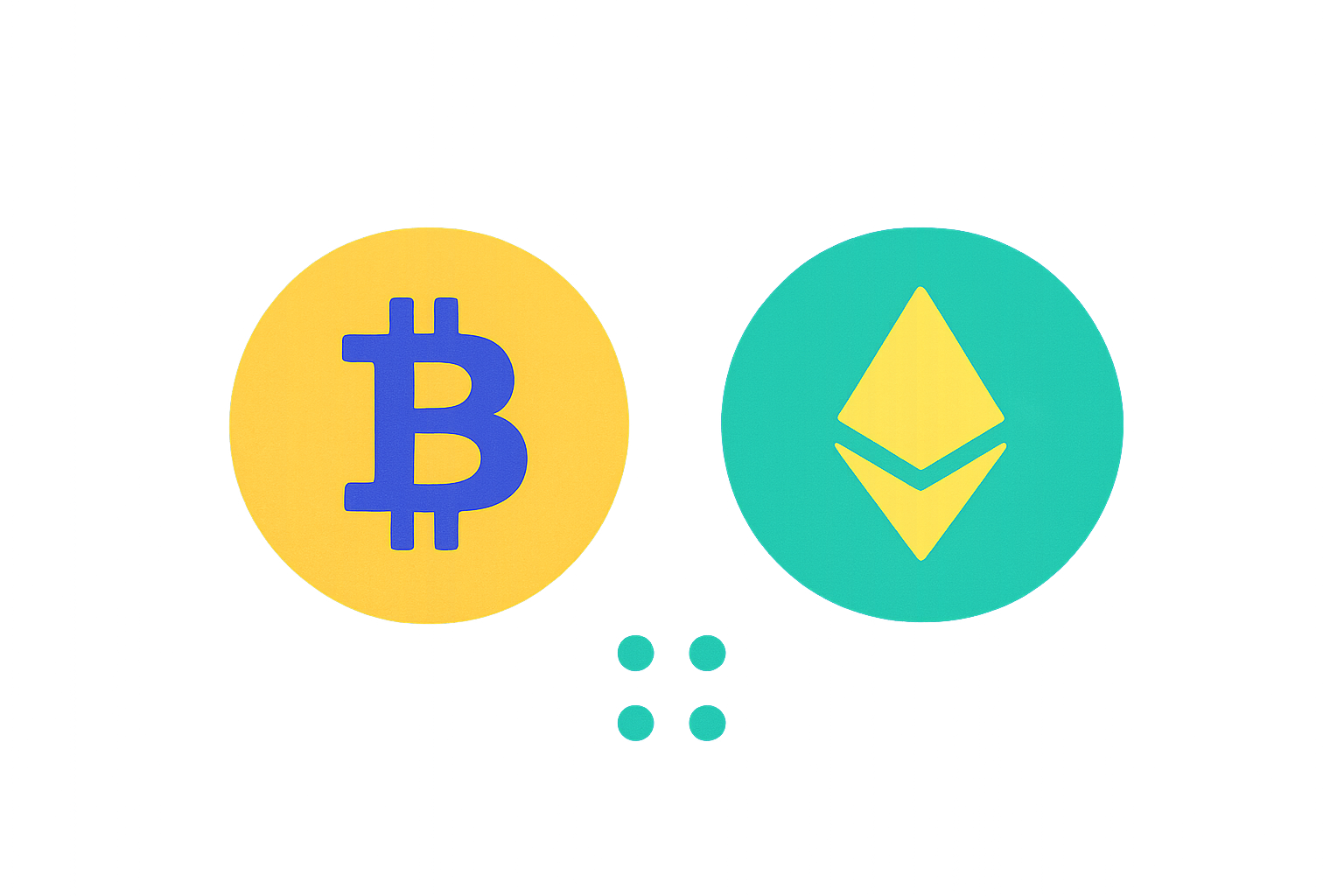
Explore the dynamic relationship between Bitcoin and Ethereum in this comprehensive comparison. This article examines their origins, purposes, market positions, and technical differences, highlighting how they cater to distinct niches. From understanding the complementary roles both play in the cryptocurrency ecosystem to assessing investment strategies, readers will discover insights into their coexistence and potential. Ideal for investors, developers, and cryptocurrency enthusiasts seeking to grasp these two giants' roles and influence, it offers clarity on their fundamental differences rather than viewing them as direct competitors.
Ethereum vs Bitcoin: A Comprehensive Comparison

Is Ethereum a Competitor of Bitcoin? Understanding the Relationship Between Two Crypto Giants

The cryptocurrency landscape has evolved significantly since Bitcoin's introduction, and Ethereum's emergence has sparked ongoing debates about whether these two blockchain platforms are truly competitors or serve fundamentally different purposes. Understanding the relationship between Bitcoin and Ethereum requires examining their design philosophies, use cases, and market positions.

Different Origins, Different Purposes

Bitcoin was created as a peer-to-peer electronic cash system, designed primarily as a store of value and medium of exchange. Ethereum, on the other hand, was developed as a programmable blockchain platform that enables smart contracts and decentralized applications (dApps). While both utilize blockchain technology, their core missions differ substantially.

Bitcoin functions as "digital gold," focusing on security, decentralization, and maintaining a fixed supply of 21 million coins. Ethereum operates as a "world computer," prioritizing flexibility, programmability, and supporting a vast ecosystem of decentralized finance (DeFi) protocols, non-fungible tokens (NFTs), and other blockchain-based applications.

Market Position and Use Cases

When considering is Ethereum a competitor of Bitcoin, it's essential to recognize that they occupy different niches within the cryptocurrency ecosystem. Bitcoin dominates as the premier store of value and has established itself as the most recognized cryptocurrency globally. Its market capitalization and adoption as an institutional investment vehicle demonstrate its strength in this specific role.

Ethereum has carved out its own territory as the leading smart contract platform. The vast majority of DeFi applications, NFT marketplaces, and blockchain-based projects are built on Ethereum or compatible networks. This positions Ethereum as a utility platform rather than purely a currency or store of value.

Technical Differences That Define Their Relationship

The technical architecture of these networks highlights why the question is Ethereum a competitor of Bitcoin isn't straightforward:

Consensus Mechanisms: Bitcoin continues to use Proof-of-Work (PoW) mining, emphasizing security through computational power. Ethereum has transitioned to Proof-of-Stake (PoS), prioritizing energy efficiency and scalability.

Transaction Speed and Costs: Ethereum typically processes transactions faster than Bitcoin, though both networks experience congestion during high-demand periods. Layer-2 solutions on both platforms continue to address scalability challenges.

Programmability: Bitcoin's scripting language is intentionally limited to maintain security and simplicity. Ethereum's Turing-complete programming language enables complex smart contracts and diverse applications.

Complementary Rather Than Competitive?

Many cryptocurrency analysts argue that Bitcoin and Ethereum are complementary rather than directly competitive. Bitcoin serves as the foundational cryptocurrency and a macro-economic hedge, while Ethereum provides the infrastructure for decentralized applications and financial innovation.

Investors and institutions often view them differently: Bitcoin as a long-term store of value comparable to precious metals, and Ethereum as a technology investment with growth potential tied to blockchain adoption across industries.

The Investment Perspective

From an investment standpoint, the debate about is Ethereum a competitor of Bitcoin becomes more nuanced. Portfolio diversification strategies often include both assets, recognizing their different risk profiles and growth drivers. Bitcoin's performance typically correlates with broader cryptocurrency market sentiment and macroeconomic factors, while Ethereum's value is additionally influenced by network usage, DeFi activity, and technological upgrades.

Evolving Ecosystem Dynamics

The cryptocurrency ecosystem continues to mature, with both Bitcoin and Ethereum evolving to address their respective challenges. Bitcoin developers work on improving privacy and scaling through technologies like the Lightning Network. Ethereum's roadmap focuses on sharding, rollups, and further efficiency improvements.

Both networks face competition from newer blockchain platforms, but their established network effects, developer communities, and institutional adoption provide significant advantages. Rather than competing directly with each other, they often compete with traditional financial systems and other blockchain platforms.

Conclusion: Competition or Coexistence?

So, is Ethereum a competitor of Bitcoin? The answer depends on perspective. While they compete for investor capital and market attention, their fundamental purposes and use cases differ significantly enough that they can coexist and thrive simultaneously.

Bitcoin's position as digital gold and a store of value remains largely unchallenged by Ethereum, whose strength lies in powering decentralized applications and smart contracts. The cryptocurrency market has demonstrated sufficient size and diversity to support both networks, each excelling in their respective domains.

Understanding that Bitcoin and Ethereum serve different purposes helps investors, developers, and users make informed decisions about which platform suits their needs. Rather than viewing them as direct competitors, recognizing their complementary roles within the broader blockchain ecosystem provides a more accurate picture of their relationship and future potential.

FAQ

Is Ethereum a competitor to Bitcoin?

Yes, Ethereum competes with Bitcoin in the cryptocurrency market. While Bitcoin focuses on payments, Ethereum enables smart contracts and DApps. Both vie for market dominance and investor attention.

Who is the biggest competitor to Bitcoin?

Ethereum is Bitcoin's biggest competitor. It introduced smart contracts and decentralized applications, offering functionality beyond Bitcoin's store-of-value focus. With massive transaction volume and developer ecosystem, Ethereum remains the leading alternative cryptocurrency.

Who is Ethereum's biggest competitor?

Bitcoin remains Ethereum's primary competitor as the largest cryptocurrency by market capitalization. However, among smart contract platforms, Solana and Cardano are major rivals competing for developer adoption and transaction volume.

Is it better to buy Ethereum or Bitcoin?

Bitcoin is generally the better long-term choice due to its established market position and broader adoption. However, Ethereum offers stronger short-term growth potential. Your choice depends on investment horizon and risk tolerance.

* The information is not intended to be and does not constitute financial advice or any other recommendation of any sort offered or endorsed by Gate.

Share

Content

Different Origins, Different Purposes

Market Position and Use Cases

Technical Differences That Define Their Relationship

Complementary Rather Than Competitive?

The Investment Perspective

Evolving Ecosystem Dynamics

Conclusion: Competition or Coexistence?

FAQ

Related Articles
Decentralized Finance and Centralized Finance: A Comparative Analysis

Decentralized Finance and Centralized Finance: A Comparative Analysis

This article provides a comprehensive comparison of Decentralized Finance (DeFi) and Centralized Finance (CeFi), highlighting their core functionalities and distinctions. It addresses the nuances of user trust, control, and risk in cryptocurrency management, essential for anyone navigating the digital asset landscape. The article explores how both systems offer trading, lending, and storing services, yet operate differently—CeFi relies on intermediaries like Gate with inherent counterparty risks, whereas DeFi emphasizes peer-to-peer transactions with blockchain transparency. By understanding these differences, traders can make informed decisions tailored to their technical proficiency and risk tolerance.
2025-12-01 10:08:46
What Are the Biggest Cryptocurrency Security Risks and How Can Investors Protect Themselves?

What Are the Biggest Cryptocurrency Security Risks and How Can Investors Protect Themselves?

This article delves into the significant security risks in the cryptocurrency industry, focusing on smart contract vulnerabilities, exchange hacks, and centralization issues. It highlights key incidents, such as the DAO Hack and recent breaches like the one affecting Gate, emphasizing how these events shaped investor behavior. The discussion provides valuable insights into preventative measures investors can take, such as employing self-custody solutions and understanding the importance of security protocols on platforms like Gate. Targeted at cryptocurrency investors, this piece aims to enhance their understanding of cryptographic risks and secure asset management.
2025-11-13 05:27:47
How does SUI price volatility compare to Bitcoin and Ethereum in 2026?

How does SUI price volatility compare to Bitcoin and Ethereum in 2026?

# Article Overview: SUI Price Volatility vs Bitcoin and Ethereum in 2026 This comprehensive analysis examines SUI's price volatility profile compared to Bitcoin and Ethereum throughout 2026, revealing SUI's emerging stability as institutional adoption accelerates. The article addresses investor concerns about comparative risk levels, price prediction accuracy, and optimal trading strategies across Layer 1 blockchains. Structured in four key sections, it progresses from current price action and technical levels, through correlation analysis, to 2026 price trajectory forecasts. Readers will discover why SUI's contained volatility (demonstrated by its -0.83% movement despite a $78.9M token unlock) positions it as a resilient alternative to Bitcoin and Ethereum's extreme swings, supported by institutional catalysts like Bitwise's ETF filing on Gate and growing DeFi ecosystem expansion targeting the $10 price milestone.
2026-01-01 03:48:39
What Are the Biggest Security Risks in Crypto History?

What Are the Biggest Security Risks in Crypto History?

This article explores the most significant security risks in crypto history, emphasizing vulnerabilities in smart contracts, centralized exchange collapses, and network attacks. It addresses issues such as coding errors, exchange mismanagement, and coordinated assaults on blockchain systems. The text appeals to crypto investors and developers by highlighting the importance of robust security measures and the industry's evolving responses. Structured in three main sections, the article presents a comprehensive analysis of past incidents to inform future security strategies. Keywords include smart contract vulnerabilities, centralized exchange risks, and network security attacks.
2025-11-23 05:19:20
Maximize Your Earnings with Secure Digital Asset Savings

Maximize Your Earnings with Secure Digital Asset Savings

Explore the power of crypto savings accounts to elevate your earnings and secure your digital assets. With the potential for higher interest rates and flexibility compared to traditional savings methods, these accounts enable growth in cryptocurrency holdings. The article provides insights into the operation, benefits, and security features of crypto savings accounts, helping users make informed decisions in selecting providers like Gate. Popular cryptocurrencies and stablecoins are highlighted for diversification. Addressing risks and offering security tips, this guide caters to individuals seeking innovative financial strategies in the evolving digital finance landscape.
2025-11-14 06:55:20
How to Use On-Chain Data Analysis to Track Active Addresses, Transaction Volume, and Whale Movements in Crypto

How to Use On-Chain Data Analysis to Track Active Addresses, Transaction Volume, and Whale Movements in Crypto

# How to Use On-Chain Data Analysis to Track Active Addresses, Transaction Volume, and Whale Movements in Crypto Master on-chain data analysis to unlock real blockchain insights beyond price charts. This comprehensive guide reveals how to monitor active addresses for network growth, analyze transaction volume and value flows for market patterns, and track whale movements through Gate to predict price shifts. Learn to evaluate fee trends, understand network congestion mechanics, and distinguish genuine adoption from temporary spikes. Whether you're a trader identifying support levels, an investor assessing ecosystem health, or an analyst detecting institutional activity, this article equips you with essential on-chain metrics and practical strategies to make informed cryptocurrency decisions. Gain competitive edge by combining active addresses, transaction analysis, and whale holder distribution to anticipate market movements.
2025-12-27 04:07:10
Recommended for You
Is Gold a Metal Nonmetal or Metalloid: Crypto Asset Classification Explained

Is Gold a Metal Nonmetal or Metalloid: Crypto Asset Classification Explained

This comprehensive guide establishes gold's unequivocal classification as a metal element (Au, atomic number 79) with exceptional physical properties including luster, conductivity, and corrosion resistance. The article explores gold's evolution from traditional finance into blockchain-based digital assets, examining gold-backed tokens that combine precious metal stability with cryptocurrency accessibility. It addresses investor concerns regarding security, transparency, and reserve authenticity while clarifying misconceptions between gold-backed versus gold-pegged tokens. The guide provides practical verification strategies and introduces latest developments including institutional adoption, DeFi integration, and fractional ownership capabilities. Perfect for investors seeking to understand gold's dual role as both a physical commodity and emerging digital asset on major crypto platforms.
2026-01-14 01:02:02
How does Bitcoin price volatility affect cryptocurrency market cycles and support resistance levels?

How does Bitcoin price volatility affect cryptocurrency market cycles and support resistance levels?

This article explores how Bitcoin's price volatility shapes cryptocurrency market cycles and influences critical support and resistance levels. It examines Bitcoin's dramatic swings from $90,205 to $126,272 in 2025, revealing how institutional adoption through spot ETFs has stabilized extreme movements while creating new market dynamics. The article analyzes how Bitcoin's support and resistance zones trigger altcoin cascades, with correlation coefficients exceeding 0.7 during downturns amplifying systematic risk across markets. It covers how technical indicators like RSI, MACD, and Bollinger Bands help traders predict turning points and optimize entry-exit strategies on platforms like Gate. The piece provides actionable insights for traders navigating volatile conditions, demonstrating that while volatility intensifies, mature technical analysis and disciplined risk management remain essential for successful cryptocurrency trading in 2025-2026.
2026-01-14 01:02:01
Coins to Mine with Raspberry Pi: A Comprehensive Guide
Coins to Mine with Raspberry Pi: A Comprehensive Guide

This comprehensive guide explores profitable cryptocurrency mining opportunities using affordable Raspberry Pi hardware, designed for hobbyists and blockchain enthusiasts seeking to enter the mining space. The article addresses key challenges of CPU-based mining while highlighting viable solutions through strategic coin selection and practical implementation. Discover why Monero, Verus Coin, and RavenCoin Lite represent the most profitable options for ARM-based architecture, each offering unique advantages for modest-powered devices. Learn the complete setup process from operating system installation through mining pool configuration, ensuring optimal performance without thermal or electrical issues. The guide emphasizes realistic profitability expectations, security best practices for wallet management, and energy-efficient approaches ideal for renewable energy integration. Perfect for those prioritizing hands-on blockchain education alongside potential cryptocurrency rewards, this resource combines technica
2026-01-14 00:22:51
How to Get Money Off SecureSpend Card
How to Get Money Off SecureSpend Card

This guide provides a comprehensive walkthrough for converting SecureSpend prepaid card balances into cryptocurrencies and managing digital assets across exchanges and wallets. Designed for both crypto newcomers and experienced traders, it addresses the need for increased financial flexibility, privacy, and portfolio diversification. The article covers five essential steps: assessing your card balance, selecting reliable exchanges like Gate, linking your SecureSpend card through secure verification, purchasing cryptocurrency, and transferring assets to personal Web3 wallets for enhanced security. Additionally, it explains how to convert crypto back to fiat currency when needed, provides critical security best practices including two-factor authentication and network protection, and outlines the benefits of bridging traditional finance with decentralized systems. Ideal for anyone seeking to navigate the intersection of prepaid cards and blockchain technology.
2026-01-14 00:16:39
Is It Safe to Invest in Bitcoin Today

Is It Safe to Invest in Bitcoin Today

This comprehensive guide explores the security and viability of Bitcoin investment in today's market environment. It examines current market trends showing Bitcoin's institutional adoption and valuation potential, alongside inherent risks including volatility and security considerations. The article addresses key concerns through practical security best practices, regulatory developments that enhance investor protection, and guidance on suitable investment approaches. Designed for both novice and experienced investors, it clarifies common misconceptions about Bitcoin suitability and provides actionable strategies for portfolio allocation, risk management, and secure storage. By combining market analysis with security frameworks and educational content, this resource helps investors make informed decisions aligned with their financial objectives and risk tolerance in the evolving cryptocurrency landscape.
2026-01-14 00:13:44
How to Recover Trust Wallet Phrase: A Complete Guide

How to Recover Trust Wallet Phrase: A Complete Guide

This comprehensive guide addresses how to recover your Trust Wallet using a 12-word recovery phrase, a critical skill for cryptocurrency holders. The recovery phrase serves as the master key to your entire digital asset portfolio, making its security paramount. The article walks readers through systematic recovery steps including assessing backup availability, implementing security measures like two-factor authentication, contacting Trust Wallet support through official channels only, and exploring third-party recovery services cautiously. Beyond recovery, the guide emphasizes proactive protection strategies: maintaining multiple secure backups in geographically diverse locations, leveraging cold storage solutions and hardware wallets, and adopting enhanced security practices. The article also explores emerging technologies such as Shamir's Secret Sharing and social recovery mechanisms that provide additional security layers. Whether you've lost access or seek to strengthen wallet security, this guide equips
2026-01-14 00:09:01