How Does Cryptocurrency Competitive Landscape Compare in 2025: Market Share, Performance, and Key Advantages
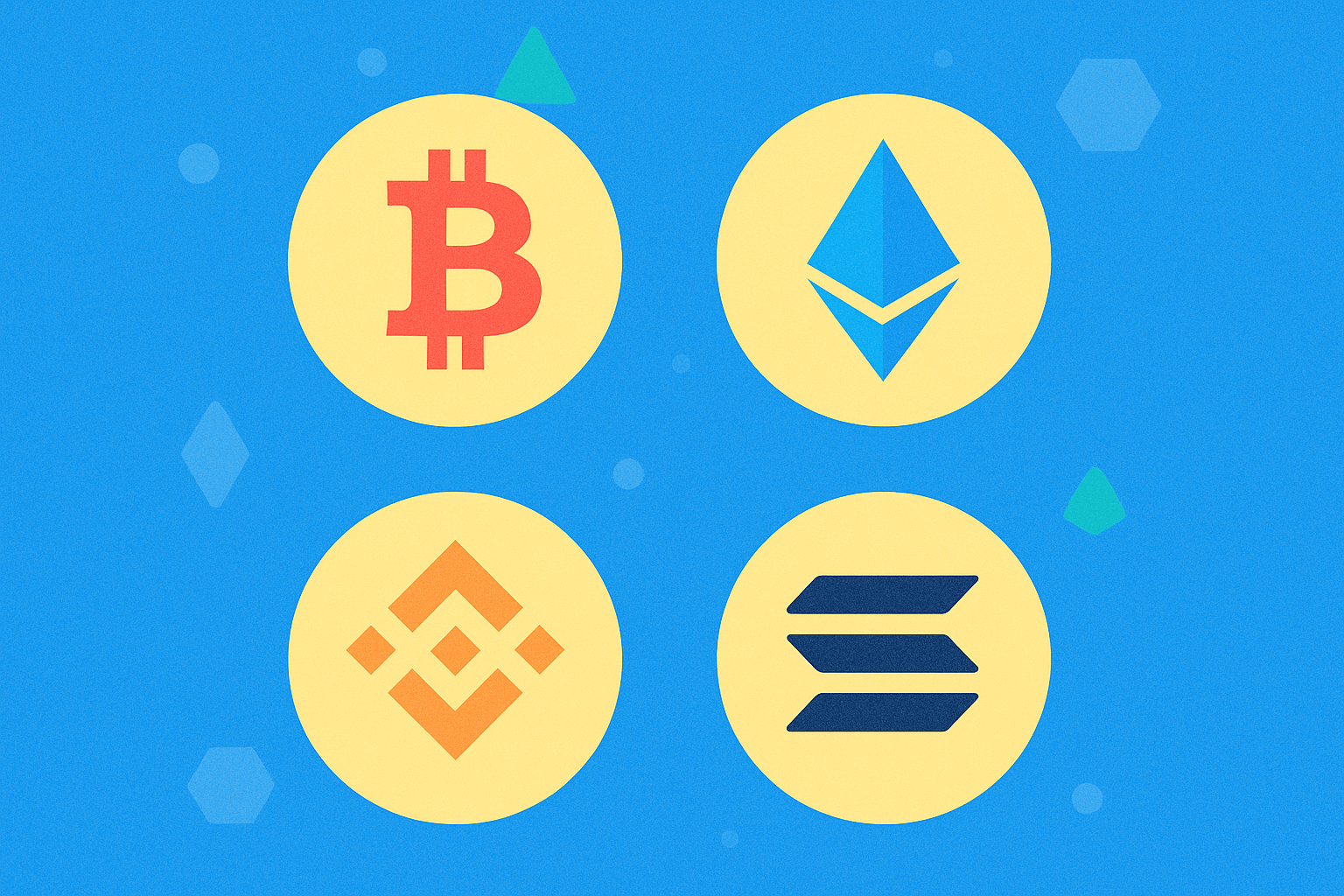
Major cryptocurrency competitors in 2025: Bitcoin, Ethereum, BNB, and Solana leading with combined market dominance exceeding 70%
The cryptocurrency competitive landscape reveals a concentrated market structure, with Bitcoin, Ethereum, BNB, and Solana collectively commanding over 70 percent of total cryptocurrency market capitalization. This remarkable concentration underscores the dominance of these four leading cryptocurrencies and their critical role in shaping market dynamics.
Bitcoin maintains its position as the market's flagship asset, benefiting from first-mover advantage, institutional adoption, and its role as the primary store of value. Ethereum follows as the dominant smart contract platform, enabling decentralized applications and generating substantial network effects. BNB, the native token of the Binance ecosystem, benefits from the world's largest cryptocurrency exchange infrastructure, while Solana attracts developers through its high-speed transaction capabilities and lower costs compared to alternatives.
This market concentration reflects several critical factors distinguishing top cryptocurrency competitors from mid-tier alternatives. Established infrastructure, proven security track records, and substantial developer ecosystems create powerful moats that newer or smaller-cap projects struggle to overcome. For context, Algorand, ranked #80 among cryptocurrencies with approximately 0.032 percent market dominance and a market cap of roughly $1 billion, illustrates how dramatically market share drops beyond the leading cryptocurrencies, despite innovative consensus mechanisms and strong technical foundations.
The 70-percent threshold represents a natural equilibrium in cryptocurrency market dynamics, reflecting user concentration, liquidity availability, and institutional preferences. This dominance structure suggests that while emerging competitors continuously emerge, established leading cryptocurrencies maintain formidable competitive advantages through network effects, regulatory clarity, and accumulated capital. Understanding this market concentration proves essential for investors evaluating the cryptocurrency competitive landscape in 2025.
Performance metrics comparison: transaction speed, network security, and developer adoption across top Layer-1 and Layer-2 platforms
When evaluating cryptocurrency platforms in today's competitive landscape, performance metrics have become the primary differentiators between leading blockchain solutions. Layer-1 blockchains like Algorand compete directly with Layer-2 scaling solutions by optimizing transaction speed, a critical factor for user adoption and enterprise integration. Algorand's innovative BA* consensus mechanism enables rapid finality without compromising decentralization, addressing a fundamental challenge in cryptocurrency architecture.
Network security remains equally paramount as transaction speed in the performance metrics comparison. Leading platforms employ sophisticated cryptographic techniques—including cryptographic sortition in Algorand's case—to ensure robust protection against attacks while maintaining throughput. This balance represents a competitive advantage in platforms seeking to capture institutional capital.
Developer adoption serves as the third pillar driving platform differentiation. Ecosystems supporting multiple programming languages and comprehensive software development kits naturally attract more blockchain developers. Platforms offering superior documentation and community support see accelerated decentralized application growth. The cryptocurrency market's evolution demonstrates that transaction speed alone cannot ensure dominance; platforms must simultaneously deliver security assurances and cultivate vibrant developer communities to maintain competitive positioning in 2025's dynamic landscape.
Market share dynamics and valuation trends showing emerging challengers gaining ground in DeFi and Web3 infrastructure segments
The cryptocurrency market in 2025 reflects a fundamental shift in how valuation and market share distribute across competing blockchain projects. Rather than dominance concentrating among established players, emerging challengers are strategically positioning themselves within specialized segments, particularly DeFi and Web3 infrastructure, where technological differentiation creates sustainable competitive advantages.
Projects like Algorand exemplify this trend, combining technical innovation with focused infrastructure development. Ranked 80th globally with a market share of 0.032%, Algorand maintains a $1.036 billion valuation while demonstrating how specialized consensus mechanisms and scalability solutions attract dedicated developer communities. The project's emphasis on Web3 infrastructure through advanced cryptographic protocols reflects broader market recognition that technical superiority in specific niches often outweighs raw market dominance.
Valuation trends increasingly reward projects offering distinct solutions within DeFi and Web3 ecosystems rather than general-purpose alternatives. Emerging challengers leverage improved consensus mechanisms, enhanced transaction throughput, and specialized tooling to capture market segments previously overlooked. This market fragmentation suggests that 2025's competitive landscape rewards innovation in infrastructure development and technical differentiation, enabling mid-tier projects to capture meaningful market share by solving specific blockchain challenges that major competitors may overlook or inadequately address.
FAQ
What is the crypto market trend in 2025?
In 2025, the crypto market shows strong institutional adoption, regulatory clarity driving mainstream integration, and Bitcoin leading with growing store-of-value narrative. Altcoins gain traction through real utility and DeFi expansion. Overall market demonstrates increased maturity and sustainable growth trajectory.
What significant event in the crypto industry is expected to occur in 2025 according to the article?
According to the article, major institutional adoption acceleration, regulatory framework maturation, and significant innovations in blockchain scalability solutions are expected to reshape the crypto competitive landscape in 2025, driving market consolidation and performance differentiation among major cryptocurrencies.
Is it worth investing in crypto in 2025?
Yes. Crypto has matured significantly with institutional adoption, regulatory clarity, and proven use cases. Market fundamentals remain strong with increasing enterprise integration and utility. Bitcoin and leading altcoins show resilience, making 2025 an opportune entry point for investors seeking portfolio diversification and growth potential.
Which cryptocurrencies have the largest market share in 2025?
Bitcoin and Ethereum maintain the largest market share in 2025, followed by Solana, XRP, and Cardano. Bitcoin remains dominant as the primary store of value, while Ethereum leads smart contract platforms. These top cryptocurrencies collectively represent over 60% of the total crypto market capitalization.
What are the key competitive advantages of Bitcoin and Ethereum compared to other cryptocurrencies in 2025?
Bitcoin leads as the most secure and widely adopted store of value with the largest transaction volume and network effect. Ethereum dominates smart contract platforms with the most robust developer ecosystem, highest DeFi transaction value, and established institutional adoption. Both benefit from unmatched liquidity and market confidence.
FAQ
Is Algo coin a good investment?
Yes. Algorand offers strong fundamentals with fast, secure blockchain technology, low transaction costs, and growing institutional adoption. Its sustainable tokenomics and developer ecosystem position it well for long-term growth potential.
Can algo reach $10?
Yes, ALGO can potentially reach $10. With growing adoption, ecosystem development, and increasing institutional interest in Algorand's technology, price appreciation to $10 is achievable within the right market conditions and network expansion timeline.
Does Algo Coin have a future?
Yes, Algo Coin has strong future potential. Algorand's advanced blockchain technology, institutional adoption, and focus on sustainability position it well for long-term growth. As enterprise demand for efficient Layer-1 solutions increases, ALGO is poised to capture significant market value in the Web3 ecosystem.
Can Algorand reach $5?
Yes, Algorand can reach $5. With continued network adoption, enterprise partnerships, and technological improvements, ALGO has significant growth potential. Market conditions and broader crypto adoption will be key drivers for this price target in future market cycles.
What is Algorand (ALGO) and how does it work?
Algorand is a blockchain platform enabling fast, secure, and scalable transactions. ALGO is its native token used for network fees and staking. It employs Pure Proof of Stake consensus, allowing anyone to participate and earn rewards while maintaining decentralization and environmental efficiency.
What are the main use cases and advantages of Algorand?
Algorand enables fast, secure, and scalable blockchain transactions with sub-second finality. Key advantages include low transaction costs, environmental sustainability through proof-of-stake consensus, and support for smart contracts and decentralized applications across finance, supply chain, and digital assets.
What are the risks and challenges associated with investing in ALGO?
ALGO faces market volatility, competition from other Layer-1 blockchains, regulatory uncertainties in crypto, and fluctuating adoption rates. Token price can be affected by market sentiment and macroeconomic factors. Investors should monitor network developments and market trends carefully.
How does SUI price volatility compare to Bitcoin and Ethereum in 2026?
How Do Leading Cryptocurrencies Compare in 2025: Market Share, Performance, and Key Differences
What is Monad (MON)? A Deep Dive Into the Layer 1 Blockchain's Whitepaper Logic, Use Cases, and 10,000 TPS Technology
What is the difference between top cryptocurrency competitors: market cap, performance, and user adoption in 2026

How to Measure Crypto Community and Ecosystem Activity: Twitter Followers, Developer Contributions, and DApp Growth in 2026
How Does Avalanche (AVAX) Compare to Solana and Ethereum in Market Cap and Performance in 2025?
Planet IX AoC Badge Mint Giveaway
How to Pay Bills with Cryptocurrency
Metaplanet Stock Price Prediction 2025: What Bitcoin Investors Should Know?
Arbitrum Airdrop Guide: Cross-Chain Bridge Tutorial

Fhenix Airdrop Guide: How to Participate and Claim FHE Rewards