Stablecoin: A Beginner's Guide to Stable Digital Currencies

What is a Stablecoin?
A stablecoin is a type of digital currency designed to maintain a stable value by pegging itself to reserve assets such as fiat currencies (like the US dollar), commodities (like gold), or other financial instruments. Unlike Bitcoin or Ethereum, which may experience significant price fluctuations, stablecoins aim to provide the benefits of cryptocurrency technology—such as fast transactions, security, and cross-border transfers—without volatility.
The stablecoin market has experienced substantial growth, with a total market value exceeding $235 billion in recent years, up from $152 billion in the previous year.
Types of Stablecoins
Fiat-Backed Stablecoins
The most commonly encountered type of stablecoin is the fiat-backed stablecoin, such as those pegged to the US dollar. These stablecoins maintain fiat currency reserves at a 1:1 ratio, meaning one unit of stablecoin can be exchanged for one unit of the corresponding fiat currency. The reserves are held by independent custodians and are regularly audited for transparency.
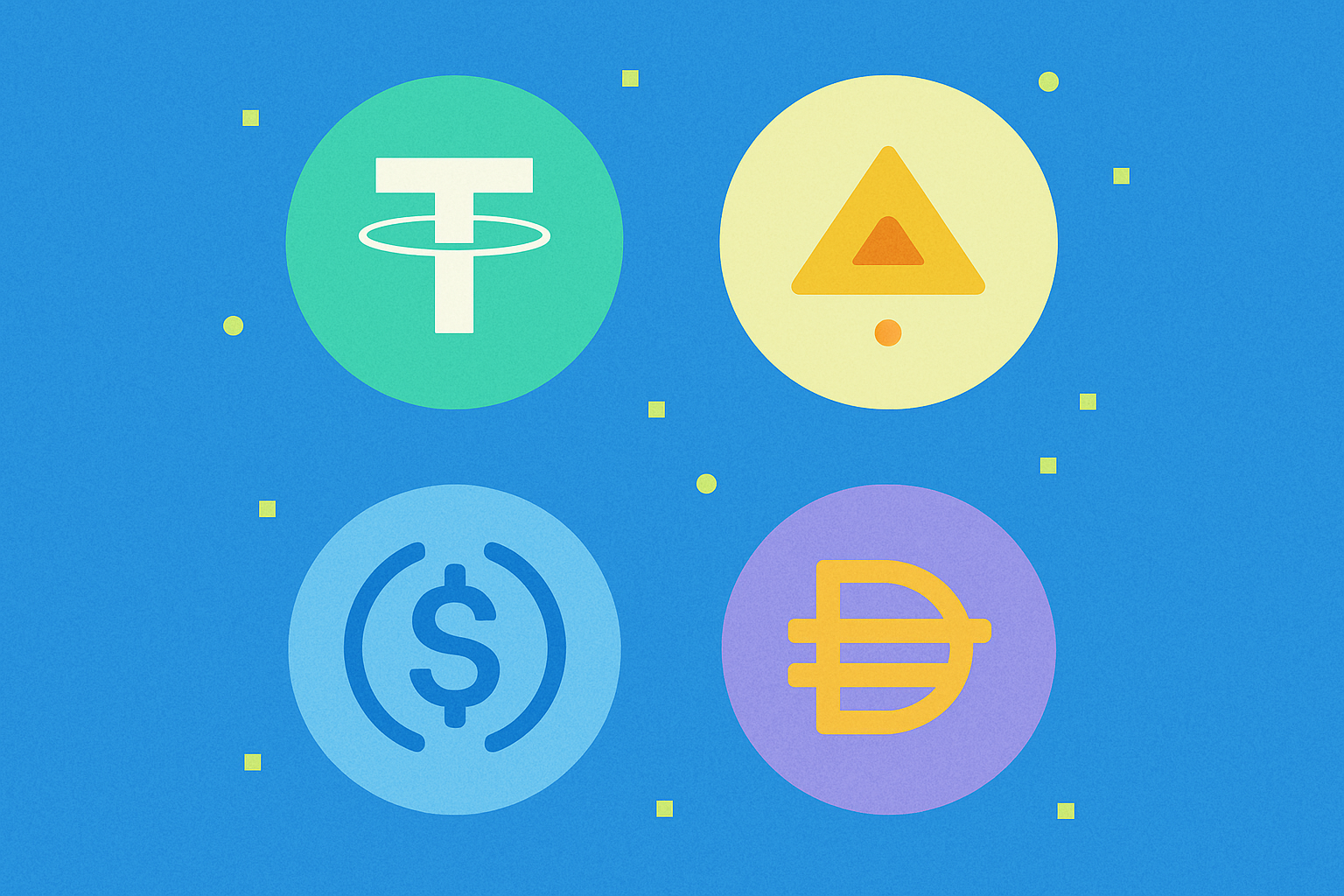
Examples: Tether (USDT), USD Coin (USDC), certain stablecoins issued by major platforms, Pax Dollar (USDP), and PayPal USD (PYUSD)
Commodity-Backed Stablecoins
These stablecoins are backed by real assets such as gold, silver, or oil. The value of the stablecoin is tied to the market value of these commodities. Holders often have the ability to redeem their stablecoins for the underlying physical commodity.
Examples: Tether Gold (XAUt), Pax Gold (PAXG)
Crypto-Backed Stablecoins
These stablecoins use other digital currencies as collateral. Due to the volatility of digital currencies, these stablecoins are typically overcollateralized, meaning the value of crypto held in reserves exceeds the value of stablecoins issued.
Examples: DAI (DAI), which is backed by digital currencies such as Ethereum through the MakerDAO protocol
Algorithmic Stablecoins
Algorithmic stablecoins do not rely on collateral but instead use mechanisms to control the supply of digital currency based on demand. When the price rises above the target value, the algorithm increases the supply to lower the price. Conversely, when the price falls, the supply is reduced.
Examples: Frax (FRAX), which combines collateral backing with algorithmic adjustments
Most Popular Stablecoins
Tether (USDT)
Tether is the largest stablecoin by market capitalization, with a value exceeding $143 billion in recent years. Launched in 2014, USDT is pegged to the US dollar and is available on multiple major blockchains including Ethereum, Solana, and Tron.
However, Tether has faced scrutiny regarding its reserve practices. In 2021, Tether Limited was fined $41 million by the US Commodity Futures Trading Commission. Despite these concerns, USDT remains a prominent stablecoin in the market.
USD Coin (USDC)
USDC is the second-largest stablecoin by market capitalization, with a value exceeding $58 billion. Issued by Circle, USDC emphasizes transparency and regulatory compliance. Its reserves are held in cash and short-term US Treasury bonds, with weekly attestations published to verify these reserves.
Circle launched USDC in September 2018 in partnership with Coinbase as part of the Center Consortium. USDC has gained significant popularity in North America and is widely used in decentralized finance (DeFi) applications.
Stablecoins from Major Platforms
Stablecoins issued by major platforms are backed by US dollar reserves and US Treasury bonds, similar to USDT and USDC. These stablecoins maintain a 1:1 peg to the US dollar.
DAI
Unlike the centralized stablecoins mentioned above, DAI is a decentralized stablecoin created through the MakerDAO protocol. DAI maintains its peg to the US dollar through a system of smart contracts and overcollateralization with other digital currencies, particularly Ethereum.
PayPal USD (PYUSD)
Launched by PayPal in partnership with Paxos, PYUSD represents the entry of traditional financial institutions into the stablecoin market. It is specifically designed for payments and is backed by reserves managed by Paxos.
Ripple USD (RLUSD)
RLUSD is a recently launched stablecoin from Ripple. Announced in recent years, it is designed for cross-border payments and institutional use, pegged to the US dollar and utilizing Ripple's payment infrastructure.
It is important to note that XRP itself is not a stablecoin. XRP is a separate digital asset primarily used for liquidity in cross-border transactions, whereas RLUSD is specifically designed as a stablecoin pegged to the dollar.
Euro Stablecoins
Numerous euro stablecoins have emerged to serve the European market and global users requiring digital assets denominated in euros. Notable examples include:
- EURT (Tether Euro): A euro-pegged stablecoin issued by Tether
- EURC (Circle's Euro Coin): A euro stablecoin from the issuer of USDC
- EURS (Stasis Euro): One of the oldest euro stablecoins
- EUROC (EuroCoin): A regulated euro stablecoin gaining acceptance in the European market
How Stablecoins Maintain Their Value
Reserve Assets
Fiat-backed stablecoins maintain their value through backing by reserve assets. For every stablecoin in circulation, the issuing company must hold an equivalent amount of supporting assets in reserves.
Peg Mechanisms
The most common peg mechanism is a 1:1 ratio with a fiat currency, typically the US dollar. Other stablecoins may be pegged to different currencies such as the euro (EURC) or commodities like gold.
Stability Maintenance
To ensure stablecoins can maintain their peg, issuers employ various methods:
- Minting and Redemption: Users can create new stablecoins by depositing equivalent value of backing assets, or redeem their stablecoins for underlying assets
- Arbitrage Opportunities: If the market price of a stablecoin deviates from its peg, investors can profit by purchasing when below peg and redeeming for backing assets, or selling when above peg
- Overcollateralization: For crypto-backed stablecoins such as DAI, the system requires users to deposit significantly more value in digital currency than the value of stablecoins they receive
- Algorithmic Supply Adjustments: Algorithmic stablecoins use smart contracts to automatically adjust supply based on demand
Transparency and Audits
Many stablecoin issuers publish periodic attestations or "proof of reserves" to verify they maintain adequate supporting assets.
Benefits of Stablecoins
Price Stability in Volatile Markets
The primary advantage of stablecoins is price stability compared to volatile cryptocurrencies. During market downturns, cryptocurrency traders can quickly convert their assets to stablecoins to preserve value.
Cross-Border Transactions and Remittances
Stablecoins enable faster and cheaper international money transfers compared to traditional banking systems. This is particularly significant for remittances.
Financial Inclusion
In regions with limited banking access or unstable local currencies, stablecoins offer a means for individuals to participate in the global economy.
DeFi Applications
Stablecoins form the backbone of many decentralized finance (DeFi) protocols. They facilitate lending, borrowing, and yield farming without exposure to volatility risk.
Bridge Applications
Bridge stablecoins represent an innovative category facilitating fund transfers between different blockchains. This cross-network connectivity is crucial for the broader cryptocurrency ecosystem.
Protection Against Inflation
In countries experiencing high inflation or currency controls, stablecoins pegged to more stable currencies such as the US dollar provide an option for residents to protect their savings.
Risks and Challenges
Regulatory Concerns
Stablecoins continue to attract attention from regulators as they grow in importance. Different jurisdictions are developing regulatory frameworks.
In the United States, both the House and Senate have shown support for stablecoin legislation. In Europe, the Markets in Crypto Assets Regulation (MiCA) has banned algorithmic stablecoins.
Reserve Transparency Issues
The transparency of reserves backing stablecoins remains an ongoing concern. While some issuers such as Circle (USDC) publish regular attestations, others have faced criticism for lack of transparency.
Depegging Risk
The history of stablecoins includes several instances where coins lost their peg to underlying assets. The most notable example is the collapse of TerraUSD (UST) in May 2022.
Security and Centralization Risks
Most stablecoins are issued by centralized entities. Users must trust that issuers properly manage reserves and honor redemptions.
Uses of Stablecoins
Trading and Investment
Stablecoins serve as important trading pairs in digital currency markets, enabling traders to enter and exit positions without converting to fiat currency.
Payments and Commerce
The stability of stablecoins makes them suitable for everyday commerce. Unlike Bitcoin or Ethereum, where price volatility may alter transaction values, stablecoins provide predictability.
Remittances and International Transfers
Traditional cross-border payments through banks or remittance services can be expensive and slow. Stablecoins enable near-instantaneous international transfers at significantly lower costs.
Value Storage in High-Inflation Regions
In countries experiencing high inflation or currency controls, stablecoins offer residents an option to preserve purchasing power.
DeFi Applications
Stablecoins form the foundation of the decentralized finance ecosystem, enabling:
- Lending and Borrowing: Platforms such as Aave and Compound
- Liquidity Provision: Stablecoins form part of many trading pairs
- Yield Farming: Users can earn returns from liquidity provision
- Synthetic Assets: Stablecoins serve as collateral
Stablecoin Regulations
Key Regulatory Issues
- Financial stability risk
- Consumer and investor protection
- Anti-money laundering and counter-terrorism financing (AML/CFT)
- Monetary policy implications
- Banking system disruption
Regional Regulatory Approaches
United States
Both the House and Senate have made progress on stablecoin legislation in recent years. Proposed legislation aims to create a regulatory framework.
The SEC has issued statements indicating that certain "protected stablecoins" with adequate reserves and redemption rights may not be considered securities.
European Union
The European Union has implemented the Markets in Crypto Assets Regulation (MiCA), which came into effect in 2023. MiCA bans algorithmic stablecoins and requires other stablecoins to maintain assets held by third parties.
Singapore
The Monetary Authority of Singapore (MAS) has outlined a regulatory framework for single-currency stablecoins (SCS).
Hong Kong
Hong Kong has developed a regulatory framework for stablecoin issuers and launched a sandbox.
Future Regulatory Trends
- Bank-like Regulation for stablecoin issuers
- Increased Transparency regarding reserve management and composition
- Consumer Protection Measures including redemption rights
- Integration with Existing Financial Systems through licensing and regulatory frameworks
How to Purchase and Use Stablecoins
General Considerations for Purchasing Stablecoins
When acquiring stablecoins, consider the following important factors:
- Network Compatibility: Ensure the sending and receiving platforms operate on the same blockchain network
- Minimum Deposit Requirements: Some stablecoins have minimum deposit amounts
- MEMO Requirements: Certain tokens require both an address and MEMO field
- Contract Address Verification: Verify that the asset contract address matches what your platform supports
- Network Fees: Different blockchains have varying transaction fees
- Record Keeping: Maintain documentation of all transactions for tax and personal accounting purposes
Storage Options for Stablecoins
For enhanced security, consider transferring your stablecoins from exchanges to self-custody wallets. Options include hardware wallets (maximum security), software wallets, and mobile wallets.
Conclusion
Stablecoins bridge blockchain technology and traditional finance, providing blockchain benefits with price stability. Their market value of $235 billion reflects growing importance in both digital and traditional financial systems. Major institutions such as PayPal, Bank of America, and Stripe are entering this space as governments develop regulatory frameworks.
In the future, stablecoins may face increased regulation, greater integration with traditional financial systems, innovation in decentralized options, expanded use cases, and region-specific variants supporting particular economic needs.
Despite various challenges, including regulatory uncertainty, transparency concerns, and depegging risks, stablecoins have become essential to the digital economy. By staying informed about different types, benefits, risks, and regulations, users can optimize their use of these diverse digital assets while mitigating potential risks.
FAQ
What is a Stablecoin (Stablecoin)? How does it differ from Bitcoin and Ethereum?
A stablecoin is a digital cryptocurrency designed for price stability, typically pegged to fiat currencies like USD or other assets. Unlike Bitcoin and Ethereum whose prices fluctuate significantly based on market demand, stablecoins maintain a relatively constant value, usually staying close to their pegged asset value.
How do stablecoins maintain price stability? What is the mechanism behind it?
Stablecoins maintain price stability through collateral reserves, algorithmic supply adjustments, or a combination of both. Fiat-backed coins hold reserve assets; algorithmic coins automatically mint or burn tokens based on market demand to keep prices anchored to their target value.
What are the advantages of using stablecoins? What cryptocurrency problems do they solve?
Stablecoins solve crypto's extreme price volatility by maintaining stable values through fiat reserves, crypto collateral, or algorithms. They combine blockchain transparency and global liquidity with near-fiat price stability, enabling reliable payments, cross-border transfers, and DeFi participation while protecting assets from market swings.
What are the common stablecoins? What are USDT, USDC, and DAI respectively?
USDT and USDC are fiat-backed stablecoins pegged 1:1 to the US dollar, with USDT having the largest trading volume and USDC offering higher regulatory transparency. DAI is an algorithmic stablecoin issued by MakerDAO, maintained through decentralized mechanisms.
Are stablecoins safe? What risks should I be aware of when using stablecoins?
Stablecoins carry redemption risks and potential liquidity constraints during high demand periods. Security vulnerabilities, fraud risks, and regulatory uncertainty also exist. Choose platforms with strong reserve backing and transparent audits to mitigate these concerns.
Where can I buy and use stablecoins?
Stablecoins are available on centralized and decentralized exchanges, peer-to-peer platforms, and official issuer websites. You can purchase them using fiat currency or crypto exchanges, then use them for payments, trading, lending, and DeFi protocols across blockchain networks.
What are the advantages of stablecoins compared to fiat currencies like the US dollar?
Stablecoins offer lower transaction costs, faster settlement, and 24/7 availability compared to traditional fiat. They reduce cryptocurrency volatility while maintaining stable value, enhancing market liquidity and accessibility.
What are the future prospects for stablecoins?
Stablecoins demonstrate strong growth potential, with transaction settlement volume reaching 2.5 trillion USD annually and expanding into mainstream payments. Driven by DeFi adoption, institutional investment, and emerging market demand, the market is expected to exceed 5 trillion USD in transaction volume. However, regulatory frameworks and CBDC competition will shape their trajectory significantly.
Stablecoin: A Beginner's Guide to Understanding Digital Currencies with Stability

Stablecoins: The Fundamentals and Advantages for Crypto Beginners
What Are Stablecoins? An In-Depth Guide to How They Work, How to Choose the Right One, and How Beginners Can Get Started
Stablecoins Explained: A Comprehensive Beginner’s Guide to How They Work, How to Choose the Right One, and How to Get Started

What is Pieverse (PIEVERSE) and How Does it Aim to Revolutionize Blockchain Payments?
Top Cryptocurrency Debit Cards for European Users

Roam Listing Details: Launch Date, Price Predictions, and How to Buy $ROAM

DePIN: Hardware Set to Transform Web3

MACD指標是什麼?

Bitget Wallet Valued at $300 Million After Investment from Mainstream Exchange, Boasts 10 Million Users

How to Buy $LUNA Coin and What is the Lynk's Cat Token?