How to Build a Personal Moat in the AI Era: 5 Key Strategies to Stay Irreplaceable
Real Transformations in the AI Era: From “Tool Revolution” to “Capability Reconstruction”
For decades, most technological progress has centered on upgrading tools. The internet improved information access, while mobile internet enhanced connectivity. AI, however, is fundamentally different—it doesn’t just boost efficiency; it’s changing how people acquire skills and capabilities.
Generative AI, exemplified by ChatGPT, now handles writing, programming, analysis, design, and more. Skills that once demanded years of training are rapidly being “outsourced” to machines.
In essence, AI isn’t simply replacing individual jobs—it’s reshaping entire systems of capability.
Why Anxiety About “Being Replaced by AI” Is Escalating
Social media and viral information have amplified the narrative that “AI will replace humans.” This anxiety comes primarily from two sources:
First, AI’s abilities are advancing quickly. From text generation to multimodal understanding, its performance now rivals—and sometimes surpasses—human professionals. Second, platform algorithms (like ByteDance’s recommendation system) spotlight extreme cases, making individuals more likely to overestimate risks.
It’s important to clarify:
AI won’t replace everyone equally. It will first target standardized, repetitive tasks with low decision-making requirements.
The real divide will be determined by whether individuals have the ability to collaborate with AI.
The Real Risk for Most People: Marginalization, Not Replacement
Rather than outright replacement, AI will accelerate social stratification.
The future will likely look like this:
- Some people will master AI and see exponential productivity gains
- Others will remain stuck in old modes and become increasingly marginalized
This mirrors the internet era:
Those who knew how to use search engines gained information far more efficiently than those who didn’t. AI amplifies this gap even further.
So, the real concern for most people isn’t unemployment—it’s losing their competitive edge.
Five Core Capabilities: Building a Personal Moat in the AI Era
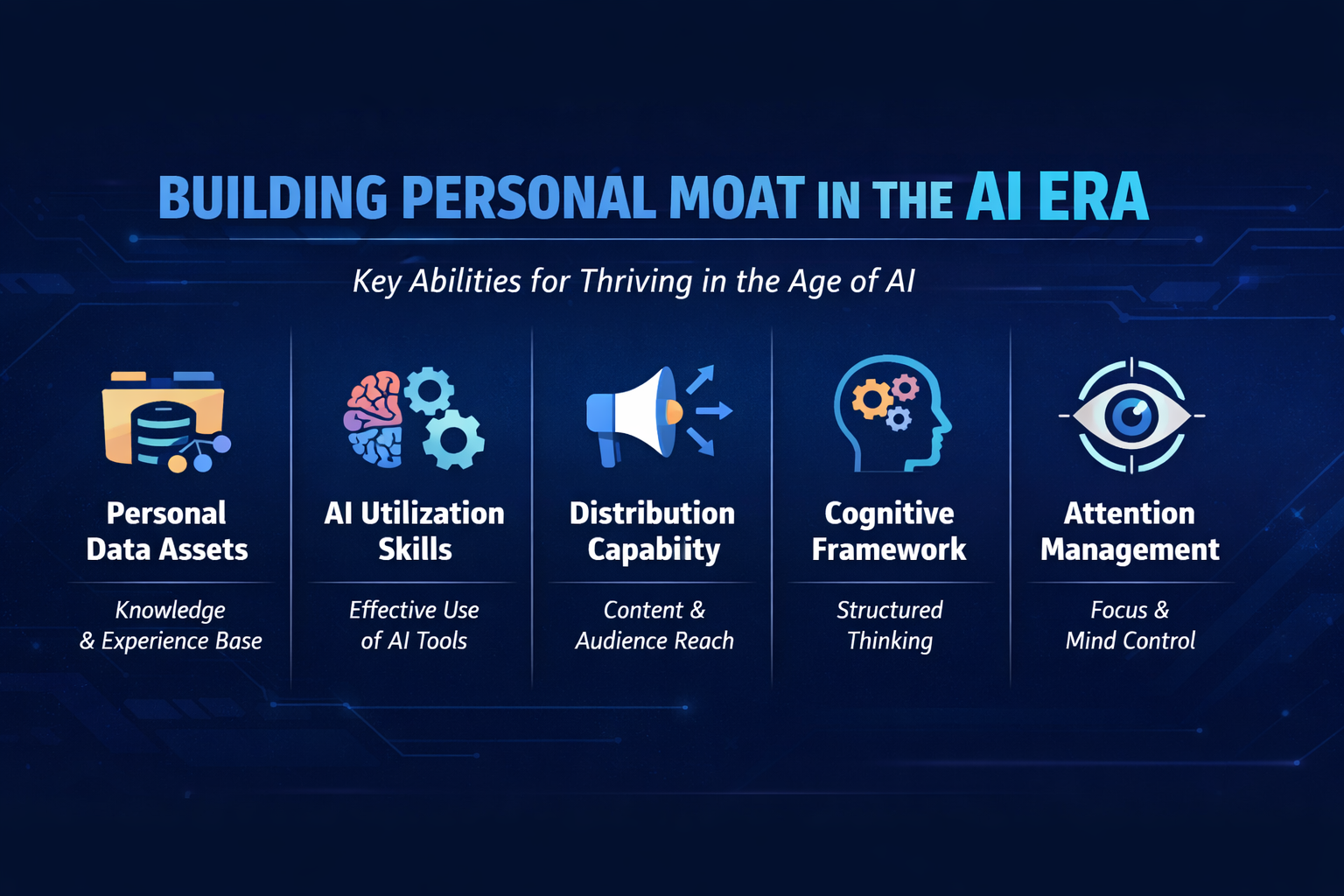
In the AI era, personal moats are no longer built on a single skill—they’re forged from a combination of capabilities.
1. Personal Data Assets
Data is emerging as a new form of productive capital. This isn’t just about accumulating information, but about structured, reusable knowledge.
With tools like Notion and Obsidian, anyone can build a personal knowledge base, integrating learning, work experience, and insights over time. These assets may become the foundation for training “personal AI” in the future.
2. AI Proficiency
Compared to traditional skills, AI proficiency is a “meta-capability.”
It includes:
- Formulating high-quality questions
- Breaking down complex tasks
- Combining multiple AI tools to build workflows
The essence is orchestrating intelligence—not simply replacing it.
3. Distribution Capability
In an era of information overload, content value is declining while distribution capability is becoming increasingly vital.
Building personal channels—social media, blogs, or video platforms—enables individuals to accumulate attention over time. Thought leaders like Naval Ravikant have established influence through consistent output.
Distribution capability is fundamentally about owning “user access rights.”
4. Cognitive Structure
AI can deliver answers, but it can’t replace the quality of questions.
A person’s cognitive structure determines how they interpret, break down, and assess problems. In a world saturated with information, structured thinking is a core competitive advantage.
5. Attention Management
Attention is the foundation for all other capabilities.
Without focus, even the most advanced AI tools won’t enable deep productivity. Platform companies continually optimize algorithms to maximize user engagement, so individuals must proactively manage their attention resources.
Three Actionable Paths: A Personal Upgrade Plan from Zero to One
Understanding these capabilities is only the first step—the next is implementation.
- Build a personal knowledge system. Structure and organize information from daily learning and work to create your own “knowledge database.”
- Choose a direction for AI enhancement. Whether writing, programming, or design, leverage AI tools to boost efficiency and develop differentiated skills.
- Start public output. Even small-scale, consistent expression can build influence and opportunity networks over time.
Transition from “information consumer” to “value creator.”
Extending AI Era Infrastructure: From Tools to Asset Gateways
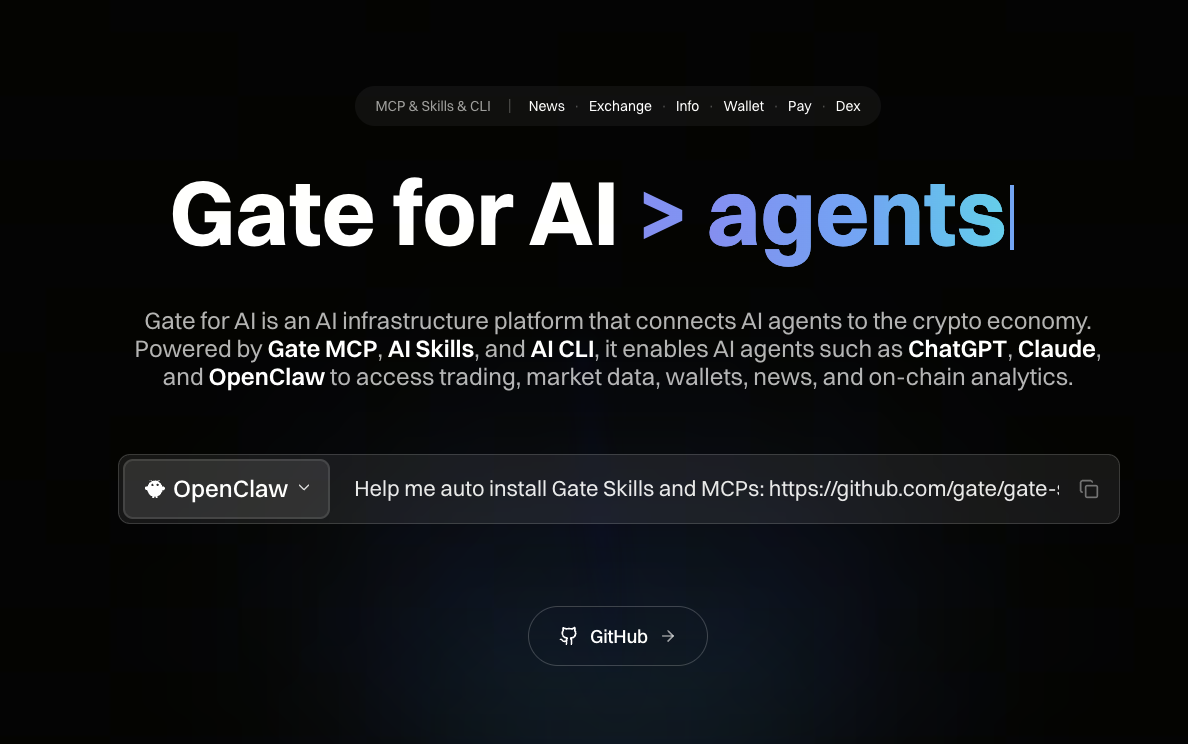 Image source: Gate for AI page
As AI technology moves into the application layer, a new trend is emerging: AI is gaining “economic attributes.” It’s not just a production tool—it’s becoming part of value distribution and asset system construction.
Within this context, platforms are building “AI asset gateways” to connect AI projects, data resources, and users. Gate’s “Gate for AI” section, for example, approaches the AI ecosystem from a trading platform perspective.
Its core logic can be summarized in three points:
- Connect AI projects and users, enabling ordinary users to access AI assets and narratives early
- Provide market information and asset liquidity for the AI sector, lowering entry barriers
- Serve as a “distribution and pricing mechanism,” allowing the market to discover the value of AI projects
From a broader perspective, these platforms signal AI’s evolution from “production tool” to “financialized and assetized” infrastructure.
For ordinary users, this opens new ways to participate: not only can you use AI to boost efficiency, but you can also engage in early-stage value distribution by understanding AI narratives and project structures.
Still, AI assets are in their early stages—volatility and uncertainty are high. Participation requires focus on project fundamentals and long-term logic, rather than short-term sentiment.
Long-Term Opportunities in the AI Era: Human–AI Collaboration
In the long run, AI won’t eliminate human value—it will transform how value is created.
The most competitive individuals of the future will be:
- Those who can understand problems
- Those who can orchestrate AI
- Those who can connect resources and users
AI is best viewed as a “capability amplifier.” It enhances the efficiency of talented individuals, but can leave those lacking direction even more lost.
The key isn’t the technology itself—it’s how people use it.
Conclusion: Shifting Perception from “Competitor” to “Amplifier”
The core of the AI era isn’t a battle between humans and machines—it’s collaboration.
For most people, the most effective strategy isn’t fear or avoidance, but proactively building these capabilities:
- Accumulable data assets
- Efficient AI proficiency
- Stable distribution channels
- Clear cognitive structure
- Controllable attention resources
When these elements come together, AI stops being a threat and becomes a personal amplifier.
Ultimately, whether someone is replaced isn’t determined by AI—it’s determined by their ability to work alongside it.
Related Articles

What Is ERC-8183? Exploring the AI Agent Commercial Standard and the Infrastructure of the Decentralized Agent Economy
AI Agents Becoming Economic Actors: What Infrastructure Gaps Can Blockchain Fill?

What Is RoboForce? An In-Depth Analysis of the Technical Path and Industrial Prospects of an AI Robotic Workforce Platform

How to Reduce Token Costs in the AI Era: Practical Strategies from Prompt Optimization to Model Selection
What is Athene Network (ATN)? Exploring AI-Blockchain Integration