Rising Prices but Bearish Funding Rates: Is Crypto Entering a “Layered Bull Market” After Wall Street Capital Inflows?
The Latest Market Paradox: Rising Prices, Yet Bearish Futures Sentiment
In recent days, the market has presented a seemingly contradictory scenario:
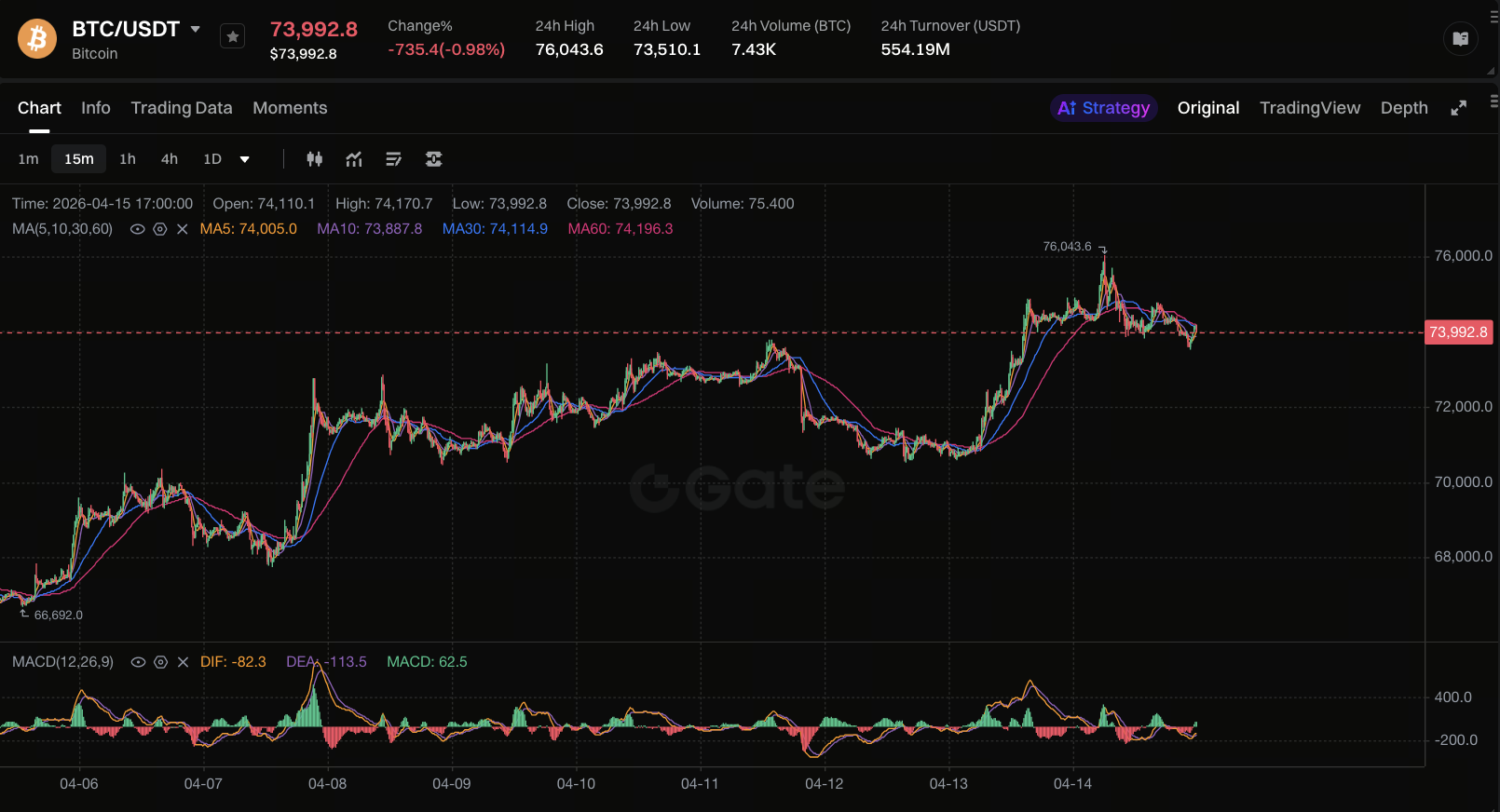
Image source: Gate Market Page
On one hand, Bitcoin surged to nearly $76,000 before retracing, lifting its overall price center compared to earlier periods. On the other, the Funding Rate on major CEXs and DEXs has not strengthened in tandem; instead, it remains in bearish territory, with short sentiment at times even heavier than the previous day.
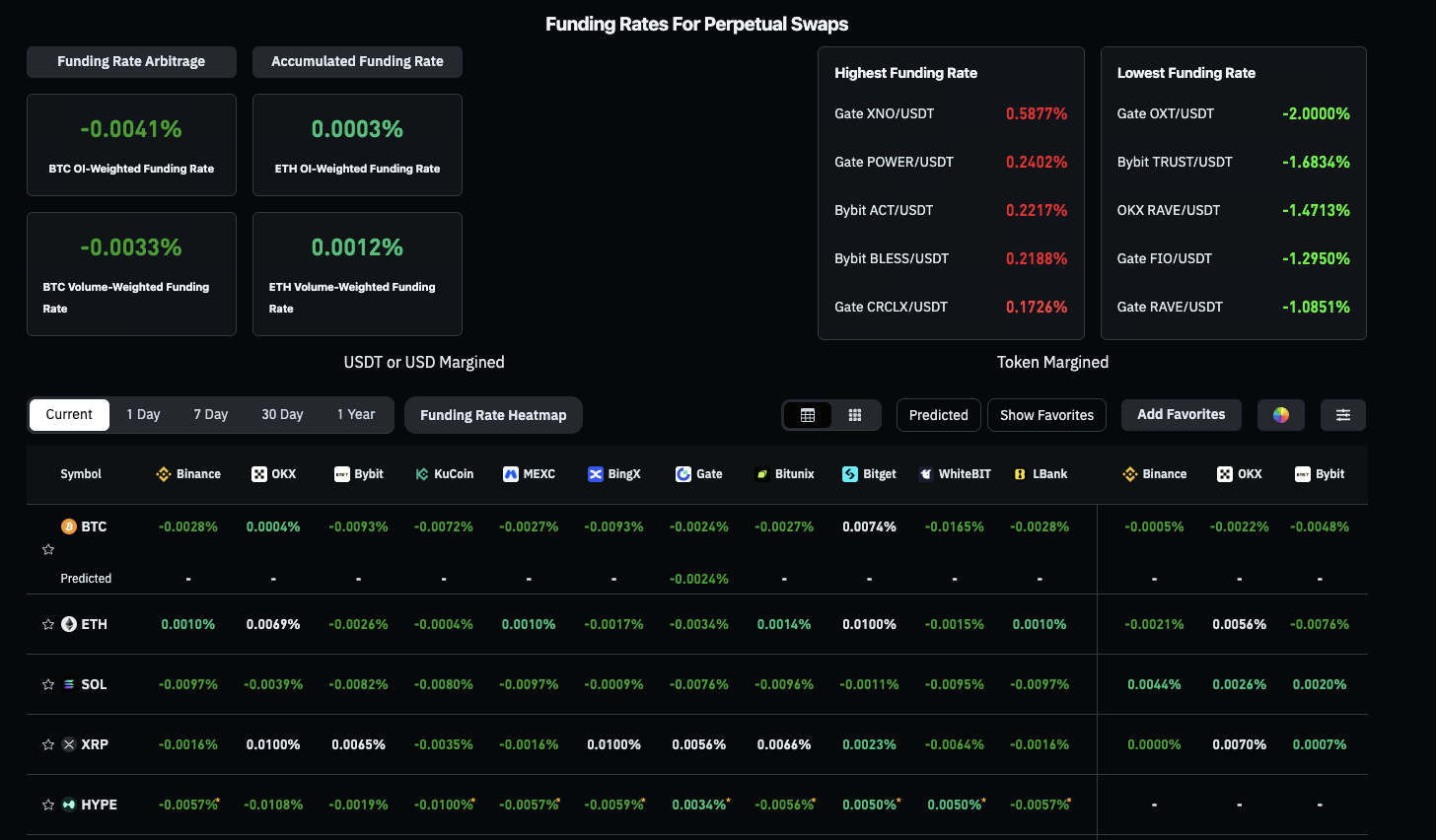
Image source: Coinglass Funding Rate Page
This reflects the new normal after structural changes in the market. In prior retail-driven cycles, price rallies were often accompanied by a swift shift to positive Funding Rates and crowded long positions. Now, as institutionalization deepens, price drivers and Futures sentiment have decoupled, resulting in a market where “Spot remains strong, Futures remain bearish.”
Why Do “Price Gains + Negative Funding Rates” Coexist?
Spot Bids and Futures Positions Originate from Distinct Market Participants
Spot market inflows are increasingly driven by ETFs, asset management accounts, and allocation-focused capital, while the Futures market is still dominated by high-frequency and short-term traders.
The former prioritize quarterly allocations and risk budgets; the latter focus on intraday volatility and short-term drawdowns. With divergent time horizons, their signals often conflict.
Institutional Hedging Systematically Depresses Funding Rates
As institutional participation increases, a common approach is “Spot long + Perpetual short” or “ETF holdings + Derivative hedging.”
These strategies are not outright bearish bets, but risk management tactics. However, they manifest as increased short supply in the Order Book, which pushes the Funding Rate lower.
Price Spikes and Pullbacks Reinforce Short-Term Bearish Narratives
When prices break above key levels and then retreat, short-term traders often interpret this as a “false breakout.”
If the Funding Rate is already subdued during this phase, new short positions can further deepen the bearish reading, leading to situations where “price hasn’t weakened, but sentiment turns bearish first.”
Funding Rate Is a Crowdedness Indicator, Not a Trend Predictor
The Funding Rate fundamentally serves as a mechanism to balance Perpetual Futures long and short costs.
It answers “who is more crowded,” but cannot independently signal if a trend has ended. In institutional-driven cycles, relying solely on the Funding Rate increases the risk of misinterpretation.
How Wall Street Is Reshaping the Market: From Trading Venue to Product Marketplace
If 2024 marked the start of “Spot ETF legalization,” then 2026 is ushering in an era of “product competition.”
Goldman Sachs’ application for a Bitcoin Premium Income ETF is a watershed moment—Wall Street is no longer selling just Bitcoin exposure, but also Bitcoin volatility and return structures.
This shift brings three fundamental changes:
- Capital inflows: Crypto funds are no longer limited to exchanges and on-chain bridging; traditional wealth management channels are becoming new sources of incremental capital.
- Capital attributes: The share of short-term momentum capital is declining, while medium- and low-turnover, risk-budget-driven capital is on the rise.
- Pricing models: The market is transitioning from “watching Spot price moves” to comprehensive pricing that includes “Spot + volatility + product demand.”
As a result, today’s crypto market resembles a layered financial system, not a market governed solely by sentiment.
Rotation Logic in the New Capital Structure: BTC, ETH, and High Beta Assets
With capital stratification, rotation cycles are also being redefined:
- First layer: BTC as the core—institutions prioritize allocating to the most liquid and compliant BTC.
- Second layer: ETH as the hub—once BTC stabilizes, some risk budgets shift to ETH, reflected in ETH’s relative strength and renewed activity.
- Third layer: High Beta themes—altcoins still have opportunities, but now rely on clear catalysts and sufficient liquidity, rather than broad-based beta rallies.
Even when Funding Rates are bearish, prices can remain resilient because not all supporting capital is positioned in Perpetual Futures.
The Core Risk in This Cycle: Not a Lack of Capital, but Mismatch
The greatest current risk is not “no incremental capital,” but “a mismatch between new capital and trading structure.” This is evident in:
- Slow-moving Spot capital is entering the market, but the Futures side is still dominated by excessive leverage.
- Institutional capital favors core assets, but the market misinterprets this as a bull run for all assets.
- Rapid rotation among risk assets leads to momentum capital increasing positions at inopportune times.
This typically results in indices looking stable, but individual asset performance diverging widely. Investors who continue to trade using the old “broad diffusion” logic are likely to experience repeated drawdowns in a structurally driven market.
Practical Framework: Three Key Indicators for Assessing Trend Continuation
When “price and Funding Rate diverge,” it’s essential to monitor at least three sets of data—not just one signal.
- Funding Rate (sentiment): Gauge whether long/short positioning is extremely crowded. Bearish readings don’t always signal a bearish outlook, but can indicate potential short squeezes or reflexive risk.
- Open Interest (leverage): If prices rise alongside OI, new leverage is entering; if OI drops, it’s mostly short covering. The sustainability of these scenarios differs.
- Spot net flows and ETF capital (cash): This is crucial for determining if real buying is supporting the trend. Without cash inflows, any technical rebound is more fragile.
A simplified assessment method:
- Bearish Funding Rate + rising OI + Spot net inflows: Higher probability of continued price increases; beware of passive short squeezes.
- Bearish Funding Rate + rising OI + weakening Spot: Indicates high-level games, with increased risk of sharp reversals.
- Neutral Funding Rate + moderate OI + sustained Spot inflows: The healthiest structure, best suited for trend holding.
Conclusion: The Market Is Undergoing Structural Repricing, Not a Simple Bull or Bear Cycle
Currently, even as prices rebound, the Funding Rate remains bearish. This underscores that the market has entered a new phase—not just a simple bull-bear rotation, but a repricing of capital sources, product structures, and risk expression.
Going forward, market analysis should move beyond linear thinking. The more effective approach: treat price as the outcome, Funding Rate as the measure of crowdedness, and ETF and Spot flows as the driving force. When all three align, the trend is stable; when they diverge, it’s time to slow down trading.
In this era of institutionalization, the greatest risk isn’t being bullish or bearish—it’s using old market playbooks to interpret new structural dynamics.
Related Articles

Will Sidra Break $1,000? A Realistic Look at Sidra Chain Price Claims in 2026–2027

BlockDAG (BDAG): A High-Speed and Secure Layer 1 for the Next Era

Fractional NFTs: Lowering Barriers and Enhancing Liquidity
What is USDC? A Complete Guide to One of the Most Trusted Stablecoins

USDD vs USDT: A Comparison of Stablecoin Mechanisms, Risks, and Use Cases