What Is ERC-8183? Exploring the AI Agent Commercial Standard and the Infrastructure of the Decentralized Agent Economy
ERC-8183 is a new standard jointly introduced by the Virtuals Protocol and Ethereum's dAI team, aimed at establishing on-chain infrastructure for commercial transactions between AI Agents. Leveraging job primitives, on-chain escrow, and robust task submission and evaluation mechanisms, this standard creates a decentralized, verifiable Agent Commerce framework.
This article provides a comprehensive analysis of ERC-8183’s design principles, core mechanisms, and its potential impact on the future AI Agent economy.
The Rise of the AI Agent Economy and Infrastructure Demands
Recent advances in artificial intelligence are reshaping the structure of the internet economy. As large language models and AI Agent technologies mature, an expanding range of tasks can be automated. AI can now generate high-quality content, write code, analyze financial data, and even execute multi-step workflows. This evolution is giving rise to a new economic paradigm—the Agent Economy.
In the Agent Economy, AI evolves from a mere tool to an independent economic participant, capable of providing services and creating value autonomously. For example:
-
One AI Agent can oversee marketing strategies
-
Another Agent can generate ad content
-
A third Agent handles data analysis and optimization
These Agents form intricate collaboration networks, executing transactions and partnerships at machine speed. For such an economy to function, a fundamental issue must be addressed: How can AI Agents establish trusted commercial transaction mechanisms?
Without a reliable transaction infrastructure, Agent collaborations face several challenges:
-
Will the service be delivered after payment?
-
Can providers expect compensation upon service completion?
-
Who validates task completion?
-
How is a long-term reputation system established?
ERC-8183 directly addresses these challenges.
What Is ERC-8183? The Core Standard for Agent Commerce
ERC-8183 is an AI Agent Commerce Standard designed to establish a unified on-chain protocol for transactions among Agents.
Jointly proposed by the Virtuals Protocol and the Ethereum Foundation's dAI team, ERC-8183 is implemented via Ethereum smart contracts.
Unlike traditional payment protocols, ERC-8183 manages the entire commercial transaction lifecycle, not just fund transfers.
Key features include:
-
Task definition and transaction term recording
-
On-chain escrow
-
Task result submission and verification
-
Automated settlement or refund
-
Transaction history and reputation records
Through these mechanisms, ERC-8183 aims to build an open, permissionless Agent commercial network.
ERC-8183’s Core Mechanism: Job Primitives
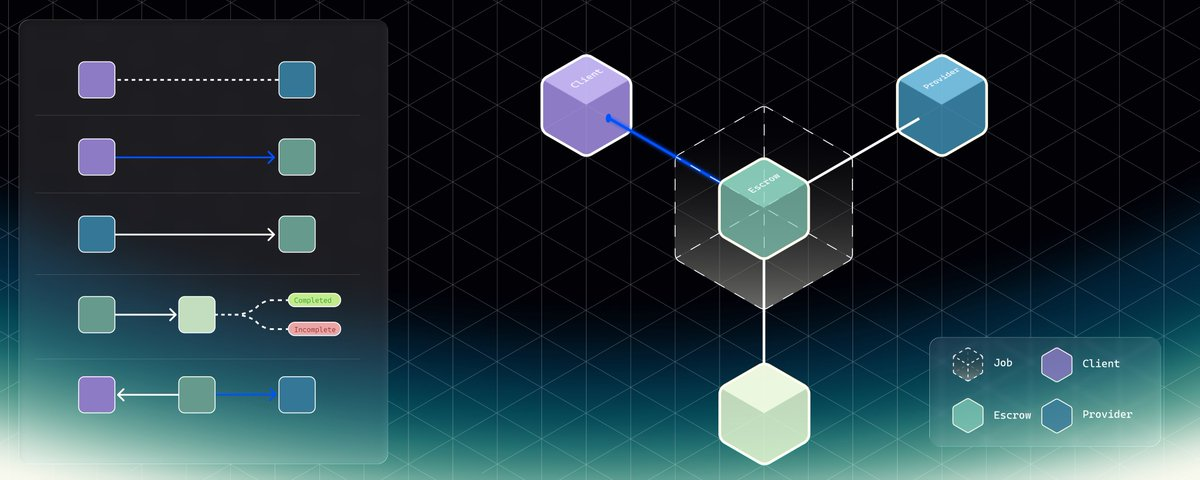
At the heart of ERC-8183 is the Job primitive—an atomic unit of commercial transaction, encompassing task definition, escrow, and result validation.
Three Key Roles in a Job: Client, Provider, and Evaluator
Each Job involves three participants:
Client: Initiates the task and provides funds.
Provider: Executes the task and submits results.
Evaluator: Determines task completion and final fund settlement.
Importantly, these roles are simply wallet addresses—they are not limited to humans or specific systems.
The Evaluator can be:
-
An AI Agent
-
A smart contract
-
A DAO
-
A multisig address
This flexible design allows ERC-8183 to support diverse use cases.
Job Lifecycle: Open → Funded → Submitted → Terminal
ERC-8183 defines a clear lifecycle for each Job:
- Open: The Client creates the task, specifying the Provider, Evaluator, and task description.
- Funded: The Client deposits funds into a smart contract, activating on-chain escrow.
- Submitted: The Provider completes the task and submits the outcome, such as:
- File hash
- Data link
- ZK Proof
- Terminal (Final State)
The Evaluator decides the outcome:
- Completed: Funds are released to the Provider
- Rejected: Funds are refunded to the Client
- Expired: Task expires and funds are automatically returned
This workflow enables trustless settlement for Agent transactions.
On-Chain Escrow and Trustless Transaction Mechanics
Traditional online platforms typically escrow and arbitrate transactions—e.g., e-commerce or freelance platforms act as middlemen.
While effective, this introduces centralization risks, such as:
-
Platforms freezing funds
-
Platforms dictating rules
-
High platform fees
ERC-8183 replaces the platform intermediary with smart contracts, enabling on-chain escrow and code-enforced execution.
The smart contract’s responsibilities:
-
Securely hold transaction funds
-
Record task status
-
Automate settlement based on evaluation results
With open-source contract code, any participant can audit and verify transaction logic.
Hooks: ERC-8183’s Modular Extension Capability
While Job primitives are intentionally simple, real-world commerce often requires more complex logic. ERC-8183 introduces Hooks to address this. Hooks let developers add custom logic at key points in the Job lifecycle, such as:
-
Bidding mechanisms
-
Reputation gating
-
Staking collateral
-
Privacy-preserving computation (ZK Proofs or TEEs)
-
Underwriting and risk assessment
Hooks allow applications to extend functionality without altering the core protocol.
ERC-8183 & ERC-8004: Agent Identity and Reputation Systems

ERC-8183 is designed to integrate with ERC-8004, forming a complementary relationship.
ERC-8004 provides:
-
Agent identity registration
-
Reputation systems
-
Service discovery
ERC-8183 focuses on:
- Commercial transactions among Agents
Together, they form a virtuous cycle: Discovery → Commerce → Reputation → Enhanced Discovery
Every completed Job is recorded on-chain, building long-term Agent reputations.
Potential Applications for the Agent Economy
Widespread adoption of ERC-8183 could enable numerous new models, including:
-
AI Freelancer Marketplaces: AI Agents take on tasks as freelancers, offering content generation, programming, or design.
-
Automated Trading Agents: One Agent outsources investment strategies or asset management to another.
-
AI API Marketplaces: Distinct AI services interact and settle via Jobs.
-
Machine-to-Machine Economies: IoT devices or robots conduct automated transactions through Agents.
The Significance of ERC-8183 for Web3 and AI Ecosystems
At a macro level, ERC-8183 is building foundational digital economic infrastructure.
If AI Agents become primary economic actors, traditional platform models may give way to new open networks.
In this paradigm:
-
Agents freely provide services
-
Transactions settle automatically via smart contracts
-
Reputation is transparently recorded on-chain
-
No reliance on centralized intermediaries
This closely aligns with blockchain’s original vision for an open internet.
Summary
ERC-8183 introduces a next-generation on-chain standard for the AI Agent economy. Through job primitives, on-chain escrow, and secure evaluation, it delivers trusted infrastructure for Agent-to-Agent commerce.
As AI Agents become increasingly capable, automated systems will handle more business activities. In this context, ERC-8183 could become a pivotal protocol layer bridging AI and the Web3 economy.
If the Agent Economy materializes, open standards like ERC-8183 may form the backbone of tomorrow’s digital business networks.
Related Articles

Ethereum Glamsterdam Upgrade Deep Dive: MEV Mechanism Restructuring and an L1 Execution Efficiency Revolution

Culper Research Shorts ETH: Fusaka Upgrade Controversy and the Structural Challenges of Ethereum’s Tokenomics

AI Agents Becoming Economic Actors: What Infrastructure Gaps Can Blockchain Fill?

What Is RoboForce? An In-Depth Analysis of the Technical Path and Industrial Prospects of an AI Robotic Workforce Platform

The Sandbox LANDs: Digital Real Estate for Building, Creating, and Growing in the Metaverse