LCP_hide_placeholder
fomox
MarketsPerpsSpotSwap
Meme
Referral
More
Smart Money Recruitment
Search Token/Wallet
/

Comprehensive Guide to Cryptocurrency Forks and Blockchain Splits
2025-12-28 10:05:51
Blockchain
Crypto Insights
Crypto Tutorial
DAO
Web 3.0
Article Rating : 4
75 ratings
# Article Introduction This comprehensive guide demystifies cryptocurrency forks and blockchain splits for both beginners and technical professionals. It explores hard forks versus soft forks, their mechanisms, and real-world examples like Bitcoin Cash and Ethereum Classic. Beyond cryptocurrencies, the guide covers forks in Git programming, Linux distributions, and applications, establishing the universal concept of independent development. Readers will understand why forks occur, how they reshape blockchain networks, and how to navigate technical terminology correctly. Perfect for developers, crypto investors, and technology enthusiasts seeking clarity on this foundational concept.
Comprehensive Guide to Cryptocurrency Forks and Blockchain Splits

What is a Fork in Simple Terms: Git, Cryptocurrencies, Applications and Beyond

Fork — Definition in Simple Terms

The term 'fork' derives from English and literally means 'fork' or 'branch'. In technical contexts, a fork represents the creation of a copy or new version of something—whether software code, a blockchain, or an application—that subsequently evolves independently from the original source.

The concept of a fork is universal across multiple disciplines because it fundamentally describes the process of division and creation of something new based on existing foundations. This universality makes the term convenient for application across diverse fields. Although a fork in Git and a fork in blockchain are entirely different processes, they are united by the underlying concept of separation and independent development.

What is a Fork in Cryptocurrency

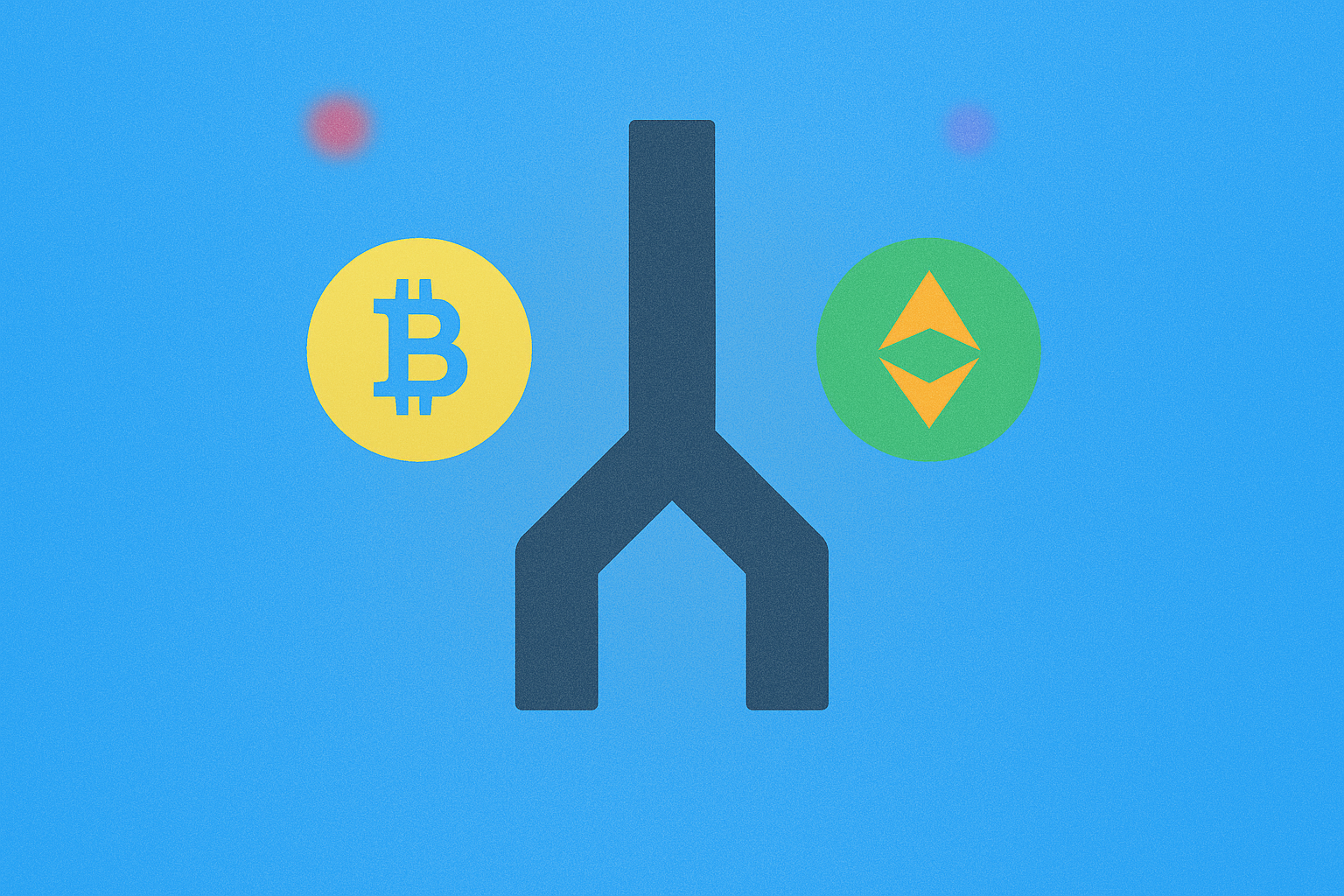
In cryptocurrency, a fork represents a fundamental change to the rules governing a blockchain, potentially resulting in the division of the chain into two distinct versions.

A blockchain comprises blocks, each containing transaction information. A fork occurs when a portion of the community decides to modify these governing rules. The motivations for such changes are varied and include: increasing transaction speed by modifying block size, introducing new features such as smart contract support, correcting protocol vulnerabilities or bugs, and resolving community disputes regarding the project's future direction.

There are two primary types of blockchain forks: Hard forks represent radical rule changes that are incompatible with previous blockchain versions, often resulting in blockchain division and the creation of new cryptocurrencies. Soft forks, by contrast, represent more conservative modifications that maintain compatibility with existing rules, modifying the current chain without creating a new one.

Several notable examples illustrate blockchain forks in practice. Bitcoin Cash emerged from community disagreement over scalability, creating an independent cryptocurrency. Ethereum and Ethereum Classic diverged following a cyberattack on The DAO project—while the majority modified the blockchain, some remained loyal to the original chain, now called Ethereum Classic. Bitcoin SV was created when developers increased block size to 128 MB, establishing another independent cryptocurrency.

What is a Fork in Git and Programming

In software development, a fork is primarily associated with the Git version control system and platforms such as GitHub, GitLab, or Bitbucket.

In Git, a fork creates an independent copy of a repository, enabling developers to work on a project without affecting the original. Primary reasons for forking include: making modifications to an existing project, creating a personal version, and conducting experiments.

The process of forking a repository is straightforward: navigate to the desired repository page, click the Fork button in the upper right corner, and the platform creates a copy within your account. Subsequently, you can modify this copy—adding files, making changes, or experimenting freely. If you wish to contribute modifications to the original project, you can create a pull request.

It is important to distinguish between forking and cloning: Fork creates a repository copy on a server like GitHub, while Clone creates a local copy on your computer. Additionally, forking extends beyond single repositories. In Linux distributions, a fork creates a new distribution based on an existing one—Ubuntu represents a fork of Debian, while Linux Mint is forked from Ubuntu. In applications, forking creates modified program versions based on source code; for example, the Brave browser is a fork of Chromium.

Fork in Other Sectors

Forking appears in various other technological applications. ForkPlayer is a popular Smart TV application enabling internet content viewing, featuring support for public playlists, custom link additions, and simplified configuration across different TV models.

A fork bomb represents a malicious script or program that creates infinite system processes, overwhelming operating system resources and causing system freezing or crashes.

How to Correctly Use the Term Fork

While 'forking' sounds natural among developers and cryptocurrency enthusiasts, it may confuse those outside the technical community. The verb 'fork' belongs to colloquial technical language. In official documents, articles, or presentations, more neutral phrasing is preferable, such as: 'create a repository fork', 'perform a blockchain fork', or 'divide the project'.

Synonyms for 'fork' vary by context: in programming (copy, branch, modification), in cryptocurrencies (division, update, fork), and in applications (version, adaptation).

Conclusion

A fork represents a universal concept foundational to innovation and development across multiple disciplines. In cryptocurrencies, forks enable new currency creation and blockchain adaptation to emerging requirements. In programming, forks empower developers to experiment, enhance projects, and create personalized software versions. Understanding the specific context of fork references prevents confusion and facilitates better navigation within the technical world.

FAQ

What is the definition of a fork?

A fork is a protocol upgrade where blockchain rules change, creating a new version. It can be hard fork (incompatible, creates new chain) or soft fork (backward compatible). Forks enable improvements, bug fixes, and network evolution.

Why is it called fork?

A fork occurs when a blockchain splits into two separate chains, typically due to protocol upgrades or community disagreements. The term comes from the divergence point where the blockchain branches into different paths, creating a new cryptocurrency with its own distinct features and community.

What is a fork in computers?

A fork is a copy of blockchain code that creates a new version. It can be soft (backward-compatible updates) or hard (breaking changes requiring all nodes to upgrade). Hard forks often launch new cryptocurrencies with different rules and features.

What is a fork in blockchain and cryptocurrency?

A fork is a change to a blockchain's protocol rules. Hard forks create new chains incompatible with the original, while soft forks are backward compatible upgrades. Forks enable protocol improvements, bug fixes, or community-driven splits.

How do you create a fork in programming?

A fork duplicates the original blockchain or codebase at a specific block height. Developers modify the code, change parameters, and launch a new network with a fresh genesis block. This creates a separate blockchain with independent rules and governance from the original.

What is the difference between a hard fork and a soft fork?

A hard fork is a backward-incompatible upgrade that requires all nodes to update, creating a new blockchain if not adopted. A soft fork is backward-compatible, requiring only a majority of nodes to upgrade while remaining compatible with older versions.

What happens when a fork occurs in a blockchain network?

A fork creates a split in the blockchain. If it's a soft fork, the network remains compatible. A hard fork creates a new chain with different rules, resulting in two separate cryptocurrencies. Nodes must choose which chain to follow.
* The information is not intended to be and does not constitute financial advice or any other recommendation of any sort offered or endorsed by Gate.

Share

Content

Fork — Definition in Simple Terms

What is a Fork in Cryptocurrency

What is a Fork in Git and Programming

Fork in Other Sectors

How to Correctly Use the Term Fork

Conclusion

FAQ

Related Articles
Cryptocurrency Fork Challenges: Understanding Risks and Drawbacks

Cryptocurrency Fork Challenges: Understanding Risks and Drawbacks

This article delves into the intricacies of cryptocurrency hard forks, outlining their causes, primary differences from soft forks, and their impacts on blockchain stability and community dynamics. It addresses challenges in understanding the drawbacks of forks and provides strategies for avoiding them. By highlighting real-world examples like Ethereum and Bitcoin Cash, the piece caters to blockchain developers, crypto investors, and community participants, offering insights into risk management and informed decision-making. The structured analysis enhances keyword density and readability, aiding fast comprehension of hard fork implications and their influence on cryptocurrency value and security.
2025-12-20 14:40:37
Understanding Blockchain Forks: Essential Security Practices

Understanding Blockchain Forks: Essential Security Practices

The article "Understanding Blockchain Forks: Essential Security Practices" explores the implications, security practices, and decision-making processes surrounding hard and soft forks in blockchain technology. It addresses conflicts within crypto communities that can lead to forks, detailing differences between hard and soft forks, the causes of accidental and intentional hard forks, and their respective pros and cons. The article underscores the need for clear communication, decentralized governance, and rigorous testing to prevent unnecessary forks, making it essential for blockchain developers and crypto investors seeking to navigate network upgrades and security measures effectively.
2025-12-20 06:20:50
DAO: Meaning and Responsibilities

DAO: Meaning and Responsibilities

# Understanding DAO: Meaning and Key Responsibilities in Crypto This comprehensive guide explores Decentralized Autonomous Organizations (DAOs), blockchain-based entities governed by smart contracts rather than centralized authorities. Designed for crypto investors, blockchain developers, and community participants, the article clarifies what DAOs are and their core operational functions. It addresses key governance mechanisms, resource management, project funding, dispute resolution, and transparency requirements essential for DAO success. Through structured sections covering compliance, decision-making processes, and membership obligations, readers gain practical insights into how DAOs differ from traditional organizations. Whether you're evaluating DAO participation on Gate or seeking to understand decentralized governance models, this resource provides the foundational knowledge needed to navigate autonomous blockchain ecosystems effectively.
2026-01-02 18:13:27
What is tokenomics: token distribution, inflation mechanisms, and governance explained

What is tokenomics: token distribution, inflation mechanisms, and governance explained

This comprehensive guide explains tokenomics fundamentals through Internet Computer's proven model. Learn how token distribution architecture balances Foundation stewardship, early contributor rewards, and investor allocation to align ecosystem incentives. Discover how uncapped supply remains sustainable through governance-driven inflation mechanisms and cycle burning—where network utility directly reduces token circulation. Explore the reverse gas model linking ICP conversion to computational resources, and understand how NNS neurons empower token holders with governance rights and staking rewards. The article provides actionable insights for evaluating project sustainability, vesting schedules, and long-term token value through real-world tokenomics design principles.
2026-01-15 01:17:24
Understanding Cryptographic Hash Functions for Enhanced Blockchain Security

Understanding Cryptographic Hash Functions for Enhanced Blockchain Security

This article delves into cryptographic hash functions, highlighting their crucial role in blockchain security and digital data integrity. It explains how these algorithms produce unique, fixed-length outputs to verify and protect sensitive information. Key topics include algorithm features like determinism, collision resistance, and the avalanche effect, showcasing their application in cryptocurrencies for transaction validation and wallet security. Ideal for tech enthusiasts and professionals in cybersecurity, it underscores the importance of understanding cryptographic hash functions in the digital age.
2025-12-03 12:40:03
Understanding Cryptographic Hash Functions: A Comprehensive Guide
Understanding Cryptographic Hash Functions: A Comprehensive Guide

This article delves into the significance and functionality of cryptographic hash functions, essential for securing cryptocurrencies and blockchain networks. It explains how these algorithms ensure data integrity, privacy, and security without centralized control. Key topics include the mechanics, purposes, differences from encryption, and features of hash functions, plus their role in cryptocurrency transactions. Designed for technologists and crypto enthusiasts, this guide offers insight into crucial cybersecurity measures, enhancing understanding of decentralized systems and digital privacy.
2025-12-05 04:45:12
Recommended for You
How much KAS net inflow in 24 hours: Kaspa holdings and capital flow analysis

How much KAS net inflow in 24 hours: Kaspa holdings and capital flow analysis

This article provides comprehensive insights into Kaspa (KAS) capital flow dynamics, analyzing a significant $31.03 million net inflow recorded within 24 hours amid positive market momentum. The analysis covers three critical areas: first, the substantial net inflow demonstrating robust investor demand and institutional positioning in KAS, reflecting coordinated buying pressure during bullish market conditions. Second, the exchange concentration analysis highlighting centralized exchanges' dominance, particularly Gate's pivotal role in facilitating major KAS trading pairs and capital movements. Third, moderate leverage metrics showing $58.63 million in total open interest positions, indicating disciplined market maturity without excessive speculation. This comprehensive capital flow analysis equips traders, investors, and analysts with essential metrics for understanding Kaspa's market structure, price discovery mechanisms, and real-time sentiment indicators for informed decision-making.
2026-01-15 05:38:14
What is token economy model: allocation mechanism, inflation design, and burning mechanisms explained
What is token economy model: allocation mechanism, inflation design, and burning mechanisms explained

This article provides a comprehensive guide to token economy models, using Pi Network as a detailed case study. It explores four critical components: token allocation mechanisms with a 100 billion cap and 80% community distribution; inflation design featuring four user roles (Pioneer, Contributor, Ambassador, Node) with progressive reward coefficients; burning mechanisms through transaction-based value destruction within Pi Browser applications; and governance rights empowered by 17.5 million verified users. The article examines how balanced tokenomics prevent excessive inflation while incentivizing participation, sustainable value creation through ecosystem utility requirements rather than aggressive burning, and decentralized decision-making frameworks. Designed for blockchain investors, developers, and ecosystem participants, this guide explains how modern token economies align stakeholder interests, drive adoption, and maintain long-term value preservation through structural design rather than speculative
2026-01-15 05:36:25
How does macroeconomic interconnectivity impact crypto prices through Fed policy, inflation data, and traditional financial market volatility in 2026?
How does macroeconomic interconnectivity impact crypto prices through Fed policy, inflation data, and traditional financial market volatility in 2026?

This article examines how macroeconomic interconnectivity shapes cryptocurrency valuations through three critical channels in 2026. First, Federal Reserve policy transmission—interest rate cuts and quantitative easing—directly compresses Treasury yields and reshapes global capital flows toward risk assets. Second, US inflation data releases (CPI, PPI, PCE) create immediate cryptocurrency price reactions, strengthening crypto-equity correlations as traditional market linkages tighten. Third, S&P 500 and gold fluctuations serve as leading indicators for Bitcoin and Ethereum movements, demonstrating asymmetric spillover effects from traditional markets. The article reveals how recession expectations, USD strength, and divergent global central bank policies amplify crypto market volatility. Essential reading for investors navigating 2026's uncertain macroeconomic landscape through Gate and digital asset ecosystems.
2026-01-15 05:31:55
What is MOT token fundamentals analysis: whitepaper logic, use cases, and technology innovation 2026?
What is MOT token fundamentals analysis: whitepaper logic, use cases, and technology innovation 2026?

This comprehensive MOT token fundamentals analysis examines the whitepaper's technology management framework, ecosystem architecture, and innovative positioning within the blockchain landscape. MOT operates as a utility token on Solana, addressing supply chain transparency, financial services, healthcare records, and IoT security across enterprise sectors. The whitepaper establishes decentralized infrastructure enabling scalable operations and governance while maintaining security and transparency. Real-world applications span supply chain tracking, payment systems, and intelligent logistics coordination, demonstrating multi-dimensional use cases beyond gaming. MOT's 2026 roadmap targets 25 technology innovations including perpetual futures, prediction markets, and stablecoin integration, strengthening competitive positioning. The token's modular architecture, zero-knowledge proofs, and continuous ecosystem development distinguish it from competitors. This analysis helps investors and developers understand MO
2026-01-15 05:29:41
How Does Macroeconomic Policy Impact Crypto Prices: Understanding Federal Reserve, Inflation, and Traditional Market Effects

How Does Macroeconomic Policy Impact Crypto Prices: Understanding Federal Reserve, Inflation, and Traditional Market Effects

This article examines how macroeconomic policies fundamentally reshape cryptocurrency valuations through three critical mechanisms. First, Federal Reserve interest rate decisions transmit directly to crypto markets—rate cuts increase liquidity and support Bitcoin valuations, while rate hikes reduce accessibility and trigger declines. Second, inflation dynamics reveal that cryptocurrencies exhibit inconsistent hedging properties compared to traditional safe-haven assets like gold and US Treasuries, with weaker inflation protection capabilities. Third, cryptocurrency markets now demonstrate strong positive correlation with S&P 500 volatility, indicating crypto's integration into mainstream finance. The article demonstrates that gold price movements precede Bitcoin rallies by 60-90 days, providing actionable leading indicators for traders. Additionally, the comprehensive FAQ section addresses critical questions about Federal Reserve impacts, inflation effects, market correlations, quantitative easing consequence
2026-01-15 05:27:40
What is AIC: How does the debt-to-equity-to-direct-equity investment model reshape fintech in 2026?

What is AIC: How does the debt-to-equity-to-direct-equity investment model reshape fintech in 2026?

This article explores how AIC's debt-to-equity-to-direct-equity investment model is reshaping fintech in 2026. With over 3.8 trillion yuan in signed commitments, AIC has evolved from traditional debt-to-equity conversion to direct equity investment, enabling more efficient capital deployment. The model addresses technology financing gaps in semiconductors, new energy, and advanced manufacturing by creating integrated capital allocation pathways. However, commercial banks face five critical risk management hurdles including valuation accuracy, governance risks, concentration exposure, exit complications, and regulatory compliance. The AIC framework fundamentally transforms fintech financing by reducing costs, democratizing funding access, and positioning equity-based structures as the cornerstone of modern tech enterprise growth, while balancing interests across investors, companies, and users through innovative capital mechanisms.
2026-01-15 05:25:45