Cryptocurrency Fork Challenges: Understanding Risks and Drawbacks

The Crypto Crossroads: Explaining Hard Forks in Blockchain
Blockchain technology, despite its decentralized nature, is not immune to conflicts among its developers and community members. When disagreements arise that cannot be resolved through conventional governance mechanisms such as decentralized autonomous organizations (DAOs) or governance tokens, hard forks may emerge as the ultimate resolution. While hard forks often carry negative connotations and present significant disadvantages of cryptocurrency forks, they have occasionally led to the creation of highly successful blockchain networks, with Ethereum being a prime example of a hard-forked chain surpassing its predecessor in influence and adoption.
What are hard forks in crypto?
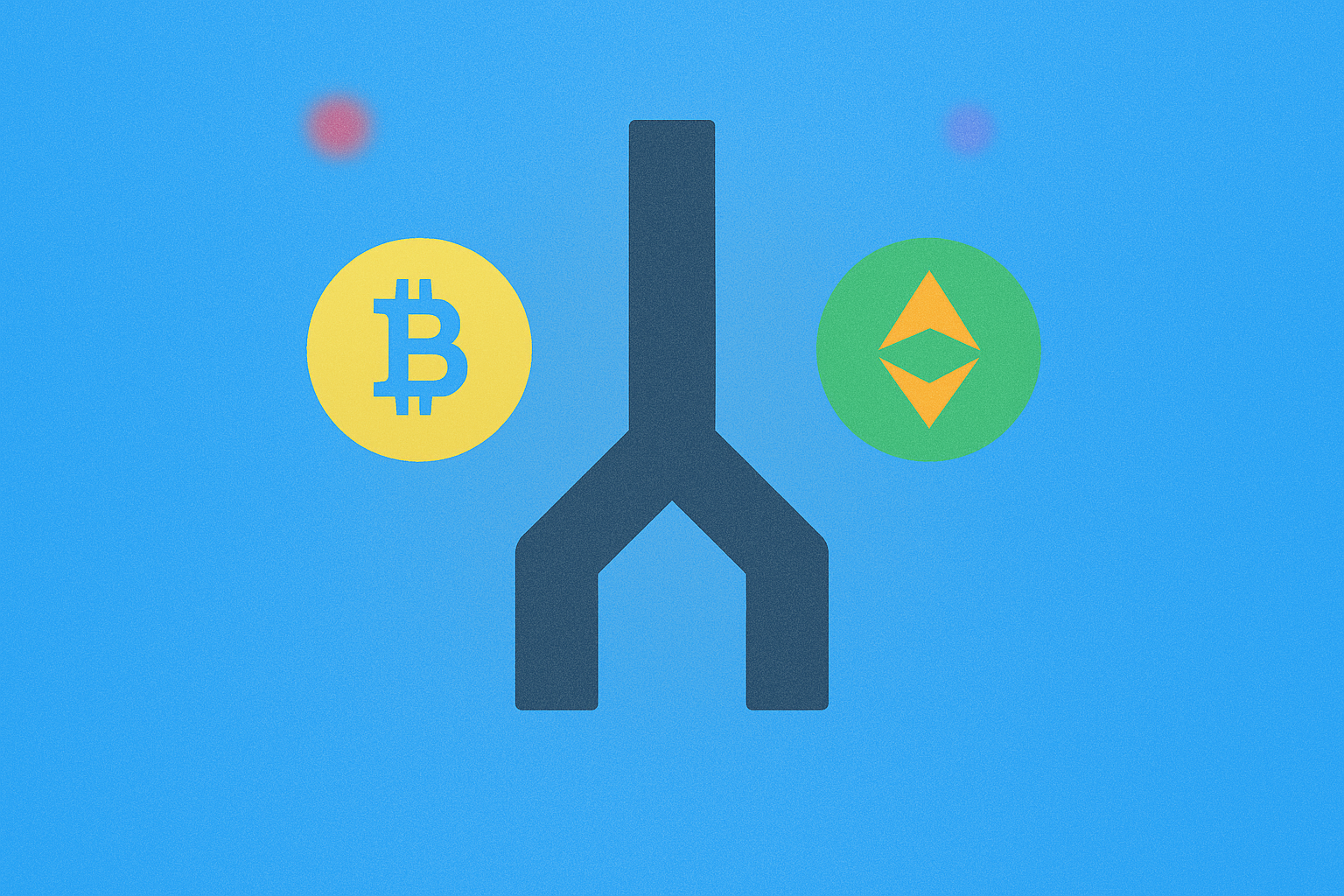
A hard fork represents a fundamental and irreversible change to a blockchain's underlying code that results in a permanent split of the network into two separate chains. This type of upgrade requires all nodes operating on the blockchain to update their software to the new protocol specifications in order to continue processing transactions. Without implementing the update, nodes become incompatible with the new network and cannot participate in transaction validation or block creation.
The backward incompatibility of hard forks is their defining characteristic. Once a hard fork is executed, it creates two entirely distinct blockchains, each with its own native cryptocurrency, independent transaction history, unique technical specifications, and separate validation procedures. The two resulting chains operate independently and cannot interact with each other, effectively creating a permanent division in the network.
Hard forks versus soft forks: Key differences
Soft forks represent a less disruptive alternative to hard forks in blockchain upgrades. The fundamental distinction lies in their backward compatibility: soft forks allow nodes to continue functioning on the network without mandatory software updates, whereas hard forks require all nodes to upgrade or become obsolete.
To illustrate this difference, consider a soft fork as analogous to a smartphone software update. Users with older versions can still use their devices and access basic functionality, though they may not benefit from the latest features and improvements. Soft forks modify specific aspects of a blockchain's infrastructure without altering the core protocol rules, avoiding the creation of separate blockchains.
A prominent example of a successful soft fork is Bitcoin's Segregated Witness (SegWit) implementation. This upgrade reorganized how transaction data was stored within each block, resulting in improved network efficiency and enhanced scalability without requiring a network split or forcing all nodes to update immediately.
What causes hard forks?
Hard forks can arise from both planned, carefully orchestrated community decisions and contentious, irreconcilable disputes within the blockchain ecosystem. The root causes typically stem from fundamental disagreements regarding the blockchain's future direction, conflicting values among stakeholders, or divergent technical philosophies. Understanding these causes is essential to comprehending the disadvantages of cryptocurrency forks that may follow.
The creation of Bitcoin Cash (BCH) exemplifies a contentious hard fork driven by technical disagreements. The dispute centered on Bitcoin's block size limit, with one faction supporting the SegWit soft fork solution that maintained the 1 MB block size, while opposing developers advocated for increasing block capacity to accommodate growing transaction volumes. Unable to reach consensus, the BCH supporters initiated a hard fork, creating an alternative Bitcoin blockchain with larger blocks.
Security breaches and data integrity concerns can also necessitate hard fork interventions. The Ethereum hard fork demonstrates this scenario. Following a significant hack of The DAO, a crowdfunding protocol built on Ethereum, the community faced a critical decision: accept the theft as an immutable part of the blockchain's history or reverse the malicious transactions through a hard fork. The majority chose to hard fork, creating today's Ethereum (ETH) with restored funds, while the original chain continued as Ethereum Classic (ETC), preserving the transaction history including the hack.
What are accidental hard forks?
Not all hard forks result from intentional design decisions or community consensus. Accidental hard forks occur unexpectedly due to technical failures rather than planned upgrades, though their impact on the network is identical to intentional hard forks: a split into two separate chains.
These unplanned splits typically result from software bugs, network synchronization failures, or other technical malfunctions within the blockchain infrastructure. Node operators continuously monitor their networks for warning signs of potential accidental forks. To minimize the risk and impact of such events, development teams employ comprehensive testing procedures, engage third-party auditors to review code, and implement sophisticated tracking mechanisms to detect anomalies before they can cause network splits.
Pros and cons of hard forks
While hard forks often carry negative associations within cryptocurrency communities, they can provide significant benefits when implemented with broad consensus and clear communication. Understanding both the advantages and the disadvantages of cryptocurrency forks helps stakeholders make informed decisions about proposed upgrades.
Advantages of hard forks include:
The introduction of novel features and use cases represents a primary benefit. Hard forks provide developers with maximum flexibility to implement innovative functionality and fundamentally reshape their blockchain's capabilities. By restructuring the foundational infrastructure, programmers can address scalability limitations, enhance network efficiency, and introduce entirely new applications that would be impossible under the constraints of the existing protocol. In the rapidly evolving cryptocurrency market, this ability to implement radical changes may prove essential for maintaining competitiveness and relevance.
Security improvements and fund recovery capabilities offer another significant advantage. When hackers successfully exploit vulnerabilities to steal funds or manipulate transaction data, a hard fork provides a mechanism to reset the network and restore assets to affected users. By creating a new blockchain fork, developers can thoroughly analyze security weaknesses in the previous chain, implement enhanced safety measures, and rewrite transaction history to compensate victims of attacks.
Community conflict resolution represents a pragmatic benefit in certain scenarios. When irreconcilable differences emerge within a blockchain community, a hard fork allows dissenting developers to pursue their vision independently without interfering with the original chain. While this outcome is typically less desirable than achieving consensus on a soft fork, it prevents prolonged conflicts by creating clear separations between competing philosophical or technical approaches.
Disadvantages of cryptocurrency forks include:
Community fragmentation poses perhaps the most significant drawback among the disadvantages of cryptocurrency forks. Hard forks inherently create divisions by splitting a single blockchain into two incompatible chains, often disrupting harmony, reducing collaborative synergy, and creating lasting rifts within the developer community. The debates surrounding hard forks frequently generate intense conflicts, forcing participants to choose sides between competing visions and potentially damaging long-term relationships and cooperation.
User confusion in the cryptocurrency market represents another substantial challenge among the disadvantages of cryptocurrency forks. Forked cryptocurrencies become new digital assets rather than simple upgrades of existing coins, and when these new assets share similar names with their predecessors—such as Bitcoin and Bitcoin Cash, or Ethereum and Ethereum Classic—traders and investors may struggle to distinguish between them. Without clear and consistent communication from the development community, this confusion can lead to mistaken transactions, investment errors, and general market uncertainty.
Security risks emerge on both resulting chains following a hard fork, representing critical disadvantages of cryptocurrency forks. Even if the majority of nodes choose to remain on the original chain, the fork inevitably divides network resources, computational power, and active participants between two blockchains. This division reduces decentralization and security for both networks, with smaller chains becoming particularly vulnerable. Networks with reduced hash power or fewer active validators face increased susceptibility to 51% attacks, where malicious actors can gain control by commanding a majority of the network's validation resources.
How to avoid hard forks
Given the irreversible nature of hard forks and the various disadvantages of cryptocurrency forks that accompany them, developers employ various strategies to avoid scenarios requiring such drastic measures. While hard forks may occasionally prove necessary in extreme circumstances, proactive approaches can significantly reduce the likelihood of reaching that point.
Community engagement and clear communication form the foundation of hard fork prevention. Development teams regularly publish updates through social media channels, community forums, and official communication platforms to maintain transparency regarding proposed changes and ongoing developments. These open communication pathways ensure all stakeholders—from individual users to major node operators—remain informed at every stage of the development process. By fostering dialogue and actively soliciting feedback, teams can identify potential concerns early and address them before they escalate into irreconcilable conflicts. The free flow of information throughout a Web3 community enables proactive problem-solving and helps prevent misunderstandings that might otherwise lead to contentious splits.
Decentralized governance protocols provide structured frameworks for collective decision-making. On-chain governance tools, including DAOs and governance tokens, enable stakeholders to participate directly in protocol decisions through voting mechanisms and proposal submissions. This inclusive model ensures that community members feel valued and invested in the blockchain's direction, as they possess tangible influence over its evolution. When users perceive themselves as integral parts of a collaborative ecosystem with shared objectives, they become more likely to work toward maintaining network unity rather than creating divisions. The democratic nature of these governance systems helps align diverse interests and build consensus around proposed changes.
Testnet deployment enables thorough evaluation of proposed changes in risk-free environments. These simulated blockchain networks allow developers to test software updates extensively before implementation on the mainnet, where mistakes could have costly and irreversible consequences. Through testnet experimentation, programmers can explore multiple upgrade scenarios, identify potential issues, assess performance impacts, and refine their approaches based on empirical data. The evidence gathered during testing phases provides objective information that developers can share with the community, facilitating informed discussions and evidence-based decision-making regarding optimal solutions.
Emergency response plans, also known as contingency protocols, prepare development teams to handle disputes and crises effectively. These plans establish clear procedures for conflict resolution as issues arise and outline fallback strategies to mitigate negative impacts during stressful situations. Even when consensus proves unattainable, well-designed contingency plans help developers anticipate potential outcomes, identify security vulnerabilities in advance, and implement protective measures. This preparation ensures that operations can continue smoothly even if the network ultimately splits, minimizing disruption and protecting users during transitions.
Conclusion
Hard forks represent both a challenge and an opportunity within blockchain ecosystems. While the disadvantages of cryptocurrency forks can create community divisions, market confusion, and security vulnerabilities, they also provide mechanisms for implementing radical innovations, addressing security breaches, and resolving fundamental disagreements when no other solution exists. The key to managing hard forks effectively lies in understanding their implications, maintaining open communication within communities, implementing robust governance structures, and employing comprehensive testing and contingency planning. As blockchain technology continues to evolve, the ability to navigate potential hard forks through proactive engagement and strategic planning remains essential for building resilient, adaptable, and unified cryptocurrency networks. Whether hard forks ultimately strengthen or weaken a blockchain depends largely on how the community approaches the process—with transparency, preparation, and a commitment to collective decision-making serving as the cornerstones of successful outcomes. By acknowledging the disadvantages of cryptocurrency forks and working proactively to minimize their negative impacts, blockchain communities can position themselves for long-term success and stability.
FAQ
What happens when a crypto forks?
A crypto fork occurs when blockchain developers implement new rules. Hard forks create a separate network and new cryptocurrency, while soft forks adjust existing rules without splitting the chain. Hard fork holders receive new assets if they already hold the original cryptocurrency.
What are some disadvantages of cryptocurrency?
Cryptocurrency faces significant challenges including lack of regulatory oversight enabling fraud, extreme price volatility affecting stability, and potential misuse for illegal activities. Additionally, transaction irreversibility and technical complexity create barriers for mainstream adoption.
How do cryptocurrency forks affect security and network stability?
Forks create parallel chains that may reduce network hashrate and processing efficiency, potentially increasing vulnerability to attacks. Divided liquidity and validator resources can compromise consensus security and cause transaction delays across networks.
What are the risks of holding coins during a cryptocurrency fork?
Holding coins during a fork risks value loss and complications claiming new coins. Forks create market uncertainty and potential security vulnerabilities. Always verify fork legitimacy before participating to protect your assets.
How do forks impact the value and liquidity of cryptocurrencies?
Forks create market uncertainty and split investor interest, typically reducing value and liquidity. Hard forks generate new currencies diluting the original asset, while soft forks adjust rules. Both scenarios often trigger price volatility and trading volume decreases during transition periods.

Understanding Blockchain Forks: Essential Security Practices

DAO: Meaning and Responsibilities
Comprehensive Guide to Cryptocurrency Forks and Blockchain Splits

What is tokenomics: token distribution, inflation mechanisms, and governance explained

Understanding Cryptographic Hash Functions for Enhanced Blockchain Security
Understanding Cryptographic Hash Functions: A Comprehensive Guide

What is BOT project fundamentals: whitepaper logic, use cases, technology innovation and team background explained

Why Do All Cryptocurrencies Fall Together?

What is NPC price volatility: historical trends, support resistance levels, and 2026 price prediction

What is SEI crypto market cap and 24-hour trading volume in 2026

A Strong Stock Market Depends On Key Economic Drivers