Comprehensive Guide to Cryptocurrency Forks and Blockchain Splits
What is a Fork in Simple Terms: Git, Cryptocurrencies, Applications and Beyond
Fork — Definition in Simple Terms
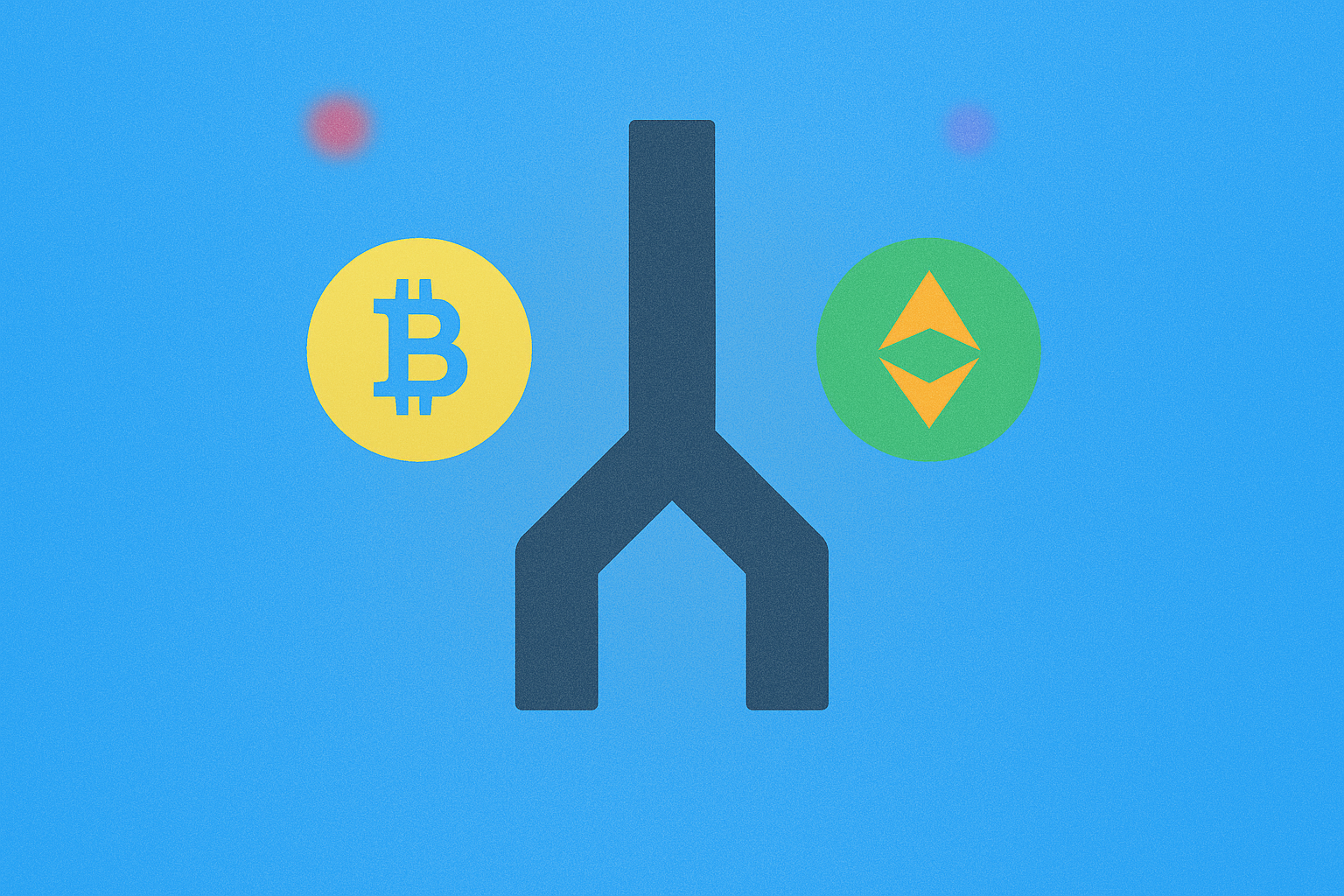
The term 'fork' derives from English and literally means 'fork' or 'branch'. In technical contexts, a fork represents the creation of a copy or new version of something—whether software code, a blockchain, or an application—that subsequently evolves independently from the original source.
The concept of a fork is universal across multiple disciplines because it fundamentally describes the process of division and creation of something new based on existing foundations. This universality makes the term convenient for application across diverse fields. Although a fork in Git and a fork in blockchain are entirely different processes, they are united by the underlying concept of separation and independent development.
What is a Fork in Cryptocurrency
In cryptocurrency, a fork represents a fundamental change to the rules governing a blockchain, potentially resulting in the division of the chain into two distinct versions.
A blockchain comprises blocks, each containing transaction information. A fork occurs when a portion of the community decides to modify these governing rules. The motivations for such changes are varied and include: increasing transaction speed by modifying block size, introducing new features such as smart contract support, correcting protocol vulnerabilities or bugs, and resolving community disputes regarding the project's future direction.
There are two primary types of blockchain forks: Hard forks represent radical rule changes that are incompatible with previous blockchain versions, often resulting in blockchain division and the creation of new cryptocurrencies. Soft forks, by contrast, represent more conservative modifications that maintain compatibility with existing rules, modifying the current chain without creating a new one.
Several notable examples illustrate blockchain forks in practice. Bitcoin Cash emerged from community disagreement over scalability, creating an independent cryptocurrency. Ethereum and Ethereum Classic diverged following a cyberattack on The DAO project—while the majority modified the blockchain, some remained loyal to the original chain, now called Ethereum Classic. Bitcoin SV was created when developers increased block size to 128 MB, establishing another independent cryptocurrency.
What is a Fork in Git and Programming
In software development, a fork is primarily associated with the Git version control system and platforms such as GitHub, GitLab, or Bitbucket.
In Git, a fork creates an independent copy of a repository, enabling developers to work on a project without affecting the original. Primary reasons for forking include: making modifications to an existing project, creating a personal version, and conducting experiments.
The process of forking a repository is straightforward: navigate to the desired repository page, click the Fork button in the upper right corner, and the platform creates a copy within your account. Subsequently, you can modify this copy—adding files, making changes, or experimenting freely. If you wish to contribute modifications to the original project, you can create a pull request.
It is important to distinguish between forking and cloning: Fork creates a repository copy on a server like GitHub, while Clone creates a local copy on your computer. Additionally, forking extends beyond single repositories. In Linux distributions, a fork creates a new distribution based on an existing one—Ubuntu represents a fork of Debian, while Linux Mint is forked from Ubuntu. In applications, forking creates modified program versions based on source code; for example, the Brave browser is a fork of Chromium.
Fork in Other Sectors
Forking appears in various other technological applications. ForkPlayer is a popular Smart TV application enabling internet content viewing, featuring support for public playlists, custom link additions, and simplified configuration across different TV models.
A fork bomb represents a malicious script or program that creates infinite system processes, overwhelming operating system resources and causing system freezing or crashes.
How to Correctly Use the Term Fork
While 'forking' sounds natural among developers and cryptocurrency enthusiasts, it may confuse those outside the technical community. The verb 'fork' belongs to colloquial technical language. In official documents, articles, or presentations, more neutral phrasing is preferable, such as: 'create a repository fork', 'perform a blockchain fork', or 'divide the project'.
Synonyms for 'fork' vary by context: in programming (copy, branch, modification), in cryptocurrencies (division, update, fork), and in applications (version, adaptation).
Conclusion
A fork represents a universal concept foundational to innovation and development across multiple disciplines. In cryptocurrencies, forks enable new currency creation and blockchain adaptation to emerging requirements. In programming, forks empower developers to experiment, enhance projects, and create personalized software versions. Understanding the specific context of fork references prevents confusion and facilitates better navigation within the technical world.
FAQ
What is the definition of a fork?
A fork is a protocol upgrade where blockchain rules change, creating a new version. It can be hard fork (incompatible, creates new chain) or soft fork (backward compatible). Forks enable improvements, bug fixes, and network evolution.
Why is it called fork?
A fork occurs when a blockchain splits into two separate chains, typically due to protocol upgrades or community disagreements. The term comes from the divergence point where the blockchain branches into different paths, creating a new cryptocurrency with its own distinct features and community.
What is a fork in computers?
A fork is a copy of blockchain code that creates a new version. It can be soft (backward-compatible updates) or hard (breaking changes requiring all nodes to upgrade). Hard forks often launch new cryptocurrencies with different rules and features.
What is a fork in blockchain and cryptocurrency?
A fork is a change to a blockchain's protocol rules. Hard forks create new chains incompatible with the original, while soft forks are backward compatible upgrades. Forks enable protocol improvements, bug fixes, or community-driven splits.
How do you create a fork in programming?
A fork duplicates the original blockchain or codebase at a specific block height. Developers modify the code, change parameters, and launch a new network with a fresh genesis block. This creates a separate blockchain with independent rules and governance from the original.
What is the difference between a hard fork and a soft fork?
A hard fork is a backward-incompatible upgrade that requires all nodes to update, creating a new blockchain if not adopted. A soft fork is backward-compatible, requiring only a majority of nodes to upgrade while remaining compatible with older versions.
What happens when a fork occurs in a blockchain network?
A fork creates a split in the blockchain. If it's a soft fork, the network remains compatible. A hard fork creates a new chain with different rules, resulting in two separate cryptocurrencies. Nodes must choose which chain to follow.
Cryptocurrency Fork Challenges: Understanding Risks and Drawbacks

Understanding Blockchain Forks: Essential Security Practices

DAO: Meaning and Responsibilities

What is tokenomics: token distribution, inflation mechanisms, and governance explained

Understanding Cryptographic Hash Functions for Enhanced Blockchain Security

Understanding Cryptographic Hash Functions: A Comprehensive Guide

What is Movement (MOVE) coin: Fundamentals, Whitepaper Logic, and Technology Innovation Analysis

How to Mine Cryptocurrency on PC

What is the current market overview of MOVE crypto with 24-hour trading volume and market cap ranking

What is BOT project fundamentals: whitepaper logic, use cases, technology innovation and team background explained
Why Do All Cryptocurrencies Fall Together?