
fomox
MarketsPerpsSpotSwap
Meme
Referral
More
Search Token/Wallet
/

What are the top cryptocurrencies by market cap and trading volume in 2026
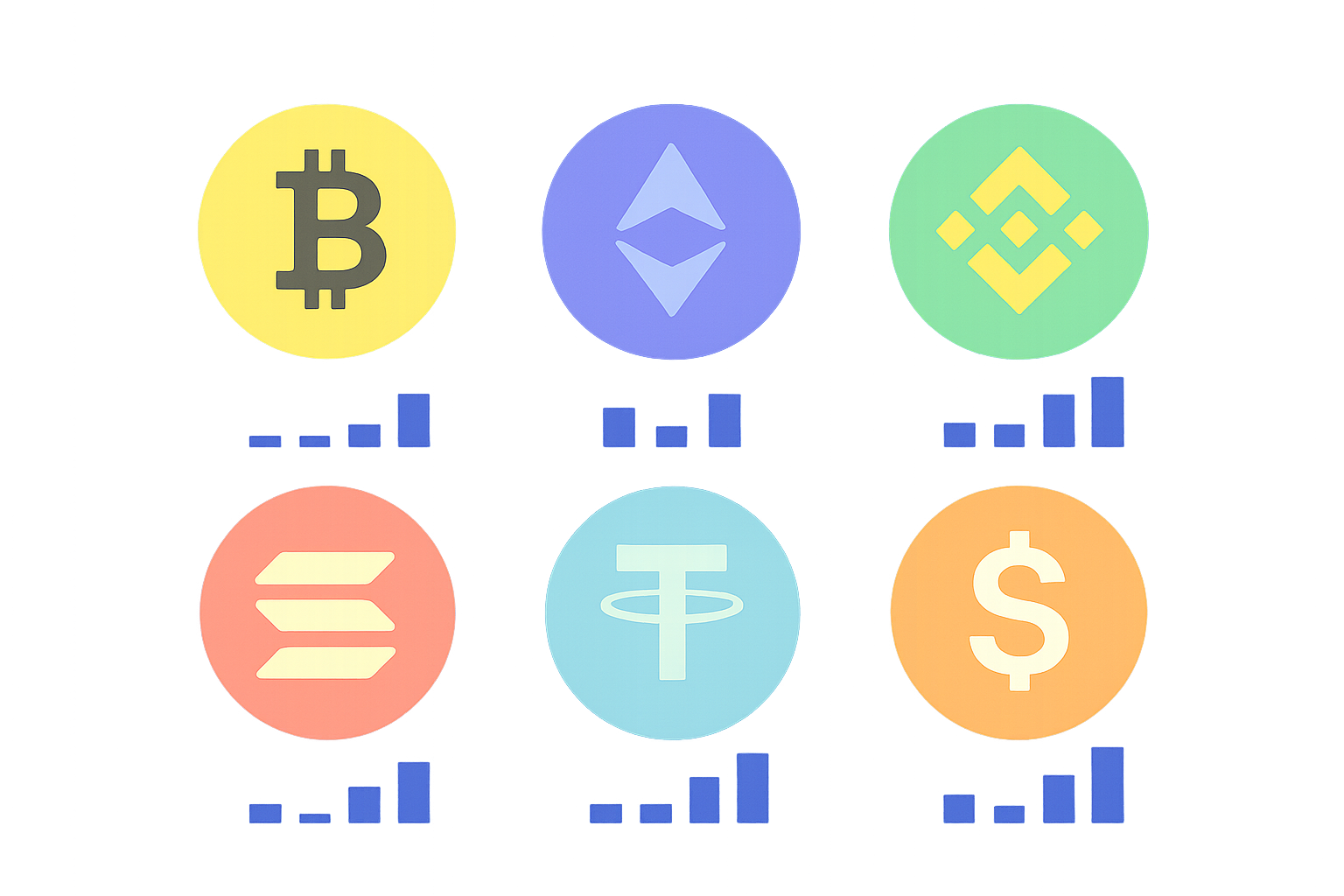
2026-01-12 04:27:29
Bitcoin
Crypto Trading
Ethereum
Stablecoin
Top crypto
Avaliação do artigo : 5
146 avaliações
This comprehensive guide examines the top cryptocurrencies by market cap and trading volume in 2026, revealing Bitcoin and Ethereum's continued dominance through established market positioning and institutional adoption. The article analyzes key performance metrics including 24-hour and 7-day trading volumes, liquidity patterns, and exchange accessibility across platforms like Gate. It explores how circulating supply dynamics and exchange coverage shape market accessibility, while comparing major cryptocurrencies such as BNB, Solana, and leading stablecoins like USDT and USDC. Designed for traders and institutional investors, this resource provides essential market hierarchy insights, supply mechanics analysis, and emerging cryptocurrency trends that entered top rankings in 2026. Perfect for portfolio allocation strategies and understanding cryptocurrency viability in current market conditions.
What are the top cryptocurrencies by market cap and trading volume in 2026

Top 10 Cryptocurrencies by Market Cap: Bitcoin and Ethereum Lead 2026 Rankings

The cryptocurrency market in 2026 demonstrates a clear hierarchy dominated by established digital assets. Bitcoin and Ethereum maintain their commanding positions as the top cryptocurrencies by market capitalization, reflecting their pioneering status and institutional adoption levels. Market cap rankings serve as the primary measure for evaluating cryptocurrency prominence, calculated by multiplying current price by circulating supply, providing investors with a snapshot of total market valuation for each asset.

Bitcoin's supremacy in the 2026 rankings underscores its role as the foundational cryptocurrency, while Ethereum's consistent positioning reflects its dominance in decentralized applications and smart contract functionality. These top cryptocurrencies benefit from established trading volume infrastructure and liquidity across major exchanges including gate, enabling seamless price discovery and efficient capital movement.

The market cap hierarchy among cryptocurrencies in 2026 correlates directly with investor confidence and real-world utility adoption. Higher-ranked digital assets typically demonstrate superior trading volume consistency, broader exchange listing accessibility, and stronger ecosystem development. For traders and institutional investors, understanding these cryptocurrency rankings by market cap provides crucial context for portfolio allocation strategies and risk assessment. The top positions indicate not merely higher valuations but also greater network effects and proven resilience through market cycles.

Trading Volume and Liquidity Analysis: 24-Hour and 7-Day Performance Metrics

Understanding how cryptocurrencies perform requires examining their trading volume and liquidity patterns across multiple timeframes. The 24-hour and 7-day performance metrics provide crucial insights into market dynamics and investor sentiment, revealing whether a cryptocurrency maintains consistent interest or experiences volatility. Zerebro illustrates this dynamic well, showing a 24-hour trading volume of approximately $3.34 million alongside a price decline of 5.57% during the same period, yet demonstrating resilience with a 7-day gain of 5.11%. These metrics serve as vital indicators of market health and accessibility for traders seeking to enter or exit positions efficiently.

Liquidity analysis becomes particularly important when evaluating top cryptocurrencies by market cap, as higher trading volumes typically indicate tighter bid-ask spreads and reduced slippage risk. When comparing 24-hour versus 7-day metrics, traders can identify emerging trends and distinguish between short-term price fluctuations and longer-term momentum. Zerebro's trading performance demonstrates how volume patterns can diverge from price trends, with stronger weekly performance despite daily weakness. This distinction matters significantly for investors assessing cryptocurrency viability on exchange platforms like gate, where volume correlates directly with execution quality and market depth.

Exchange Coverage and Supply Dynamics: Circulation, Total Supply, and Market Accessibility

The interplay between circulating supply and total supply fundamentally shapes a cryptocurrency's market accessibility and trading dynamics. Zerebro demonstrates mature supply mechanics, with its circulating supply of approximately 1 billion tokens representing 99.99% of the total supply. This near-complete circulation minimizes inflation concerns and creates predictable market conditions, directly influencing how market cap and trading volume behave across different timeframes.

Broad exchange coverage significantly amplifies market accessibility for major cryptocurrencies in 2026. Zerebro's presence across 23 exchanges, including gate, ensures traders can easily execute positions across multiple platforms. This distributed availability reduces friction in accessing the asset and facilitates price discovery through competitive trading environments. Enhanced market accessibility naturally translates to more stable trading volume patterns and deeper liquidity pools.

The alignment between fully diluted valuation and current market cap reveals supply maturity. When these metrics converge at 100%, it indicates the asset has reached its maximum supply potential, eliminating future dilution concerns. This transparency encourages institutional participation and strengthens confidence in long-term market cap sustainability, while the predictable supply foundation supports consistent trading volume across exchanges globally.

FAQ

What are the top 10 cryptocurrencies by market cap in 2026?

As of January 2026, Bitcoin, Ethereum, BNB, Solana, XRP, Cardano, Dogecoin, Polkadot, Litecoin, and Avalanche remain the leading cryptocurrencies by market capitalization, though rankings continue to evolve based on market dynamics and adoption rates.

How are Bitcoin and Ethereum ranked by market position and trading volume in 2026?

Bitcoin remains the leading cryptocurrency by market cap and trading volume in 2026, maintaining its dominance as the most traded digital asset. Ethereum secures the second position, with substantial trading volume driven by its robust DeFi ecosystem and widespread adoption.

Which cryptocurrencies have the largest trading volume in the crypto market in 2026, and what is their daily average trading amount?

Bitcoin and Ethereum lead with daily trading volumes exceeding $40 billion and $25 billion respectively. Stablecoins like USDT and USDC follow with $20+ billion daily volume, dominating market liquidity and facilitating majority of crypto transactions.

Which emerging cryptocurrencies entered the top 50 by market cap in 2026, and what drove their growth?

AI-powered tokens and layer-2 solutions dominated 2026 entries. Projects like advanced AI infrastructure coins and scaling solutions grew through institutional adoption, technological breakthroughs, and increased mainstream blockchain integration, reaching top 50 positions.

How are stablecoins (such as USDT, USDC) performing in market cap rankings and trading volume in 2026?

Stablecoins maintain top 5 market cap positions in 2026, with USDT leading at over $150 billion and USDC following at $80 billion. Combined daily trading value exceeds $200 billion, driven by DeFi adoption, institutional adoption, and cross-chain integration, solidifying their role as essential liquidity infrastructure.

What changes occurred in the top ten cryptocurrency market cap rankings comparing 2026 to 2025?

In 2026, Bitcoin and Ethereum maintained their dominant positions, while Layer 2 solutions and AI-related tokens entered the top ten, pushing some traditional altcoins lower. Stablecoins showed increased market penetration, reflecting growing institutional adoption and market maturity.

* As informações não pretendem ser e não constituem aconselhamento financeiro ou qualquer outra recomendação de qualquer tipo oferecida ou endossada pela Gate.

Compartilhar

Conteúdo

Top 10 Cryptocurrencies by Market Cap: Bitcoin and Ethereum Lead 2026 Rankings

Trading Volume and Liquidity Analysis: 24-Hour and 7-Day Performance Metrics

Exchange Coverage and Supply Dynamics: Circulation, Total Supply, and Market Accessibility

FAQ

Artigos Relacionados
How Does Cryptocurrency Competitive Analysis Drive Market Success in 2025?
How Does Cryptocurrency Competitive Analysis Drive Market Success in 2025?

This article examines how cryptocurrency competitive analysis propels market success in 2025 by comparing the performance of top assets like Bitcoin, Ethereum, and Solana. It highlights unique value propositions, such as Terra Classic's algorithmic stability and energy-efficient PoS mechanism. The analysis also sheds light on market share shifts among major exchanges like Gate, with insights into the dynamics of volatile trading periods and regional exchange strengths. This makes it essential for investors and stakeholders seeking strategies to navigate the evolving crypto market landscape effectively.
2025-11-16 05:54:56
What is crypto market cap ranking, trading volume, and liquidity overview for January 2026?
What is crypto market cap ranking, trading volume, and liquidity overview for January 2026?

# Article Introduction This comprehensive guide examines cryptocurrency market dynamics in January 2026, analyzing market cap rankings, trading volumes, and liquidity metrics across major digital assets. Bitcoin and Ethereum dominate with combined valuations exceeding $2 trillion, while stablecoin circulation surges to $310 billion, reflecting institutional adoption. Trading volumes reach record daily peaks of $150+ billion on leading platforms including Gate, demonstrating unprecedented market maturity. The article addresses critical concerns for investors and traders: understanding market cap distribution, assessing liquidity depth, and evaluating institutional participation impacts. Through detailed analysis of order book dynamics, bid-ask spreads, and price discovery mechanisms, this guide equips both retail and institutional participants with actionable insights for navigating crypto markets' institutional-grade infrastructure evolution.
2026-01-04 02:03:18
What Is the Crypto Market Overview in 2025: Market Cap Rankings, Trading Volume, and Liquidity Analysis
What Is the Crypto Market Overview in 2025: Market Cap Rankings, Trading Volume, and Liquidity Analysis

# Crypto Market Overview in 2025: Market Cap Rankings, Trading Volume, and Liquidity Analysis Bitcoin and Ethereum command 60% of total cryptocurrency market capitalization, solidifying institutional-grade digital assets' market dominance. Stablecoins USDT and USDC drive unprecedented trading volumes exceeding $150 billion daily, becoming essential liquidity infrastructure for DeFi platforms. Gate and major exchanges control 75% of global trading pairs, creating concentrated liquidity dynamics that impact price execution and market stability. This overview equips traders, institutions, and investors with critical insights into market structure, trading depth, and liquidity concentration. Understanding these metrics enables informed decision-making across market cap rankings, trading volumes, and exchange-based liquidity distribution in 2025's evolving crypto ecosystem.
2025-12-27 03:15:30
How does crypto price volatility affect your trading decisions in 2025?
How does crypto price volatility affect your trading decisions in 2025?

This article delves into how crypto price volatility impacts trading decisions in 2025, offering insights into market stability trends, technical analysis techniques, and volatility management strategies. With increased institutional participation, the cryptocurrency market has shifted towards stability, reducing manipulative volatility and enhancing price discovery. Readers will learn about support and resistance levels, momentum indicators, and correlation analysis between Bitcoin and Ethereum. The article serves traders aiming to finesse their strategies through advanced tools like ATR, RSI, and MACD, ensuring informed trading decisions.
2025-12-24 01:11:36
Is Crypto Halal in Islam? A Guide to Bitcoin, Ethereum, and More
Is Crypto Halal in Islam? A Guide to Bitcoin, Ethereum, and More

# Article Overview: Understanding the Islamic Perspective on Cryptocurrency Trading This comprehensive guide explores whether cryptocurrencies like Bitcoin and Ethereum align with Sharia law, addressing Muslim investors' critical compliance questions. The article dissects Islamic finance principles—prohibiting riba (interest), gharar (uncertainty), and maysir (gambling)—then evaluates crypto's halal status across spot trading, mining, staking, and NFTs. It examines three scholarly perspectives on cryptocurrency legitimacy, distinguishes between permissible long-term investment and haram speculative trading, and highlights Sharia-compliant options on platforms like Gate. Designed for Muslim investors seeking ethical crypto engagement, this resource provides actionable guidance on evaluating assets, understanding trading structures, and consulting scholars for faith-aligned decisions.
2025-12-31 20:28:35
A Beginner's Guide to Understanding Altcoins

A Beginner's Guide to Understanding Altcoins

# A Beginner's Guide to Understanding Altcoins This comprehensive guide explores the altcoin ecosystem beyond Bitcoin, covering essential concepts for cryptocurrency investors. Learn what altcoins are, their categories (stablecoins, utility tokens, governance tokens, memecoins), and the 10 leading altcoins including Ethereum, XRP, Solana, and Cardano. Discover key metrics like altcoin dominance and market capitalization to identify altseason opportunities. The guide addresses investment strategies, research frameworks for evaluating projects, security best practices for wallet storage on Gate, and risk management essentials. Perfect for beginners seeking to navigate altcoin investments with informed decision-making and protective measures against market volatility and scams.
2025-12-28 14:04:50
Recomendado para você
What is WFI fundamental analysis: how do whitepaper logic, use cases, and team roadmap impact token value in 2026

What is WFI fundamental analysis: how do whitepaper logic, use cases, and team roadmap impact token value in 2026

This comprehensive analysis examines WFI token fundamentals through whitepaper logic, use cases, and team execution roadmap impacting 2026 valuation. WFI's decentralized banking architecture delivers 18% stablecoin yields and cross-chain integration, solving traditional finance constraints while driving real-world adoption across 140 million merchants. The 112% price surge from $1.29 to $2.74 in 2025 reflects genuine utility demand, not speculation. Community governance demonstrates exceptional strength with 99.72% approval for buyback-and-burn strategy, already destroying 7.89 million tokens worth $1.43 million. Strategic partnerships fueled market expansion from $2.8B to $4B, with projections reaching $5B by 2026. Leadership from Tether and Bitpanda strengthens institutional credibility. WFI's multi-revenue streams including ATM withdrawals, card services, and yield mechanisms create sustainable token economics. This article dissects how whitepaper innovation, platform functionality, and team execution coll
2026-01-12 08:01:56
What is a token economic model and how do allocation mechanisms, inflation design, and governance rights affect crypto value

What is a token economic model and how do allocation mechanisms, inflation design, and governance rights affect crypto value

This article explores token economic models as the foundational system governing cryptocurrency value creation through three critical mechanisms. Token allocation mechanisms—balancing team, investor, and community distributions with strategic vesting periods—establish stakeholder incentives and prevent supply shocks. Inflation and deflation design maintains price stability by programming supply dynamics directly into protocols, with mechanisms like scheduled emissions and token burns creating predictable scarcity. Finally, governance rights empower token holders to participate in protocol decisions, aligning long-term interests with network growth. The article demonstrates how these components work synergistically: well-structured allocations, transparent supply policies, and inclusive governance create self-reinforcing cycles that sustain value appreciation while building community trust and ecosystem resilience.
2026-01-12 07:59:45
What is BabyDoge coin and how does its deflationary mechanism work in 2026?
What is BabyDoge coin and how does its deflationary mechanism work in 2026?

BabyDoge Coin operates through a dual deflationary mechanism that allocates 5% of transaction fees as redistribution rewards to holders while burning 2.5% permanently, having eliminated over 48% of initial supply since launch. The project has expanded across multiple blockchains including Binance Smart Chain and Ethereum, serving approximately 1.7 million active addresses on BSC. With 1.95 million Twitter followers and over 1.9 million token holders, BabyDoge demonstrates strong community engagement beyond typical memecoin dynamics. The ecosystem has evolved significantly with 2025 NFT integration and a perpetual futures DEX launch, creating tangible utility infrastructure for 2026. These developments—including planned bridge expansions and UX improvements—position BabyDoge competitively within the cryptocurrency landscape where deflationary tokenomics combined with real DeFi applications drive institutional and retail adoption.
2026-01-12 07:56:46
What are the key derivatives market signals to watch in crypto trading: futures open interest, funding rates, and liquidation data explained
What are the key derivatives market signals to watch in crypto trading: futures open interest, funding rates, and liquidation data explained

This guide explores critical derivatives market signals essential for crypto trading success on Gate and other platforms. Learn how futures open interest surges like Baby Doge's 44% jump reveal genuine bullish conviction and trader accumulation patterns. Understand funding rates and long-short dynamics to identify overheated leverage before liquidation cascades occur. Master on-chain liquidation data analysis to pinpoint market extremes and systemic vulnerabilities. Discover how options open interest concentration at key strikes predicts significant price action. By simultaneously monitoring these three interconnected signals—open interest trends, funding rate extremes, and liquidation clusters—traders can develop robust strategies for identifying reversals, managing risk, and optimizing entry-exit timing during high-volatility periods in derivatives markets.
2026-01-12 07:54:52
What is Dash (DASH) market overview: price, market cap, and 24-hour trading volume in 2026
What is Dash (DASH) market overview: price, market cap, and 24-hour trading volume in 2026

This article provides a comprehensive market overview of Dash (DASH) in January 2026, featuring critical trading metrics and investment insights. Dash currently trades at $37.13 with a market cap of $465.96M and 24-hour trading volume of $54.09M, demonstrating solid market liquidity and consistent trader engagement. The article examines Dash's circulating supply of 12.55M tokens and its availability across 55+ exchanges including Gate, ensuring accessibility for global traders. Key sections analyze price movements, liquidity metrics, and supply dynamics while addressing investor concerns through FAQs covering features, price predictions, market rankings, and storage solutions. Designed for investors seeking detailed Dash market data and understanding its competitive positioning within the cryptocurrency landscape.
2026-01-12 07:49:36
How Does Dogecoin Price Volatility Compare to Bitcoin and Ethereum in 2026?

How Does Dogecoin Price Volatility Compare to Bitcoin and Ethereum in 2026?

This comprehensive guide analyzes Dogecoin's price volatility profile compared to Bitcoin and Ethereum throughout 2026. DOGE currently trades around $0.12-$0.16, establishing critical technical levels with 12.5%-33% upside potential to resistance zones. Dogecoin exhibits significantly higher volatility than both Bitcoin and Ethereum, with a beta coefficient of 1.57 relative to Bitcoin, meaning DOGE experiences amplified price swings from market movements. The article examines key support at $0.12 and resistance between $0.14-$0.16, while exploring correlation dynamics and 2026 price scenarios ranging from conservative $0.10-$0.30 estimates to bullish $0.80-$1.00 targets. Essential risk factors including regulatory shifts, macroeconomic conditions, and sentiment-driven trading are detailed. Perfect for traders and investors using Gate platform seeking to understand DOGE's high-beta characteristics and make informed risk management decisions.
2026-01-12 07:47:35