Innovative Blockchain Solutions with Directed Acyclic Graph Technology

What is a directed acyclic graph (DAG)?
Directed acyclic graph (DAG) technology represents a significant innovation in the cryptocurrency and distributed ledger space. While blockchain technology has dominated the industry since its inception, DAG offers an alternative approach to structuring and processing transactions that addresses some of the limitations inherent in traditional blockchain systems.
TL;DR
DAG technology provides several key advantages over traditional blockchain architecture. By eliminating the need to create and mine blocks, DAG systems achieve faster transaction processing speeds and improved scalability. The structure organizes transactions as connected nodes rather than sequential blocks, which significantly reduces energy consumption. Transaction fees in DAG-based systems are minimal or non-existent, making them particularly suitable for micropayment applications. While DAG technology shows considerable promise, it is not intended to completely replace blockchain but rather to offer an alternative solution for specific use cases. Despite these advantages, DAG systems face ongoing challenges, including centralization concerns, and the technology must still prove its ability to match blockchain's security and reliability at scale.
DAG vs blockchain technology
A directed acyclic graph is a data modeling and structuring tool used by certain cryptocurrencies as an alternative to traditional blockchain architecture. The term "blockchain killer" is sometimes applied to DAG technology, as some industry observers believe it has the potential to supersede blockchain in certain applications. However, blockchain technology remains the dominant infrastructure in the cryptocurrency ecosystem.
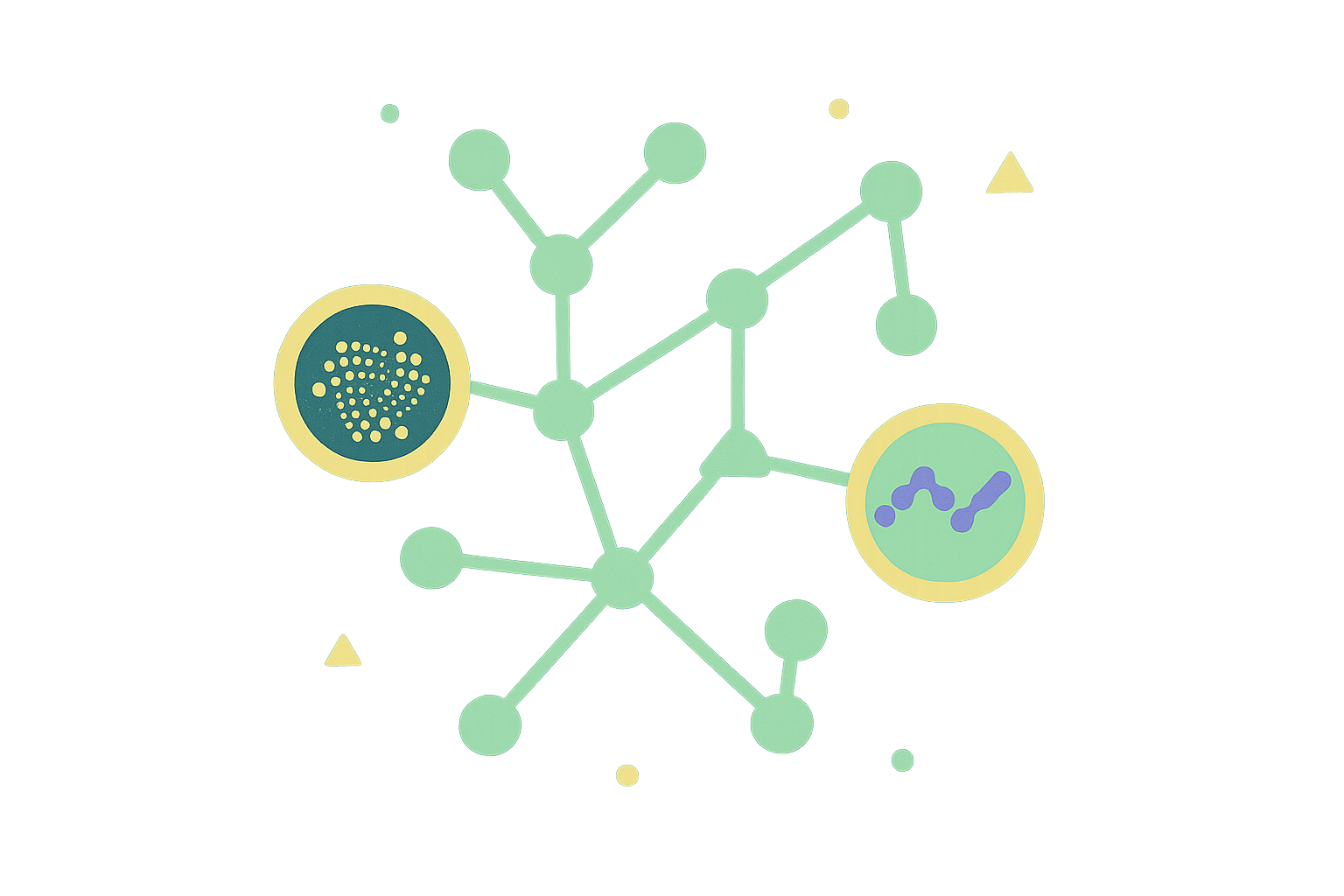
The DAG architecture employs a unique structure based on circles and lines. Each circle, known as a vertex, represents individual activities or transactions that require addition to the network. The lines, called edges, indicate the sequence in which transactions receive approval and always point in a single direction. This directional flow gives the technology its name: "directed" refers to the one-way movement of edges, while "acyclic" means the vertices never loop back to create cycles.
This data structure proves particularly useful for modeling complex relationships between multiple variables, allowing researchers and developers to analyze how different factors influence one another. In cryptocurrency applications, DAGs facilitate consensus achievement in distributed networks without requiring block creation. A crucial distinction from blockchain is that transactions build directly upon one another rather than being grouped into blocks, resulting in substantially faster transaction processing speeds.
What's the difference between a DAG and a blockchain?
While DAGs and blockchains serve similar fundamental purposes in the cryptocurrency industry, they differ significantly in their structural implementation and operational characteristics. The most fundamental difference lies in how they organize data: blockchains group transactions into discrete blocks that are linked together sequentially, creating a literal chain of blocks. DAGs, conversely, do not create blocks at all. Instead, they build individual transactions directly on top of previous transactions, creating a more fluid and continuous structure.
Visually, these differences are striking. Blockchain systems resemble their namesake—a chain of connected blocks extending linearly. DAG systems, however, appear as complex graphs composed of interconnected circles and lines, with multiple parallel pathways rather than a single sequential chain. This structural difference fundamentally affects how each technology processes transactions and achieves consensus.
How does DAG technology work?
The operational mechanism of DAG technology centers on its unique transaction validation process. The system comprises vertices (circles) representing individual transactions and edges (lines) showing the connections between them. Transactions stack upon one another in layers, creating an ever-expanding network structure.
When a user initiates a transaction, they must first confirm one or more previous transactions, known as "tips." Tips are unconfirmed transactions awaiting validation. By confirming these tips as part of submitting their own transaction, users contribute to the network's validation process. Once submitted, their transaction becomes a new tip, waiting for subsequent users to confirm it when making their own transactions. This creates a self-sustaining cycle where each participant validates others' transactions, continuously expanding the network layer by layer.
The system incorporates robust mechanisms to prevent double-spending attacks. When nodes validate older transactions, they trace the entire transaction path back to the network's origin. This comprehensive verification ensures that account balances are sufficient and all previous transactions are legitimate. Users who attempt to build upon invalid transaction paths risk having their own transactions rejected by the network. Even legitimate transactions can be ignored if they connect to a chain of transactions where the balance verification fails due to earlier fraudulent activity. This creates strong incentives for users to validate transactions carefully and maintain the network's integrity.
What is DAG used for?
DAG technology finds its primary application in processing transactions more efficiently than traditional blockchain systems. The absence of block creation eliminates waiting times associated with block mining and confirmation. Users can submit unlimited transactions without being constrained by block times, needing only to confirm previous transactions before proceeding with their own.
Energy efficiency represents another significant advantage of DAG systems. Traditional blockchain networks using Proof-of-Work consensus algorithms require substantial computational power and energy consumption. While DAG-based cryptocurrencies may still employ PoW mechanisms, they consume only a fraction of the energy required by conventional blockchain mining operations.
Micropayment processing showcases DAG technology's practical utility. Distributed ledger systems like traditional blockchains often struggle with micropayments because transaction fees can exceed the payment amount itself. DAG systems require minimal or no processing fees, typically charging only small node fees that remain constant even during network congestion. This makes DAG-based systems ideal for applications requiring frequent small-value transactions, such as Internet of Things (IoT) devices, content micropayments, or machine-to-machine transactions.
Which cryptocurrencies use DAG?
Despite DAG technology's theoretical advantages, relatively few cryptocurrency projects have implemented it over the years. IOTA stands as one of the most prominent examples, with its name serving as an acronym for Internet of Things Application. IOTA (MIOTA) has gained recognition for delivering fast transaction speeds, excellent scalability, robust security, strong privacy protections, and reliable data integrity. The platform uses nodes and tangles—combinations of multiple nodes that work together to validate transactions. Users must verify two other transactions before their own receives approval, ensuring that all participants contribute to the consensus mechanism and maintaining complete network decentralization.
Nano represents another notable DAG implementation, though it takes a hybrid approach by combining DAG and blockchain technology. The system routes all data through nodes, while each user maintains their own blockchain-based wallet. Transaction validation requires confirmation from both sender and receiver, creating a bilateral verification process. Nano has earned a reputation for fast transaction speeds, scalability, security, privacy, and zero transaction fees, making it attractive for users seeking fee-free transactions.
BlockDAG offers another DAG implementation, providing energy-efficient mining rigs and a mobile application for mining BDAG tokens. Unlike Bitcoin, which implements halving events every four years, BDAG follows a more frequent halving schedule occurring every 12 months, creating different tokenomic dynamics.
DAG pros and cons
Like any technology, DAG systems present both advantages and disadvantages that must be carefully considered when comparing DAG blockchain alternatives.
DAG advantages include superior speed, as the absence of block time restrictions allows immediate transaction processing without limits on transaction volume, requiring only the confirmation of previous transactions. The technology offers zero or minimal fees since mining operations are unnecessary, eliminating the need for miner rewards through transaction fees. Some DAG implementations may charge small fees for specialized node operations, but these remain negligible, particularly benefiting microtransaction use cases. Energy efficiency represents another key advantage, as DAG systems avoid the intensive power consumption associated with traditional PoW mining, resulting in a minimal carbon footprint. Scalability issues that plague many blockchain systems are largely absent from DAG implementations, as the lack of block times eliminates waiting periods that create bottlenecks.
However, DAG systems face significant challenges. Decentralization remains a concern, as some DAG protocols incorporate centralized elements, often justified as temporary measures to bootstrap network growth. The technology has not yet proven it can thrive without third-party intervention, potentially leaving networks vulnerable to attacks. Additionally, DAG systems remain relatively untested at scale. Despite existing for several years, DAG technology has not achieved the widespread adoption seen by blockchain protocols, including Layer-2 solutions, leaving questions about its long-term viability and ability to handle massive transaction volumes.
Conclusion
Directed acyclic graphs represent a promising technological innovation with significant potential in the distributed ledger space. When comparing DAG blockchain architectures, the technology offers compelling advantages over traditional blockchain systems, including lower transaction fees, faster processing speeds, reduced energy consumption, and improved scalability. However, DAG technology remains in a relatively early stage of development, with its full capabilities and limitations yet to be thoroughly explored and understood.
Current implementations face challenges that prevent DAG systems from truly challenging blockchain's dominance, particularly regarding decentralization concerns and lack of proven scalability at enterprise levels. The technology's maturation means that many possible use cases and applications continue to be explored. As the cryptocurrency and distributed ledger ecosystem continues to evolve, the crypto community watches with interest to see how DAG technology develops and what new applications emerge. Rather than replacing blockchain entirely, DAG appears positioned to serve as a complementary technology, offering alternative solutions for specific use cases where its unique advantages provide the most value. The ongoing development of DAG blockchain hybrids and pure DAG implementations will likely reveal new opportunities and applications that further define its role in the broader blockchain and cryptocurrency landscape.
FAQ
Can BlockDAG reach 1 dollar?
Yes, BlockDAG has the potential to reach $1 by 2025 if it successfully launches its mainnet and gains wide adoption in the crypto market.
What is the difference between DAG and blockchain?
DAG uses a network of nodes, while blockchain uses blocks linked chronologically. DAG is faster, but blockchain is generally more secure.
What does DAG stand for?
DAG stands for Directed Acyclic Graph. It's a data structure used in blockchain technology to represent transactions and improve scalability and speed.
Which crypto uses DAG?
Several cryptocurrencies use DAG, including Nano, IOTA, and Hedera Hashgraph. These projects leverage DAG technology for faster and more scalable transactions.

Understanding Directed Acyclic Graphs in Blockchain Technology

Exploring DAG Technology in Blockchain Networks

Understanding Directed Acyclic Graph in Blockchain Technology

Exploring Directed Acyclic Graph in Blockchain Networks
Exploring Directed Acyclic Graphs in Blockchain Technology
DAG vs. Blockchain: Comparison and Benefits
What is Fuel Network (FUEL)? Everything You Need to Know about FUEL

Zora (ZORA) Airdrop Guide: Participation Steps, Reward Collection, and Price Predictions
What Is BNB Chain?
All You Need To Know About Yescoin
How to Buy Baron ($BARRON) Coin: What is Baron Trump Cryptocurrency?